Best / Roundup
The most energy-efficient dehumidifiers
Efficiency in this category is measured in liters of water per kilowatt-hour, the spread is narrower than the marketing implies, and sizing the machine right saves more than buying the efficient one.
#adThis page contains affiliate links. We earn a commission on qualifying purchases, at no cost to you, and it never changes a ranking. Full disclosure.
The short answer
Dehumidifier efficiency is Integrated Energy Factor, in liters of water removed per kWh consumed - higher is better. ENERGY STAR certified models run from about 1.70 to 2.35 L/kWh depending on class. Within the 50-pint class the whole spread is 2.01 to 2.20, so sizing the machine correctly saves more than picking the efficient one.
What IEF is, and why it replaced the old metric
The old metric was Energy Factor, which measured only the energy used while the compressor was running. Integrated Energy Factor, adopted with the 2019 test procedure, includes the energy the machine uses when it has cycled off - standby, controls, the fan. That closed a real loophole, because a unit with a thirsty standby mode could post a good EF and cost you more in practice.
ENERGY STAR's own summary is that a certified dehumidifier is about 20 percent more efficient than a non-certified one. The current specification took effect on 1 October 2025. On a 50-pint machine run through a damp season that is roughly $40, which is enough to change a value comparison - budget picks, costed over a season.
The real spread, measured across the whole certified list
| Class | DOE capacity | Models | Median draw | Range | Median IEF | kWh/year |
|---|---|---|---|---|---|---|
| ~10 pint | 8-13 pt/day | 39 | 105 W | 92-128 W | 1.91 | 117 |
| ~16 pint | 14-18 pt/day | 44 | 167 W | 166-180 W | 1.89 | 181 |
| 20-22 pint | 19-23 pt/day | 51 | 258 W | 214-267 W | 1.7 | 276 |
| 25 pint | 23-27 pt/day | 127 | 265 W | 236-289 W | 1.79 | 285 |
| 30-32 pint | 27-33 pt/day | 21 | 318 W | 293-318 W | 2.01 | 343 |
| 35 pint | 33-38 pt/day | 73 | 351 W | 313-373 W | 2.01 | 375 |
| 40 pint | 38-45 pt/day | 5 | 401 W | 396-410 W | 2.21 | 432 |
| 50 pint | 45-52 pt/day | 164 | 488 W | 443-490 W | 2.01 | 520 |
Computed on 2026-09-01 from the ENERGY STAR certified product list (136 brands). Formula: liters/day = pints/day x 0.473176; kWh/day = liters/day / IEF; watts = kWh/day x 1000 / 24. Cross-check: dividing each model's published annual consumption by its computed draw gives a median implied run time of 1074 hours a year across the whole list. Source data.
| Unit | DOE pints | Drainage | Average draw | Where the figure comes from |
|---|---|---|---|---|
| Midea Cube 50 Pint Dehumidifier | 50 | gravity | 487 W | ENERGY STAR certified entry, computed |
| Midea Cube 50 Pint Dehumidifier with Pump | 50 | pump | 487 W | ENERGY STAR certified entry, computed |
| Midea Cube 20 Pint Dehumidifier | 20 | gravity | 234 W | ENERGY STAR certified entry, computed |
| Midea Cube 35 Pint Dehumidifier | 35 | gravity | 351 W | ENERGY STAR certified entry, computed |
| Frigidaire 50 Pint Dehumidifier with Pump and Wi-Fi | 50 | pump | 490 W | ENERGY STAR certified entry, computed |
| Hisense 50 Pint Dehumidifier with Pump | 50 | pump | 490 W | ENERGY STAR certified entry, computed |
| Frigidaire 50 Pint Dehumidifier with Wi-Fi | 50 | gravity | 488 W | ENERGY STAR certified entry, computed |
| GE 50 Pint Dehumidifier with Pump | 50 | pump | Not published | No named certified entry |
| GE 50 Pint Dehumidifier | 50 | gravity | Not published | No named certified entry |
| Quilo 50 Pint Dehumidifier with Pump | 50 | pump | 487 W | ENERGY STAR certified entry, computed |
| hOmeLabs 50 Pint Dehumidifier | 50 | gravity | Not published | No named certified entry |
| hOmeLabs 50 Pint Dehumidifier with Pump | 50 | pump | Not published | No named certified entry |
| hOmeLabs 32 Pint Dehumidifier | 32 | gravity | 318 W | ENERGY STAR certified entry, computed |
| Waykar 34 Pint ENERGY STAR Most Efficient Dehumidifier | 10 | gravity | 105 W | ENERGY STAR certified entry, computed |
| Waykar 120 Pint ENERGY STAR Dehumidifier | 32 | gravity | 318 W | ENERGY STAR certified entry, computed |
| Honeywell Smart Wi-Fi 30 Pint Dehumidifier (TP50AWKN) | 30 | gravity | Not published | No named certified entry |
| hOmeLabs 8 Pint Dehumidifier | 8 | bucket | Not published | No named certified entry |
| AlorAir Sentinel HD55 Crawl Space Dehumidifier | 36 | gravity | 344 W | ENERGY STAR certified entry, computed |
| AlorAir Sentinel HDi65S Crawl Space Dehumidifier with Pump | 55 | pump | Not published | No named certified entry |
| Waykar 80 Pint ENERGY STAR Dehumidifier | 50 | gravity | Not published | No named certified entry |
| Ivation 19 Pint Desiccant Dehumidifier | 19 | gravity | Not published | No named certified entry |
| Ivation 13 Pint Desiccant Dehumidifier | 13 | gravity | Not published | No named certified entry |
| Pro Breeze Electric Mini Dehumidifier | 1 | bucket | 23 W | Stated on the maker's listing |
| LG PuriCare 50 Pint Dehumidifier with Wi-Fi | 50 | gravity | 489 W | ENERGY STAR certified entry, computed |
| GoveeLife Smart Dehumidifier (H7151) | 50 | gravity | Not published | No named certified entry |
| AlorAir Sentinel HD35P Wi-Fi Crawl Space Dehumidifier with Pump | 35 | pump | Not published | No named certified entry |
| AEOCKY X1-Pro Rotary Desiccant Dehumidifier | 10 | gravity | 340 W | Stated on the maker's listing |
| DuraComfort 119 Pint Max Dehumidifier | 50 | gravity | 487 W | ENERGY STAR certified entry, computed |
| Yaufey 150 Pint Dehumidifier | 49 | gravity | 485 W | ENERGY STAR certified entry, computed |
| Waykar 145 Pint Dehumidifier with Pump | 49 | pump | Not published | No named certified entry |
| Waykar 70 Pint Crawl Space Dehumidifier with Pump | 24 | pump | 264 W | ENERGY STAR certified entry, computed |
| AlorAir Helios D35 Crawl Space Dehumidifier | 24 | gravity | 243 W | ENERGY STAR certified entry, computed |
17 of 32 map to a named entry in the ENERGY STAR certified list and carry a computed figure. The other 15 say so rather than borrowing a sibling model's number.
Read the class rows rather than the whole table. Within a capacity class the range is narrow: 443 to 490 W across 164 certified 50-pint models, 293 to 318 W across 21 certified 30-32 pint ones. A big-sounding efficiency difference between two 50-pint machines is usually a few percent.
Where efficiency genuinely varies is between classes and at the extremes. The ENERGY STAR Most Efficient list contains portable units certified at IEF 2.20 and ducted whole-home units at 2.35 - and the crawl space AlorAir on this page hits 2.08 while removing 36 pints, which beats the 50-pint class median of 2.01.

Quick picks
| # | Product | Best for | Draw | Price |
|---|---|---|---|---|
| 1 |  hOmeLabs 32 Pint DehumidifierThe one hOmeLabs unit with a named entry in the ENERGY STAR list, so it is the one where the running cost is a published figure rather than a class estimate. hOmeLabs 32 Pint DehumidifierThe one hOmeLabs unit with a named entry in the ENERGY STAR list, so it is the one where the running cost is a published figure rather than a class estimate. | A bedroom that is damp but not wet | 318 W | $234.99View on Amazon #ad Price as of October 16, 2026. How we are funded |
| 2 |  AlorAir Sentinel HD55 Crawl Space DehumidifierThe clearest example on this site of why the number on the box is not the number that matters: sold as 113 pints, certified at 36.33. AlorAir Sentinel HD55 Crawl Space DehumidifierThe clearest example on this site of why the number on the box is not the number that matters: sold as 113 pints, certified at 36.33. | A crawl space you cannot stand up in | 344 W | |
| 3 |  Midea Cube 50 Pint DehumidifierThe only unit here that solves the real basement problem, which is not capacity but where the water goes when you are not standing next to it. Midea Cube 50 Pint DehumidifierThe only unit here that solves the real basement problem, which is not capacity but where the water goes when you are not standing next to it. | A basement you visit once a month | 487 W | |
| 4 |  GE 50 Pint DehumidifierGE's current no-pump 50-pint, with a 30 percent humidistat floor and Smart Dry fan control - and no ENERGY STAR claim on the listing, which is the change worth noticing. GE 50 Pint DehumidifierGE's current no-pump 50-pint, with a 30 percent humidistat floor and Smart Dry fan control - and no ENERGY STAR claim on the listing, which is the change worth noticing. | A garage or shop with a floor drain | Not published |
hOmeLabs
hOmeLabs 32 Pint Dehumidifier
Best for: A bedroom that is damp but not wet
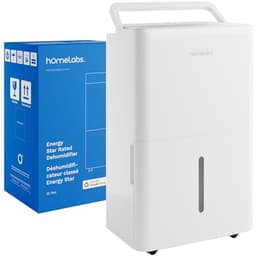
The one hOmeLabs unit with a named entry in the ENERGY STAR list, so it is the one where the running cost is a published figure rather than a class estimate.
Average draw
318 W
Computed from the ENERGY STAR certified entry hOmeLabs HME0089: 32.46 pt/day at IEF 2.01 L/kWh. This is the only hOmeLabs capacity in this registry with a named certified entry, which is why it is the only one carrying a number rather than a band.
What is good
- 318 W against the 50-pint class median of 488 W - about 35% less to run, hour for hour
- Named in the ENERGY STAR certified list, so its IEF is public
- Quiet enough for a bedroom in a way that a 50-pint compressor generally is not
- Wi-Fi and auto shut-off at a small-unit price
What is not
- 32 DOE pints is genuinely less water than 50 - undersizing a wet basement costs more than the machine saved
- Gravity drainage only
- 4,500 sq ft coverage for 32 pints is another claim to ignore
Who it is for
A bedroom, a home office, or a small basement that is humid rather than actively wet.
Skip it if
Skip it if the floor is ever damp to the touch or the walls sweat. That is a 50-pint problem, and a 32-pint machine will run continuously and still lose.
AlorAir
AlorAir Sentinel HD55 Crawl Space Dehumidifier
Best for: A crawl space you cannot stand up in
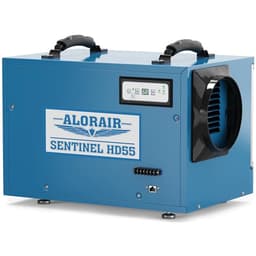
The clearest example on this site of why the number on the box is not the number that matters: sold as 113 pints, certified at 36.33.
Average draw
344 W
Computed from the ENERGY STAR certified entry ALORAIR Sentinel HD55S: 36.33 pt/day at IEF 2.08 L/kWh, 379 kWh a year. The retail listing is the HD55; the certified entry carries the S suffix. At IEF 2.08 it is more efficient than the median 50-pint portable while removing about three quarters as much water.
What is good
- Built low and flat to fit between floor joists, which no portable unit does
- Auto defrost and low-temperature operation, both essential in an unheated crawl space
- IEF 2.08 is above the 50-pint class median of 2.01 despite the smaller capacity
- No tank at all, so there is nothing to forget to empty
What is not
- The 113-pint headline is a saturation figure at 95F and 90% RH; the DOE-condition rating is 36.33
- 1,200 sq ft coverage, less than most 50-pint portables claim, for considerably more money
- Needs a drain or a condensate pump - there is no bucket fallback
Who it is for
Crawl spaces, low-clearance basements and unheated storage where a standing portable will not fit or will freeze.
Skip it if
Skip it for a normal basement. A 50-pint portable removes more water at the DOE condition for less money; you are paying for the form factor and the temperature range.
Midea
Midea Cube 50 Pint Dehumidifier
Best for: A basement you visit once a month
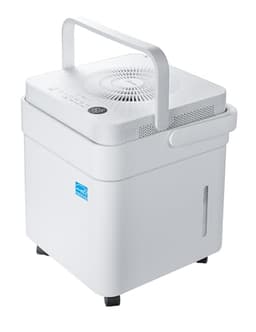
The only unit here that solves the real basement problem, which is not capacity but where the water goes when you are not standing next to it.
Average draw
487 W
Computed from the ENERGY STAR certified entry for Midea MAD50S1QWT-A, the 50 pt / 4,500 sq ft Cube without a pump: 49.67 pt/day at IEF 2.01 L/kWh. Midea's own US product page confirms MAD50S1QWT-A is this configuration. Midea publishes no wattage on the Amazon listing or on that page.
What is good
- The body separates, so the tank half can sit lower than the compressor half and the hose gets a genuine downhill run
- Certified at 49.67 pt/day, which is a real 50-pint machine rather than a saturation number
- IEF 2.01 L/kWh puts it exactly on the median for the 50-pint class - neither a bargain nor a penalty
- Wi-Fi that tells you it has stopped, which is the only smart feature that matters in a basement
What is not
- No pump, so the drain has to run downhill the whole way
- Midea publishes no wattage anywhere, so the 487 W above is computed rather than quoted
- The 4,500 sq ft coverage claim is marketing, not a spec - see the sizing guide
Who it is for
Someone with a floor drain, a sump, or a window well lower than the machine, who wants to set it once and stop thinking about it.
Skip it if
Skip it if the only drain in the room is higher than the unit. Without a pump, gravity is the entire drainage system, and no setting fixes an uphill hose.
GE
GE 50 Pint Dehumidifier
Best for: A garage or shop with a floor drain
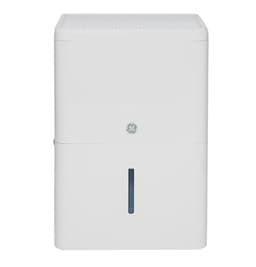
GE's current no-pump 50-pint, with a 30 percent humidistat floor and Smart Dry fan control - and no ENERGY STAR claim on the listing, which is the change worth noticing.
Average draw
Not published
Not published by GE. The ADHE50 series does not appear by name in the ENERGY STAR certified list and this listing makes no ENERGY STAR claim - its predecessor did. The certified 50-pint class runs 443-490 W with a median of 488 W, and a non-certified unit is more likely to sit at the top of that band than below it.
What is good
- Humidistat sets down to 30 percent where most units stop at 35 or 40
- Smart Dry adjusts fan speed to room humidity rather than running flat out
- Bucket-full alarm sounds for ten seconds rather than only lighting an icon
- Clean-filter alert, which is the maintenance nobody remembers to do
What is not
- No ENERGY STAR certification claimed, and no certified entry to compute a draw from
- Gravity drainage only
- A 5,000 sq ft coverage claim, up from its predecessor's 4,000 on the same capacity - a reminder that coverage claims are not a spec
Who it is for
A garage, workshop or utility room with a floor drain, where a low humidistat floor is useful and efficiency certification is not the deciding factor.
Skip it if
Skip it if it will run all season and efficiency matters. A certified 50-pint unit costs about $8 a month less by ENERGY STAR's own figure.
Four things that save more than IEF does
- 1Correct sizing. An undersized unit runs at full draw permanently because it never hits its target. This dwarfs every other factor on this page.
- 2A realistic humidity target. Holding 50% rather than 40% cuts run time substantially, and 50% is inside the EPA's recommended 30 to 50 percent band anyway.
- 3Sealing the space. A basement window left open, or a garage door with a failed seal, admits humid air faster than the machine removes it. It is free and it is the single biggest lever most people have.
- 4A clean filter. A clogged filter starves the coil, which drops extraction while the machine keeps drawing full power. Efficiency falls without the wattage falling. Cleaning and maintenance.
What we would skip
Paying a large premium for a marginally better IEF
Across the 164 certified 50-pint models the IEF range is 2.01 to 2.20 - about a nine percent spread, which is roughly $2.60 a month at 12 hours a day. If the more efficient unit costs $80 more, it takes two and a half years to pay that back, and only if you run it every day.
An efficient machine that is the wrong size
An undersized unit never reaches its target so it never idles, and runs at full draw permanently. That costs far more than the difference between a good IEF and an average one. Size first, then optimize.
How we picked
- ENERGY STAR certification, and the model's published Integrated Energy Factor in liters per kWh.
- Computed average draw, so efficiency can be expressed as watts rather than an abstract ratio.
- Efficiency relative to capacity class, because a 30-pint unit drawing less than a 50-pint one is not more efficient, it is smaller.
- Whether the maker publishes anything at all - a model absent from the certified list has no published efficiency figure to judge.
- Not tested by us.
We did not test these units. The full criteria and their weighting are on the methodology page.
FAQ
Questions
What is a good IEF for a dehumidifier?
Do ENERGY STAR dehumidifiers really save money?
Is a bigger dehumidifier less efficient?
Sources
Sources
Read next
- IEF, and what an ENERGY STAR badge is worthWhat IEF measures, what it replaced, the real spread across 527 models, and what the badge saves.
- How many watts a dehumidifier actually usesWattage for every capacity class, computed from certified data, with the formula and the cross-check.
- Running it for lessSix changes ranked by what they save, three that save nothing, and one that costs you money.
- What size dehumidifier do I need?A four-step method that uses measured humidity instead of the square-footage claim on the box.
- Dehumidifier running cost calculatorYour own rate, your own hours, and every default value shown on screen with its source.
- Whole house dehumidifiersIEF 2.22 to 3.26 against a portable's 2.01, and 52 to 172 pints - but sold through contractors, not online.
- The best budget dehumidifiersThe electricity costs more than the machine. Five value picks, and the false economy that costs $49 a season.