Best / Roundup
The best dehumidifiers with a built-in pump
A pump is the difference between a hose you can run and a hose you cannot. Here is what each of these makers will actually tell you about theirs, which is less than you would expect.
#adThis page contains affiliate links. We earn a commission on qualifying purchases, at no cost to you, and it never changes a ranking. Full disclosure.
The short answer
Buy a pump model only if the place you want the water to end up is higher than the machine. A pump adds cost and one more failure point, and it buys nothing at all if there is a floor drain below the unit. Where you do need one, the deciding number is the pump's reach, and only some makers publish it.
What a condensate pump actually does
A dehumidifier's coil condenses water into a tray. Without a pump, that tray either fills a bucket or feeds a hose that has to fall continuously to a drain. A built-in pump adds a small reservoir and an electric pump that empties it in bursts, which means the discharge can go up: into a laundry sink, out through a window, up to a standpipe.
The pump does not run continuously. It fires when the reservoir fills, for a few seconds. That is why adding one barely moves the running cost: every Midea 50-pint Cube revision in the ENERGY STAR certified list, pump or not, computes to between 487 and 490 W. The pump is effectively free to run and costs you only at purchase.
The number nobody wants to print
Here is the disclosure gap, laid out plainly. Of the seven pump units in our registry, three state a lift - GE 15 vertical feet, Quilo 15 feet, and AlorAir's crawl space unit 19.6 feet - and one more, the Midea Cube, states only a 16 foot drain tube. Frigidaire, Hisense and hOmeLabs state nothing about what their pumps can reach, and hOmeLabs is not in the ENERGY STAR certified list at this capacity either. The Hisense is the interesting case of the three, because it withholds the pump figure while publishing a two-year warranty and a 38F operating floor that nobody else here matches - the full reference is here.
That matters because a hose run and a lift height are different constraints. Sixteen feet of hose across a flat floor is easy for any pump; sixteen feet of hose going twelve feet vertically is not. Where a maker states a run and not a lift, treat the vertical component as unknown and keep it short. Pump lift and distance.
Quick picks
| # | Product | Best for | Draw | Price |
|---|---|---|---|---|
| 1 |  Midea Cube 50 Pint Dehumidifier with PumpThe stacking Midea Cube with a condensate pump added, which is the difference between a hose you can run and a hose you cannot. Midea Cube 50 Pint Dehumidifier with PumpThe stacking Midea Cube with a condensate pump added, which is the difference between a hose you can run and a hose you cannot. | A basement whose only drain is upstairs | 487 W | $237.45View on Amazon #ad Price as of October 17, 2026. How we are funded |
| 2 |  hOmeLabs 50 Pint Dehumidifier with PumpBucket, gravity hose and a built-in pump in a single unit, carrying the least supportable coverage claim in the category. hOmeLabs 50 Pint Dehumidifier with PumpBucket, gravity hose and a built-in pump in a single unit, carrying the least supportable coverage claim in the category. | All three drainage modes on one machine | Not published | $309.99View on Amazon #ad Price as of October 17, 2026. How we are funded |
| 3 |  GE 50 Pint Dehumidifier with PumpGE states both numbers a pump buyer needs - 15 feet of vertical lift and a 16 foot hose - which is the most complete pump specification of any 50-pint unit we track. GE 50 Pint Dehumidifier with PumpGE states both numbers a pump buyer needs - 15 feet of vertical lift and a 16 foot hose - which is the most complete pump specification of any 50-pint unit we track. | A lift and a hose length, both in writing | Not published | |
| 4 |  Frigidaire 50 Pint Dehumidifier with Pump and Wi-FiFrigidaire's own documents give two different wattages for this machine and the certified record gives a third - which makes it the clearest case on the site for trusting the computed average over any printed figure. Frigidaire 50 Pint Dehumidifier with Pump and Wi-FiFrigidaire's own documents give two different wattages for this machine and the certified record gives a third - which makes it the clearest case on the site for trusting the computed average over any printed figure. | Seeing why a nameplate is not a running cost | 490 W | $254.35View on Amazon #ad Price as of October 17, 2026. How we are funded |
| 5 |  Hisense 50 Pint Dehumidifier with PumpA certified 50-pint pump unit that claims operation down to 38F - lower than the 41F most compressor units state - which is the specification that matters in a cold basement. Hisense 50 Pint Dehumidifier with PumpA certified 50-pint pump unit that claims operation down to 38F - lower than the 41F most compressor units state - which is the specification that matters in a cold basement. | A cold basement where the pump has to keep working | 490 W | $308.95View on Amazon #ad Price as of October 17, 2026. How we are funded |
Midea
Midea Cube 50 Pint Dehumidifier with Pump
Best for: A basement whose only drain is upstairs
The stacking Midea Cube with a condensate pump added, which is the difference between a hose you can run and a hose you cannot.
Average draw
487 W
Computed from the ENERGY STAR certified entry for Midea MAD50PS1QWT-A, the pump variant of the same platform: 49.67 pt/day at IEF 2.01 L/kWh. The listing prints the unsuffixed MAD50PS1QWT, so the certified string carries a suffix the box does not; every Midea 50-pint revision in the certified list, pump or not, computes to 487-490 W, so neither the suffix nor the pump moves the number meaningfully. The pump itself only runs in bursts.
What is good
- Pump means the destination can be higher than the machine - a laundry sink, a window, a stack
- Identical DOE capacity and IEF to the non-pump Cube, so the pump costs you nothing in efficiency
- The split body still works, so you can also run it on gravity and keep the pump as the backup
- Certified 49.67 pt/day, an honest 50-pint rating
What is not
- Costs more than the identical machine without the pump
- A pump is one more thing that can fail, and when it does the unit stops rather than overflows
- No published wattage from Midea - the figure above is computed
Who it is for
Anyone whose drain is above the floor. That is most finished basements and nearly every crawl space.
Skip it if
Skip it if you already have a floor drain within hose reach and below the machine. You would be paying for a pump you will never switch on.
hOmeLabs
hOmeLabs 50 Pint Dehumidifier with Pump
Best for: All three drainage modes on one machine
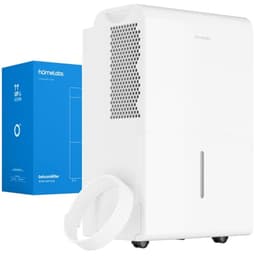
Bucket, gravity hose and a built-in pump in a single unit, carrying the least supportable coverage claim in the category.
Average draw
Not published
No published wattage and no 50-pint hOmeLabs entry in the ENERGY STAR certified list. Class band for certified 50-pint units is 443-490 W, median 488 W.
What is good
- All three drainage modes on one machine - bucket, gravity, or pump
- Drains upward, which is the whole point in a room whose only outlet is above the unit
- Same familiar controls as the rest of the hOmeLabs line
- Auto shut-off and continuous drainage set-up out of the box
What is not
- 7,500 sq ft coverage claim is the highest here and the least supportable
- No ENERGY STAR certification at this capacity, so no published IEF to compute a draw from
- Pump lift and hose length are not stated
Who it is for
Someone who needs a pump, wants the option of all three drainage modes, and is willing to ignore the coverage number entirely.
Skip it if
Skip it if efficiency matters to you. Without a certified IEF there is no published basis for a running-cost figure, and over a season that is real money.
GE
GE 50 Pint Dehumidifier with Pump
Best for: A lift and a hose length, both in writing
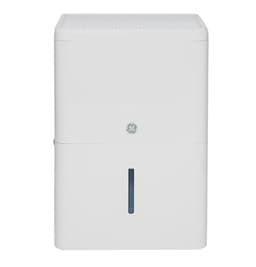
GE states both numbers a pump buyer needs - 15 feet of vertical lift and a 16 foot hose - which is the most complete pump specification of any 50-pint unit we track.
Average draw
Not published
Not published by GE. The ADHE50 series does not appear by name in the ENERGY STAR certified list and this listing makes no ENERGY STAR claim - its predecessor did. The certified 50-pint class runs 443-490 W with a median of 488 W; adding a pump does not change capacity or IEF on the certified units that have one.
What is good
- States a vertical lift and a hose length separately - the two constraints a pump route actually has
- The listing tells you when to choose the pump model, which is more guidance than most makers give
- Humidistat down to 30 percent, a 24-hour timer and Smart Dry fan control
- Bucket-full alarm and clean-filter alert
What is not
- No ENERGY STAR certification claimed, so there is no certified figure to compute running cost from
- 15 pint bucket is smaller than several rivals, which matters if the pump ever stops
- 5,000 sq ft coverage claim, up from 4,000 on its predecessor for the same capacity
Who it is for
Someone whose drain is up a wall or across a room and who wants the limits of the pump stated before buying rather than discovered after.
Skip it if
Skip it if the discharge point is more than 15 feet above the unit or needs more than the included 16 feet of hose. Those are the limits GE put in writing.
Frigidaire
Frigidaire 50 Pint Dehumidifier with Pump and Wi-Fi
Best for: Seeing why a nameplate is not a running cost
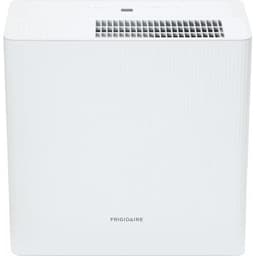
Frigidaire's own documents give two different wattages for this machine and the certified record gives a third - which makes it the clearest case on the site for trusting the computed average over any printed figure.
Average draw
490 W
Computed from the ENERGY STAR certified entry for Frigidaire FHDP5033Y1 - the same model number as this listing: 49.95 pt/day at IEF 2.01 L/kWh. Frigidaire's own figures do not agree with each other: its US specification sheet states 115 V, 5.5 A and 620 W, while its Canadian product page states 115 V, 8.8 A and 470 W. Those are nameplate figures, not averages, and they do not reconcile - use 490 W for running cost.
What is good
- The retail model number is exactly the certified one, so the 490 W figure is a direct match rather than a family estimate
- Pump discharges upward into a sink or out of a window, with bucket and continuous-drain modes as well
- Stated to keep working down to 41F, which matters in an unheated basement in shoulder season
- Wi-Fi with the Frigidaire app, plus Alexa and Google Home
What is not
- Frigidaire's two published wattages disagree - 620 W and 470 W - and neither is the running-cost figure
- No pump lift or hose run is stated on the listing or on either Frigidaire page we checked
- The Amazon listing itself is sparse; the useful detail lives on Frigidaire's own pages
Who it is for
Someone who wants a pump and Wi-Fi from a maker with a certified exact-model record, and who will size the circuit from the higher of the maker's figures.
Skip it if
Skip it if your pump route is long or tall. Frigidaire states no lift, where GE and Quilo state 15 feet in writing.
Hisense
Hisense 50 Pint Dehumidifier with Pump
Best for: A cold basement where the pump has to keep working
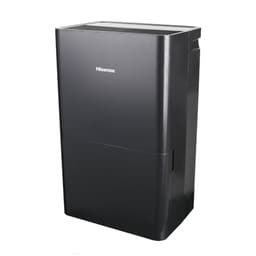
A certified 50-pint pump unit that claims operation down to 38F - lower than the 41F most compressor units state - which is the specification that matters in a cold basement.
Average draw
490 W
Computed from the ENERGY STAR certified entry for Hisense ADH50KP26 - the same model number as this listing: 49.95 pt/day at IEF 2.01 L/kWh. Hisense publishes no wattage on the listing.
What is good
- Claims operation down to 38F, three degrees below the usual compressor floor
- Exact certified model match, so the 490 W figure describes this machine
- Quick-connect hose included for the pump
- Three operating modes and three fan speeds, including an auto fan setting
What is not
- No pump lift, hose length or bucket capacity stated on the listing
- No Wi-Fi or app mentioned
- Below about 38F it is still a compressor unit, and a desiccant machine is the right tool
Who it is for
Someone with a cool basement or garage and a drain above the machine, where a few degrees of extra low-temperature headroom decides whether the unit keeps working in spring and autumn.
Skip it if
Skip it if your pump route is long or tall. Hisense does not state a lift, where GE and Quilo state 15 feet.
How a pump model fails, and what to want
Two failure modes. The good one: the pump stops, the reservoir float trips, the machine shuts itself off and you find a dry unit that has done nothing for a week. The bad one: the pump stops and the tray overflows onto the floor.
Which one you get depends on the design, and no maker advertises it. What you can control is the fallback. A pump model with a reasonable bucket - the Frigidaire at 1.9 gallons, the GE at 15 pints - can hold around seven hours of condensate if the pump quits, which turns a wet floor into a full bucket. That is worth more than any smart feature on this page. A pump is the component most likely to fail without telling you, which is the strongest argument in the category for a connected unit that can raise an alarm - or for the one unit here that offers bucket, hose, pump and Wi-Fi together.
What we would skip
Any pump model whose maker will not state a lift or a hose run
You are buying the pump for one reason: to reach a specific place. If the listing does not say how high or how far it will push, you are buying a capability nobody will commit to in writing. GE states 15 vertical feet of lift and a 16 foot hose. Midea states a 16 foot drain tube but no lift. Frigidaire, Hisense and hOmeLabs state nothing. That is a real difference between otherwise similar machines.
How we picked
- A built-in condensate pump, not an external one sold separately.
- Whether the manufacturer publishes the pump's reach - hose run, lift height, or anything at all.
- What happens when the pump fails: does the unit shut down, or does the tray overflow? A large bucket as a fallback is worth real money here.
- Certified DOE capacity and computed average draw, so the pump is not paid for in efficiency.
- None of these units has been tested by us. The pump claims are the manufacturers', quoted and attributed.
We did not test these units. The full criteria and their weighting are on the methodology page.
FAQ
Questions
How high can a dehumidifier pump push water?
Does a built-in pump use much more electricity?
Can I use a pump model on gravity drainage instead?
Is an external condensate pump as good?
Sources
Sources
Read next
- Pump or gravity: decide this before anything elseA five-minute test that eliminates half the market, and the middle option most buyers miss.
- How far will the pump actually push it?Three of seven pump models state a lift. What they say, and how to plan when a maker states nothing.
- The best dehumidifiers for a basementFive basement units ranked on drainage first, with computed running costs and a unit we would not buy.
- The best crawl space dehumidifiersFour crawl space options, and the 3.1x gap between the pint number on the box and the certified one.
- How many watts a dehumidifier actually usesWattage for every capacity class, computed from certified data, with the formula and the cross-check.
- The best dehumidifiers with a drain hoseFive units with a usable gravity port, and the one check that decides whether a hose works in your room.
- The best dehumidifiers for a laundry roomA spun wash load holds about 4.7 pints of water and the sink is on the wall. Four pump-first picks for laundry rooms.