Best / Roundup
The best smart dehumidifiers
An app on a dehumidifier sounds like a gimmick until the pump quietly stops on a Tuesday and nobody notices until Saturday. That is the feature. Everything else is a remote control.
#adThis page contains affiliate links. We earn a commission on qualifying purchases, at no cost to you, and it never changes a ranking. Full disclosure.

The short answer
A connected dehumidifier is worth the premium for one reason: it can tell you it has stopped. The LG PuriCare pairs a certified 49.81-pint machine with ThinQ maintenance alerts, Frigidaire adds Wi-Fi to a pump model, GoveeLife offers Alexa, Google Assistant and IFTTT, and AlorAir puts monitoring on a crawl space unit you would otherwise have to crawl under to check.
The case for a connected dehumidifier, in one scenario
A dehumidifier in a finished basement fails on a Tuesday. Nobody is in the basement on Tuesday. The humidity climbs back through 60%, then 70%. By Saturday the room smells, and whatever was going to grow has had four days of ideal conditions. Nothing about that sequence required an expensive machine or an unusual fault - just a full bucket and a closed door.
That is the entire argument for connectivity in this category, and it is a better argument than it is usually given credit for. Dehumidifiers are unlike almost every other appliance you might connect: they run unattended, in rooms you avoid, and their failure is invisible until it is expensive. A notification is worth more here than it is on a kettle.
What connectivity does not do is change the physics. Every machine below is an ordinary compressor dehumidifier with a radio in it, and the certified numbers say so.
How we picked
- What the connectivity actually provides - alerts and monitoring, or just remote control - read from each maker's own listing.
- The DOE capacity from the ENERGY STAR certified list, matched to the model number, so a smart machine is still judged as a dehumidifier first.
- Average draw computed from the certified IEF where a model match exists; a class band and a plain statement where it does not.
- Drainage, because the most useful alert in the category is the one about water that has stopped going where it should.
- What we did not do: we have not installed any of these apps, tested an alert, or measured extraction. Every claim is quoted from a manufacturer listing and linked.
We did not test these units. The full criteria and their weighting are on the methodology page.
Quick picks
| # | Product | Best for | Draw | Price |
|---|---|---|---|---|
| 1 |  LG PuriCare 50 Pint Dehumidifier with Wi-FiThe only connected unit here from a manufacturer that makes its own compressors, and the certified numbers say it is an ordinary 50-pint machine with an app on top. LG PuriCare 50 Pint Dehumidifier with Wi-FiThe only connected unit here from a manufacturer that makes its own compressors, and the certified numbers say it is an ordinary 50-pint machine with an app on top. | Someone who wants app control from a brand with a service network | 489 W | |
| 2 |  Frigidaire 50 Pint Dehumidifier with Pump and Wi-FiFrigidaire's own documents give two different wattages for this machine and the certified record gives a third - which makes it the clearest case on the site for trusting the computed average over any printed figure. Frigidaire 50 Pint Dehumidifier with Pump and Wi-FiFrigidaire's own documents give two different wattages for this machine and the certified record gives a third - which makes it the clearest case on the site for trusting the computed average over any printed figure. | Seeing why a nameplate is not a running cost | 490 W | $336.99View on Amazon #ad Price as of September 21, 2026. How we are funded |
| 3 |  GoveeLife Smart Dehumidifier (H7151)The most genuinely connected unit we track - app, voice and IFTTT - and the only one whose listing prints both its DOE number and its saturation number instead of just the flattering one. GoveeLife Smart Dehumidifier (H7151)The most genuinely connected unit we track - app, voice and IFTTT - and the only one whose listing prints both its DOE number and its saturation number instead of just the flattering one. | A smart home that already runs on Alexa or Google routines | Not published | |
| 4 |  AlorAir Sentinel HD35P Wi-Fi Crawl Space Dehumidifier with PumpSold as 70 pints and honest enough to print the 35 next to it, with a pump that states its reach and a warranty term nothing else here matches. AlorAir Sentinel HD35P Wi-Fi Crawl Space Dehumidifier with PumpSold as 70 pints and honest enough to print the 35 next to it, with a pump that states its reach and a warranty term nothing else here matches. | A crawl space you would rather monitor than crawl into | Not published |
LG
LG PuriCare 50 Pint Dehumidifier with Wi-Fi
Best for: Someone who wants app control from a brand with a service network
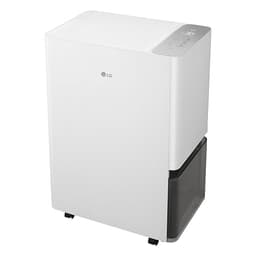
The only connected unit here from a manufacturer that makes its own compressors, and the certified numbers say it is an ordinary 50-pint machine with an app on top.
Average draw
489 W
Computed from the ENERGY STAR certified entry LG DT501BKR0: 49.81 pt/day at IEF 2.01 L/kWh, 526 kWh a year. The listing's model number is DT501BWR0 and the certified entry is DT501BKR0 - one character apart in what is almost certainly a color code. We have not seen LG confirm that in writing, so treat this as the certified figure for the same platform rather than an exact string match.
What is good
- App control from a manufacturer with a US service network, not a white-label brand
- A 1-Hour Boost mode, which none of the other connected units here offer
- Maintenance alerts through the app rather than a blinking light you have to notice
- Continuous drain option alongside the bucket
What is not
- No published coverage figure, no published wattage and no published noise level
- The certified entry is DT501BKR0 and the listing says DT501BWR0, so the match is one character short of exact
- No pump - the drain has to be below the machine
- Costs more than machines with identical certified capacity and efficiency
Who it is for
Someone who wants to check and change the setting from their phone and would rather buy that from LG than from a brand that exists only on Amazon.
Skip it if
Skip it if you need the water to go uphill. There is no pump, and at this price a pump model is within reach.
Frigidaire
Frigidaire 50 Pint Dehumidifier with Pump and Wi-Fi
Best for: Seeing why a nameplate is not a running cost
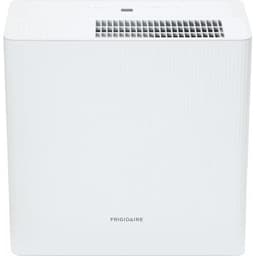
Frigidaire's own documents give two different wattages for this machine and the certified record gives a third - which makes it the clearest case on the site for trusting the computed average over any printed figure.
Average draw
490 W
Computed from the ENERGY STAR certified entry for Frigidaire FHDP5033Y1 - the same model number as this listing: 49.95 pt/day at IEF 2.01 L/kWh. Frigidaire's own figures do not agree with each other: its US specification sheet states 115 V, 5.5 A and 620 W, while its Canadian product page states 115 V, 8.8 A and 470 W. Those are nameplate figures, not averages, and they do not reconcile - use 490 W for running cost.
What is good
- The retail model number is exactly the certified one, so the 490 W figure is a direct match rather than a family estimate
- Pump discharges upward into a sink or out of a window, with bucket and continuous-drain modes as well
- Stated to keep working down to 41F, which matters in an unheated basement in shoulder season
- Wi-Fi with the Frigidaire app, plus Alexa and Google Home
What is not
- Frigidaire's two published wattages disagree - 620 W and 470 W - and neither is the running-cost figure
- No pump lift or hose run is stated on the listing or on either Frigidaire page we checked
- The Amazon listing itself is sparse; the useful detail lives on Frigidaire's own pages
Who it is for
Someone who wants a pump and Wi-Fi from a maker with a certified exact-model record, and who will size the circuit from the higher of the maker's figures.
Skip it if
Skip it if your pump route is long or tall. Frigidaire states no lift, where GE and Quilo state 15 feet in writing.
GoveeLife
GoveeLife Smart Dehumidifier (H7151)
Best for: A smart home that already runs on Alexa or Google routines
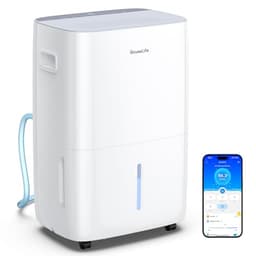
The most genuinely connected unit we track - app, voice and IFTTT - and the only one whose listing prints both its DOE number and its saturation number instead of just the flattering one.
Average draw
Not published
Not published, and no GoveeLife entry appears by name in the ENERGY STAR certified list, so we cannot compute one either. The listing says the unit is 'certified by DOE & CEC', which is a compliance statement rather than an ENERGY STAR certification, and no model number we could match appears in the certified file. The certified 50-pint class runs 443 to 490 W; that band stands in for a number.
What is good
- States both capacity numbers on the listing, which almost nobody in this category does
- Voice control and IFTTT, so it can be driven by a humidity sensor you already own
- Washable filter - no consumable to forget about
- Auto defrost for cooler rooms
What is not
- No ENERGY STAR certified entry we could match, so the wattage is a class band rather than a figure
- The listing admits it 'will emit a certain amount of heat' on high - true of every compressor unit, but worth knowing
- No pump; the included hose is 3 ft of corrugated pipe
- Sold by the brand's own storefront rather than shipped by Amazon
Who it is for
Someone who already has a smart-home routine and wants the dehumidifier inside it - triggered by a sensor, reported in an app, silenced by a voice command.
Skip it if
Skip it if you want a computed running cost. Without a certified entry we can only give you the class band, and on this site that is the difference between a figure and an estimate.
AlorAir
AlorAir Sentinel HD35P Wi-Fi Crawl Space Dehumidifier with Pump
Best for: A crawl space you would rather monitor than crawl into
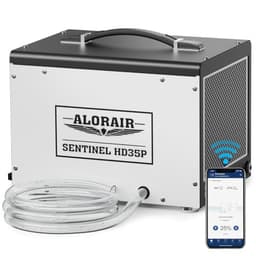
Sold as 70 pints and honest enough to print the 35 next to it, with a pump that states its reach and a warranty term nothing else here matches.
Average draw
Not published
Not published, and the Sentinel HD35P does not appear by name in the ENERGY STAR certified list. AlorAir's certified entries are the Sentinel HD55S (36.33 pt/day, 344 W), the Helios D35 (243 W) and the Sentinel Pro35X (221 W). A 35-pint AHAM unit plausibly sits in that 221-344 W range, but the listing gives no figure and we are not going to invent the placement.
What is good
- Prints the AHAM figure next to the saturation figure instead of hiding it
- States its pump reach - 19.6 ft - where most pump makers state nothing
- Remote monitoring is the point in a crawl space: you find out it stopped without going under the house
- A 6-year limited warranty, three times the category norm
What is not
- No published wattage and no certified entry, so there is no computed running cost
- Costs roughly twice a 50-pint portable and removes less water per day at the test condition
- Compact means compact - 1,000 sq ft, not a whole basement
- Sold through the brand's own storefront
Who it is for
Someone whose damp problem is under the floor, who wants a pump that commits to a number and an app that tells them the machine is still running.
Skip it if
Skip it if the space is a normal basement you walk into. You would be paying a crawl-space premium and a Wi-Fi premium for less certified capacity than a 50-pint portable.
What each app actually offers
| Unit | Platform | Alerts stated? | Voice / automation |
|---|---|---|---|
| LG PuriCare 50 | LG ThinQ | Yes - maintenance alerts | Not stated on the listing |
| Frigidaire 50 with Pump and Wi-Fi | Frigidaire app | Not stated | Not stated on the listing |
| GoveeLife H7151 | Govee app | Not stated | Alexa, Google Assistant, IFTTT |
| AlorAir Sentinel HD35P Wi-Fi | AlorAir app | Live humidity and operation status | Not stated on the listing |
Read from each current Amazon listing on 2026-09-21. 'Not stated' means exactly that - the feature may exist, but the maker does not claim it in writing, and this site does not fill those gaps with assumptions.
Two things stand out. The first is that only LG explicitly promises maintenance alerts, which is the feature the whole category should be sold on. The second is that GoveeLife is the only one with IFTTT, which matters more than it sounds: it means a humidity sensor you already own - in a different room, on a different platform - can drive the machine.
The one that prints both its numbers
50 to 137
Pints per day, as the GoveeLife listing states it - the DOE figure and the saturation figure, together
From the GoveeLife H7151 Amazon listing, retrieved 2026-09-21. Publishing both numbers is unusual enough in this category to be worth pointing out; most listings print only the larger one. Large capacity dehumidifiers covers what the gap between those numbers means.
The AlorAir does the same thing in the other direction - its title says 70 pints and its own bullet says 35 pints a day AHAM, 70 saturation. In a tier where the headline number is usually the only one offered, two of the four connected units here volunteer both. We do not know why, and we are not going to pretend it is a principled stand, but it is a real difference in disclosure.
What you pay for the radio
Connectivity is not free, and it is worth being clear about what it is displacing. The LG is certified at 49.81 pints and IEF 2.01 - the same efficiency as three quarters of the certified 50-pint class, and the same efficiency as machines that cost noticeably less. You are not buying a better dehumidifier. You are buying the same dehumidifier with a notification.
LG PuriCare, certified sibling DT501BKR0
(489 W / 1000) x 12 h x $0.1834/kWh = $1.08 per day
0.489
kWh per hour
$32.76
per month, 12 h/day
$65.52
per month, 24 h/day
Rate is the US residential average of 18.34 cents/kWh from the EIA Electric Power Monthly, June 2026. Yours will differ - use the calculator.
Whether that is worth it depends entirely on where the machine lives. In a kitchen you walk through daily, it is a gadget. In a crawl space, a rental property, or a second home you visit monthly, it is the cheapest insurance in the category. How to run it cheaper.
A cheaper way to get the same alert
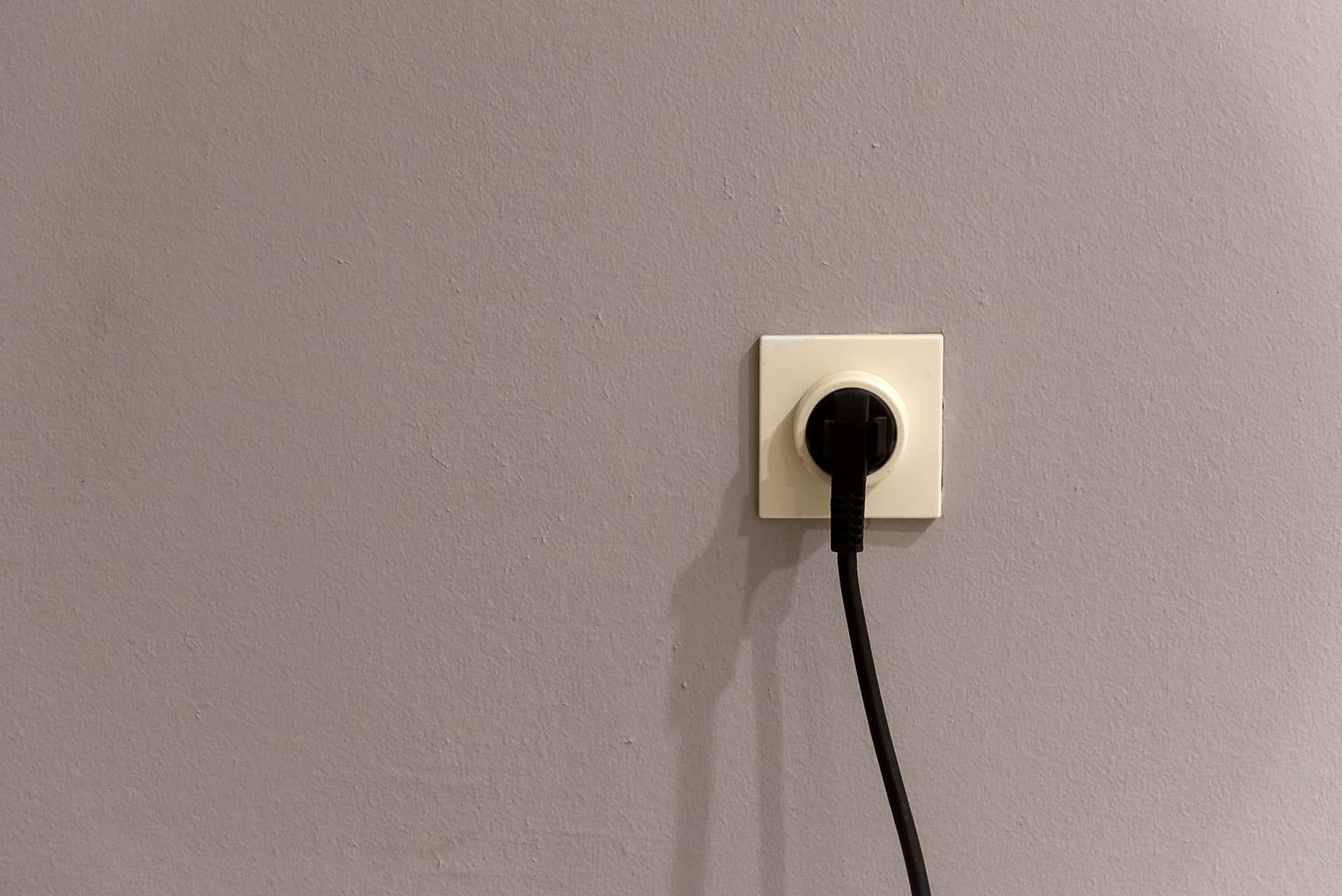
If the alert is the feature you want, you can buy it separately. A smart plug with energy monitoring costs a fraction of the Wi-Fi premium and will tell you when the machine stops drawing current - which catches a full bucket, a tripped breaker and a dead compressor alike. It will not tell you the room humidity, and it cannot change a setting, but on the failure that actually causes damage it is the same warning.
We mention it because it is honest, not because it is always better. A built-in app knows things a plug cannot: the current humidity, the target, whether the unit is in defrost. But if your budget is tight and your machine is fine, the plug route deserves a look before you replace a working dehumidifier for the radio.
What we would skip
Any connected dehumidifier that cannot alert you when it stops
Remote control is the least valuable thing an app does. A dehumidifier lives somewhere you do not go, doing a job you cannot see, and the failure modes are silent: a full bucket, a blocked drain, a pump that has given up, a tripped breaker. If the app only lets you change the target humidity from the sofa, you have paid for a convenience. If it tells you the machine is off, you have paid for the thing that prevents the damage.
What we did not do
We have not installed these apps, tested an alert, timed a notification or checked what happens when the Wi-Fi drops. Everything above about connectivity is quoted from the manufacturer's own listing copy, and everything about capacity and power is from the ENERGY STAR certified file. Where a maker does not claim a feature, this page records the absence rather than assuming the feature exists. How we work.
FAQ
Questions
Are smart dehumidifiers worth it?
Which dehumidifiers work with Alexa?
Does Wi-Fi make a dehumidifier more efficient?
Can I make an ordinary dehumidifier smart?
Do smart dehumidifiers keep working without internet?
Sources
Sources
- LG PuriCare 50-Pint WiFi Dehumidifier, model DT501BWR0 - Amazon.com listing stating LG ThinQ app control with maintenance alerts and Manual/Auto/Continuous/1-Hour Boost modes (retrieved 2026-09-21)
- GoveeLife Dehumidifier H7151 - Amazon.com listing stating 50 to 137 pints, Govee app, Alexa, Google Assistant and IFTTT support, washable filter, auto defrost (retrieved 2026-09-21)
- ALORAIR Smart Wi-Fi 70 Pints Crawlspace Dehumidifier with Pump, Sentinel HD35P Wifi - Amazon.com listing stating 35 pints/day AHAM and 70 pints saturation, Wi-Fi monitoring, a pump to 19.6 ft and a 6-year limited warranty (retrieved 2026-09-21)
- ENERGY STAR Certified Dehumidifiers list - LG DT501BKR0 at 49.81 pt/day and IEF 2.01; 124 of the 165 certified 50-pint portables sit at exactly IEF 2.01 (retrieved 2026-09-21)
Read next
- The best dehumidifiers with a built-in pumpFive pump-equipped units, ranked partly on which makers will state what their pump can actually reach.
- LG PuriCare 50 Pint with Wi-FiCertified 49.81 pints at 489 W - class-typical numbers. The ThinQ alerts and LG's own name on the certificate are the reasons to consider it.
- Frigidaire 50 Pint with Pump and Wi-FiFrigidaire prints 620 W and 470 W; the certified record says 490 W. Why the average sets your bill.
- The best dehumidifiers for a basementFive basement units ranked on drainage first, with computed running costs and a unit we would not buy.
- It is not collecting any waterEight checks in order. The first four take a minute each and none of them is a fault.
- Running it for lessSix changes ranked by what they save, three that save nothing, and one that costs you money.