Reviews / LG
LG PuriCare 50 Pint with Wi-Fi
On capacity and efficiency this is the same machine as three quarters of its class, and LG does not pretend otherwise. What it adds is a manufacturer with its own name on the certificate and an app that says it will tell you when something needs doing.
#adThis page contains affiliate links. We earn a commission on qualifying purchases, at no cost to you, and it never changes a ranking. Full disclosure.
The short answer
ENERGY STAR certifies LG's DT501BKR0 at 49.81 pints a day and IEF 2.01, which computes to 489 W - squarely mid-class. The listing adds LG ThinQ app control with maintenance alerts, four modes including a 1-Hour Boost, and a continuous drain option. There is no pump, and LG publishes no coverage area, no noise figure and no wattage.
The certified numbers, and one character of doubt
| Field | Value |
|---|---|
| Certified model | LG DT501BKR0 |
| Model on the listing | DT501BWR0 |
| Water removal capacity (DOE, 65F / 60% RH) | 49.81 pt/day |
| Integrated Energy Factor | 2.01 L/kWh |
| Average draw (computed) | 489 W |
| Estimated annual energy use | 526 kWh/yr |
From the ENERGY STAR Certified Dehumidifiers list, retrieved 2026-09-21. The 489 W is computed from the capacity and IEF using the formula on the methodology page.
One honesty note before anything else. The certified entry is DT501BKR0 and the Amazon listing states DT501BWR0 - one character apart, in the position where appliance makers usually put a color code. It is almost certainly the same machine in a different finish, and LG's certified family supports that reading: the DT251BWR0 and DT351BWR0 are both in the file under W codes at 24.99 and 35.30 pints.
Almost certainly is not the same as certainly, and we have not seen LG confirm it in writing. So the 489 W above is the certified figure for the same platform rather than an exact string match, and this page will keep saying so. Several units on this site carry an exact match - the DuraComfort in the large-capacity roundup is one - and the distinction is worth preserving.
It is an ordinary machine, and that is not a criticism
124 of 165
Certified 50-pint portables sitting at exactly IEF 2.01 - the LG among them
From the ENERGY STAR Certified Dehumidifiers list, retrieved 2026-09-21. The class runs from 2.01 to 2.24, but three quarters of it is at the floor. The minimum is where nearly everyone builds.
IEF 2.01 is simultaneously the floor and the norm of this class. The LG is not efficient and it is not wasteful; it is where the category is. Its 526 kWh a year sits at the thirsty end of a range running 444 to 530, and that is a function of certified capacity - 49.81 pints is near the top of what any portable is rated for - rather than of the machine converting electricity into dry air any worse than its neighbors.
LG PuriCare, certified DT501BKR0
(489 W / 1000) x 12 h x $0.1834/kWh = $1.08 per day
0.489
kWh per hour
$32.76
per month, 12 h/day
$65.52
per month, 24 h/day
Rate is the US residential average of 18.34 cents/kWh from the EIA Electric Power Monthly, June 2026. Yours will differ - use the calculator.
Anyone shopping this class on running cost is choosing between machines separated by about sixteen dollars a year across the entire field. IEF and what an ENERGY STAR badge is worth explains why that field is so tight.
What you are actually buying
A manufacturer, under its own name
The certified file is unusually informative about this category, because it names the company responsible for every measurement. There are 136 dehumidifier brand names in that file and only 77 companies behind them - 59 certificates name more than one brand outright. LG is in the smaller group: it certifies under its own corporate identity, it makes refrigeration hardware at scale, and it has a US service network that predates this product line by decades.
That is not a claim about durability, because nobody publishes failure data in this category and we have not run this machine. It is a claim about accountability, which is a different and more checkable thing. The brand guide has the full map.
An app that promises alerts, not just a remote
The ThinQ listing says the app will let you adjust settings, monitor performance and receive maintenance alerts remotely. That last clause is the one that matters, and the LG is the only connected unit we track whose listing states it explicitly.
The reason it matters is specific to dehumidifiers. This is an appliance that runs unattended, in a room you avoid, and whose failures are silent - a full bucket, a blocked drain, a tripped breaker. Nothing announces itself. By the time you notice, the humidity has been climbing for days. A notification is worth considerably more here than on an appliance you stand in front of. What smart actually buys you.
We have not installed the app, tested an alert, or checked what it does when the Wi-Fi drops. The promise is LG's, quoted from its own listing.
Four modes, including one nobody else offers
Manual, Auto, Continuous and a 1-Hour Boost. The first three are the category standard. The Boost is not - no other unit we track lists a timed maximum-output mode, and it is a sensible fit for the actual pattern of use in a laundry room or after a shower, where the humidity spike is an event rather than a baseline.
Quick picks
| # | Product | Best for | Draw | Price |
|---|---|---|---|---|
| 1 |  LG PuriCare 50 Pint Dehumidifier with Wi-FiThe only connected unit here from a manufacturer that makes its own compressors, and the certified numbers say it is an ordinary 50-pint machine with an app on top. LG PuriCare 50 Pint Dehumidifier with Wi-FiThe only connected unit here from a manufacturer that makes its own compressors, and the certified numbers say it is an ordinary 50-pint machine with an app on top. | Someone who wants app control from a brand with a service network | 489 W | |
| 2 |  Frigidaire 50 Pint Dehumidifier with Pump and Wi-FiFrigidaire's own documents give two different wattages for this machine and the certified record gives a third - which makes it the clearest case on the site for trusting the computed average over any printed figure. Frigidaire 50 Pint Dehumidifier with Pump and Wi-FiFrigidaire's own documents give two different wattages for this machine and the certified record gives a third - which makes it the clearest case on the site for trusting the computed average over any printed figure. | Seeing why a nameplate is not a running cost | 490 W | $336.99View on Amazon #ad Price as of September 21, 2026. How we are funded |
| 3 |  Midea Cube 50 Pint DehumidifierThe only unit here that solves the real basement problem, which is not capacity but where the water goes when you are not standing next to it. Midea Cube 50 Pint DehumidifierThe only unit here that solves the real basement problem, which is not capacity but where the water goes when you are not standing next to it. | A basement you visit once a month | 487 W | $249.99View on Amazon #ad Price as of September 21, 2026. How we are funded |
LG
LG PuriCare 50 Pint Dehumidifier with Wi-Fi
Best for: Someone who wants app control from a brand with a service network
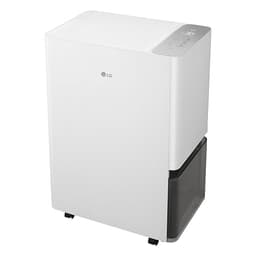
The only connected unit here from a manufacturer that makes its own compressors, and the certified numbers say it is an ordinary 50-pint machine with an app on top.
Average draw
489 W
Computed from the ENERGY STAR certified entry LG DT501BKR0: 49.81 pt/day at IEF 2.01 L/kWh, 526 kWh a year. The listing's model number is DT501BWR0 and the certified entry is DT501BKR0 - one character apart in what is almost certainly a color code. We have not seen LG confirm that in writing, so treat this as the certified figure for the same platform rather than an exact string match.
What is good
- App control from a manufacturer with a US service network, not a white-label brand
- A 1-Hour Boost mode, which none of the other connected units here offer
- Maintenance alerts through the app rather than a blinking light you have to notice
- Continuous drain option alongside the bucket
What is not
- No published coverage figure, no published wattage and no published noise level
- The certified entry is DT501BKR0 and the listing says DT501BWR0, so the match is one character short of exact
- No pump - the drain has to be below the machine
- Costs more than machines with identical certified capacity and efficiency
Who it is for
Someone who wants to check and change the setting from their phone and would rather buy that from LG than from a brand that exists only on Amazon.
Skip it if
Skip it if you need the water to go uphill. There is no pump, and at this price a pump model is within reach.
Frigidaire
Frigidaire 50 Pint Dehumidifier with Pump and Wi-Fi
Best for: Seeing why a nameplate is not a running cost
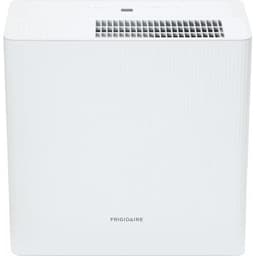
Frigidaire's own documents give two different wattages for this machine and the certified record gives a third - which makes it the clearest case on the site for trusting the computed average over any printed figure.
Average draw
490 W
Computed from the ENERGY STAR certified entry for Frigidaire FHDP5033Y1 - the same model number as this listing: 49.95 pt/day at IEF 2.01 L/kWh. Frigidaire's own figures do not agree with each other: its US specification sheet states 115 V, 5.5 A and 620 W, while its Canadian product page states 115 V, 8.8 A and 470 W. Those are nameplate figures, not averages, and they do not reconcile - use 490 W for running cost.
What is good
- The retail model number is exactly the certified one, so the 490 W figure is a direct match rather than a family estimate
- Pump discharges upward into a sink or out of a window, with bucket and continuous-drain modes as well
- Stated to keep working down to 41F, which matters in an unheated basement in shoulder season
- Wi-Fi with the Frigidaire app, plus Alexa and Google Home
What is not
- Frigidaire's two published wattages disagree - 620 W and 470 W - and neither is the running-cost figure
- No pump lift or hose run is stated on the listing or on either Frigidaire page we checked
- The Amazon listing itself is sparse; the useful detail lives on Frigidaire's own pages
Who it is for
Someone who wants a pump and Wi-Fi from a maker with a certified exact-model record, and who will size the circuit from the higher of the maker's figures.
Skip it if
Skip it if your pump route is long or tall. Frigidaire states no lift, where GE and Quilo state 15 feet in writing.
Midea
Midea Cube 50 Pint Dehumidifier
Best for: A basement you visit once a month
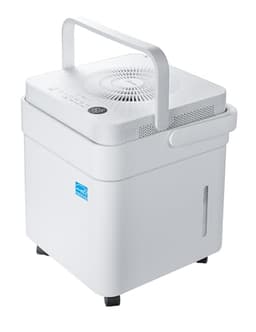
The only unit here that solves the real basement problem, which is not capacity but where the water goes when you are not standing next to it.
Average draw
487 W
Computed from the ENERGY STAR certified entry for Midea MAD50S1QWT-A, the 50 pt / 4,500 sq ft Cube without a pump: 49.67 pt/day at IEF 2.01 L/kWh. Midea's own US product page confirms MAD50S1QWT-A is this configuration. Midea publishes no wattage on the Amazon listing or on that page.
What is good
- The body separates, so the tank half can sit lower than the compressor half and the hose gets a genuine downhill run
- Certified at 49.67 pt/day, which is a real 50-pint machine rather than a saturation number
- IEF 2.01 L/kWh puts it exactly on the median for the 50-pint class - neither a bargain nor a penalty
- Wi-Fi that tells you it has stopped, which is the only smart feature that matters in a basement
What is not
- No pump, so the drain has to run downhill the whole way
- Midea publishes no wattage anywhere, so the 487 W above is computed rather than quoted
- The 4,500 sq ft coverage claim is marketing, not a spec - see the sizing guide
Who it is for
Someone with a floor drain, a sump, or a window well lower than the machine, who wants to set it once and stop thinking about it.
Skip it if
Skip it if the only drain in the room is higher than the unit. Without a pump, gravity is the entire drainage system, and no setting fixes an uphill hose.
What LG does not publish
| Specification | Published? | Note |
|---|---|---|
| Coverage area | No | The listing names basements, large rooms and laundry rooms, with no square footage |
| Noise level | No | 'Designed for quieter performance in bedrooms, offices, nurseries' - no dBA figure |
| Wattage | No | Normal for the category; the 489 W above is computed from certified data |
| Bucket capacity | No | Continuous drain is offered, the bucket size is not stated |
| Warranty term | No | Not on the listing |
| Operating temperature range | No | Only four of the 31 units we track publish one |
| Size and weight | Yes | 23.86 x 16.73 x 11.02 in, 43.4 lb |
Read from the current listing on 2026-09-21. The noise gap is the awkward one: the listing markets the machine for bedrooms and nurseries on the basis of quietness and then declines to say how quiet.
None of these omissions is unusual - most of this category publishes almost nothing. It is worth noting anyway, because this is a premium-priced machine from a major manufacturer, and it discloses no more than an Amazon-native brand does.

Who should buy something else
- Anyone whose drain is above the machine. There is no pump. At this price a pump model is well within reach. The best dehumidifiers with a built-in pump.
- Anyone who visits the room rarely and hates emptying buckets. The Midea Cube's split body holds far more water, and no bucket figure is published for the LG at all. Midea vs Frigidaire covers the body question.
- Anyone buying for a bedroom on noise grounds. The listing markets quietness without publishing a figure, so there is nothing to compare. The quietest dehumidifiers.
- Anyone with a cold basement or garage. LG publishes no temperature floor. If the room drops toward 40F, buy from the short list of makers who state one. Dehumidifiers for cold rooms.
- Anyone choosing purely on cost per pint. The certified numbers here are class-typical, and cheaper machines share them exactly.
What we did not do
We have not run this unit. No extraction test, no power meter, no sound measurement, and no time with the ThinQ app. Every figure above is either quoted from the listing or computed from the ENERGY STAR certified record for DT501BKR0, with the sources below. Where LG publishes nothing, this page says so rather than substituting a sibling model's number. How we work.
FAQ
Questions
Is the LG PuriCare dehumidifier any good?
How many watts does the LG PuriCare 50 pint dehumidifier use?
Does the LG PuriCare dehumidifier have a pump?
How loud is the LG PuriCare dehumidifier?
What is the difference between DT501BWR0 and DT501BKR0?
Sources
Sources
- LG PuriCare 50-Pint WiFi Dehumidifier, model DT501BWR0 - Amazon.com listing stating removal of up to 50 pints per day, LG ThinQ app control with remote settings, performance monitoring and maintenance alerts, Manual/Auto/Continuous/1-Hour Boost modes, a continuous drain option, 23.86 x 16.73 x 11.02 in and 43.43 lb (retrieved 2026-09-21)
- ENERGY STAR Certified Dehumidifiers list - LG DT501BKR0 at 49.81 pt/day and IEF 2.01 L/kWh, 526 kWh/yr; LG DT251BWR0 at 24.99 pt/day and DT351BWR0 at 35.30 pt/day; 124 of the 165 certified 50-pint portables at exactly IEF 2.01 (retrieved 2026-09-21)
- EIA Electric Power Monthly, Table 5.6.A, June 2026 - the residential electricity rate used
Read next
- The best smart dehumidifiersFour connected units compared on what the app really buys you - which is being told the machine has stopped.
- The best dehumidifier brands136 brand names, 77 companies. Who makes their own machines, who shares a factory, and how to check in two minutes.
- Midea vs Frigidaire, 50 pint49.67 pints against 49.71, both at IEF 2.01. The measurements tie, so here is what actually decides it.
- The best 50-pint dehumidifiersSix 50-pint units and the certified data behind them: a 443-490 W range and a coverage claim that varies 1.9x.
- Frigidaire 50 Pint with Pump and Wi-FiFrigidaire prints 620 W and 470 W; the certified record says 490 W. Why the average sets your bill.
- IEF, and what an ENERGY STAR badge is worthWhat IEF measures, what it replaced, the real spread across 527 models, and what the badge saves.