Compare / Head to head
Midea vs Frigidaire, 50 pint
The two names most people end up choosing between, measured under the same government test, land within four hundredths of a pint of each other. The decision is real, but it is not about capacity.
#adThis page contains affiliate links. We earn a commission on qualifying purchases, at no cost to you, and it never changes a ranking. Full disclosure.
The short answer
By measurement these are the same machine: the Midea MAD50S1QWT-A is certified at 49.67 pints a day and the Frigidaire FHDD5034Y1 at 49.71, both at IEF 2.01, computing to 487 W and 488 W. Choose Midea for the stacking Cube body and the best drainage flexibility in the class; choose Frigidaire for Wi-Fi, a US retail and service network, and a larger bucket.
The measurements, side by side
| Midea Cube 50 | Frigidaire 50 Pint | |
|---|---|---|
| Certified model | MAD50S1QWT-A | FHDD5034Y1 |
| DOE capacity | 49.67 pt/day | 49.71 pt/day |
| Integrated Energy Factor | 2.01 L/kWh | 2.01 L/kWh |
| Average draw (computed) | 487 W | 488 W |
| Annual energy use | 515 kWh/yr | 521 kWh/yr |
| Certifying partner | GD Midea Air-Conditioning Equipment Co., Ltd. | Electrolux Consumer Products, Inc. |
From the ENERGY STAR Certified Dehumidifiers list, retrieved 2026-09-21. The wattage is computed from the certified capacity and IEF using the formula on the methodology page.
Four hundredths of a pint a day. One watt. Six kilowatt-hours a year, which is about a dollar. If you are choosing between these two on performance, the honest answer is that there is nothing to choose - and that is not a quirk of these two models. Three quarters of the certified 50-pint class sits at exactly IEF 2.01, so this is what the whole category looks like once you strip the marketing off.
$1 a year
The difference in electricity between these two machines, at the US average residential rate
515 kWh/yr against 521 kWh/yr, at 18.34 cents per kWh from the EIA Electric Power Monthly, June 2026. Runtime and your local rate will move your bill by multiples of this. The calculator will do it at your rate.
So what does separate them
The body: Midea's is the genuinely different one
The Cube is the only meaningfully different physical design in this class. It splits and stacks: the collection section separates, so the bucket is enormous by category standards, and the unit takes up less floor when stacked. In a basement you visit once a month, that is not a styling choice - it is the difference between emptying a bucket weekly and not thinking about it.
Frigidaire's body is a conventional portable. It is not worse - it is the shape everything else in the category is - but it does not solve the bucket problem the way the Cube does.
Connectivity: Frigidaire has it, Midea's Cube line does not advertise it
Frigidaire puts Wi-Fi and an app on both of its current 50-pint models, which on a machine that lives somewhere you rarely go is the feature with the clearest practical value. What smart actually buys you makes the case at length. If you want app control, this is the deciding difference between these two brands.
Who stands behind it
This is where the brands genuinely differ, and the certified file makes it visible. Midea's certifying partner is GD Midea Air-Conditioning Equipment Co., Ltd. - the manufacturer, under its own corporate name, with 49 certified dehumidifier models. Frigidaire's certifying partner is Electrolux Consumer Products, Inc., because Frigidaire is a heritage American appliance brand owned and certified by Electrolux rather than a standalone dehumidifier maker.
Neither arrangement is a problem. Midea makes its own refrigeration hardware at scale. Electrolux brings a US retail and service network that most of this category cannot match. What it means practically is that a Frigidaire warranty claim runs through a large domestic appliance operation, and a Midea one runs through Midea. The brand guide has the wider map.
Quick picks
| # | Product | Best for | Draw | Price |
|---|---|---|---|---|
| 1 |  Midea Cube 50 Pint DehumidifierThe only unit here that solves the real basement problem, which is not capacity but where the water goes when you are not standing next to it. Midea Cube 50 Pint DehumidifierThe only unit here that solves the real basement problem, which is not capacity but where the water goes when you are not standing next to it. | A basement you visit once a month | 487 W | $249.99View on Amazon #ad Price as of September 21, 2026. How we are funded |
| 2 |  Frigidaire 50 Pint Dehumidifier with Wi-FiFrigidaire's current no-pump 50-pint: certified by exact model number, Wi-Fi equipped, and a 2.7 gallon bucket that is among the largest of any 50-pint unit we track. Frigidaire 50 Pint Dehumidifier with Wi-FiFrigidaire's current no-pump 50-pint: certified by exact model number, Wi-Fi equipped, and a 2.7 gallon bucket that is among the largest of any 50-pint unit we track. | A Frigidaire with a drain below it | 488 W | $319.00View on Amazon #ad Price as of September 21, 2026. How we are funded |
| 3 | Midea Cube 50 Pint Dehumidifier with PumpThe stacking Midea Cube with a condensate pump added, which is the difference between a hose you can run and a hose you cannot. | A basement whose only drain is upstairs | 487 W | |
| 4 |  Frigidaire 50 Pint Dehumidifier with Pump and Wi-FiFrigidaire's own documents give two different wattages for this machine and the certified record gives a third - which makes it the clearest case on the site for trusting the computed average over any printed figure. Frigidaire 50 Pint Dehumidifier with Pump and Wi-FiFrigidaire's own documents give two different wattages for this machine and the certified record gives a third - which makes it the clearest case on the site for trusting the computed average over any printed figure. | Seeing why a nameplate is not a running cost | 490 W | $336.99View on Amazon #ad Price as of September 21, 2026. How we are funded |
Midea
Midea Cube 50 Pint Dehumidifier
Best for: A basement you visit once a month
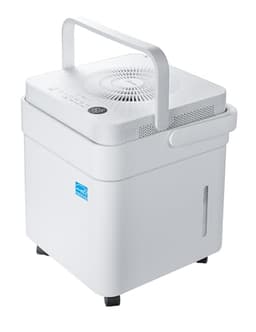
The only unit here that solves the real basement problem, which is not capacity but where the water goes when you are not standing next to it.
Average draw
487 W
Computed from the ENERGY STAR certified entry for Midea MAD50S1QWT-A, the 50 pt / 4,500 sq ft Cube without a pump: 49.67 pt/day at IEF 2.01 L/kWh. Midea's own US product page confirms MAD50S1QWT-A is this configuration. Midea publishes no wattage on the Amazon listing or on that page.
What is good
- The body separates, so the tank half can sit lower than the compressor half and the hose gets a genuine downhill run
- Certified at 49.67 pt/day, which is a real 50-pint machine rather than a saturation number
- IEF 2.01 L/kWh puts it exactly on the median for the 50-pint class - neither a bargain nor a penalty
- Wi-Fi that tells you it has stopped, which is the only smart feature that matters in a basement
What is not
- No pump, so the drain has to run downhill the whole way
- Midea publishes no wattage anywhere, so the 487 W above is computed rather than quoted
- The 4,500 sq ft coverage claim is marketing, not a spec - see the sizing guide
Who it is for
Someone with a floor drain, a sump, or a window well lower than the machine, who wants to set it once and stop thinking about it.
Skip it if
Skip it if the only drain in the room is higher than the unit. Without a pump, gravity is the entire drainage system, and no setting fixes an uphill hose.
Frigidaire
Frigidaire 50 Pint Dehumidifier with Wi-Fi
Best for: A Frigidaire with a drain below it
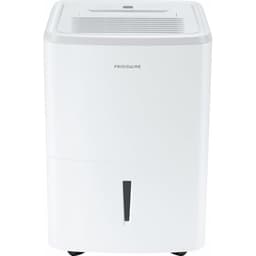
Frigidaire's current no-pump 50-pint: certified by exact model number, Wi-Fi equipped, and a 2.7 gallon bucket that is among the largest of any 50-pint unit we track.
Average draw
488 W
Computed from the ENERGY STAR certified entry for Frigidaire FHDD5034Y1 - the same model number as this listing: 49.71 pt/day at IEF 2.01 L/kWh. Frigidaire's Canadian product page states 115 V, 8.8 A and 470 W; those figures do not reconcile with each other and are nameplate rather than average values, so 488 W is the running-cost figure.
What is good
- Exact certified model match, so the 488 W figure describes this machine rather than a sibling
- 2.7 gallon bucket - roughly ten hours of condensate at full rated capacity if you ever run it without a hose
- Continuous drain, three fan speeds and operation down to 41F
- Wi-Fi and the Frigidaire app for scheduling and remote control
What is not
- Gravity only. The drain must be below the machine
- The Wi-Fi depends on Frigidaire's app remaining supported
- Frigidaire's own published wattage and amperage do not agree with each other
Who it is for
Someone with a floor drain who wants a certified, well-documented 50-pint unit and has a use for scheduling.
Skip it if
Skip it if the only drain is above the machine. That is the one job a gravity unit cannot do, whatever else it has.
Midea
Midea Cube 50 Pint Dehumidifier with Pump
Best for: A basement whose only drain is upstairs
The stacking Midea Cube with a condensate pump added, which is the difference between a hose you can run and a hose you cannot.
Average draw
487 W
Computed from the ENERGY STAR certified entry for Midea MAD50PS1QWT-A, the pump variant of the same platform: 49.67 pt/day at IEF 2.01 L/kWh. The current retail revision is the -B; every Midea 50-pint Cube revision in the certified list, pump or not, computes to 487-490 W, so the pump does not move the number meaningfully. The pump itself only runs in bursts.
What is good
- Pump means the destination can be higher than the machine - a laundry sink, a window, a stack
- Identical DOE capacity and IEF to the non-pump Cube, so the pump costs you nothing in efficiency
- The split body still works, so you can also run it on gravity and keep the pump as the backup
- Certified 49.67 pt/day, an honest 50-pint rating
What is not
- Costs more than the identical machine without the pump
- A pump is one more thing that can fail, and when it does the unit stops rather than overflows
- No published wattage from Midea - the figure above is computed
Who it is for
Anyone whose drain is above the floor. That is most finished basements and nearly every crawl space.
Skip it if
Skip it if you already have a floor drain within hose reach and below the machine. You would be paying for a pump you will never switch on.
Frigidaire
Frigidaire 50 Pint Dehumidifier with Pump and Wi-Fi
Best for: Seeing why a nameplate is not a running cost
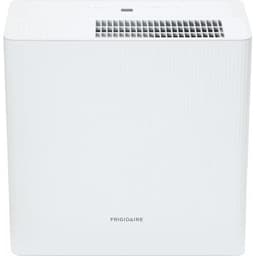
Frigidaire's own documents give two different wattages for this machine and the certified record gives a third - which makes it the clearest case on the site for trusting the computed average over any printed figure.
Average draw
490 W
Computed from the ENERGY STAR certified entry for Frigidaire FHDP5033Y1 - the same model number as this listing: 49.95 pt/day at IEF 2.01 L/kWh. Frigidaire's own figures do not agree with each other: its US specification sheet states 115 V, 5.5 A and 620 W, while its Canadian product page states 115 V, 8.8 A and 470 W. Those are nameplate figures, not averages, and they do not reconcile - use 490 W for running cost.
What is good
- The retail model number is exactly the certified one, so the 490 W figure is a direct match rather than a family estimate
- Pump discharges upward into a sink or out of a window, with bucket and continuous-drain modes as well
- Stated to keep working down to 41F, which matters in an unheated basement in shoulder season
- Wi-Fi with the Frigidaire app, plus Alexa and Google Home
What is not
- Frigidaire's two published wattages disagree - 620 W and 470 W - and neither is the running-cost figure
- No pump lift or hose run is stated on the listing or on either Frigidaire page we checked
- The Amazon listing itself is sparse; the useful detail lives on Frigidaire's own pages
Who it is for
Someone who wants a pump and Wi-Fi from a maker with a certified exact-model record, and who will size the circuit from the higher of the maker's figures.
Skip it if
Skip it if your pump route is long or tall. Frigidaire states no lift, where GE and Quilo state 15 feet in writing.
The pump question changes the comparison
Both brands sell a pump version, and they diverge more there than they do on the base models.
- Midea Cube with pump keeps the split body, so you get the pump and the oversized bucket as a fallback. Midea states a 16 ft drain tube but no lift height.
- Frigidaire with pump and Wi-Fi adds app control to the pump, which is the combination that makes most sense - a pump is the component most likely to fail silently, and an alert is the thing that tells you. Frigidaire states no lift height either.
Neither maker publishes what its pump can actually reach, which is the specification you are buying a pump for. GE and Quilo both state 15 feet. If your drain route has real height in it, that omission should outrank brand preference. How far will the pump actually push it.
How to decide in one question
| If your situation is... | Buy |
|---|---|
| A basement you check rarely and no drain nearby | Midea Cube - the split bucket is the largest practical advantage in the class |
| You want to see and change it from your phone | Frigidaire - Wi-Fi on both current 50-pint models |
| The drain is above the machine | Either pump model; neither states a lift, so keep the rise short |
| You want a US service network behind it | Frigidaire - certified by Electrolux |
| You want the manufacturer's own name on the certificate | Midea - GD Midea certifies 49 models under its own corporate entity |
| You are choosing on running cost | Neither. One dollar a year separates them |
What we did not do
We have not run either machine, measured extraction, or compared them in a room. Every capacity, efficiency and annual energy figure here is read from the ENERGY STAR certified file under the model number each maker publishes, and every feature claim is quoted from the maker's own listing. Where neither states a figure - pump lift, in particular - this page says so. How we work.
FAQ
Questions
Is Midea or Frigidaire better for a 50 pint dehumidifier?
Who makes Frigidaire dehumidifiers?
Who makes Midea dehumidifiers?
Does the Midea Cube really hold more water?
Which one is cheaper to run?
Sources
Sources
- ENERGY STAR Certified Dehumidifiers list - Midea MAD50S1QWT-A 49.67 pt/day at IEF 2.01, 515 kWh/yr, partner GD Midea Air-Conditioning Equipment Co., Ltd.; Frigidaire FHDD5034Y1 49.71 pt/day at IEF 2.01, 521 kWh/yr, partner Electrolux Consumer Products, Inc. (retrieved 2026-09-21)
- EIA Electric Power Monthly, Table 5.6.A, June 2026 - the residential electricity rate used
Read next
- Midea Cube 50 PintCertified 49.67 pt/day at 487 W, and the splitting body that solves a real drainage constraint.
- Frigidaire 50 Pint PortableFrigidaire's no-pump 50-pint: certified at 488 W, a 2.7 gallon bucket and nothing to break in the drainage.
- The best 50-pint dehumidifiersSix 50-pint units and the certified data behind them: a 443-490 W range and a coverage claim that varies 1.9x.
- The best dehumidifier brands136 brand names, 77 companies. Who makes their own machines, who shares a factory, and how to check in two minutes.
- The best smart dehumidifiersFour connected units compared on what the app really buys you - which is being told the machine has stopped.
- How far will the pump actually push it?Three of seven pump models state a lift. What they say, and how to plan when a maker states nothing.