Drainage / Guide
How far will the pump actually push it?
The specification you most need before buying a pump model is the one fewer than half of makers publish. Here is what is on record, and how to plan around the silence.
#adThis page contains affiliate links. We earn a commission on qualifying purchases, at no cost to you, and it never changes a ranking. Full disclosure.
The short answer
It depends on the unit. GE states 15 vertical feet of lift and a 16 foot hose for its 50-pint pump model, Quilo states 15 feet, and AlorAir's crawl space unit states 19.6 feet. Midea states only a 16 foot drain tube, and Frigidaire, Hisense and hOmeLabs publish no figure at all.
Two different limits, routinely conflated
A condensate pump has two constraints and they are not interchangeable:
- Lift is the vertical height it can raise water. This is the hard limit - it is set by the pressure the pump can generate, and past it the pump simply cannot move the water at all.
- Run is the total length of hose. Long horizontal runs add friction, which eats into the pressure available for lift, but a flat run is far less demanding than a vertical one.
Sixteen feet of hose along a flat basement floor is trivial. Sixteen feet of hose that goes twelve feet up a wall is a completely different demand on the same pump. When a manufacturer publishes a hose length and calls it the spec, they have told you about the easy constraint and stayed quiet about the hard one.
What is actually on record
| Unit | Lift height | Hose run | What the maker says |
|---|---|---|---|
| AlorAir Sentinel HDi65S | 19.6 ft | Not stated | States a lifting distance of up to 19.6 ft |
| GE 50 Pint with Pump | 15 vertical ft | 16 ft, included | States lift and hose length as separate figures |
| Quilo 50 Pint with Pump | 15 ft | Drain tube included | States up to 15 ft, vertically or horizontally |
| Midea Cube 50 with Pump | Not stated | 16 ft, included | States a drain tube length but no lift |
| Frigidaire 50 with Pump and Wi-Fi | Not stated | Not stated | No reach figure on the listing or Frigidaire's pages |
| Hisense 50 Pint with Pump | Not stated | Not stated | Quick-connect hose included, length not stated |
| hOmeLabs 50 with Pump | Not stated | Not stated | No reach figure |
Every entry read from the current listing on 2026-09-16. Three of seven state a lift, one states only a hose length, and three state nothing. The Hisense reference works through what the rest of a machine has to offer to be worth buying without that figure.
How to plan a route without a published figure
- 1Minimize the vertical. Every foot of rise is the expensive part. A sink four feet up is a different job from a window eight feet up, and if there is a lower option, take it.
- 2Go up first, then across. Lifting to the required height near the machine and then running horizontally is easier on the pump than a long gradual climb, because it avoids water sitting in a shallow-graded line.
- 3Do not extend the supplied hose. Where the maker published a figure, it assumes their hose. Where they published nothing, adding length is guesswork on top of guesswork.
- 4Avoid elbows. Wide curves instead of sharp turns; every tight bend costs pressure and is a kink waiting to happen.
- 5Assume the modest end. Treat an unstated lift as if it were small. If your route needs a genuinely high lift, buy a purpose-built external condensate pump with a published head rating rather than hoping.
The external pump, which does publish its numbers
This is the practical answer to the whole problem. Standalone condensate pumps - the kind fitted under air conditioners and furnaces - are sold as plumbing components rather than consumer appliances, and they publish a maximum head in feet because installers need it.
So if your route is demanding, an external pump under a gravity-drain dehumidifier is both cheaper than a built-in pump model and better specified. You give up tidiness and gain a number somebody will stand behind. It is also reusable when the dehumidifier is eventually replaced.
Quick picks
| # | Product | Best for | Draw | Price |
|---|---|---|---|---|
| 1 |  Midea Cube 50 Pint Dehumidifier with PumpThe stacking Midea Cube with a condensate pump added, which is the difference between a hose you can run and a hose you cannot. Midea Cube 50 Pint Dehumidifier with PumpThe stacking Midea Cube with a condensate pump added, which is the difference between a hose you can run and a hose you cannot. | A basement whose only drain is upstairs | 487 W | $237.45View on Amazon #ad Price as of October 17, 2026. How we are funded |
| 2 |  AlorAir Sentinel HDi65S Crawl Space Dehumidifier with PumpA low-clearance unit with the condensate pump built in, which is the only sane configuration for a space whose floor is the lowest point on the property. AlorAir Sentinel HDi65S Crawl Space Dehumidifier with PumpA low-clearance unit with the condensate pump built in, which is the only sane configuration for a space whose floor is the lowest point on the property. | A crawl space with nowhere for water to go | Not published | $680.09View on Amazon #ad Price as of October 17, 2026. How we are funded |
| 3 |  GE 50 Pint Dehumidifier with PumpGE states both numbers a pump buyer needs - 15 feet of vertical lift and a 16 foot hose - which is the most complete pump specification of any 50-pint unit we track. GE 50 Pint Dehumidifier with PumpGE states both numbers a pump buyer needs - 15 feet of vertical lift and a 16 foot hose - which is the most complete pump specification of any 50-pint unit we track. | A lift and a hose length, both in writing | Not published |
Midea
Midea Cube 50 Pint Dehumidifier with Pump
Best for: A basement whose only drain is upstairs
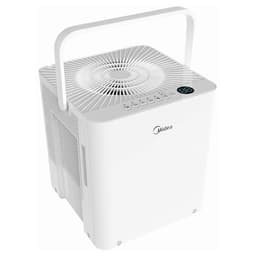
The stacking Midea Cube with a condensate pump added, which is the difference between a hose you can run and a hose you cannot.
Average draw
487 W
Computed from the ENERGY STAR certified entry for Midea MAD50PS1QWT-A, the pump variant of the same platform: 49.67 pt/day at IEF 2.01 L/kWh. The listing prints the unsuffixed MAD50PS1QWT, so the certified string carries a suffix the box does not; every Midea 50-pint revision in the certified list, pump or not, computes to 487-490 W, so neither the suffix nor the pump moves the number meaningfully. The pump itself only runs in bursts.
What is good
- Pump means the destination can be higher than the machine - a laundry sink, a window, a stack
- Identical DOE capacity and IEF to the non-pump Cube, so the pump costs you nothing in efficiency
- The split body still works, so you can also run it on gravity and keep the pump as the backup
- Certified 49.67 pt/day, an honest 50-pint rating
What is not
- Costs more than the identical machine without the pump
- A pump is one more thing that can fail, and when it does the unit stops rather than overflows
- No published wattage from Midea - the figure above is computed
Who it is for
Anyone whose drain is above the floor. That is most finished basements and nearly every crawl space.
Skip it if
Skip it if you already have a floor drain within hose reach and below the machine. You would be paying for a pump you will never switch on.
AlorAir
AlorAir Sentinel HDi65S Crawl Space Dehumidifier with Pump
Best for: A crawl space with nowhere for water to go
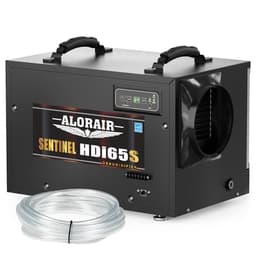
A low-clearance unit with the condensate pump built in, which is the only sane configuration for a space whose floor is the lowest point on the property.
Average draw
Not published
Not published, and the HDi65S does not appear by name in the ENERGY STAR certified list - AlorAir's certified entries are the Sentinel HD55S (344 W), the Helios D35 (243 W) and the Sentinel Pro35X (221 W). Given the HD55S computes to 344 W at 36 DOE pints, a genuinely larger AlorAir unit sits above that. We are not going to put a figure on it without a source.
What is good
- Condensate pump built in, so the discharge can go up and out rather than down and nowhere
- Compact enough for low-clearance crawl spaces and joist bays
- Auto defrost, MERV-1 filter, cETL listed
- Optional remote monitoring, which matters for a machine nobody looks at
What is not
- No published wattage and no named ENERGY STAR entry
- The 120-pint headline is a saturation number, as with every unit in this class
- Expensive relative to a portable of comparable DOE capacity
Who it is for
Encapsulated crawl spaces and sub-floor voids with no gravity drain, where the alternative is a bucket nobody will ever empty.
Skip it if
Skip it if you have a floor drain below the unit. The HD55 does the same job on gravity for less, and has a certified efficiency figure this one lacks.
GE
GE 50 Pint Dehumidifier with Pump
Best for: A lift and a hose length, both in writing
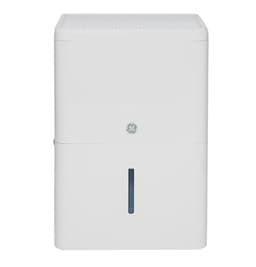
GE states both numbers a pump buyer needs - 15 feet of vertical lift and a 16 foot hose - which is the most complete pump specification of any 50-pint unit we track.
Average draw
Not published
Not published by GE. The ADHE50 series does not appear by name in the ENERGY STAR certified list and this listing makes no ENERGY STAR claim - its predecessor did. The certified 50-pint class runs 443-490 W with a median of 488 W; adding a pump does not change capacity or IEF on the certified units that have one.
What is good
- States a vertical lift and a hose length separately - the two constraints a pump route actually has
- The listing tells you when to choose the pump model, which is more guidance than most makers give
- Humidistat down to 30 percent, a 24-hour timer and Smart Dry fan control
- Bucket-full alarm and clean-filter alert
What is not
- No ENERGY STAR certification claimed, so there is no certified figure to compute running cost from
- 15 pint bucket is smaller than several rivals, which matters if the pump ever stops
- 5,000 sq ft coverage claim, up from 4,000 on its predecessor for the same capacity
Who it is for
Someone whose drain is up a wall or across a room and who wants the limits of the pump stated before buying rather than discovered after.
Skip it if
Skip it if the discharge point is more than 15 feet above the unit or needs more than the included 16 feet of hose. Those are the limits GE put in writing.
What failure looks like
A pump asked to work beyond its reach usually does not fail cleanly. It runs, moves some water, and cannot clear the reservoir before the next cycle fills it - so the reservoir stays high, the float stays tripped, and the machine either shuts down repeatedly or runs the pump continuously until it burns out.
The tell is a pump that runs far more often than it should, or that runs for a long time each cycle. Both mean the route is asking too much. Shorten it, lower the destination, or fit a pump specified for the job. Drain not working.
FAQ
Questions
How high can a dehumidifier pump lift water?
Can I run a dehumidifier pump hose out of a window?
Is an external condensate pump better than a built-in one?
Sources
Sources
- GE Dehumidifier with Pump & Hose, 50 Pint, ADHE50PWF - Amazon.com listing stating up to 15 vertical feet of lift and a 16 ft drain hose (retrieved 2026-09-16)
- Quilo 50-Pint Dehumidifier, QLDAD50PWK - Amazon.com listing stating a drain pump to 15 ft vertically or horizontally (retrieved 2026-09-16)
- ALORAIR Sentinel HDi65S - Amazon.com listing stating an integrated condensate pump with a lifting distance of up to 19.6 ft (retrieved 2026-09-16)
Read next
- Pump or gravity: decide this before anything elseA five-minute test that eliminates half the market, and the middle option most buyers miss.
- The best dehumidifiers with a built-in pumpFive pump-equipped units, ranked partly on which makers will state what their pump can actually reach.
- The continuous drain has stopped workingSeven checks in order of likelihood, and the two that solve most cases without a tool.
- Hoses, threads and adaptersWhich hose, which adapters, and the four fittings that turn a working drain into a leak.
- The best crawl space dehumidifiersFour crawl space options, and the 3.1x gap between the pint number on the box and the certified one.
- AlorAir Sentinel HDi65SThe pump makes a crawl space install possible - and it is the one AlorAir with no certified efficiency data.
- Frigidaire dehumidifier error codesNine codes, five faults, and the two Frigidaire documents that give different answers for F0.