Reviews / AlorAir
AlorAir Sentinel HDi65S
The configuration that makes sense for a space whose floor is the lowest point on the property - and a headline number that, as with everything in this class, is measured somewhere your crawl space will never be.
#adThis page contains affiliate links. We earn a commission on qualifying purchases, at no cost to you, and it never changes a ranking. Full disclosure.
The short answer
A low-profile crawl space dehumidifier with an integrated condensate pump, listed at 120 pints a day at saturation and 55 pints on AlorAir's AHAM figure. It has no tank at all. It does not appear by name in the ENERGY STAR certified list, so there is no published efficiency figure for it.
Why the built-in pump is the whole argument
A crawl space is, by definition, the lowest accessible point under the house. That creates a problem no other room has: there is frequently nowhere downhill for water to go.
Gravity drainage needs a destination below the machine's outlet. In a basement that is usually a floor drain or a sump. In a crawl space the floor IS the bottom, and the nearest drain is often up and out through a rim joist. Without a pump you are left with the option nobody actually takes: a tank, in a space you have to crawl into.
So the HDi65S is not a premium version of a cheaper unit. It is the configuration that makes the installation possible at all, and that is the correct way to think about the price difference. Pump versus gravity.
The number on the box, and the number that compares
120 vs 55
Saturation headline against AlorAir's own AHAM rating
The 120-pint figure is capacity at saturation, conventionally 95F and 90% relative humidity - a condition no US crawl space reaches. AlorAir also publishes 55 pints per day on the AHAM basis. Both figures are the manufacturer's own.
This is the same pattern as every unit in the crawl space and commercial class, and it is why cross-shopping one of these against a 50-pint portable on the headline number is comparing nothing. Its sibling, the Sentinel HD55, is sold as 113 pints and certified at 36.33 at the DOE test condition - a factor of 3.1. The full explanation.
For the HDi65S specifically we cannot close that loop, because it is not in the certified list. AlorAir's certified entries are the Sentinel HD55S, the Helios D35 and the Sentinel Pro35X. So the DOE-condition capacity of this unit is not published anywhere we can find, and we are not going to derive one from a sibling.
Quick picks
| # | Product | Best for | Draw | Price |
|---|---|---|---|---|
| 1 |  AlorAir Sentinel HDi65S Crawl Space Dehumidifier with PumpA low-clearance unit with the condensate pump built in, which is the only sane configuration for a space whose floor is the lowest point on the property. AlorAir Sentinel HDi65S Crawl Space Dehumidifier with PumpA low-clearance unit with the condensate pump built in, which is the only sane configuration for a space whose floor is the lowest point on the property. | A crawl space with nowhere for water to go | Not published | |
| 2 |  AlorAir Sentinel HD55 Crawl Space DehumidifierThe clearest example on this site of why the number on the box is not the number that matters: sold as 113 pints, certified at 36.33. AlorAir Sentinel HD55 Crawl Space DehumidifierThe clearest example on this site of why the number on the box is not the number that matters: sold as 113 pints, certified at 36.33. | A crawl space you cannot stand up in | 344 W |
AlorAir
AlorAir Sentinel HDi65S Crawl Space Dehumidifier with Pump
Best for: A crawl space with nowhere for water to go
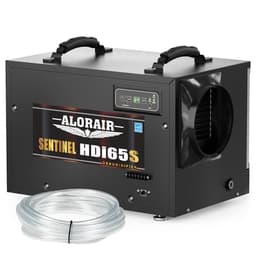
A low-clearance unit with the condensate pump built in, which is the only sane configuration for a space whose floor is the lowest point on the property.
Average draw
Not published
Not published, and the HDi65S does not appear by name in the ENERGY STAR certified list - AlorAir's certified entries are the Sentinel HD55S (344 W), the Helios D35 (243 W) and the Sentinel Pro35X (221 W). Given the HD55S computes to 344 W at 36 DOE pints, a genuinely larger AlorAir unit sits above that. We are not going to put a figure on it without a source.
What is good
- Condensate pump built in, so the discharge can go up and out rather than down and nowhere
- Compact enough for low-clearance crawl spaces and joist bays
- Auto defrost, MERV-1 filter, cETL listed
- Optional remote monitoring, which matters for a machine nobody looks at
What is not
- No published wattage and no named ENERGY STAR entry
- The 120-pint headline is a saturation number, as with every unit in this class
- Expensive relative to a portable of comparable DOE capacity
Who it is for
Encapsulated crawl spaces and sub-floor voids with no gravity drain, where the alternative is a bucket nobody will ever empty.
Skip it if
Skip it if you have a floor drain below the unit. The HD55 does the same job on gravity for less, and has a certified efficiency figure this one lacks.
AlorAir
AlorAir Sentinel HD55 Crawl Space Dehumidifier
Best for: A crawl space you cannot stand up in
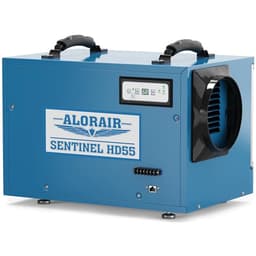
The clearest example on this site of why the number on the box is not the number that matters: sold as 113 pints, certified at 36.33.
Average draw
344 W
Computed from the ENERGY STAR certified entry ALORAIR Sentinel HD55S: 36.33 pt/day at IEF 2.08 L/kWh, 379 kWh a year. The retail listing is the HD55; the certified entry carries the S suffix. At IEF 2.08 it is more efficient than the median 50-pint portable while removing about three quarters as much water.
What is good
- Built low and flat to fit between floor joists, which no portable unit does
- Auto defrost and low-temperature operation, both essential in an unheated crawl space
- IEF 2.08 is above the 50-pint class median of 2.01 despite the smaller capacity
- No tank at all, so there is nothing to forget to empty
What is not
- The 113-pint headline is a saturation figure at 95F and 90% RH; the DOE-condition rating is 36.33
- 1,200 sq ft coverage, less than most 50-pint portables claim, for considerably more money
- Needs a drain or a condensate pump - there is no bucket fallback
Who it is for
Crawl spaces, low-clearance basements and unheated storage where a standing portable will not fit or will freeze.
Skip it if
Skip it for a normal basement. A 50-pint portable removes more water at the DOE condition for less money; you are paying for the form factor and the temperature range.
No certified entry means no efficiency figure
This is the unit's real documentation weakness, and it is worth being blunt about because it is invisible on the listing.
Every wattage on this site is computed from a model's ENERGY STAR certified capacity and Integrated Energy Factor. No certified entry, no IEF, no computed draw. For context, AlorAir's certified HD55S computes to 344 W at 36 DOE pints and IEF 2.08 - which is better than the 50-pint portable class median of 2.01. A genuinely larger AlorAir unit sits above 344 W, and that is as far as the evidence goes.
If running cost matters to you and you want a number rather than an inference, the HD55 is the AlorAir with published data behind it. The HD55 review.
What AlorAir does publish, and what it does not
| Specification | Published? | Note |
|---|---|---|
| Saturation capacity | Yes - 120 pt/day | At 95F / 90% RH. Not comparable to a DOE rating |
| AHAM capacity | Yes - 55 pt/day | A different standard again |
| DOE-condition capacity | No | Not in the ENERGY STAR certified list |
| Integrated Energy Factor | No | Follows from the above |
| Wattage | No | Not stated on the listing |
| Pump lift | Yes - up to 19.6 ft | The highest stated lift of any pump unit we track |
| Coverage | Yes - 1,300 sq ft | A marketing figure, as always |
| Warranty | Yes - 6-year limited | Genuinely good, and unusual |
AlorAir is one of three pump makers we track that state a lift at all - GE and Quilo both state 15 feet. A hose length is still not stated. Pump lift and distance.
The warranty is a real part of the value
Six years limited, against the one year most portables carry. For a machine installed in a space nobody enters between annual inspections, that difference is not a footnote - it is a meaningful share of what you are paying for. A portable that fails quietly in a crawl space is discovered by the smell.
Who should buy something else
- Anyone with a gravity drain below the unit. The HD55 does the same job without the pump for less, and has certified efficiency data this one lacks.
- Anyone with a normal basement. A 50-pint portable removes more water at the DOE condition for considerably less. You would be paying for a form factor and a temperature range a basement does not need.
- Anyone with an unsealed, bare-earth crawl space. Ground moisture will beat any machine. Vapor barrier first, then condition the enclosed volume. The crawl space roundup.
- Anyone who needs a published efficiency number to justify the purchase. It does not exist for this model.
We have not installed or run this unit, and we have not measured its pump reach - AlorAir states 19.6 feet of lift, and we have not verified it. AlorAir sells a smaller, cheaper version of this configuration with Wi-Fi monitoring added - the Sentinel HD35P Wi-Fi - and a gravity-only stablemate that, unlike either pump model, does have a certified entry.
FAQ
Questions
Is the AlorAir HDi65S really 120 pints?
How many watts does the AlorAir HDi65S use?
How high can the HDi65S pump water?
HDi65S or HD55 - which one?
Sources
Sources
- ALORAIR 120 Pints Energy Star Crawlspace Dehumidifier with Pump, Sentinel HDi65S, 1,300 sq ft, 6-year limited warranty - manufacturer listing (retrieved 2026-09-06)
- ENERGY STAR Certified Dehumidifiers list - AlorAir's certified entries are the Sentinel HD55S (36.33 pt/day, IEF 2.08), Helios D35 and Sentinel Pro35X; the HDi65S does not appear (retrieved 2026-09-01)
Read next
- The best crawl space dehumidifiersFour crawl space options, and the 3.1x gap between the pint number on the box and the certified one.
- AlorAir Sentinel HD55113 pints on the box, 36.33 certified - and still the right machine for a crawl space.
- How far will the pump actually push it?Three of seven pump models state a lift. What they say, and how to plan when a maker states nothing.
- Pump or gravity: decide this before anything elseA five-minute test that eliminates half the market, and the middle option most buyers miss.
- What the pint number on a dehumidifier actually meansThe 2019 DOE test change, the official conversion table, and the saturation rating that is 3x the certified one.