Best / Roundup
The best crawl space dehumidifiers
This is the corner of the category where the headline number and the certified number diverge most: one unit here is sold as 113 pints and certified at 36.33.
#adThis page contains affiliate links. We earn a commission on qualifying purchases, at no cost to you, and it never changes a ranking. Full disclosure.
The short answer
A crawl space needs a low-profile unit that fits under the joists, works at low temperature, and drains without a tank. Ignore the saturation pint rating on the box: the AlorAir Sentinel HD55 is sold as 113 pints and certified at 36.33 pints per day at the DOE test condition.
The number problem, stated plainly
3.1x
Gap between the headline and the certified rating on one unit here
AlorAir Sentinel HD55: listing headline 113 pints/day at saturation; ENERGY STAR certified capacity 36.33 pints/day at 65F and 60% RH. Both figures are real measurements of different things.
Crawl space and commercial units are conventionally rated at saturation - 95F, 90% relative humidity - because that is the condition a restoration contractor cares about after a flood. Portable household units are rated by the DOE procedure at 65F and 60% RH. Neither convention is dishonest. Putting the two numbers side by side and calling it a comparison is.
So when a 113-pint crawl space unit costs three times a 50-pint portable, you are not buying twice the capacity. On the DOE scale you are buying about three quarters of it. What the money actually buys is the form factor, the temperature range, the build, and a six-year warranty instead of one.
What the form factor buys
- 1It fits. A crawl space unit is a flat box designed to sit between or under joists in 24 to 36 inches of clearance. A standing portable simply does not go in, and if you get it in, it cannot be serviced.
- 2It works cold. These spaces run near ground temperature all year. Auto defrost and low-temperature operation are standard here and optional on portables.
- 3It has no tank. Which sounds like a limitation and is the point: a bucket in a crawl space is a bucket nobody will empty.
- 4It is built to be left alone. AlorAir publishes a six-year limited warranty against most portables' one year, and offers remote monitoring - which matters for a machine you will otherwise never look at.
- 5It is efficient for its class. The certified HD55S runs an IEF of 2.08 L/kWh against the 50-pint portable class median of 2.01, at 344 W.

Quick picks
| # | Product | Best for | Draw | Price |
|---|---|---|---|---|
| 1 |  AlorAir Sentinel HD55 Crawl Space DehumidifierThe clearest example on this site of why the number on the box is not the number that matters: sold as 113 pints, certified at 36.33. AlorAir Sentinel HD55 Crawl Space DehumidifierThe clearest example on this site of why the number on the box is not the number that matters: sold as 113 pints, certified at 36.33. | A crawl space you cannot stand up in | 344 W | |
| 2 |  AlorAir Sentinel HDi65S Crawl Space Dehumidifier with PumpA low-clearance unit with the condensate pump built in, which is the only sane configuration for a space whose floor is the lowest point on the property. AlorAir Sentinel HDi65S Crawl Space Dehumidifier with PumpA low-clearance unit with the condensate pump built in, which is the only sane configuration for a space whose floor is the lowest point on the property. | A crawl space with nowhere for water to go | Not published | $680.09View on Amazon #ad Price as of October 16, 2026. How we are funded |
| 3 |  Ivation 19 Pint Desiccant DehumidifierThe only technology here that does not lose to the cold, which makes it the right answer in exactly the rooms where a compressor is the wrong one. Ivation 19 Pint Desiccant DehumidifierThe only technology here that does not lose to the cold, which makes it the right answer in exactly the rooms where a compressor is the wrong one. | An unheated garage in winter | Not published | $299.99View on Amazon #ad Price as of October 16, 2026. How we are funded |
| 4 |  Midea Cube 50 Pint Dehumidifier with PumpThe stacking Midea Cube with a condensate pump added, which is the difference between a hose you can run and a hose you cannot. Midea Cube 50 Pint Dehumidifier with PumpThe stacking Midea Cube with a condensate pump added, which is the difference between a hose you can run and a hose you cannot. | A basement whose only drain is upstairs | 487 W | $248.89View on Amazon #ad Price as of October 16, 2026. How we are funded |
AlorAir
AlorAir Sentinel HD55 Crawl Space Dehumidifier
Best for: A crawl space you cannot stand up in
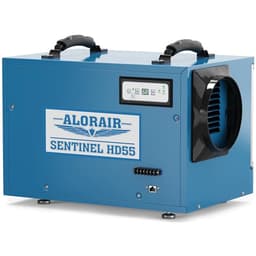
The clearest example on this site of why the number on the box is not the number that matters: sold as 113 pints, certified at 36.33.
Average draw
344 W
Computed from the ENERGY STAR certified entry ALORAIR Sentinel HD55S: 36.33 pt/day at IEF 2.08 L/kWh, 379 kWh a year. The retail listing is the HD55; the certified entry carries the S suffix. At IEF 2.08 it is more efficient than the median 50-pint portable while removing about three quarters as much water.
What is good
- Built low and flat to fit between floor joists, which no portable unit does
- Auto defrost and low-temperature operation, both essential in an unheated crawl space
- IEF 2.08 is above the 50-pint class median of 2.01 despite the smaller capacity
- No tank at all, so there is nothing to forget to empty
What is not
- The 113-pint headline is a saturation figure at 95F and 90% RH; the DOE-condition rating is 36.33
- 1,200 sq ft coverage, less than most 50-pint portables claim, for considerably more money
- Needs a drain or a condensate pump - there is no bucket fallback
Who it is for
Crawl spaces, low-clearance basements and unheated storage where a standing portable will not fit or will freeze.
Skip it if
Skip it for a normal basement. A 50-pint portable removes more water at the DOE condition for less money; you are paying for the form factor and the temperature range.
AlorAir
AlorAir Sentinel HDi65S Crawl Space Dehumidifier with Pump
Best for: A crawl space with nowhere for water to go
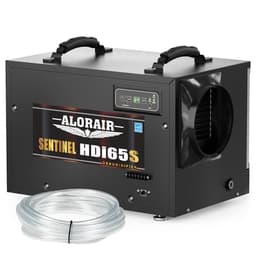
A low-clearance unit with the condensate pump built in, which is the only sane configuration for a space whose floor is the lowest point on the property.
Average draw
Not published
Not published, and the HDi65S does not appear by name in the ENERGY STAR certified list - AlorAir's certified entries are the Sentinel HD55S (344 W), the Helios D35 (243 W) and the Sentinel Pro35X (221 W). Given the HD55S computes to 344 W at 36 DOE pints, a genuinely larger AlorAir unit sits above that. We are not going to put a figure on it without a source.
What is good
- Condensate pump built in, so the discharge can go up and out rather than down and nowhere
- Compact enough for low-clearance crawl spaces and joist bays
- Auto defrost, MERV-1 filter, cETL listed
- Optional remote monitoring, which matters for a machine nobody looks at
What is not
- No published wattage and no named ENERGY STAR entry
- The 120-pint headline is a saturation number, as with every unit in this class
- Expensive relative to a portable of comparable DOE capacity
Who it is for
Encapsulated crawl spaces and sub-floor voids with no gravity drain, where the alternative is a bucket nobody will ever empty.
Skip it if
Skip it if you have a floor drain below the unit. The HD55 does the same job on gravity for less, and has a certified efficiency figure this one lacks.
Ivation
Ivation 19 Pint Desiccant Dehumidifier
Best for: An unheated garage in winter
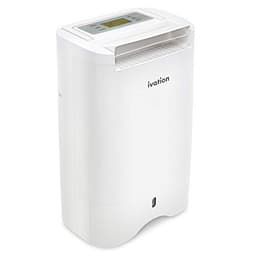
The only technology here that does not lose to the cold, which makes it the right answer in exactly the rooms where a compressor is the wrong one.
Average draw
Not published
Not published, and desiccant units are not represented in the ENERGY STAR certified dehumidifier list, which covers compressor portables and whole-home units. Desiccant machines use a resistive heater to regenerate the rotor, so their draw is roughly flat with temperature rather than falling off with it - the opposite trade to a compressor. We will not print a number for this one without a published source.
What is good
- Keeps extracting at temperatures where a compressor's coil ices and its output collapses
- No compressor, so it is quieter and lighter than any refrigerant unit here
- Continuous drain hose included
- Warm, dry exhaust, which is useful in a cold room and a nuisance in a warm one
What is not
- No published wattage, and desiccant units are generally less efficient than compressors at normal room temperature
- 410 sq ft coverage - this is a small-space machine
- It heats the room, which is the last thing a summer basement needs
Who it is for
Unheated garages, boats, sheds and crawl spaces in winter, where a compressor unit spends its time defrosting.
Skip it if
Skip it for a warm summer basement. Above roughly 65F a compressor removes more water per kWh, and the desiccant's waste heat works against you.
Midea
Midea Cube 50 Pint Dehumidifier with Pump
Best for: A basement whose only drain is upstairs
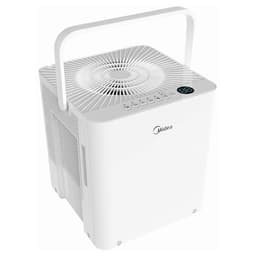
The stacking Midea Cube with a condensate pump added, which is the difference between a hose you can run and a hose you cannot.
Average draw
487 W
Computed from the ENERGY STAR certified entry for Midea MAD50PS1QWT-A, the pump variant of the same platform: 49.67 pt/day at IEF 2.01 L/kWh. The listing prints the unsuffixed MAD50PS1QWT, so the certified string carries a suffix the box does not; every Midea 50-pint revision in the certified list, pump or not, computes to 487-490 W, so neither the suffix nor the pump moves the number meaningfully. The pump itself only runs in bursts.
What is good
- Pump means the destination can be higher than the machine - a laundry sink, a window, a stack
- Identical DOE capacity and IEF to the non-pump Cube, so the pump costs you nothing in efficiency
- The split body still works, so you can also run it on gravity and keep the pump as the backup
- Certified 49.67 pt/day, an honest 50-pint rating
What is not
- Costs more than the identical machine without the pump
- A pump is one more thing that can fail, and when it does the unit stops rather than overflows
- No published wattage from Midea - the figure above is computed
Who it is for
Anyone whose drain is above the floor. That is most finished basements and nearly every crawl space.
Skip it if
Skip it if you already have a floor drain within hose reach and below the machine. You would be paying for a pump you will never switch on.
Encapsulation comes first
A dehumidifier in a vented, bare-earth crawl space is dehumidifying the outdoors. Ground moisture evaporates continuously through soil, and outside air moves through the vents carrying its own humidity. The machine will run permanently and the space will stay damp.
The sequence that works is: seal the ground with a vapor barrier, close or seal the vents, address any standing water and its source, and only then condition the enclosed volume. In that order, a 36-pint certified unit is comfortably enough for a typical residential crawl space. Out of that order, no amount of capacity is. The space at the other end of the house has the opposite problem: heat rather than cold, and almost no published specification to shop on. The best dehumidifiers for an attic.
What we would skip
Any crawl space unit chosen by its saturation rating
Every unit in this class is marketed on capacity at 95F and 90% relative humidity. The AlorAir Sentinel HD55 is sold as 113 pints and its ENERGY STAR certified capacity at the DOE condition is 36.33 pints per day - a factor of 3.1. Compare crawl space units against each other on that basis if you like, but never against a portable's DOE rating. Some units in this class are not in the certified file at all, which removes even that comparison - the AlorAir Sentinel HD35P Wi-Fi is one, and its cheaper stablemate is not.
A bucket-drained unit in a space you cannot stand up in
Nobody empties a bucket in a crawl space. Not weekly, not ever. Every unit here either has no tank at all or needs a permanent hose or pump run, and that is the correct design for the room.
How we picked
- Physical fit first. A crawl space unit has to pass through an access hatch and sit below the joists, which rules out every standing portable.
- Certified DOE capacity, stated alongside the saturation headline so the gap is visible.
- Low-temperature operation and auto defrost, because these spaces are unheated year-round.
- Drainage that does not involve a human going back in there - a gravity run or a built-in pump, never a tank.
- Not tested by us. Every figure quoted or computed with the source named.
We did not test these units. The full criteria and their weighting are on the methodology page.
FAQ
Questions
What size dehumidifier do I need for a crawl space?
Do I need to encapsulate before installing a dehumidifier?
Can I use a normal portable dehumidifier in a crawl space?
How do crawl space dehumidifiers drain?
Sources
Sources
Read next
- What the pint number on a dehumidifier actually meansThe 2019 DOE test change, the official conversion table, and the saturation rating that is 3x the certified one.
- The best dehumidifiers with a built-in pumpFive pump-equipped units, ranked partly on which makers will state what their pump can actually reach.
- Desiccant or compressor?11.8 pints against 2.9 at 41F, and the crossover point where the obvious answer stops being right.
- How far will the pump actually push it?Three of seven pump models state a lift. What they say, and how to plan when a maker states nothing.
- AlorAir Sentinel HD55113 pints on the box, 36.33 certified - and still the right machine for a crawl space.
- AlorAir Sentinel HDi65SThe pump makes a crawl space install possible - and it is the one AlorAir with no certified efficiency data.
- The best dehumidifiers for a musty smellThe smell is the exhaust of a damp problem. Four units for the room producing it, and the search that comes first.