Compare / Comparison
Desiccant or compressor?
The only comparison on this site where the cheap and obvious answer is wrong in a specific, common situation - an unheated space in winter.
#adThis page contains affiliate links. We earn a commission on qualifying purchases, at no cost to you, and it never changes a ranking. Full disclosure.
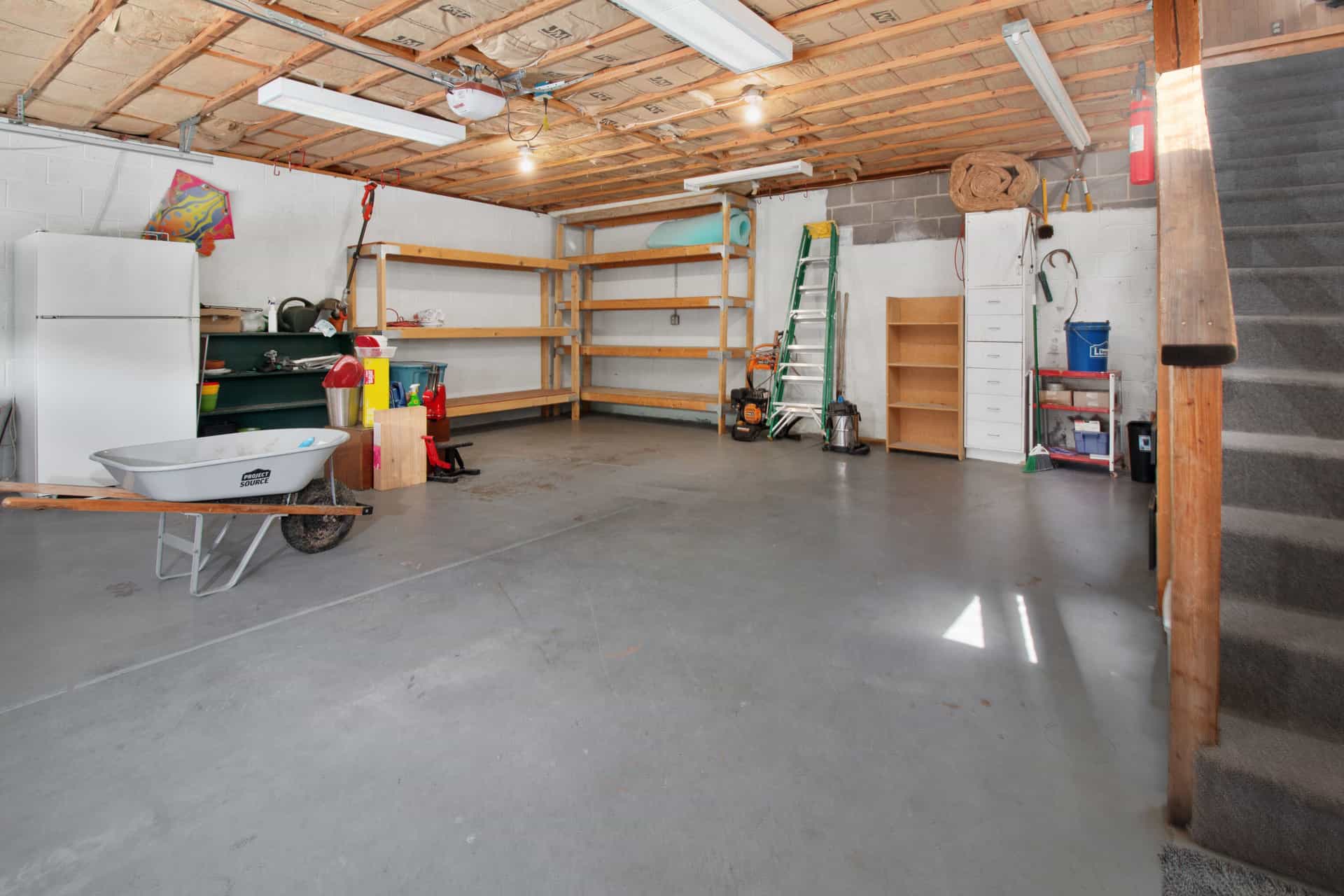
The short answer
A compressor unit is more efficient and higher capacity in a warm room. A desiccant unit keeps working when the room is cold, where a compressor's coil ices and its output collapses. Ivation's published figures put a desiccant rotor at 11.8 pints a day at 41F against a compressor's 2.9.
Two different mechanisms
A compressor dehumidifier is a refrigeration circuit. It chills a coil below the air's dew point, water condenses onto it and drains away. Its performance depends entirely on being able to get that coil colder than the dew point without freezing it, which is a harder ask the colder the room gets.
A desiccant unit has no cold coil. Air passes through a rotor coated in a water-absorbing material; a heater then drives the moisture back out of the rotor and it condenses in a separate stream. There is nothing to freeze, and the process works essentially the same at 40F as at 70F.
The crossover

4x
Desiccant advantage at 41F, per Ivation's published comparison
11.8 pints per day for a desiccant rotor against 2.9 pints per day for a compressor at 41F. Quoted from Ivation's own listing copy, retrieved 2026-09-01. The advantage reverses above roughly 65F.
| Room temperature | Winner | Why |
|---|---|---|
| Above 70F | Compressor, clearly | Plenty of water available and refrigeration is the efficient way to condense it |
| 60-70F | Compressor | Still comfortably in its range - this is the DOE test condition band |
| 50-60F | Compressor, with reduced output | Falling capacity and more frequent defrost cycles |
| 41-50F | Desiccant | The compressor's coil is icing and it spends more time defrosting than working |
| Below 41F | Desiccant, and only desiccant | Most compressor units effectively stop, and thermoelectric units do stop |
What the desiccant costs you
- It heats the room. Not incidentally - the heater is how it works. In a cold garage that is a small bonus. In a warm basement in August it is exactly wrong and it fights the air conditioning upstairs.
- Efficiency at normal temperatures. A resistive heater is a blunt instrument compared with a refrigeration circuit. In the temperature range where both work, the compressor moves more water per kilowatt-hour.
- No published efficiency figure at all. Desiccant units are not represented in the ENERGY STAR certified dehumidifier list, which covers compressor portables and whole-home units. That means there is no IEF to compute a wattage from, and neither Ivation model in our registry publishes one.
- Capacity. The desiccant units here are rated 13 and 19 pints a day against a compressor's 50. In a warm room that is a large gap.
What the compressor costs you
Everything below about 50F. And it is worth being clear about how it fails, because it does not fail cleanly - it keeps running, keeps drawing its full 488 watts, and produces steadily less water while spending more of each hour in a defrost cycle. From the outside it looks like a working machine. The bucket tells the truth.
Quick picks
| # | Product | Best for | Draw | Price |
|---|---|---|---|---|
| 1 |  Ivation 19 Pint Desiccant DehumidifierThe only technology here that does not lose to the cold, which makes it the right answer in exactly the rooms where a compressor is the wrong one. Ivation 19 Pint Desiccant DehumidifierThe only technology here that does not lose to the cold, which makes it the right answer in exactly the rooms where a compressor is the wrong one. | An unheated garage in winter | Not published | $299.99View on Amazon #ad Price as of October 17, 2026. How we are funded |
| 2 |  Midea Cube 50 Pint DehumidifierThe only unit here that solves the real basement problem, which is not capacity but where the water goes when you are not standing next to it. Midea Cube 50 Pint DehumidifierThe only unit here that solves the real basement problem, which is not capacity but where the water goes when you are not standing next to it. | A basement you visit once a month | 487 W | |
| 3 |  Ivation 13 Pint Desiccant DehumidifierThe small desiccant, for spaces that are cold and enclosed rather than large and damp. Ivation 13 Pint Desiccant DehumidifierThe small desiccant, for spaces that are cold and enclosed rather than large and damp. | A cold closet, attic or bathroom | Not published | $279.99View on Amazon #ad Price as of October 17, 2026. How we are funded |
| 4 |  GE 50 Pint DehumidifierGE's current no-pump 50-pint, with a 30 percent humidistat floor and Smart Dry fan control - and no ENERGY STAR claim on the listing, which is the change worth noticing. GE 50 Pint DehumidifierGE's current no-pump 50-pint, with a 30 percent humidistat floor and Smart Dry fan control - and no ENERGY STAR claim on the listing, which is the change worth noticing. | A garage or shop with a floor drain | Not published |
Ivation
Ivation 19 Pint Desiccant Dehumidifier
Best for: An unheated garage in winter
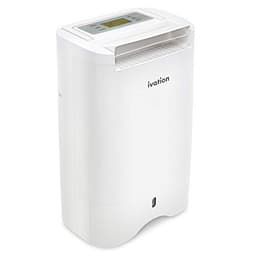
The only technology here that does not lose to the cold, which makes it the right answer in exactly the rooms where a compressor is the wrong one.
Average draw
Not published
Not published, and desiccant units are not represented in the ENERGY STAR certified dehumidifier list, which covers compressor portables and whole-home units. Desiccant machines use a resistive heater to regenerate the rotor, so their draw is roughly flat with temperature rather than falling off with it - the opposite trade to a compressor. We will not print a number for this one without a published source.
What is good
- Keeps extracting at temperatures where a compressor's coil ices and its output collapses
- No compressor, so it is quieter and lighter than any refrigerant unit here
- Continuous drain hose included
- Warm, dry exhaust, which is useful in a cold room and a nuisance in a warm one
What is not
- No published wattage, and desiccant units are generally less efficient than compressors at normal room temperature
- 410 sq ft coverage - this is a small-space machine
- It heats the room, which is the last thing a summer basement needs
Who it is for
Unheated garages, boats, sheds and crawl spaces in winter, where a compressor unit spends its time defrosting.
Skip it if
Skip it for a warm summer basement. Above roughly 65F a compressor removes more water per kWh, and the desiccant's waste heat works against you.
Midea
Midea Cube 50 Pint Dehumidifier
Best for: A basement you visit once a month
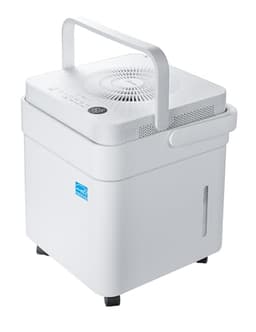
The only unit here that solves the real basement problem, which is not capacity but where the water goes when you are not standing next to it.
Average draw
487 W
Computed from the ENERGY STAR certified entry for Midea MAD50S1QWT-A, the 50 pt / 4,500 sq ft Cube without a pump: 49.67 pt/day at IEF 2.01 L/kWh. Midea's own US product page confirms MAD50S1QWT-A is this configuration. Midea publishes no wattage on the Amazon listing or on that page.
What is good
- The body separates, so the tank half can sit lower than the compressor half and the hose gets a genuine downhill run
- Certified at 49.67 pt/day, which is a real 50-pint machine rather than a saturation number
- IEF 2.01 L/kWh puts it exactly on the median for the 50-pint class - neither a bargain nor a penalty
- Wi-Fi that tells you it has stopped, which is the only smart feature that matters in a basement
What is not
- No pump, so the drain has to run downhill the whole way
- Midea publishes no wattage anywhere, so the 487 W above is computed rather than quoted
- The 4,500 sq ft coverage claim is marketing, not a spec - see the sizing guide
Who it is for
Someone with a floor drain, a sump, or a window well lower than the machine, who wants to set it once and stop thinking about it.
Skip it if
Skip it if the only drain in the room is higher than the unit. Without a pump, gravity is the entire drainage system, and no setting fixes an uphill hose.
Ivation
Ivation 13 Pint Desiccant Dehumidifier
Best for: A cold closet, attic or bathroom
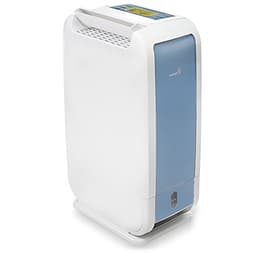
The small desiccant, for spaces that are cold and enclosed rather than large and damp.
Average draw
Not published
The listing states 470 W on high and 280 W on low at 120 V. Those are mode ratings rather than an average draw, and desiccant units are not represented in the ENERGY STAR certified list, so there is no certified figure to compute an average from.
What is good
- Works in the cold, unlike every compressor unit on this site
- Small and light enough to move between an attic and a closet
- Continuous drain hose supported at this size, which the compressor minis do not offer
- Quiet - no compressor to cycle
What is not
- 270 sq ft is a genuinely small room
- No published wattage
- Warms the space it dries
Who it is for
Closets, attics, bathrooms and RV interiors in a cold climate.
Skip it if
Skip it if you need real capacity. Thirteen pints a day is a maintenance machine, not a recovery machine.
GE
GE 50 Pint Dehumidifier
Best for: A garage or shop with a floor drain
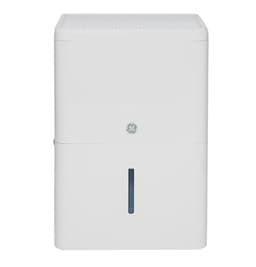
GE's current no-pump 50-pint, with a 30 percent humidistat floor and Smart Dry fan control - and no ENERGY STAR claim on the listing, which is the change worth noticing.
Average draw
Not published
Not published by GE. The ADHE50 series does not appear by name in the ENERGY STAR certified list and this listing makes no ENERGY STAR claim - its predecessor did. The certified 50-pint class runs 443-490 W with a median of 488 W, and a non-certified unit is more likely to sit at the top of that band than below it.
What is good
- Humidistat sets down to 30 percent where most units stop at 35 or 40
- Smart Dry adjusts fan speed to room humidity rather than running flat out
- Bucket-full alarm sounds for ten seconds rather than only lighting an icon
- Clean-filter alert, which is the maintenance nobody remembers to do
What is not
- No ENERGY STAR certification claimed, and no certified entry to compute a draw from
- Gravity drainage only
- A 5,000 sq ft coverage claim, up from its predecessor's 4,000 on the same capacity - a reminder that coverage claims are not a spec
Who it is for
A garage, workshop or utility room with a floor drain, where a low humidistat floor is useful and efficiency certification is not the deciding factor.
Skip it if
Skip it if it will run all season and efficiency matters. A certified 50-pint unit costs about $8 a month less by ENERGY STAR's own figure.
The practical answer for a four-season climate
No single machine is ideal for a space that is 80F in August and 38F in January, and the honest recommendation is a compromise rather than a product:
- 1Buy the compressor unit and run it from spring to autumn. That is when most of the moisture problem exists anyway - warm air holds more water, so summer is when a space gains the most.
- 2Switch it off below about 50F rather than leaving it running and wondering why the bucket is empty. It is not doing much and it is drawing full power to do it.
- 3Add a small desiccant unit for the winter months if the space genuinely needs to stay dry through them - a workshop with tools, a store with paper, a boat.
- 4Or heat the space slightly. Bringing a garage to 55F transforms what a compressor unit can do, and depending on your electricity rate that may be cheaper than a second machine.
One thing neither is
A thermoelectric mini unit is a third mechanism and it is not a competitor to either of these. It removes about a pint a day and Pro Breeze states it will not work below 41F, which rules it out of exactly the cold-weather job people buy it for. The mini, reviewed. If you are choosing for a specific cold space rather than comparing technologies in the abstract, the cold room roundup lists what each maker actually states.
FAQ
Questions
Are desiccant dehumidifiers better than compressor ones?
At what temperature does a compressor dehumidifier stop working?
Do desiccant dehumidifiers use more electricity?
Which is better for a garage?
Sources
Sources
- Ivation desiccant dehumidifier listings - stated 11.8 pints/day at 41F for a desiccant rotor against 2.9 pints/day for a compressor, and desiccant rotor performance at low temperature (retrieved 2026-09-01)
- Pro Breeze Electric Mini Dehumidifier - stated optimal range 59-86F, will not work below 41F (retrieved 2026-09-01)
- ENERGY STAR Certified Dehumidifiers product list - covers compressor portables and whole-home units; desiccant units are not represented (retrieved 2026-09-01)
Read next
- The best dehumidifiers for a garageFive garage options and the temperature at which the obvious compressor choice becomes the wrong one.
- The coil has iced upNormal below 60F, a filter problem above it, and the one cause that is a warranty call.
- How a dehumidifier actually worksThe refrigeration cycle, why the machine warms the room, and why cold air defeats it.
- The best crawl space dehumidifiersFour crawl space options, and the 3.1x gap between the pint number on the box and the certified one.
- The best dehumidifiers for a bathroomFour small units for a bathroom, plus the honest argument that an extractor fan beats all of them.
- Ivation 19 Pint DesiccantThe one technology that does not lose to the cold - and the one unit here with no published efficiency data at all.
- It is blowing warm airWarm exhaust is the design, not a fault. Where the heat comes from, and the one case that is genuinely wrong.
- The best dehumidifiers for a gun safeThe interior is a desiccant job we do not sell. The room around it is the half a machine actually fixes.
- The best dehumidifiers for an RV or boatUnheated storage is the case that decides it - and it is the case a compressor unit cannot work in.