Reviews / Pro Breeze
Pro Breeze Electric Mini
The most commonly mis-bought product in this category, and a perfectly good one for the job it is actually designed to do.
#adThis page contains affiliate links. We earn a commission on qualifying purchases, at no cost to you, and it never changes a ranking. Full disclosure.
The short answer
Removes 17 ounces of water a day, which is 1.06 pints - roughly one fiftieth of a 50-pint dehumidifier. It uses a thermoelectric (Peltier) module rather than a compressor, so it is silent, and it stops working below 41F.
The arithmetic, because it is the whole review
1.06 pints
What it removes in 24 hours, per the maker's own figure
17 fluid ounces a day, stated on Pro Breeze's listing. A 50-pint dehumidifier removes 50 pints. There are 16 fluid ounces in a US pint.
That number is not hidden. Pro Breeze prints it, in ounces, on the listing. The confusion comes from the coverage claim printed next to it: 215 square feet. A buyer who reads square feet rather than ounces reasonably concludes this is a small dehumidifier for a small room.
It is not a small dehumidifier. It is a different class of device, and the distance between them is not a matter of degree. Fifty of these, running continuously, would match one 50-pint machine.
How thermoelectric works, and why it is limited
A Peltier module is a solid-state heat pump: apply a current and one face goes cold while the other goes hot. A small fan pulls air across the cold face, water condenses on it, and drips into a tank.
There is no compressor, no refrigerant and no moving part except the fan, which is why it is silent and why it is cheap. It is also why the capacity is what it is: the amount of heat a small Peltier module can move is tiny compared with a refrigeration circuit, and heat moved is water condensed. How a dehumidifier works.
The operating range follows from the same physics. Pro Breeze states an optimal range of 59 to 86F and says it will not work below 41F - which rules out most of the unheated garages, sheds and boat lockers people buy these for in winter.
Quick picks
| # | Product | Best for | Draw | Price |
|---|---|---|---|---|
| 1 |  Pro Breeze Electric Mini DehumidifierA thermoelectric unit that removes about one pint a day, which is roughly one fiftieth of a 50-pint machine and needs saying out loud before anyone buys one for a basement. Pro Breeze Electric Mini DehumidifierA thermoelectric unit that removes about one pint a day, which is roughly one fiftieth of a 50-pint machine and needs saying out loud before anyone buys one for a basement. | A wardrobe, and honestly not much more | 23 W | $43.99View on Amazon #ad Price as of October 16, 2026. How we are funded |
| 2 |  hOmeLabs 8 Pint DehumidifierA real compressor unit at a size where most competitors sell thermoelectric toys, which makes it the smallest machine here that actually removes meaningful water. hOmeLabs 8 Pint DehumidifierA real compressor unit at a size where most competitors sell thermoelectric toys, which makes it the smallest machine here that actually removes meaningful water. | A closet, a boat, or a single small room | Not published | $174.99View on Amazon #ad Price as of October 16, 2026. How we are funded |
| 3 |  Ivation 13 Pint Desiccant DehumidifierThe small desiccant, for spaces that are cold and enclosed rather than large and damp. Ivation 13 Pint Desiccant DehumidifierThe small desiccant, for spaces that are cold and enclosed rather than large and damp. | A cold closet, attic or bathroom | Not published | $269.99View on Amazon #ad Price as of October 16, 2026. How we are funded |
Pro Breeze
Pro Breeze Electric Mini Dehumidifier
Best for: A wardrobe, and honestly not much more
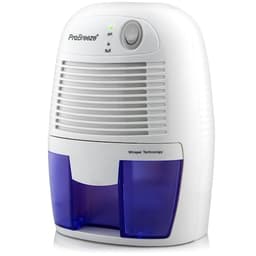
A thermoelectric unit that removes about one pint a day, which is roughly one fiftieth of a 50-pint machine and needs saying out loud before anyone buys one for a basement.
Average draw
23 W
Stated on the listing as 23 W. Thermoelectric units are outside the ENERGY STAR dehumidifier program, so this is the maker's figure rather than a computed one. A Peltier module draws far less than any compressor here - but less power and less water are the same fact, not two selling points.
What is good
- Genuinely silent - there is no compressor to cycle on and off next to your head
- Small and light enough to sit on a shelf inside a wardrobe
- Auto shut-off when the 17 oz tank fills
- Cheap enough to buy two for two closets
What is not
- About one pint a day. A 50-pint unit removes fifty times as much
- Stops working below 41F, which rules out the unheated spaces people usually buy it for
- No drain option - the tank is the only outlet
Who it is for
A wardrobe, a gun safe, a bathroom cabinet, or a single small enclosed space with a musty smell.
Skip it if
Skip it for any room. This is the single most common mis-purchase in the category: it is not a small dehumidifier, it is a different class of device, and no number of them adds up to a basement machine.
hOmeLabs
hOmeLabs 8 Pint Dehumidifier
Best for: A closet, a boat, or a single small room
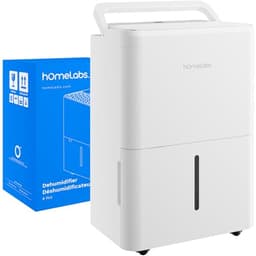
A real compressor unit at a size where most competitors sell thermoelectric toys, which makes it the smallest machine here that actually removes meaningful water.
Average draw
Not published
Not published. The certified 8-13 pint class runs 92-128 W with a median of 105 W across 39 models, and the median unit in that class uses 117 kWh a year.
What is good
- A compressor at 8 pints, so it keeps working where a Peltier unit stops
- Roughly a fifth of the power of a 50-pint machine
- Wi-Fi and auto shut-off, unusual at this size
- Small enough to sit in a wardrobe or a berth
What is not
- 1,800 sq ft coverage for 8 DOE pints is not a serious claim
- Bucket only - no continuous drain at this size
- Not ENERGY STAR certified, so no published IEF
Who it is for
Closets, gun safes, boat cabins, and single small rooms where a large machine is absurd.
Skip it if
Skip it for any room where you can feel the damp. Eight pints a day is a maintenance dose, not a cure.
Ivation
Ivation 13 Pint Desiccant Dehumidifier
Best for: A cold closet, attic or bathroom
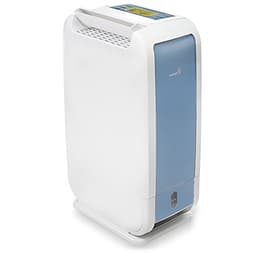
The small desiccant, for spaces that are cold and enclosed rather than large and damp.
Average draw
Not published
The listing states 470 W on high and 280 W on low at 120 V. Those are mode ratings rather than an average draw, and desiccant units are not represented in the ENERGY STAR certified list, so there is no certified figure to compute an average from.
What is good
- Works in the cold, unlike every compressor unit on this site
- Small and light enough to move between an attic and a closet
- Continuous drain hose supported at this size, which the compressor minis do not offer
- Quiet - no compressor to cycle
What is not
- 270 sq ft is a genuinely small room
- No published wattage
- Warms the space it dries
Who it is for
Closets, attics, bathrooms and RV interiors in a cold climate.
Skip it if
Skip it if you need real capacity. Thirteen pints a day is a maintenance machine, not a recovery machine.
Where it is genuinely the right answer
- A wardrobe or closet. Small enclosed volume, a musty smell rather than a measurable humidity problem, and no tolerance for noise. This is the job it was built for.
- A gun safe or a display cabinet. Same reasoning, and silence matters less than size.
- A bathroom cabinet or an ensuite. Small, enclosed, and a compressor unit would be absurd there.
- A boat cabin in the season. Above 41F, in a small enclosed volume, running continuously.
- A bedroom where the requirement is silence and the humidity is already close to acceptable. Honest about the limits: it will not change a hygrometer reading much.
Where it is not
Any room. A basement, a garage, a living room, a bedroom with an actual humidity problem. The 215 square feet on the listing is a claim about a volume of air, not about a rate of extraction, and a room's moisture load is replenished continuously from outside air, occupants and the structure. One pint a day does not hold a room.
If you have a measurable problem - a hygrometer reading above 60% - the smallest machine worth considering is a real compressor unit at 8 pints or more, and for anything below grade it is 30 to 50. Dehumidifier versus DampRid covers the same scale question at the passive end.
FAQ
Questions
How much water does the Pro Breeze mini dehumidifier remove?
Will a mini dehumidifier work in a bedroom?
Does the Pro Breeze mini work in a cold garage?
How many watts does a thermoelectric dehumidifier use?
Sources
Sources
Read next
- Dehumidifier or a tub of absorbent?A few ounces over weeks against 50 pints a day, and the line between the two jobs.
- The best dehumidifiers for a bathroomFour small units for a bathroom, plus the honest argument that an extractor fan beats all of them.
- The quietest dehumidifiersFour quiet options, and a plain statement of what we can say about noise without having measured it.
- How a dehumidifier actually worksThe refrigeration cycle, why the machine warms the room, and why cold air defeats it.
- Dehumidifier capacity chartCapacity class, pre-2020 equivalent, median watts and monthly cost, in one sourced reference table.
- Ivation 19 Pint DesiccantThe one technology that does not lose to the cold - and the one unit here with no published efficiency data at all.
- The best dehumidifiers for a closetOunces a day, not pints - and the first specification is whether there is an outlet at all.