Compare / Comparison
Dehumidifier or a tub of absorbent?
They sit in the same aisle for the same complaint and they are separated by roughly two orders of magnitude. Knowing which end of that range your problem sits at is most of the decision.
#adThis page contains affiliate links. We earn a commission on qualifying purchases, at no cost to you, and it never changes a ranking. Full disclosure.
The short answer
A calcium chloride absorber removes a few ounces of water over weeks, needs no power and works anywhere. A 50-pint dehumidifier removes 50 pints a day and draws about 488 watts. Use the absorber for a closet or a stored boat; use the machine for a room.
The scale, which is the whole comparison
| Option | Per day | Power | Ongoing cost |
|---|---|---|---|
| Calcium chloride tub | A fraction of an ounce, slowing as it saturates | None | Replacement refills |
| Thermoelectric mini unit | About 1 pint (17 oz) | Low, not published | Electricity |
| 8-pint compressor unit | 8 pints | About 105 W (class median) | Electricity |
| 30-32 pint compressor | 30-32 pints | About 318 W | Electricity |
| 50-pint compressor | 50 pints | About 488 W | Electricity |
Compressor wattages are class medians from the ENERGY STAR certified list. The thermoelectric figure is Pro Breeze's own stated 17 oz per day.
Read the first two rows together. The gap between a passive absorber and even the smallest powered unit is enormous, and the gap between the absorber and a basement machine is not really a comparison at all.
Where the absorber genuinely wins
- No power required. A boat in winter storage, a caravan, an unpowered shed, a shipping container. Nothing else on the list works at all without electricity.
- Nothing to fail. No compressor, no fan, no float, no pump. It is a tub of salt.
- Silent, and immune to temperature. Where a compressor unit gives up below 41F, calcium chloride does not care - it just works slowly, as it always did.
- Cheap enough to distribute. Four tubs in four closets costs less than one mini dehumidifier and covers more of the house.
- No maintenance beyond replacement. No filter, no tank to rinse, no drain to flush.
And where it does not
Any room. A room's moisture load is continuously replenished - from outside air, from occupants, from cooking and washing, and in a basement from the slab and walls. A passive absorber removing a fraction of an ounce a day against that is not slow, it is irrelevant.
The tell is that the tub fills and the room does not change. People often read that as the product working, because there is visibly water in it. What it means is that the absorber has collected a few ounces while the room gained and lost thousands.
The dividing line
- 1Enclosed volume under a few cubic feet, with a smell rather than a measurement - an absorber, or a thermoelectric mini if there is a socket. A wardrobe, a gun safe, a cabinet.
- 2A small room where a hygrometer reads above 60 percent - a real compressor unit, from 8 pints upward. An absorber will not move that reading.
- 3Any basement, garage or space over a few hundred square feet - a 30 to 50-pint compressor unit with drainage. Sizing.
- 4Anywhere with no power at all - an absorber, because it is the only option, and accept that it manages rather than solves.
Quick picks
| # | Product | Best for | Draw | Price |
|---|---|---|---|---|
| 1 |  Pro Breeze Electric Mini DehumidifierA thermoelectric unit that removes about one pint a day, which is roughly one fiftieth of a 50-pint machine and needs saying out loud before anyone buys one for a basement. Pro Breeze Electric Mini DehumidifierA thermoelectric unit that removes about one pint a day, which is roughly one fiftieth of a 50-pint machine and needs saying out loud before anyone buys one for a basement. | A wardrobe, and honestly not much more | 23 W | $43.99View on Amazon #ad Price as of October 16, 2026. How we are funded |
| 2 |  hOmeLabs 8 Pint DehumidifierA real compressor unit at a size where most competitors sell thermoelectric toys, which makes it the smallest machine here that actually removes meaningful water. hOmeLabs 8 Pint DehumidifierA real compressor unit at a size where most competitors sell thermoelectric toys, which makes it the smallest machine here that actually removes meaningful water. | A closet, a boat, or a single small room | Not published | $174.99View on Amazon #ad Price as of October 16, 2026. How we are funded |
| 3 | 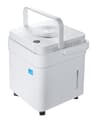 Midea Cube 50 Pint DehumidifierThe only unit here that solves the real basement problem, which is not capacity but where the water goes when you are not standing next to it. Midea Cube 50 Pint DehumidifierThe only unit here that solves the real basement problem, which is not capacity but where the water goes when you are not standing next to it. | A basement you visit once a month | 487 W |
Pro Breeze
Pro Breeze Electric Mini Dehumidifier
Best for: A wardrobe, and honestly not much more
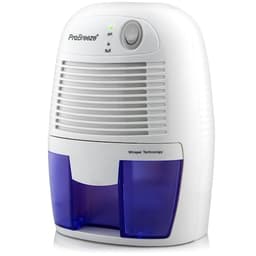
A thermoelectric unit that removes about one pint a day, which is roughly one fiftieth of a 50-pint machine and needs saying out loud before anyone buys one for a basement.
Average draw
23 W
Stated on the listing as 23 W. Thermoelectric units are outside the ENERGY STAR dehumidifier program, so this is the maker's figure rather than a computed one. A Peltier module draws far less than any compressor here - but less power and less water are the same fact, not two selling points.
What is good
- Genuinely silent - there is no compressor to cycle on and off next to your head
- Small and light enough to sit on a shelf inside a wardrobe
- Auto shut-off when the 17 oz tank fills
- Cheap enough to buy two for two closets
What is not
- About one pint a day. A 50-pint unit removes fifty times as much
- Stops working below 41F, which rules out the unheated spaces people usually buy it for
- No drain option - the tank is the only outlet
Who it is for
A wardrobe, a gun safe, a bathroom cabinet, or a single small enclosed space with a musty smell.
Skip it if
Skip it for any room. This is the single most common mis-purchase in the category: it is not a small dehumidifier, it is a different class of device, and no number of them adds up to a basement machine.
hOmeLabs
hOmeLabs 8 Pint Dehumidifier
Best for: A closet, a boat, or a single small room
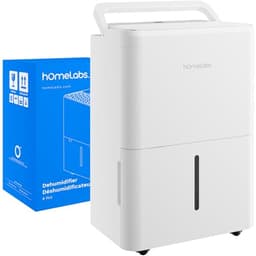
A real compressor unit at a size where most competitors sell thermoelectric toys, which makes it the smallest machine here that actually removes meaningful water.
Average draw
Not published
Not published. The certified 8-13 pint class runs 92-128 W with a median of 105 W across 39 models, and the median unit in that class uses 117 kWh a year.
What is good
- A compressor at 8 pints, so it keeps working where a Peltier unit stops
- Roughly a fifth of the power of a 50-pint machine
- Wi-Fi and auto shut-off, unusual at this size
- Small enough to sit in a wardrobe or a berth
What is not
- 1,800 sq ft coverage for 8 DOE pints is not a serious claim
- Bucket only - no continuous drain at this size
- Not ENERGY STAR certified, so no published IEF
Who it is for
Closets, gun safes, boat cabins, and single small rooms where a large machine is absurd.
Skip it if
Skip it for any room where you can feel the damp. Eight pints a day is a maintenance dose, not a cure.
Midea
Midea Cube 50 Pint Dehumidifier
Best for: A basement you visit once a month
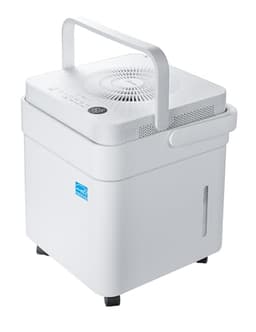
The only unit here that solves the real basement problem, which is not capacity but where the water goes when you are not standing next to it.
Average draw
487 W
Computed from the ENERGY STAR certified entry for Midea MAD50S1QWT-A, the 50 pt / 4,500 sq ft Cube without a pump: 49.67 pt/day at IEF 2.01 L/kWh. Midea's own US product page confirms MAD50S1QWT-A is this configuration. Midea publishes no wattage on the Amazon listing or on that page.
What is good
- The body separates, so the tank half can sit lower than the compressor half and the hose gets a genuine downhill run
- Certified at 49.67 pt/day, which is a real 50-pint machine rather than a saturation number
- IEF 2.01 L/kWh puts it exactly on the median for the 50-pint class - neither a bargain nor a penalty
- Wi-Fi that tells you it has stopped, which is the only smart feature that matters in a basement
What is not
- No pump, so the drain has to run downhill the whole way
- Midea publishes no wattage anywhere, so the 487 W above is computed rather than quoted
- The 4,500 sq ft coverage claim is marketing, not a spec - see the sizing guide
Who it is for
Someone with a floor drain, a sump, or a window well lower than the machine, who wants to set it once and stop thinking about it.
Skip it if
Skip it if the only drain in the room is higher than the unit. Without a pump, gravity is the entire drainage system, and no setting fixes an uphill hose.
A practical note on running both
There is nothing wrong with using both, and it is often the sensible arrangement in a house: a dehumidifier holding the basement at 50 percent, and absorber tubs in the two closets that stay musty anyway because the air never moves through them.
The failure is substituting one for the other. An absorber cannot do a dehumidifier's job at any quantity, and a dehumidifier in a sealed wardrobe is an absurd amount of machine for the volume - which is the case a thermoelectric mini is actually for. The mini, reviewed honestly.
FAQ
Questions
Is DampRid as good as a dehumidifier?
Does a moisture absorber actually work?
Can I use moisture absorbers instead of a dehumidifier in a basement?
What works in an unpowered space?
Sources
Sources
Read next
- Pro Breeze Electric Mini17 ounces a day, silent, and the single most mis-bought product in the category.
- The best dehumidifiers for a bathroomFour small units for a bathroom, plus the honest argument that an extractor fan beats all of them.
- Dehumidifier capacity chartCapacity class, pre-2020 equivalent, median watts and monthly cost, in one sourced reference table.
- Dehumidifier or humidifier?Opposite machines, one letter apart, and why the wrong one makes the problem worse.
- What size dehumidifier do I need?A four-step method that uses measured humidity instead of the square-footage claim on the box.
- Dehumidifier or just open a window?Free and effective in cold dry weather, actively counterproductive in summer. Compare dew points, not humidities.