Sizing / Guide
What size dehumidifier do I need?
The square-footage tables everyone publishes are built on a specification manufacturers make up. Here is a method that uses numbers somebody actually measured.
The short answer
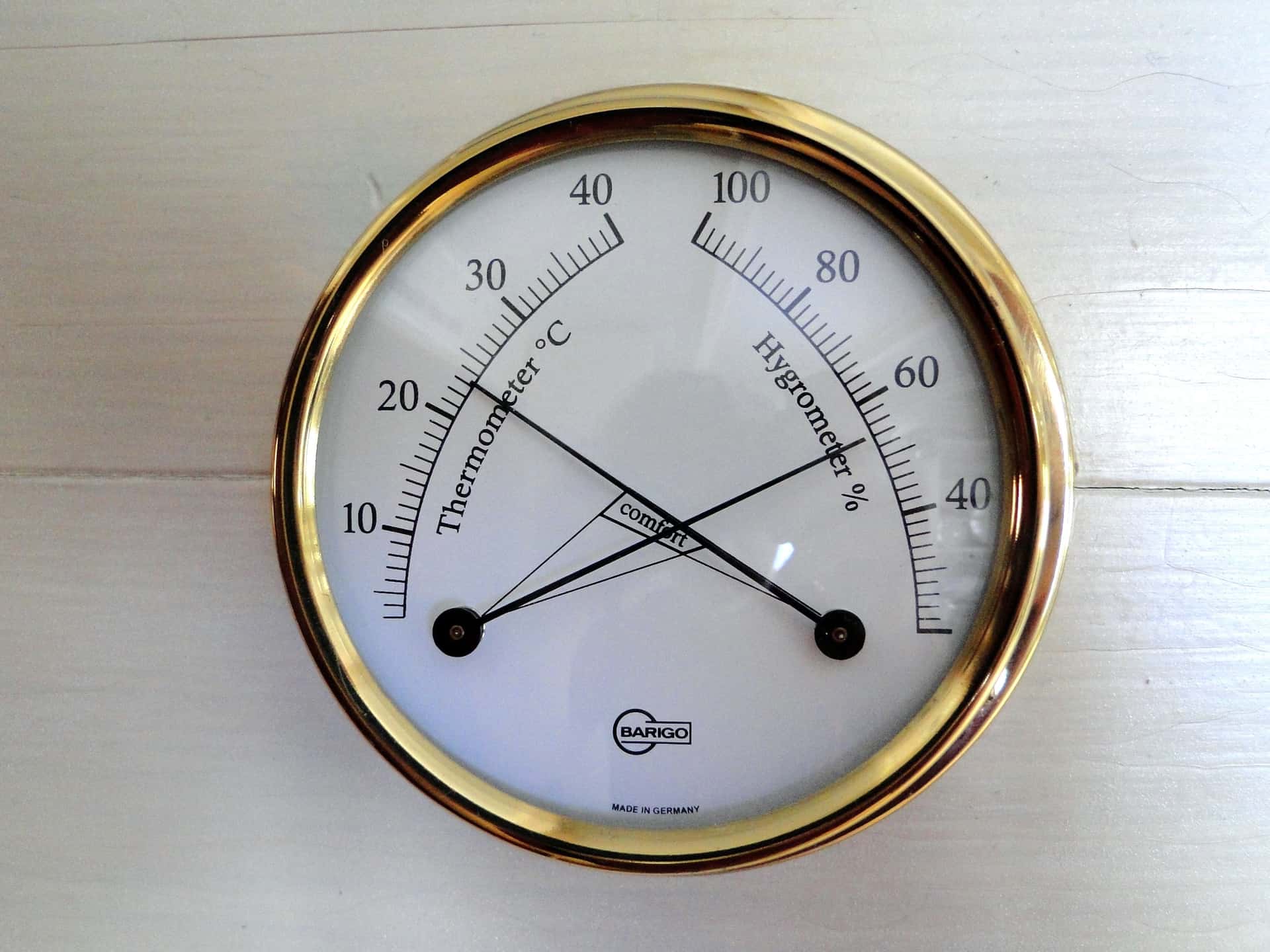
Measure the room's relative humidity for a week with a cheap hygrometer. Under 60% and you may not need a dehumidifier at all. 60 to 68% in a space under about 1,500 sq ft points to a 30 to 32-pint unit. Above 68%, or any visible moisture, go to 50 pints.
Why not just use a square-footage table
Because the square footage on a dehumidifier listing is not a measurement. In our registry of 23 current units, machines with identical certified capacity claim wildly different coverage:
| Unit | DOE capacity | Claimed coverage |
|---|---|---|
| Quilo 50 Pint with Pump | 50 pt/day | 4,000 sq ft |
| Midea Cube 50 Pint | 50 pt/day | 4,500 sq ft |
| GE 50 Pint | 50 pt/day (maker's claim) | 5,000 sq ft |
| Waykar 80 Pint | 50-pint class | 5,000 sq ft |
| hOmeLabs 50 Pint | 50 pt/day | 7,000 sq ft |
| hOmeLabs 50 Pint with Pump | 50 pt/day | 7,500 sq ft |
A 1.9x spread on the same certified capacity. The pint rating is measured under a defined federal test procedure. The square footage is written by a copywriter.
It also ignores the two variables that actually determine how much water a machine has to remove: how wet the space is, and how cold it is. A dry 2,000 sq ft basement is a smaller job than a wet 800 sq ft one.
The method
- 1Measure, for a week. A hygrometer costs about ten dollars. Put it in the middle of the room, away from a wall, and read it morning and evening. One reading tells you nothing; a week tells you the range.
- 2Note the temperature at the same time. If the space sits below about 60F for much of the year, a compressor unit is going to struggle and you should read desiccant versus compressor before choosing a capacity at all.
- 3Look for liquid water, not just humidity. Damp to the touch on the floor or walls, a white bloom on block, staining, or anything actively growing means the moisture is arriving as water rather than vapor. That changes the answer and, more importantly, means a dehumidifier is managing a symptom.
- 4Then pick the class. Using the table below, which is built on humidity and floor area together rather than area alone.
| Measured RH | Under 1,500 sq ft | 1,500-2,500 sq ft | Over 2,500 sq ft |
|---|---|---|---|
| Under 60% | Probably nothing needed | Probably nothing needed | 30-32 pint if it drifts up |
| 60-68% | 30-32 pint (about 318 W) | 50 pint (about 488 W) | 50 pint |
| 68-75% | 50 pint | 50 pint | 50 pint, or two units |
| Over 75%, or visible moisture | 50 pint plus continuous drainage | 50 pint plus drainage | 50 pint plus drainage, and find the water source |
Wattages are the medians of the ENERGY STAR certified classes. Below about 60F room temperature, shift the recommendation toward a desiccant unit regardless of the row.
The three cases that override the table
1. A cold space
Below roughly 60F a compressor dehumidifier's output falls sharply, and near 41F it ices and effectively stops. In an unheated garage, an outbuilding or a winter crawl space, the correct capacity is whatever a desiccant unit gives you, because a nominally larger compressor unit will deliver less. Ivation's own figures put a desiccant rotor at 11.8 pints a day at 41F against a compressor's 2.9.
2. Nowhere to drain
If the machine will run on its bucket, capacity is limited by how often you will empty it rather than by the room. A 50-pint unit in a damp basement fills a 1.7 gallon bucket in about six hours. That is not a schedule anyone keeps, so either arrange drainage or accept that the unit will spend most of its life switched off with a full tank. Drainage.
3. Liquid water
If water is entering the space - through the slab, through the walls, from a leak - a dehumidifier is running against an unlimited supply. It will work continuously, cost you the full running figure every month, and never reach its target. Gutters, grading, a working sump and a plumber come first. The machine is for the humidity that remains afterwards.
What each class costs, so the decision has a price
50-pint class, the basement default
(488 W / 1000) x 12 h x $0.1834/kWh = $1.07 per day
0.488
kWh per hour
$32.69
per month, 12 h/day
$65.38
per month, 24 h/day
Rate is the US residential average of 18.34 cents/kWh from the EIA Electric Power Monthly, June 2026. Yours will differ - use the calculator.
The 30-32 pint class at 318 W is about $21 a month on the same twelve-hour schedule, against the 50-pint class's $32. That $11 gap is the actual cost of going a size up - and it disappears entirely if the smaller machine is undersized, because an undersized unit never idles and runs at full draw all day. Calculate yours. Manufactured homes are the case where floor area misleads most, because the ceiling is lower and the volume smaller than the plan suggests - sizing one for a mobile home.
FAQ
Questions
What size dehumidifier for a 1,000 sq ft basement?
Is it bad to buy a dehumidifier that is too big?
Do I need a bigger dehumidifier for a basement than upstairs?
Can two small dehumidifiers replace one big one?
Sources
Sources
- ENERGY STAR Certified Dehumidifiers product list - class capacities and IEF (retrieved 2026-09-01)
- US EPA, Mold Course Chapter 2 - keep indoor RH below 60 percent, ideally 30 to 50
- Ivation desiccant listing - 11.8 pints/day at 41F for a desiccant rotor versus 2.9 for a compressor (retrieved 2026-09-01)
Read next
- What the pint number on a dehumidifier actually meansThe 2019 DOE test change, the official conversion table, and the saturation rating that is 3x the certified one.
- Dehumidifier capacity chartCapacity class, pre-2020 equivalent, median watts and monthly cost, in one sourced reference table.
- The best dehumidifiers for a basementFive basement units ranked on drainage first, with computed running costs and a unit we would not buy.
- The best 30-pint dehumidifiersThe 30 to 34-pint class at about 318 W, and an honest account of when this is the wrong size.
- Dehumidifier running cost calculatorYour own rate, your own hours, and every default value shown on screen with its source.
- Desiccant or compressor?11.8 pints against 2.9 at 41F, and the crossover point where the obvious answer stops being right.
- The square footage on the box is not a specificationIdentical certified capacity, coverage claims 1.9x apart. What the number is, and what to size from instead.
- The best dehumidifiers for a homeOne machine will not do a house - air does not cross closed doors. What each space needs, and what running three costs.
- Are dehumidifiers worth it?Worth it above 60% humidity, a waste below 50. The four cases each way, with the running cost attached.
- Sizing a dehumidifier for a large basementPortables stop at 50 pints, so a big basement is an air-distribution problem - and a floor-plan question, not a square-footage one.