Best / Roundup
The best dehumidifiers for a mobile home
A manufactured home is the only housing type in America built to a federal moisture-control standard. Knowing what that standard already requires tells you whether you need a dehumidifier or a blocked vent cleared.
#adThis page contains affiliate links. We earn a commission on qualifying purchases, at no cost to you, and it never changes a ranking. Full disclosure.

The short answer
Check three things before buying: what else is on the circuit, where the water will drain, and whether your roof cavity vents are clear. A certified 50-pint unit draws about 4.2 amps at 115 volts, so it fits a 15-amp circuit alone but not alongside a space heater. For most single-wides a certified 30 to 35 pint machine is the right size, not a 50.
Your home was built to a federal moisture standard
This is the fact that makes manufactured homes different, and almost nobody selling dehumidifiers mentions it. A HUD-code home is built to the Manufactured Home Construction and Safety Standards, and those standards contain a section specifically about condensation control - 24 CFR 3280.504. Site-built houses have nothing equivalent at federal level.
| Element | What the standard says |
|---|---|
| Ceilings (Uo Value Zones 2 and 3) | Must have "a vapor retarder with a permeance of not greater than 1 perm" installed on the living space side of the roof cavity |
| Exterior walls | Must be provided with "a system or method to manage moisture and vapor accumulation" - either a vapor barrier no greater than 1 perm on the living space side, an external covering of not less than 5.0 perms combined, or a ventilated cavity |
| Attic or roof cavity ventilation | "A minimum free ventilation area of not less than 1/300 of the attic or roof cavity floor area", with at least 50 percent of it in the upper portion |
| Ground moisture and the underfloor | Not addressed in this section - which is worth knowing, because that is where manufactured-home damp most often starts |
Quoted from 24 CFR 3280.504, Condensation control and installation of vapor retarders, retrieved 2026-09-27. Wording is the standard's, not ours.
Read that table as a diagnostic rather than trivia. Your home was required to leave the factory with a vapor retarder in the ceiling and a specific amount of roof-cavity ventilation. If it is now persistently damp, one strong possibility is that one of those systems has been compromised - insulation pushed over the vents during a re-roof, a retarder punctured by a light fitting or a ceiling fan, an added room with no ventilation path of its own.
The circuit is the constraint nobody checks
Here is the practical difference from a site-built house, and it is the one piece of arithmetic on this page worth doing before you order anything.
4.2 amps
What a certified 50-pint dehumidifier draws at 115 volts
487 W is the computed average draw of a certified 50-pint unit at the DOE test condition - 487 divided by 115 is 4.24 A. A 15-amp branch circuit gives you 15 amps, and continuous loads are conventionally planned at 80 percent of that. From the ENERGY STAR certified list and the wattage method.
On its own that is comfortable. The problem is what shares the circuit. A 1,500 W portable heater is about 13 amps and will trip the breaker with a dehumidifier on the same run. A window air conditioner is in the same territory. Manufactured homes generally have fewer branch circuits serving more of the floor area than a site-built house of the same size, so "what else is on this circuit" has a longer answer.
| Capacity class | Computed draw | Amps at 115 V |
|---|---|---|
| Certified 50-pint | 487 W | 4.2 A |
| Certified 35-pint | 351 W | 3.1 A |
| Certified 32-pint | 318 W | 2.8 A |
| Certified 20-pint | 234 W | 2.0 A |
Computed from the capacity and IEF of the specific certified models behind the picks below. A smaller machine is not just cheaper to run - on a constrained circuit it is sometimes the only one that fits.
How we picked
- Power draw against a 15-amp branch circuit, computed from certified wattages. In a house with fewer circuits than a site-built home, this is a real constraint rather than a footnote.
- Certified DOE capacity matched to the actual volume, not to the coverage claim - a single-wide is a much smaller air volume than the square footage suggests once you account for ceiling height.
- A published humidistat range, because the machine will be running in living space rather than a basement.
- Drainage, because most manufactured homes have no floor drain and nobody wants a bucket in a hallway.
- What we did not do: we have not tested any of these units, measured humidity in a manufactured home, or inspected an underfloor. Every figure is quoted or computed, and every source is linked.
We did not test these units. The full criteria and their weighting are on the methodology page.
Quick picks
| # | Product | Best for | Draw | Price |
|---|---|---|---|---|
| 1 | 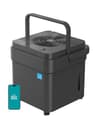 Midea Cube 35 Pint DehumidifierThe middle Cube removes 78 percent more water than the 20 for 50 percent more power, and carries the same 4.2 gallon bucket as the 50 - which makes it the size most people between the two should buy. Midea Cube 35 Pint DehumidifierThe middle Cube removes 78 percent more water than the 20 for 50 percent more power, and carries the same 4.2 gallon bucket as the 50 - which makes it the size most people between the two should buy. | A damp room or a small, dry-ish basement | 351 W | |
| 2 |  hOmeLabs 32 Pint DehumidifierThe one hOmeLabs unit with a named entry in the ENERGY STAR list, so it is the one where the running cost is a published figure rather than a class estimate. hOmeLabs 32 Pint DehumidifierThe one hOmeLabs unit with a named entry in the ENERGY STAR list, so it is the one where the running cost is a published figure rather than a class estimate. | A bedroom that is damp but not wet | 318 W | |
| 3 |  Frigidaire 50 Pint Dehumidifier with Wi-FiFrigidaire's current no-pump 50-pint: certified by exact model number, Wi-Fi equipped, and a 2.7 gallon bucket that is among the largest of any 50-pint unit we track. Frigidaire 50 Pint Dehumidifier with Wi-FiFrigidaire's current no-pump 50-pint: certified by exact model number, Wi-Fi equipped, and a 2.7 gallon bucket that is among the largest of any 50-pint unit we track. | A Frigidaire with a drain below it | 488 W | |
| 4 | 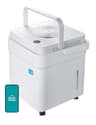 Midea Cube 20 Pint DehumidifierThe smallest Cube, and the least efficient one: certified at IEF 1.70 against 2.01 for the 35 and 50, so every pint it removes costs about 18 percent more electricity. Midea Cube 20 Pint DehumidifierThe smallest Cube, and the least efficient one: certified at IEF 1.70 against 2.01 for the 35 and 50, so every pint it removes costs about 18 percent more electricity. | One small room that is only mildly damp | 234 W | $179.91View on Amazon #ad Price as of September 27, 2026. How we are funded |
Midea
Midea Cube 35 Pint Dehumidifier
Best for: A damp room or a small, dry-ish basement
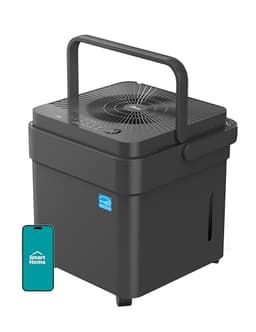
The middle Cube removes 78 percent more water than the 20 for 50 percent more power, and carries the same 4.2 gallon bucket as the 50 - which makes it the size most people between the two should buy.
Average draw
351 W
Computed from the ENERGY STAR certified entry for Midea MAD35S1QGR-A - the same model number as this listing: 35.82 pt/day at IEF 2.01 L/kWh. Midea publishes no wattage on the listing. Every certified 35-pint model we track runs IEF 2.01 to 2.09, so this is the class norm.
What is good
- Same IEF 2.01 as the 50-pint Cube, so per pint removed it is exactly as efficient
- 4.2 gallon bucket, identical to the 50 - about 22 hours at full rated capacity
- Lift-and-twist expandable body, Wi-Fi app and included drain hose
- About $9 a month less than the 50-pint Cube at twelve hours a day and the US average rate
What is not
- Midea's listing calls it similar to a 50 pint under the 2012 standard; ENERGY STAR's correlation table puts a current 35 nearer an old 60, so the maker's equivalence undersells it
- 3,500 sq ft is the most generous coverage claim per pint of the three Cubes - treat it as marketing
- No pump, so the drain must be below the machine
Who it is for
A large damp room, an apartment, or a small basement that reads in the low-to-mid 60s rather than the high 60s.
Skip it if
Skip it for a basement that reads above about 68 percent or shows visible moisture. That is 50-pint work, and the 50 costs little more to buy and nothing more per pint to run.
hOmeLabs
hOmeLabs 32 Pint Dehumidifier
Best for: A bedroom that is damp but not wet
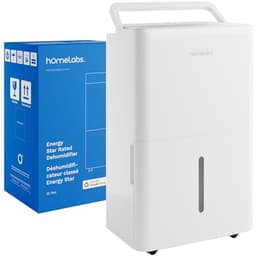
The one hOmeLabs unit with a named entry in the ENERGY STAR list, so it is the one where the running cost is a published figure rather than a class estimate.
Average draw
318 W
Computed from the ENERGY STAR certified entry hOmeLabs HME0089: 32.46 pt/day at IEF 2.01 L/kWh. This is the only hOmeLabs capacity in this registry with a named certified entry, which is why it is the only one carrying a number rather than a band.
What is good
- 318 W against the 50-pint class median of 488 W - about 35% less to run, hour for hour
- Named in the ENERGY STAR certified list, so its IEF is public
- Quiet enough for a bedroom in a way that a 50-pint compressor generally is not
- Wi-Fi and auto shut-off at a small-unit price
What is not
- 32 DOE pints is genuinely less water than 50 - undersizing a wet basement costs more than the machine saved
- Gravity drainage only
- 4,500 sq ft coverage for 32 pints is another claim to ignore
Who it is for
A bedroom, a home office, or a small basement that is humid rather than actively wet.
Skip it if
Skip it if the floor is ever damp to the touch or the walls sweat. That is a 50-pint problem, and a 32-pint machine will run continuously and still lose.
Frigidaire
Frigidaire 50 Pint Dehumidifier with Wi-Fi
Best for: A Frigidaire with a drain below it
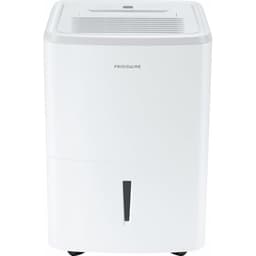
Frigidaire's current no-pump 50-pint: certified by exact model number, Wi-Fi equipped, and a 2.7 gallon bucket that is among the largest of any 50-pint unit we track.
Average draw
488 W
Computed from the ENERGY STAR certified entry for Frigidaire FHDD5034Y1 - the same model number as this listing: 49.71 pt/day at IEF 2.01 L/kWh. Frigidaire's Canadian product page states 115 V, 8.8 A and 470 W; those figures do not reconcile with each other and are nameplate rather than average values, so 488 W is the running-cost figure.
What is good
- Exact certified model match, so the 488 W figure describes this machine rather than a sibling
- 2.7 gallon bucket - roughly ten hours of condensate at full rated capacity if you ever run it without a hose
- Continuous drain, three fan speeds and operation down to 41F
- Wi-Fi and the Frigidaire app for scheduling and remote control
What is not
- Gravity only. The drain must be below the machine
- The Wi-Fi depends on Frigidaire's app remaining supported
- Frigidaire's own published wattage and amperage do not agree with each other
Who it is for
Someone with a floor drain who wants a certified, well-documented 50-pint unit and has a use for scheduling.
Skip it if
Skip it if the only drain is above the machine. That is the one job a gravity unit cannot do, whatever else it has.
Midea
Midea Cube 20 Pint Dehumidifier
Best for: One small room that is only mildly damp
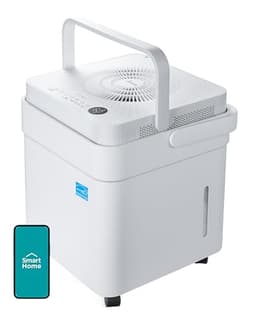
The smallest Cube, and the least efficient one: certified at IEF 1.70 against 2.01 for the 35 and 50, so every pint it removes costs about 18 percent more electricity.
Average draw
234 W
Computed from the ENERGY STAR certified entry for Midea MAD20S1QWT - the same model number as this listing: 20.16 pt/day at IEF 1.70 L/kWh. Midea publishes no wattage on the listing. The 20-22 pint certified class runs IEF 1.70 to 1.97, so this unit sits at the bottom of its own class.
What is good
- Lowest draw of any Cube at 234 W, which matters in a room where it runs most of the day
- Same lift-and-twist expandable body, Wi-Fi app and included drain hose as the larger Cubes
- 3.2 gallon bucket - about 30 hours at full rated capacity before it needs emptying
- The listing states its own pre-2020 equivalent, 30 pint, which matches ENERGY STAR's correlation table
What is not
- IEF 1.70 is the bottom of the certified 20-22 pint class - it uses about 18 percent more electricity per pint than the 35 or 50 Cube
- Undersized for any basement: running around the clock it costs about as much as a 50-pint Cube on half the hours and removes 20 pints to its 50
- No pump, so the drain must be below the machine
Who it is for
A single above-grade room reading in the low 60s - a bedroom, a home office, a bathroom that stays damp between showers.
Skip it if
Skip it for a basement or anything reading above about 65 percent. It will run continuously, never reach its target, and cost as much as the 50-pint Cube while doing less than half its work.
Size to the volume, not to the square footage
The usual advice is to size from floor area, and in a manufactured home that over-sizes almost every time. A single-wide is a narrow, connected volume with a lower ceiling than a site-built house, and the air a dehumidifier has to process is a function of volume rather than plan area.
Coverage claims make this worse rather than better. Across the 50-pint machines we track, stated coverage runs from 4,000 to 8,000 square feet on hardware with near-identical certified capacity - a 2x spread that reflects marketing rather than measurement. A figure like that cannot tell you anything about a 1,100 square foot single-wide. Coverage claims explained.
The practical version: for a single-wide that is damp but not wet, start at a certified 30 to 35 pints. Go to 50 for a double-wide, for a home in a genuinely humid climate, or where there is a known moisture source you have not fixed yet. What size dehumidifier do I need has the general method.
Where the water goes
Most manufactured homes have no floor drain, which removes the easiest option and leaves three:
- A bucket, which means emptying it, in living space, roughly daily while the home is drying out. Workable, annoying, and it stops the machine every time it fills. Buy the biggest bucket you can - the GE 50-pint's 15-pint bucket is unusually large for the class.
- A gravity hose to a sink, tub or shower, which works only if the machine sits higher than the drain. Achievable in a bathroom, awkward in a hallway. Setting up a continuous drain.
- A pump model, which removes the height constraint entirely and is the honest answer if the only drain is a kitchen sink across the home. The best dehumidifiers with a built-in pump covers the decision.
Before you buy anything
- 1Look at the roof cavity vents. The standard required a free ventilation area of at least 1/300 of the cavity floor area. Blocked vents are the most common way a compliant home becomes a damp one.
- 2Look underneath. Ground moisture is outside what section 3280.504 covers, and it is the usual source when the damp is worst low down.
- 3Run the bathroom and kitchen fans and check they vent outside, not into the cavity. This is worth more than any machine on this page.
- 4Find the circuit the dehumidifier will live on and note what else is on it.
- 5Then buy the smallest certified machine that covers the volume, and set it to a target rather than continuous. What to set it to.
What we would skip
A 50-pint machine sharing a circuit with a space heater
This is the one genuinely different constraint in a manufactured home, and it is arithmetic rather than opinion. A certified 50-pint unit draws about 487 W, which at 115 volts is roughly 4.2 amps - comfortable on its own. A 1,500 W space heater is about 13 amps. Put both on the same 15-amp branch circuit and you are over the limit before anything else is plugged in. Size the dehumidifier to the room, then check what else is on that circuit.
What we did not do
We have not measured humidity in a manufactured home, inspected an underfloor, or tested any of these units. The construction requirements are quoted from 24 CFR 3280.504 directly. The amperage figures are arithmetic on certified wattages from the ENERGY STAR file, at a nominal 115 volts - your actual supply voltage and the machine's real duty cycle will both move the number. We are not electricians and this page is not an electrical assessment; if you are unsure what shares a circuit, that is a question for one. How we work.
FAQ
Questions
What size dehumidifier do I need for a mobile home?
Will a dehumidifier trip the breaker in a mobile home?
Why is my mobile home so damp?
Where do I drain a dehumidifier in a mobile home?
Should I put a dehumidifier under my mobile home?
Sources
Sources
- 24 CFR 3280.504 - Condensation control and installation of vapor retarders, HUD Manufactured Home Construction and Safety Standards: ceiling vapor retarder of not greater than 1 perm in Uo Value Zones 2 and 3, exterior wall moisture management requirements, and attic or roof cavity free ventilation area of not less than 1/300 of the cavity floor area (retrieved 2026-09-27)
- ENERGY STAR Certified Dehumidifiers list - the certified capacity and efficiency figures behind every computed wattage and amperage on this page (retrieved 2026-09-27)
- EIA Electric Power Monthly, Table 5.6.A, June 2026 - the residential electricity rate used
Read next
- The best dehumidifiers for an apartmentThree apartment-sized units chosen for tank ergonomics and run cost, because there is no floor drain.
- What size dehumidifier do I need?A four-step method that uses measured humidity instead of the square-footage claim on the box.
- The best crawl space dehumidifiersFour crawl space options, and the 3.1x gap between the pint number on the box and the certified one.
- Setting up a continuous drainA five-step method, the plastic cap that causes most failures, and the sag that causes the rest.
- The square footage on the box is not a specificationIdentical certified capacity, coverage claims 1.9x apart. What the number is, and what to size from instead.
- What to set it to45 to 50 percent, why lower is only more expensive, and the setting that doubles your bill.