Best / Roundup
The best dehumidifiers for an apartment
No floor drain, a neighbor through the wall, and an electricity bill with your name on it. Three constraints that change the answer.
#adThis page contains affiliate links. We earn a commission on qualifying purchases, at no cost to you, and it never changes a ranking. Full disclosure.

The short answer
For most apartments, a 30 to 32-pint unit at around 318 watts, chosen for its tank size as much as its capacity. There is rarely anywhere to run a continuous drain, so how easy the bucket is to carry to a sink matters more than any other feature.
The drain constraint, which nobody writes about
Every buying guide in this category assumes a floor drain. Apartments do not have one. The bath, the shower tray and the kitchen sink are all above the machine, which rules out gravity drainage entirely, and running a hose across a living space is not a thing anyone actually does.
So an apartment dehumidifier is a bucket appliance, and the specification that governs your life is tank volume. Our registry runs from 0.62 to 4.2 gallons. At 30 pints a day, a 0.62 gallon tank fills in about four hours of active running - though in a room that is only moderately damp, actual collection is far lower and a tank may last a day or two.
The practical version: pick the largest tank you are willing to carry, and put the machine within a short walk of a sink. A full 1.7 gallon tank is about 14 pounds, and the awkward part is not the weight but crossing a room with an open container of water.
The bill is yours, so run time matters
A 30-32 pint unit, the apartment default
(318 W / 1000) x 12 h x $0.1834/kWh = $0.70 per day
0.318
kWh per hour
$21.30
per month, 12 h/day
$42.61
per month, 24 h/day
Rate is the US residential average of 18.34 cents/kWh from the EIA Electric Power Monthly, June 2026. Yours will differ - use the calculator.
Two things reduce that number honestly. Set a realistic target - 50% rather than 40% - because the last ten points of humidity cost disproportionately. And use a schedule if the unit has one: several here run from an app, and running during off-peak hours is a real saving on a time-of-use tariff. Neither of those is a compromise on the result.
Quick picks
| # | Product | Best for | Draw | Price |
|---|---|---|---|---|
| 1 |  hOmeLabs 32 Pint DehumidifierThe one hOmeLabs unit with a named entry in the ENERGY STAR list, so it is the one where the running cost is a published figure rather than a class estimate. hOmeLabs 32 Pint DehumidifierThe one hOmeLabs unit with a named entry in the ENERGY STAR list, so it is the one where the running cost is a published figure rather than a class estimate. | A bedroom that is damp but not wet | 318 W | $234.99View on Amazon #ad Price as of October 16, 2026. How we are funded |
| 2 |  Honeywell Smart Wi-Fi 30 Pint Dehumidifier (TP50AWKN)The anti-spill design is the actual selling point here, and it is a better reason to buy than the voice control the listing leads with. Honeywell Smart Wi-Fi 30 Pint Dehumidifier (TP50AWKN)The anti-spill design is the actual selling point here, and it is a better reason to buy than the voice control the listing leads with. | A room you want to run on a schedule | Not published | $311.16View on Amazon #ad Price as of October 16, 2026. How we are funded |
| 3 |  hOmeLabs 8 Pint DehumidifierA real compressor unit at a size where most competitors sell thermoelectric toys, which makes it the smallest machine here that actually removes meaningful water. hOmeLabs 8 Pint DehumidifierA real compressor unit at a size where most competitors sell thermoelectric toys, which makes it the smallest machine here that actually removes meaningful water. | A closet, a boat, or a single small room | Not published | $174.99View on Amazon #ad Price as of October 16, 2026. How we are funded |
hOmeLabs
hOmeLabs 32 Pint Dehumidifier
Best for: A bedroom that is damp but not wet
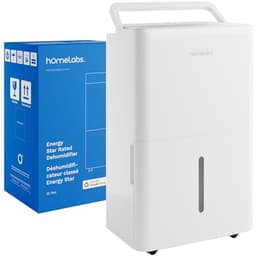
The one hOmeLabs unit with a named entry in the ENERGY STAR list, so it is the one where the running cost is a published figure rather than a class estimate.
Average draw
318 W
Computed from the ENERGY STAR certified entry hOmeLabs HME0089: 32.46 pt/day at IEF 2.01 L/kWh. This is the only hOmeLabs capacity in this registry with a named certified entry, which is why it is the only one carrying a number rather than a band.
What is good
- 318 W against the 50-pint class median of 488 W - about 35% less to run, hour for hour
- Named in the ENERGY STAR certified list, so its IEF is public
- Quiet enough for a bedroom in a way that a 50-pint compressor generally is not
- Wi-Fi and auto shut-off at a small-unit price
What is not
- 32 DOE pints is genuinely less water than 50 - undersizing a wet basement costs more than the machine saved
- Gravity drainage only
- 4,500 sq ft coverage for 32 pints is another claim to ignore
Who it is for
A bedroom, a home office, or a small basement that is humid rather than actively wet.
Skip it if
Skip it if the floor is ever damp to the touch or the walls sweat. That is a 50-pint problem, and a 32-pint machine will run continuously and still lose.
Honeywell
Honeywell Smart Wi-Fi 30 Pint Dehumidifier (TP50AWKN)
Best for: A room you want to run on a schedule
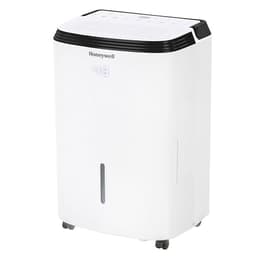
The anti-spill design is the actual selling point here, and it is a better reason to buy than the voice control the listing leads with.
Average draw
Not published
Not published. Honeywell's certified 32-pint entries, the TPFIT32AWK and TPFIT32WK, compute to 318 W at 32.46 pt/day and IEF 2.01. This is a different product line, so that figure sits in the note rather than in the spec table.
What is good
- Anti-spill bucket, which matters more than any app feature if the machine lives upstairs
- Scheduling through the app, so it can run when electricity is cheapest
- ENERGY STAR certified at a small-room capacity
- Alerts on the phone rather than only a beep in an empty room
What is not
- No published wattage, and the certified list carries a different Honeywell line
- 3,000 sq ft for 30 pints is an optimistic claim
- Depends on Honeywell's app remaining supported
Who it is for
An upstairs room or a rental where a spilled bucket is somebody's ceiling, and where scheduling is genuinely useful.
Skip it if
Skip it if the machine will sit on concrete next to a drain. You would be paying for spill protection and scheduling that a floor drain makes irrelevant.
hOmeLabs
hOmeLabs 8 Pint Dehumidifier
Best for: A closet, a boat, or a single small room
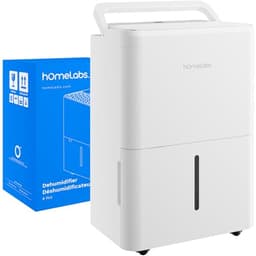
A real compressor unit at a size where most competitors sell thermoelectric toys, which makes it the smallest machine here that actually removes meaningful water.
Average draw
Not published
Not published. The certified 8-13 pint class runs 92-128 W with a median of 105 W across 39 models, and the median unit in that class uses 117 kWh a year.
What is good
- A compressor at 8 pints, so it keeps working where a Peltier unit stops
- Roughly a fifth of the power of a 50-pint machine
- Wi-Fi and auto shut-off, unusual at this size
- Small enough to sit in a wardrobe or a berth
What is not
- 1,800 sq ft coverage for 8 DOE pints is not a serious claim
- Bucket only - no continuous drain at this size
- Not ENERGY STAR certified, so no published IEF
Who it is for
Closets, gun safes, boat cabins, and single small rooms where a large machine is absurd.
Skip it if
Skip it for any room where you can feel the damp. Eight pints a day is a maintenance dose, not a cure.
Before you buy: is it condensation or a leak?
Apartment damp splits into two very different problems and they need different responses. Condensation damp appears on cold surfaces - window reveals, external corners, behind furniture against an outside wall - and is caused by ordinary living moisture in a space that is under-ventilated. That is what a dehumidifier fixes.
Penetrating damp or a plumbing leak appears as a patch that is wet regardless of the weather, often with staining, sometimes growing. A dehumidifier will run permanently, remove water indefinitely, and never resolve it - and in a rental, documenting it and telling the landlord is both the fix and your protection. A machine that quietly manages a leak also quietly conceals it. A manufactured home is a different problem again - fewer circuits, a lower ceiling and a federal moisture standard already built into the structure. The best dehumidifiers for a mobile home.
What we would skip
A 50-pint unit in a one-bedroom apartment
Too loud for the room, too much capacity for the moisture load, and 488 W on a bill you pay yourself. An oversized unit also cycles more frequently, which is the noise pattern people actually notice through a wall.
Any unit whose tank you cannot lift when full
With no floor drain, an apartment dehumidifier is a bucket appliance. A 1.7 gallon tank weighs about 14 pounds full and has to be carried to a sink without slopping. Tank size is a convenience spec in a basement and an ergonomics spec in an apartment.
How we picked
- Sized for one to two rooms rather than a basement, at 30 to 32 DOE pints and roughly 318 W.
- Tank capacity and how easily it empties, because there is usually nowhere to run a hose.
- Cycling behavior, which is what a neighbor hears.
- Anything that reduces run time on your own bill: a schedule, a decent humidistat, an auto-restart after a power cut.
- Not tested by us.
We did not test these units. The full criteria and their weighting are on the methodology page.
FAQ
Questions
What size dehumidifier do I need for an apartment?
How often will I have to empty the tank?
Will a dehumidifier lower my electricity bill by helping the AC?
Can my landlord object to a dehumidifier?
Sources
Sources
Read next
- The best 30-pint dehumidifiersThe 30 to 34-pint class at about 318 W, and an honest account of when this is the wrong size.
- The best dehumidifiers for a bedroomFour options for a room you sleep in, ranked on cycling behavior rather than a decibel figure nobody measured.
- Capacity and tank size are not the same numberHours to a full bucket, by tank size and capacity - the number no manufacturer prints.
- Dehumidifier running cost calculatorYour own rate, your own hours, and every default value shown on screen with its source.
- What to set it to45 to 50 percent, why lower is only more expensive, and the setting that doubles your bill.
- 20-pint versus 30-pint60 watts and $4 a month apart, with the efficiency running the other way. Where 20 pints genuinely works.
- The best dehumidifiers for condensationCondensation is a cold surface meeting a high dew point. Four units, and the cases where glass is the real problem.