Best / Roundup
The best dehumidifiers for condensation
Water on the inside of a window is the room telling you two numbers have crossed: the dew point of the air and the temperature of the glass. You can only change one of them with a machine.
#adThis page contains affiliate links. We earn a commission on qualifying purchases, at no cost to you, and it never changes a ranking. Full disclosure.

The short answer
Condensation forms when a surface is colder than the dew point of the air touching it. A dehumidifier lowers the dew point, so it stops condensation if it can get the dew point below the temperature of the glass. On a genuinely cold single pane in winter that may not be achievable, and insulating the surface is the better fix.
Two numbers, and you can only move one
Every case of window condensation is the same equation. The air in the room has a dew point - the temperature at which it would start giving up water. The glass has a surface temperature. When the glass is colder than the dew point, water leaves the air and lands on the glass. That is the whole mechanism.
A dehumidifier moves the first number. Insulation, secondary glazing or a warmer room moves the second. Which lever is the right one depends entirely on how cold the glass is, and that is why the same product is a brilliant answer in one house and a waste of money in another.
| Room humidity | Dew point, about | So condensation appears on anything colder than |
|---|---|---|
| 70% | 58F | 58F - which includes a lot of ordinary window glass in winter |
| 60% | 53F | 53F - a cold single pane, an uninsulated reveal, a cold wall corner |
| 50% | 49F | 49F - an unheated porch door, a metal frame |
| 40% | 43F | 43F - by now, only genuinely cold surfaces |
| 30% | 35F | 35F - almost nothing indoors is this cold |
Indicative figures for air at 68F, rounded. The point is the direction and the size of the steps, not decimal precision: every ten points of relative humidity you remove buys roughly five degrees of surface temperature. Your own room's numbers depend on its temperature.
Read that table as a decision tool. If your windows sweat and the room reads 65 percent, you have a humidity problem and a machine will fix it. If they sweat at 45 percent, you have a cold-glass problem and no dehumidifier is going to be the answer.
Where the water is coming from
Worth thirty seconds before you buy anything, because in a lot of homes the condensation is a symptom of one identifiable source rather than general dampness:
- Showers and baths, if the extractor fan is weak, ducted badly or not run for long enough afterwards. Bathrooms.
- Drying laundry indoors. A single load carries liters of water, and it all ends up on the coldest surface in the house. This is the most common cause of bedroom window condensation in winter.
- Cooking without a hood that actually vents outside.
- A dryer venting indoors, which is a continuous and substantial source people forget entirely.
- Simply breathing, in a sealed modern bedroom with the door shut. Two adults overnight is a real quantity of water, and it is why bedroom windows are the classic case.
Why a compressor unit struggles exactly where you need it
This is the awkward part of the category and it is worth stating plainly. Condensation is worst in cold rooms. A compressor dehumidifier condenses water on a chilled coil, and the colder the room, the colder that coil must run to keep working. Below roughly 41F it ices faster than the defrost cycle can clear it, and the machine spends its day defrosting rather than drying.
So in a heated bedroom at 65 to 70F, a compressor unit is the right and efficient choice. In an unheated room, a porch, a conservatory or a boat cabin, it is the wrong technology and a desiccant machine - which has no cold coil to freeze - is the one that works. Desiccant versus compressor.

Quick picks
| # | Product | Best for | Draw | Price |
|---|---|---|---|---|
| 1 |  hOmeLabs 32 Pint DehumidifierThe one hOmeLabs unit with a named entry in the ENERGY STAR list, so it is the one where the running cost is a published figure rather than a class estimate. hOmeLabs 32 Pint DehumidifierThe one hOmeLabs unit with a named entry in the ENERGY STAR list, so it is the one where the running cost is a published figure rather than a class estimate. | A bedroom that is damp but not wet | 318 W | $234.99View on Amazon #ad Price as of September 14, 2026. How we are funded |
| 2 |  Midea Cube 50 Pint DehumidifierThe only unit here that solves the real basement problem, which is not capacity but where the water goes when you are not standing next to it. Midea Cube 50 Pint DehumidifierThe only unit here that solves the real basement problem, which is not capacity but where the water goes when you are not standing next to it. | A basement you visit once a month | 487 W | $303.56View on Amazon #ad Price as of September 14, 2026. How we are funded |
| 3 |  Ivation 13 Pint Desiccant DehumidifierThe small desiccant, for spaces that are cold and enclosed rather than large and damp. Ivation 13 Pint Desiccant DehumidifierThe small desiccant, for spaces that are cold and enclosed rather than large and damp. | A cold closet, attic or bathroom | Not published | $269.99View on Amazon #ad Price as of September 14, 2026. How we are funded |
| 4 |  Pro Breeze Electric Mini DehumidifierA thermoelectric unit that removes about one pint a day, which is roughly one fiftieth of a 50-pint machine and needs saying out loud before anyone buys one for a basement. Pro Breeze Electric Mini DehumidifierA thermoelectric unit that removes about one pint a day, which is roughly one fiftieth of a 50-pint machine and needs saying out loud before anyone buys one for a basement. | A wardrobe, and honestly not much more | Not published | $42.99View on Amazon #ad Price as of September 14, 2026. How we are funded |
hOmeLabs
hOmeLabs 32 Pint Dehumidifier
Best for: A bedroom that is damp but not wet
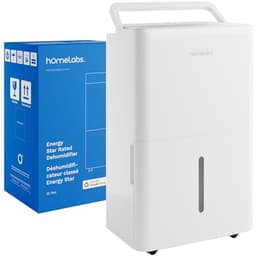
The one hOmeLabs unit with a named entry in the ENERGY STAR list, so it is the one where the running cost is a published figure rather than a class estimate.
Average draw
318 W
Computed from the ENERGY STAR certified entry hOmeLabs HME0089: 32.46 pt/day at IEF 2.01 L/kWh. This is the only hOmeLabs capacity in this registry with a named certified entry, which is why it is the only one carrying a number rather than a band.
What is good
- 318 W against the 50-pint class median of 488 W - about 35% less to run, hour for hour
- Named in the ENERGY STAR certified list, so its IEF is public
- Quiet enough for a bedroom in a way that a 50-pint compressor generally is not
- Wi-Fi and auto shut-off at a small-unit price
What is not
- 32 DOE pints is genuinely less water than 50 - undersizing a wet basement costs more than the machine saved
- Gravity drainage only
- 4,500 sq ft coverage for 32 pints is another claim to ignore
Who it is for
A bedroom, a home office, or a small basement that is humid rather than actively wet.
Skip it if
Skip it if the floor is ever damp to the touch or the walls sweat. That is a 50-pint problem, and a 32-pint machine will run continuously and still lose.
Midea
Midea Cube 50 Pint Dehumidifier
Best for: A basement you visit once a month
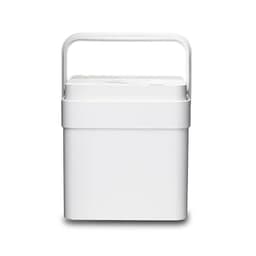
The only unit here that solves the real basement problem, which is not capacity but where the water goes when you are not standing next to it.
Average draw
487 W
Computed from the ENERGY STAR certified entry for Midea MAD50S1QWT-A, the 50 pt / 4,500 sq ft Cube without a pump: 49.67 pt/day at IEF 2.01 L/kWh. Midea's own US product page confirms MAD50S1QWT-A is this configuration. Midea publishes no wattage on the Amazon listing or on that page.
What is good
- The body separates, so the tank half can sit lower than the compressor half and the hose gets a genuine downhill run
- Certified at 49.67 pt/day, which is a real 50-pint machine rather than a saturation number
- IEF 2.01 L/kWh puts it exactly on the median for the 50-pint class - neither a bargain nor a penalty
- Wi-Fi that tells you it has stopped, which is the only smart feature that matters in a basement
What is not
- No pump, so the drain has to run downhill the whole way
- Midea publishes no wattage anywhere, so the 487 W above is computed rather than quoted
- The 4,500 sq ft coverage claim is marketing, not a spec - see the sizing guide
Who it is for
Someone with a floor drain, a sump, or a window well lower than the machine, who wants to set it once and stop thinking about it.
Skip it if
Skip it if the only drain in the room is higher than the unit. Without a pump, gravity is the entire drainage system, and no setting fixes an uphill hose.
Ivation
Ivation 13 Pint Desiccant Dehumidifier
Best for: A cold closet, attic or bathroom
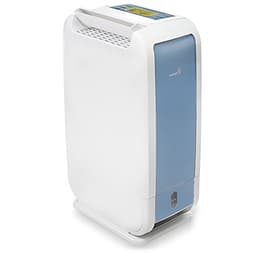
The small desiccant, for spaces that are cold and enclosed rather than large and damp.
Average draw
Not published
Not published. Not represented in the ENERGY STAR certified list, which does not cover desiccant units.
What is good
- Works in the cold, unlike every compressor unit on this site
- Small and light enough to move between an attic and a closet
- Continuous drain hose supported at this size, which the compressor minis do not offer
- Quiet - no compressor to cycle
What is not
- 270 sq ft is a genuinely small room
- No published wattage
- Warms the space it dries
Who it is for
Closets, attics, bathrooms and RV interiors in a cold climate.
Skip it if
Skip it if you need real capacity. Thirteen pints a day is a maintenance machine, not a recovery machine.
Pro Breeze
Pro Breeze Electric Mini Dehumidifier
Best for: A wardrobe, and honestly not much more
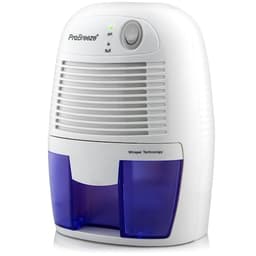
A thermoelectric unit that removes about one pint a day, which is roughly one fiftieth of a 50-pint machine and needs saying out loud before anyone buys one for a basement.
Average draw
Not published
Not published, and thermoelectric units are outside the ENERGY STAR dehumidifier program entirely. Peltier modules of this size draw far less than any compressor here - but less power and less water are the same fact, not two selling points. It removes 17 oz a day, which is 1.06 pints.
What is good
- Genuinely silent - there is no compressor to cycle on and off next to your head
- Small and light enough to sit on a shelf inside a wardrobe
- Auto shut-off when the 17 oz tank fills
- Cheap enough to buy two for two closets
What is not
- About one pint a day. A 50-pint unit removes fifty times as much
- Stops working below 41F, which rules out the unheated spaces people usually buy it for
- No drain option - the tank is the only outlet
Who it is for
A wardrobe, a gun safe, a bathroom cabinet, or a single small enclosed space with a musty smell.
Skip it if
Skip it for any room. This is the single most common mis-purchase in the category: it is not a small dehumidifier, it is a different class of device, and no number of them adds up to a basement machine.
What it costs to keep windows clear
A 30 to 32-pint unit in a bedroom
(318 W / 1000) x 12 h x $0.1834/kWh = $0.70 per day
0.318
kWh per hour
$21.30
per month, 12 h/day
$42.61
per month, 24 h/day
Rate is the US residential average of 18.34 cents/kWh from the EIA Electric Power Monthly, June 2026. Yours will differ - use the calculator.
Condensation is largely a cold-season problem, so this is usually a four or five month cost rather than a year-round one. Against that, running it only overnight in the affected room - six to eight hours rather than twelve - roughly halves the figure, and overnight is when the glass is coldest and the room is producing the most moisture.
When the machine is the wrong purchase
- 1The room already reads under 50 percent. The glass is the problem. Secondary glazing, a thermal blind, or warm air directed at the pane will do more than any dehumidifier.
- 2Condensation between the panes of a sealed unit. That is a failed seal. The water is inside the glazing unit and nothing you do to the room air reaches it - it is a glazing repair.
- 3Damp patches on walls with no condensation on the glass. That points at penetrating or rising damp rather than airborne moisture, which is a building problem. Condensation on walls.
- 4One window in an otherwise dry house. Usually a local cold bridge or a badly fitted reveal. Fix the window.
What we did not do
We have not tested any of these units and we have not measured surface temperatures in a real room. The dew point figures above are indicative values for air at 68F, given to show the size of the steps rather than to be read to a decimal. Every capacity and wattage is quoted or computed from the ENERGY STAR certified list with the source named. How we work.
What we would skip
A dehumidifier bought to fix single-glazed windows in January
If the glass is cold enough, you would have to run the room uncomfortably dry to get the dew point below it - and a compressor unit works poorly at the temperatures where that problem is worst. Secondary glazing, a thermal blind or simply accepting morning wiping is cheaper and more effective. Buy the machine for the humidity, not for the glass.
Any unit chosen on its coverage claim
Condensation is a local phenomenon on a specific cold surface. A square-footage number tells you nothing about whether the machine can pull the dew point in that room below that surface's temperature, and in our registry those claims vary 1.9x for identical certified capacity.
A compressor unit in an unheated room
Condensation is worst in cold rooms, and a compressor dehumidifier is at its weakest there - below about 41F the coil ices faster than the defrost cycle clears it. That is precisely the case for a desiccant machine instead.
How we picked
- Judged on holding a low, stable humidity overnight, because that is when glass is coldest and condensation forms.
- Low-temperature capability weighted heavily - the rooms with the worst condensation are the coldest ones.
- Capacity from the post-2019 DOE rating, matched to the room rather than a coverage claim.
- Average draw computed from certified capacity and IEF, or stated as unpublished where the technology is not covered by the certified list.
- Not tested by us. Every figure is quoted or computed, with the source named.
We did not test these units. The full criteria and their weighting are on the methodology page.
FAQ
Questions
Will a dehumidifier stop condensation on windows?
What humidity stops window condensation?
Why do my bedroom windows have condensation but no other room?
Should I use a dehumidifier in an unheated room with condensation?
Can a dehumidifier fix condensation between double glazing?
Sources
Sources
- US EPA - A Brief Guide to Mold, Moisture and Your Home: the 30-50 percent recommended band
- ENERGY STAR Certified Dehumidifiers product list - certified capacity and IEF for the compressor units on this page (retrieved 2026-09-01)
- EIA Electric Power Monthly, Table 5.6.A, June 2026 - the electricity rate used
Read next
- Dehumidifier or just open a window?Free and effective in cold dry weather, actively counterproductive in summer. Compare dew points, not humidities.
- Desiccant or compressor?11.8 pints against 2.9 at 41F, and the crossover point where the obvious answer stops being right.
- The best dehumidifiers for a bedroomFour options for a room you sleep in, ranked on cycling behavior rather than a decibel figure nobody measured.
- What to set it to45 to 50 percent, why lower is only more expensive, and the setting that doubles your bill.
- The best dehumidifiers for a bathroomFour small units for a bathroom, plus the honest argument that an extractor fan beats all of them.