Best / Roundup
The best dehumidifiers for an attic
Every other room on this site is about how cold a dehumidifier can go. An attic is the opposite problem, and it is the one specification almost nobody in this category publishes.
#adThis page contains affiliate links. We earn a commission on qualifying purchases, at no cost to you, and it never changes a ranking. Full disclosure.
The short answer
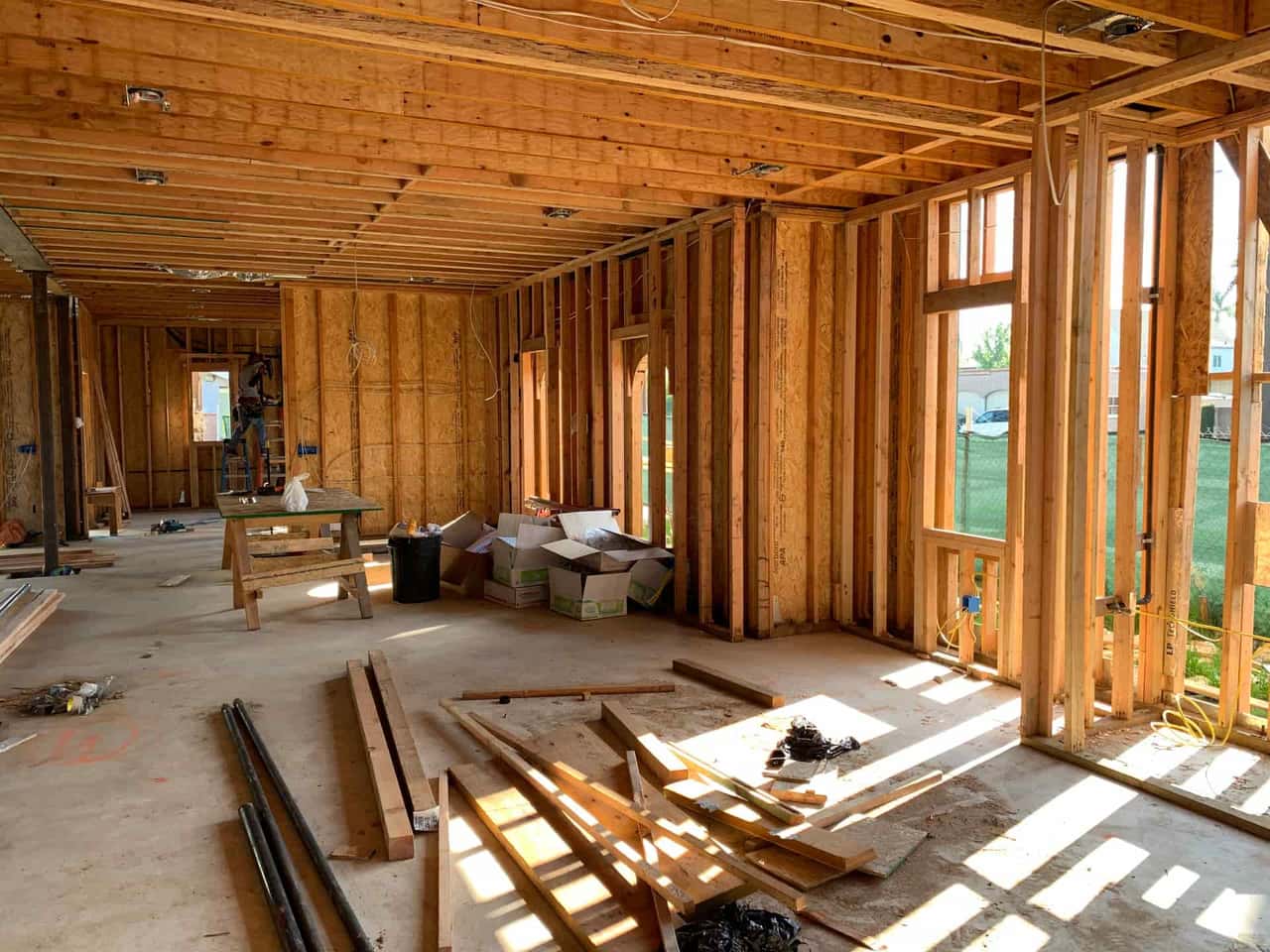
Check the maximum operating temperature before anything else, because an attic is where it binds. Of the 31 units we track, exactly one publishes a ceiling: the Ivation 19-pint desiccant, rated 33F to 104F. Before buying anything, confirm the attic's soffit vents are clear - ENERGY STAR's own position is that attic moisture is a ventilation problem first.
The specification nobody prints
1 of 31
Units we track that publish a maximum operating temperature
The Ivation 19 Pint Desiccant states a 33F to 104F range on its Amazon listing. Every other unit in our registry publishes either a minimum temperature or nothing at all. Read 2026-09-21.
This site spends most of its time on the low end of the temperature range, because that is where most buyers get caught: a compressor unit ices up in a cold garage and stops working. An attic is the mirror image, and it is worse in one specific way - the low-temperature failure is obvious and reversible, while the high-temperature failure is a compressor working outside its design envelope for a whole summer.
We would like to tell you what temperature that is for each machine. We cannot, because the makers do not say. One unit out of thirty-one states a ceiling. The rest print a capacity, a square-footage claim, and a list of rooms - and several of those lists include the word 'attic' without a temperature anywhere on the page.
Fix the ventilation before you buy the machine
ENERGY STAR's guidance on attics is worth quoting rather than paraphrasing: in summer, natural airflow in a well-vented attic 'moves super-heated air out of the attic, protecting roof shingles and removing moisture'. Their single strongest instruction is never to block soffit vents with insulation, and they warn that attic fans can make things worse by pulling conditioned air up out of the house if the ceiling plane is not sealed.
That is the order of operations. A vented attic is designed to be at outdoor humidity - it is not a room you are supposed to be drying. Running a dehumidifier in one is like running an air conditioner with the window open: it will work, in the sense that the machine will do its job, and it will never finish.
The attic where a dehumidifier genuinely belongs is the sealed, unvented, conditioned kind - a converted loft, a storage attic inside the building envelope, an attic whose insulation was moved to the roofline. In that space the air is yours to dry, and a dehumidifier is the right tool.
How we picked
- A published maximum operating temperature. This is the specification that decides whether a machine survives an attic at all, and exactly one unit we track states one.
- Whether the maker names attics in its own listing copy, rather than us assuming a unit is suitable.
- Physical size and how it gets water out, because an attic usually has an awkward route and no floor drain.
- Technology, because a desiccant unit has no compressor to protect and no refrigerant to worry about in heat.
- What we did not do: we have not run any of these units in an attic, measured an attic temperature, or verified any ceiling claim.
We did not test these units. The full criteria and their weighting are on the methodology page.
Quick picks
| # | Product | Best for | Draw | Price |
|---|---|---|---|---|
| 1 |  Ivation 19 Pint Desiccant DehumidifierThe only technology here that does not lose to the cold, which makes it the right answer in exactly the rooms where a compressor is the wrong one. Ivation 19 Pint Desiccant DehumidifierThe only technology here that does not lose to the cold, which makes it the right answer in exactly the rooms where a compressor is the wrong one. | An unheated garage in winter | Not published | $299.99View on Amazon #ad Price as of September 21, 2026. How we are funded |
| 2 |  GoveeLife Smart Dehumidifier (H7151)The most genuinely connected unit we track - app, voice and IFTTT - and the only one whose listing prints both its DOE number and its saturation number instead of just the flattering one. GoveeLife Smart Dehumidifier (H7151)The most genuinely connected unit we track - app, voice and IFTTT - and the only one whose listing prints both its DOE number and its saturation number instead of just the flattering one. | A smart home that already runs on Alexa or Google routines | Not published | |
| 3 |  AEOCKY X1-Pro Rotary Desiccant DehumidifierA desiccant wheel at a compressor price, which is the trade this category rarely offers - and it buys cold-weather operation with a 340 W heater rather than efficiency. AEOCKY X1-Pro Rotary Desiccant DehumidifierA desiccant wheel at a compressor price, which is the trade this category rarely offers - and it buys cold-weather operation with a 340 W heater rather than efficiency. | A cold room where a compressor would spend the day defrosting | 340 W | $129.99View on Amazon #ad Price as of September 21, 2026. How we are funded |
| 4 |  AlorAir Sentinel HD55 Crawl Space DehumidifierThe clearest example on this site of why the number on the box is not the number that matters: sold as 113 pints, certified at 36.33. AlorAir Sentinel HD55 Crawl Space DehumidifierThe clearest example on this site of why the number on the box is not the number that matters: sold as 113 pints, certified at 36.33. | A crawl space you cannot stand up in | 344 W |
Ivation
Ivation 19 Pint Desiccant Dehumidifier
Best for: An unheated garage in winter
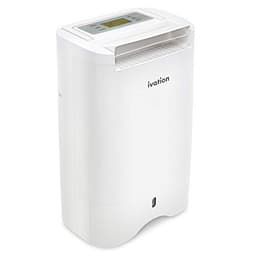
The only technology here that does not lose to the cold, which makes it the right answer in exactly the rooms where a compressor is the wrong one.
Average draw
Not published
Not published, and desiccant units are not represented in the ENERGY STAR certified dehumidifier list, which covers compressor portables and whole-home units. Desiccant machines use a resistive heater to regenerate the rotor, so their draw is roughly flat with temperature rather than falling off with it - the opposite trade to a compressor. We will not print a number for this one without a published source.
What is good
- Keeps extracting at temperatures where a compressor's coil ices and its output collapses
- No compressor, so it is quieter and lighter than any refrigerant unit here
- Continuous drain hose included
- Warm, dry exhaust, which is useful in a cold room and a nuisance in a warm one
What is not
- No published wattage, and desiccant units are generally less efficient than compressors at normal room temperature
- 410 sq ft coverage - this is a small-space machine
- It heats the room, which is the last thing a summer basement needs
Who it is for
Unheated garages, boats, sheds and crawl spaces in winter, where a compressor unit spends its time defrosting.
Skip it if
Skip it for a warm summer basement. Above roughly 65F a compressor removes more water per kWh, and the desiccant's waste heat works against you.
GoveeLife
GoveeLife Smart Dehumidifier (H7151)
Best for: A smart home that already runs on Alexa or Google routines
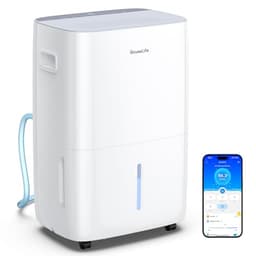
The most genuinely connected unit we track - app, voice and IFTTT - and the only one whose listing prints both its DOE number and its saturation number instead of just the flattering one.
Average draw
Not published
Not published, and no GoveeLife entry appears by name in the ENERGY STAR certified list, so we cannot compute one either. The listing says the unit is 'certified by DOE & CEC', which is a compliance statement rather than an ENERGY STAR certification, and no model number we could match appears in the certified file. The certified 50-pint class runs 443 to 490 W; that band stands in for a number.
What is good
- States both capacity numbers on the listing, which almost nobody in this category does
- Voice control and IFTTT, so it can be driven by a humidity sensor you already own
- Washable filter - no consumable to forget about
- Auto defrost for cooler rooms
What is not
- No ENERGY STAR certified entry we could match, so the wattage is a class band rather than a figure
- The listing admits it 'will emit a certain amount of heat' on high - true of every compressor unit, but worth knowing
- No pump; the included hose is 3 ft of corrugated pipe
- Sold by the brand's own storefront rather than shipped by Amazon
Who it is for
Someone who already has a smart-home routine and wants the dehumidifier inside it - triggered by a sensor, reported in an app, silenced by a voice command.
Skip it if
Skip it if you want a computed running cost. Without a certified entry we can only give you the class band, and on this site that is the difference between a figure and an estimate.
AEOCKY
AEOCKY X1-Pro Rotary Desiccant Dehumidifier
Best for: A cold room where a compressor would spend the day defrosting
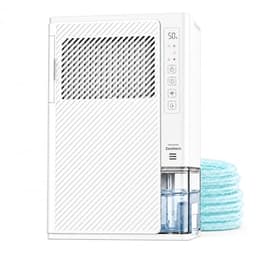
A desiccant wheel at a compressor price, which is the trade this category rarely offers - and it buys cold-weather operation with a 340 W heater rather than efficiency.
Average draw
340 W
Stated on the listing as a 340 W heat-based system. Desiccant dehumidifiers are not represented in the ENERGY STAR certified dehumidifier list at all - the program covers refrigerant units - so there is no certified figure to compute and no IEF to compare. 340 W for a stated peak of 10 pints a day is roughly a third of the water per watt that a certified 50-pint compressor manages at its own test condition, which is the honest cost of working in the cold.
What is good
- No coil means no icing, so it keeps working at temperatures that stall a compressor
- Light and small enough to actually move between a shed, a garage and a closet
- Publishes a wattage, which almost nothing in this category does
- Tank or continuous hose, with the hose in the box
What is not
- 340 W for 10 pints a day is poor water-per-watt next to any compressor unit above freezing
- The capacity figure is a lab peak, not a DOE test-condition rating, so it is not comparable to a pint number on a compressor box
- It warms the room - that is how the technology works, and the listing says so
- The listing copy is unusually aggressive marketing, which is not a reason to avoid it but is a reason to read the numbers rather than the adjectives
Who it is for
Someone drying a small unheated space - a shed, a boat, a garage in shoulder season - where a compressor unit would ice up and a mini Peltier box would do nothing.
Skip it if
Skip it for a heated basement. Above about 60F a 50-pint compressor removes five times the water for barely more power, and the running cost gap is not close.
AlorAir
AlorAir Sentinel HD55 Crawl Space Dehumidifier
Best for: A crawl space you cannot stand up in
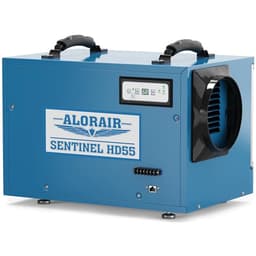
The clearest example on this site of why the number on the box is not the number that matters: sold as 113 pints, certified at 36.33.
Average draw
344 W
Computed from the ENERGY STAR certified entry ALORAIR Sentinel HD55S: 36.33 pt/day at IEF 2.08 L/kWh, 379 kWh a year. The retail listing is the HD55; the certified entry carries the S suffix. At IEF 2.08 it is more efficient than the median 50-pint portable while removing about three quarters as much water.
What is good
- Built low and flat to fit between floor joists, which no portable unit does
- Auto defrost and low-temperature operation, both essential in an unheated crawl space
- IEF 2.08 is above the 50-pint class median of 2.01 despite the smaller capacity
- No tank at all, so there is nothing to forget to empty
What is not
- The 113-pint headline is a saturation figure at 95F and 90% RH; the DOE-condition rating is 36.33
- 1,200 sq ft coverage, less than most 50-pint portables claim, for considerably more money
- Needs a drain or a condensate pump - there is no bucket fallback
Who it is for
Crawl spaces, low-clearance basements and unheated storage where a standing portable will not fit or will freeze.
Skip it if
Skip it for a normal basement. A 50-pint portable removes more water at the DOE condition for less money; you are paying for the form factor and the temperature range.
Why desiccant comes first here
The top pick on this page is a desiccant unit, which is unusual for a room that is hot rather than cold. Three reasons, and none of them is efficiency:
- It is the only one that states a ceiling. 104F is a number you can compare against a thermometer in your own attic. Nothing else here offers one.
- It has no compressor. The failure mode a hot attic threatens is a compressor running outside its envelope. A desiccant wheel and a heater do not have that particular problem.
- It is small and light enough to get up there. A 44 lb portable up a drop-down ladder is a genuinely bad afternoon, and an attic hatch is not a doorway.
The cost, as always with desiccant, is water per watt. These units draw real power for modest extraction - the AEOCKY states 340 W for a peak of 10 pints a day - and they warm the space they are drying, which in an attic is the opposite of what you want. That trade is why this page is short on enthusiasm and long on conditions. Desiccant or compressor.
Getting the water out of an attic
The drainage problem in an attic is the reverse of a basement's, and it is the part people underestimate. In a basement the drain is usually at or below the machine and gravity does the work. In an attic you are above everything, which sounds ideal - until you look for somewhere for a hose to actually go.
- A gravity hose needs a continuous fall to a drain, through the building. That usually means dropping into a wall cavity or a soil stack, which is a plumbing job rather than a hose job.
- A bucket in an attic is a bad idea for the same reason a bucket anywhere unattended is a bad idea, plus the ceiling underneath it. If you run a bucket machine up there, run it on a unit with a reliable auto shut-off and check it.
- The pump option matters less here than anywhere else on this site, because you are already at the top of the house. What you need is a route down, not a lift up. Continuous drain setup.
When the answer is not a dehumidifier
- Blocked soffit vents. Clear them. This is the most common attic moisture fault and it costs nothing to fix.
- Air leaking up from the house. Warm damp indoor air escaping through gaps around light fittings and the loft hatch condenses on cold roof timbers. Sealing the ceiling plane is the fix; drying the attic afterwards is treating the symptom.
- A bathroom fan venting into the attic. It happens more than it should, and no dehumidifier is going to win against it.
- Storing specific things. If you are protecting boxes rather than the building, a sealed container with rechargeable desiccant beats a machine fighting a vented space. Dehumidifiers for gun safes covers that approach.
What we would skip
Any dehumidifier in a vented attic that has a ventilation problem
ENERGY STAR's own guidance on attics is that summer airflow through a well-vented attic 'moves super-heated air out of the attic, protecting roof shingles and removing moisture'. If the soffit vents are blocked with insulation - the single most common attic fault there is - a dehumidifier is being asked to dry outdoor air that is being continuously replaced. It will run forever and cost a fortune. Clear the vents first; the machine is for the attic that is sealed and conditioned, not the one that is supposed to breathe and cannot.
What we did not do
We have not put a dehumidifier in an attic, measured an attic temperature, or tested any unit above its stated range. The single ceiling figure on this page is quoted from one manufacturer's listing, and the absence of ceilings everywhere else is reported as an absence rather than filled in. Where we could not source a widely repeated attic temperature figure, we left it out. How we work.
FAQ
Questions
Should I put a dehumidifier in my attic?
Can a dehumidifier get too hot in an attic?
What size dehumidifier do I need for an attic?
Why is my attic damp in winter?
Is a desiccant dehumidifier better for an attic?
Sources
Sources
- About Attic Ventilation - ENERGY STAR, stating that in summer natural airflow in a well-vented attic moves super-heated air out of the attic, protecting roof shingles and removing moisture, and warning against blocking soffit vents (retrieved 2026-09-21)
- Ivation 19 Pint Small-Area Desiccant Dehumidifier, IVADDH09 - Amazon.com listing stating operation from 33F to 104F and naming bathroom, attic, crawlspace and closets (retrieved 2026-09-21)
- GoveeLife Dehumidifier H7151 - Amazon.com listing whose drainage bullet states that 'even attics can be easily dehumidified' (retrieved 2026-09-21)
Read next
- The best crawl space dehumidifiersFour crawl space options, and the 3.1x gap between the pint number on the box and the certified one.
- Desiccant or compressor?11.8 pints against 2.9 at 41F, and the crossover point where the obvious answer stops being right.
- Setting up a continuous drainA five-step method, the plastic cap that causes most failures, and the sag that causes the rest.
- The best dehumidifiers for condensationCondensation is a cold surface meeting a high dew point. Four units, and the cases where glass is the real problem.
- The best dehumidifiers for moldA dehumidifier removes the humidity mold needs - it does not kill mold. Five units ranked on unattended running and cold-room performance.
- Ivation 19 Pint DesiccantThe one technology that does not lose to the cold - and the one unit here with no published efficiency data at all.