Drainage / Pillar guide
Setting up a continuous drain
Twenty minutes of work that turns a machine you empty twice a day into one you look at twice a year. Most of the failures come from two mistakes, and one of them is a plastic cap.
#adThis page contains affiliate links. We earn a commission on qualifying purchases, at no cost to you, and it never changes a ranking. Full disclosure.
The short answer
Find a drain lower than the machine's outlet, remove the cap from the threaded drain port, fit a hose, and run it downhill continuously with no sags. If the only drain is higher than the unit, gravity will not work and you need a pump model instead.
Step 1 - find the destination
Before touching the machine, decide where the water is going. In a basement the candidates, roughly in order of preference:
- A floor drain. The ideal - below floor level, designed for water, usually central.
- A sump pit. Excellent, and often closer than the floor drain. Keep the hose end above the pit's high-water mark so it cannot siphon back into the machine. Units with a usable gravity port.
- A laundry standpipe. Works if the machine sits high enough or the standpipe is low, which it usually is not - this is often a pump job.
- Out through the rim joist or a window well. Fine in warm weather. In winter the outlet freezes and backs the line up, so this is a seasonal solution.
- A condensate pump you already own. If a gravity route does not exist, an external pump is far cheaper than replacing the dehumidifier.
Measure the vertical difference between the machine's outlet and the destination. The outlet sits a few inches off the floor on most portables, so a destination at floor level is only just below it - the fall over the whole run may be an inch or two, which is enough but leaves no margin for a sag.
Step 2 - the cap
On most units the cap is inside the recess behind a removable panel, or is a knurled plug on the port itself. Keep it somewhere you will find it again - you need it back if you ever revert to bucket operation.
Step 3 - the hose
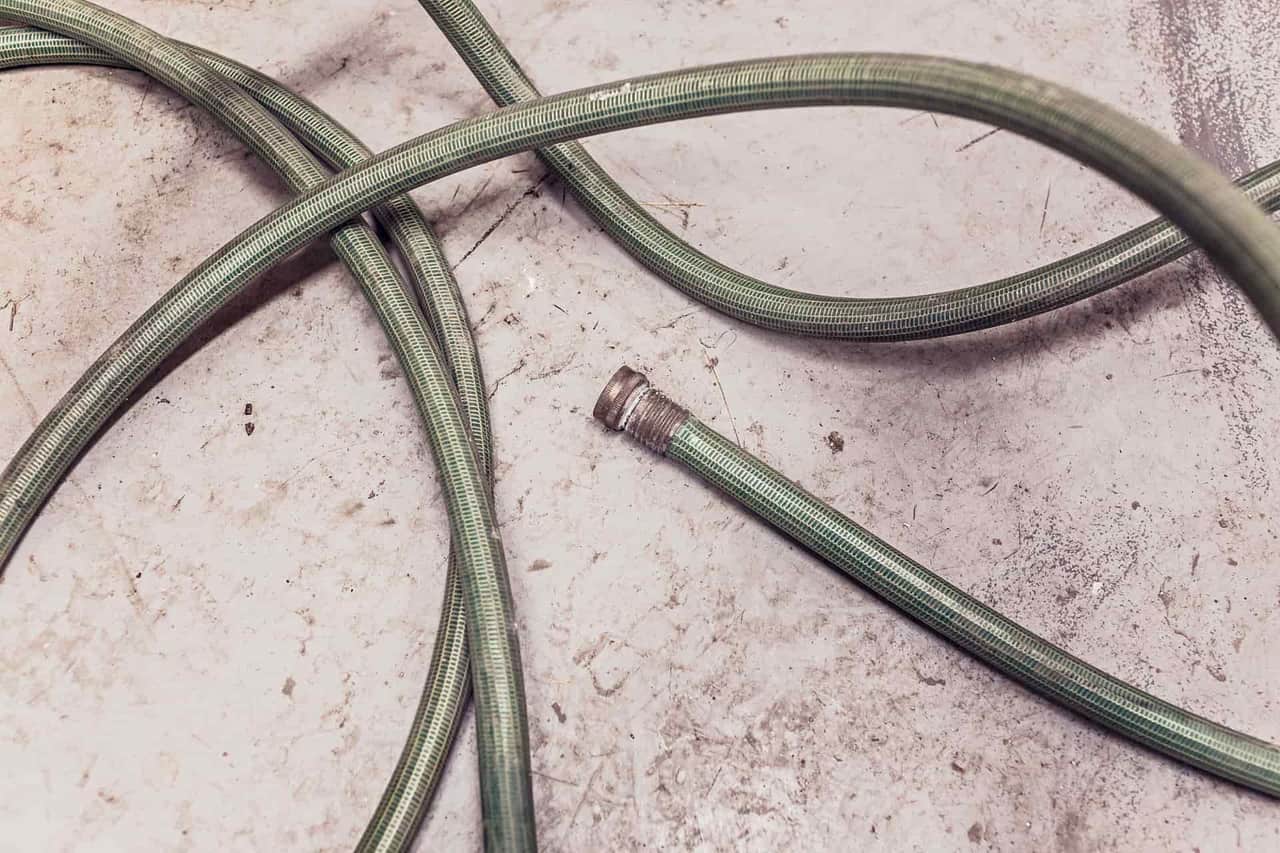
Most US portable dehumidifiers use a threaded outlet that accepts a standard garden hose fitting, which is why so many end up drained with a length of green hose. It works, and it is what the manufacturers expect.
Two alternatives are usually better. Clear vinyl tubing sized to the port is soft, has no coil memory, and lets you see a blockage. A short length of washing-machine hose is stiffer but has proper fittings and will not kink. Whatever you use, keep it as short as the route allows - every extra foot is another chance for a sag. Hose sizes and adapters.
Step 4 - the route, which is where it goes wrong
The hose must fall continuously from the port to the destination. Not on average. Continuously. A single low spot holds a plug of water, the plug blocks the line, condensate backs up into the tray, and either the float trips and the unit stops or the tray overflows.
- 1No loops. Do not coil the excess - cut it.
- 2No sags across an open floor. A hose lying loose on concrete will find a low spot. Tape it to the floor along a wall, or support it every few feet.
- 3Nothing goes up, ever. Not over a step, not over a pipe, not up onto a shelf. If the route requires going up, gravity is not your drainage system.
- 4Keep the outlet end out of the water. Submerged in a sump or a bucket, it can siphon or simply not drain.
- 5Leave the machine level. A unit tilted away from its outlet will pool water in the tray no matter how good the hose route is.
Step 5 - test it before you walk away
Run the machine on its highest fan speed with the humidity target set well below the current room reading, so it definitely runs. Come back in an hour. There should be water at the destination and none in the bucket. If the bucket has water in it, the hose is not draining and something upstream is wrong - go back to the cap.
Then check again in a week. Most drainage problems appear over days rather than minutes: the hose settles into a sag, the outlet end drifts into standing water, or the machine gets nudged out of level.
Quick picks
| # | Product | Best for | Draw | Price |
|---|---|---|---|---|
| 1 |  Midea Cube 50 Pint DehumidifierThe only unit here that solves the real basement problem, which is not capacity but where the water goes when you are not standing next to it. Midea Cube 50 Pint DehumidifierThe only unit here that solves the real basement problem, which is not capacity but where the water goes when you are not standing next to it. | A basement you visit once a month | 487 W | |
| 2 |  Frigidaire 50 Pint Dehumidifier with Wi-FiFrigidaire's current no-pump 50-pint: certified by exact model number, Wi-Fi equipped, and a 2.7 gallon bucket that is among the largest of any 50-pint unit we track. Frigidaire 50 Pint Dehumidifier with Wi-FiFrigidaire's current no-pump 50-pint: certified by exact model number, Wi-Fi equipped, and a 2.7 gallon bucket that is among the largest of any 50-pint unit we track. | A Frigidaire with a drain below it | 488 W | $308.14View on Amazon #ad Price as of October 17, 2026. How we are funded |
| 3 |  GE 50 Pint DehumidifierGE's current no-pump 50-pint, with a 30 percent humidistat floor and Smart Dry fan control - and no ENERGY STAR claim on the listing, which is the change worth noticing. GE 50 Pint DehumidifierGE's current no-pump 50-pint, with a 30 percent humidistat floor and Smart Dry fan control - and no ENERGY STAR claim on the listing, which is the change worth noticing. | A garage or shop with a floor drain | Not published |
Midea
Midea Cube 50 Pint Dehumidifier
Best for: A basement you visit once a month
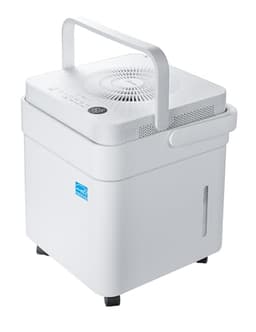
The only unit here that solves the real basement problem, which is not capacity but where the water goes when you are not standing next to it.
Average draw
487 W
Computed from the ENERGY STAR certified entry for Midea MAD50S1QWT-A, the 50 pt / 4,500 sq ft Cube without a pump: 49.67 pt/day at IEF 2.01 L/kWh. Midea's own US product page confirms MAD50S1QWT-A is this configuration. Midea publishes no wattage on the Amazon listing or on that page.
What is good
- The body separates, so the tank half can sit lower than the compressor half and the hose gets a genuine downhill run
- Certified at 49.67 pt/day, which is a real 50-pint machine rather than a saturation number
- IEF 2.01 L/kWh puts it exactly on the median for the 50-pint class - neither a bargain nor a penalty
- Wi-Fi that tells you it has stopped, which is the only smart feature that matters in a basement
What is not
- No pump, so the drain has to run downhill the whole way
- Midea publishes no wattage anywhere, so the 487 W above is computed rather than quoted
- The 4,500 sq ft coverage claim is marketing, not a spec - see the sizing guide
Who it is for
Someone with a floor drain, a sump, or a window well lower than the machine, who wants to set it once and stop thinking about it.
Skip it if
Skip it if the only drain in the room is higher than the unit. Without a pump, gravity is the entire drainage system, and no setting fixes an uphill hose.
Frigidaire
Frigidaire 50 Pint Dehumidifier with Wi-Fi
Best for: A Frigidaire with a drain below it
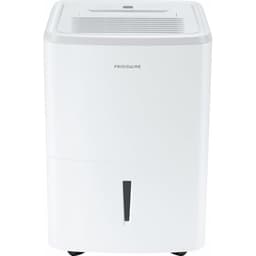
Frigidaire's current no-pump 50-pint: certified by exact model number, Wi-Fi equipped, and a 2.7 gallon bucket that is among the largest of any 50-pint unit we track.
Average draw
488 W
Computed from the ENERGY STAR certified entry for Frigidaire FHDD5034Y1 - the same model number as this listing: 49.71 pt/day at IEF 2.01 L/kWh. Frigidaire's Canadian product page states 115 V, 8.8 A and 470 W; those figures do not reconcile with each other and are nameplate rather than average values, so 488 W is the running-cost figure.
What is good
- Exact certified model match, so the 488 W figure describes this machine rather than a sibling
- 2.7 gallon bucket - roughly ten hours of condensate at full rated capacity if you ever run it without a hose
- Continuous drain, three fan speeds and operation down to 41F
- Wi-Fi and the Frigidaire app for scheduling and remote control
What is not
- Gravity only. The drain must be below the machine
- The Wi-Fi depends on Frigidaire's app remaining supported
- Frigidaire's own published wattage and amperage do not agree with each other
Who it is for
Someone with a floor drain who wants a certified, well-documented 50-pint unit and has a use for scheduling.
Skip it if
Skip it if the only drain is above the machine. That is the one job a gravity unit cannot do, whatever else it has.
GE
GE 50 Pint Dehumidifier
Best for: A garage or shop with a floor drain
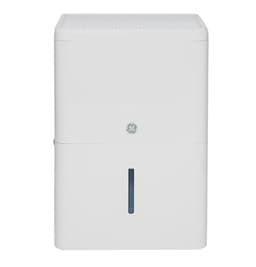
GE's current no-pump 50-pint, with a 30 percent humidistat floor and Smart Dry fan control - and no ENERGY STAR claim on the listing, which is the change worth noticing.
Average draw
Not published
Not published by GE. The ADHE50 series does not appear by name in the ENERGY STAR certified list and this listing makes no ENERGY STAR claim - its predecessor did. The certified 50-pint class runs 443-490 W with a median of 488 W, and a non-certified unit is more likely to sit at the top of that band than below it.
What is good
- Humidistat sets down to 30 percent where most units stop at 35 or 40
- Smart Dry adjusts fan speed to room humidity rather than running flat out
- Bucket-full alarm sounds for ten seconds rather than only lighting an icon
- Clean-filter alert, which is the maintenance nobody remembers to do
What is not
- No ENERGY STAR certification claimed, and no certified entry to compute a draw from
- Gravity drainage only
- A 5,000 sq ft coverage claim, up from its predecessor's 4,000 on the same capacity - a reminder that coverage claims are not a spec
Who it is for
A garage, workshop or utility room with a floor drain, where a low humidistat floor is useful and efficiency certification is not the deciding factor.
Skip it if
Skip it if it will run all season and efficiency matters. A certified 50-pint unit costs about $8 a month less by ENERGY STAR's own figure.
If none of this works for your room
Then the destination is higher than the machine and you need a pump - either a dehumidifier with one built in, or an external condensate pump sitting under the outlet. Both work. The built-in is tidier and the external is far cheaper than replacing a working unit. Pump versus gravity.
FAQ
Questions
Can I use a garden hose to drain a dehumidifier?
Why is my dehumidifier still filling its bucket with a hose attached?
How far can a dehumidifier drain by gravity?
Can I drain a dehumidifier into a floor drain?
Sources
Sources
Read next
- Pump or gravity: decide this before anything elseA five-minute test that eliminates half the market, and the middle option most buyers miss.
- Hoses, threads and adaptersWhich hose, which adapters, and the four fittings that turn a working drain into a leak.
- The continuous drain has stopped workingSeven checks in order of likelihood, and the two that solve most cases without a tool.
- The best dehumidifiers for a basementFive basement units ranked on drainage first, with computed running costs and a unit we would not buy.
- There is water on the floorUnplug it, then six causes in order. Most are the drain rather than the machine.
- The best dehumidifiers with a drain hoseFive units with a usable gravity port, and the one check that decides whether a hose works in your room.