Drainage / Comparison
Pump or gravity: decide this before anything else
It is the only dehumidifier specification that can make a machine unusable in your room rather than merely suboptimal, and it eliminates about half the market either way.
#adThis page contains affiliate links. We earn a commission on qualifying purchases, at no cost to you, and it never changes a ranking. Full disclosure.
The short answer
If the place you want the water to go is lower than the machine's drain port, use gravity - a hose, no pump, nothing to fail. If it is higher, you need a built-in condensate pump or an external one. Nothing else about the machine changes this.
The five-minute test
- 1Stand where the dehumidifier will live.
- 2Find the nearest place water can legitimately go: floor drain, sump pit, standpipe, utility sink, window well, outside wall.
- 3Look at the height of that destination against the height of the machine's drain port, which sits a few inches off the floor.
- 4Lower? Gravity. Buy the cheapest unit that meets your capacity requirement and spend nothing on a pump.
- 5Higher? Pump. About half the units in any listing are now off your list.
That is the whole decision, and it is worth making before you look at capacity, brand, price or reviews - because a machine that cannot reach your drain is the wrong machine at any specification.
The trade, in a table
| Gravity | Built-in pump | External pump | |
|---|---|---|---|
| Destination must be | Below the outlet | Anywhere within the pump's reach | Anywhere within the pump's reach |
| Extra purchase cost | None | Typically a meaningful premium | Modest, and reusable |
| Extra running cost | None | Negligible - runs in short bursts | Negligible |
| Things that can fail | The hose route | Pump, float, reservoir | Pump, float, reservoir, plus a second plug |
| Failure mode | Backs up, unit stops | Unit stops, or tray overflows depending on design | Reservoir overflows |
| Maintenance | Check the hose once a season | Clean the reservoir yearly | Clean the reservoir yearly |
The efficiency column is missing on purpose: it does not exist. Midea's certified pump and non-pump 50-pint Cube revisions both compute to about 487 W, so the pump costs nothing to run.
Why gravity is genuinely better where it works
It is not just cheaper. A gravity drain is silent, has no moving parts, cannot fail in a way that puts water on the floor, and works during a partial fault that would stop a pump. In a basement with a floor drain, adding a pump is buying complexity you will never use.
The one caveat is that gravity is unforgiving about the route. A pump will push water through a hose with a sag in it; gravity will not. See continuous drain setup for the routing rules.
What to demand from a pump model
A published reach. This is the disclosure gap in the category and it is worth being blunt about: of the seven pump units in our registry, three state a lift - GE 15 vertical feet, Quilo 15 feet, AlorAir's crawl space unit 19.6 feet - and one, the Midea Cube, states only a 16 foot drain tube. Frigidaire, Hisense and hOmeLabs state nothing. The Hisense reference sets out how that silence should weigh against the rest of a machine's specification, which is the judgement you are left making.
A hose run and a lift height are different constraints - sixteen feet across a flat floor is easy, sixteen feet going twelve feet up is not. Where a maker states neither, keep the vertical rise short and the run direct. Pump lift and distance.

Quick picks
| # | Product | Best for | Draw | Price |
|---|---|---|---|---|
| 1 |  Midea Cube 50 Pint Dehumidifier with PumpThe stacking Midea Cube with a condensate pump added, which is the difference between a hose you can run and a hose you cannot. Midea Cube 50 Pint Dehumidifier with PumpThe stacking Midea Cube with a condensate pump added, which is the difference between a hose you can run and a hose you cannot. | A basement whose only drain is upstairs | 487 W | $248.89View on Amazon #ad Price as of October 16, 2026. How we are funded |
| 2 |  Midea Cube 50 Pint DehumidifierThe only unit here that solves the real basement problem, which is not capacity but where the water goes when you are not standing next to it. Midea Cube 50 Pint DehumidifierThe only unit here that solves the real basement problem, which is not capacity but where the water goes when you are not standing next to it. | A basement you visit once a month | 487 W | |
| 3 |  Frigidaire 50 Pint Dehumidifier with Wi-FiFrigidaire's current no-pump 50-pint: certified by exact model number, Wi-Fi equipped, and a 2.7 gallon bucket that is among the largest of any 50-pint unit we track. Frigidaire 50 Pint Dehumidifier with Wi-FiFrigidaire's current no-pump 50-pint: certified by exact model number, Wi-Fi equipped, and a 2.7 gallon bucket that is among the largest of any 50-pint unit we track. | A Frigidaire with a drain below it | 488 W | $310.63View on Amazon #ad Price as of October 16, 2026. How we are funded |
| 4 |  GE 50 Pint Dehumidifier with PumpGE states both numbers a pump buyer needs - 15 feet of vertical lift and a 16 foot hose - which is the most complete pump specification of any 50-pint unit we track. GE 50 Pint Dehumidifier with PumpGE states both numbers a pump buyer needs - 15 feet of vertical lift and a 16 foot hose - which is the most complete pump specification of any 50-pint unit we track. | A lift and a hose length, both in writing | Not published |
Midea
Midea Cube 50 Pint Dehumidifier with Pump
Best for: A basement whose only drain is upstairs
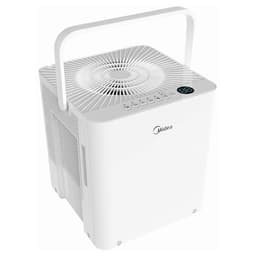
The stacking Midea Cube with a condensate pump added, which is the difference between a hose you can run and a hose you cannot.
Average draw
487 W
Computed from the ENERGY STAR certified entry for Midea MAD50PS1QWT-A, the pump variant of the same platform: 49.67 pt/day at IEF 2.01 L/kWh. The listing prints the unsuffixed MAD50PS1QWT, so the certified string carries a suffix the box does not; every Midea 50-pint revision in the certified list, pump or not, computes to 487-490 W, so neither the suffix nor the pump moves the number meaningfully. The pump itself only runs in bursts.
What is good
- Pump means the destination can be higher than the machine - a laundry sink, a window, a stack
- Identical DOE capacity and IEF to the non-pump Cube, so the pump costs you nothing in efficiency
- The split body still works, so you can also run it on gravity and keep the pump as the backup
- Certified 49.67 pt/day, an honest 50-pint rating
What is not
- Costs more than the identical machine without the pump
- A pump is one more thing that can fail, and when it does the unit stops rather than overflows
- No published wattage from Midea - the figure above is computed
Who it is for
Anyone whose drain is above the floor. That is most finished basements and nearly every crawl space.
Skip it if
Skip it if you already have a floor drain within hose reach and below the machine. You would be paying for a pump you will never switch on.
Midea
Midea Cube 50 Pint Dehumidifier
Best for: A basement you visit once a month
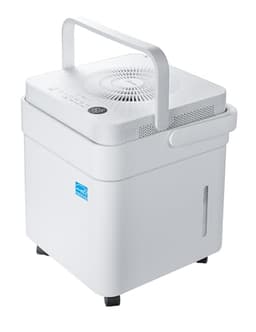
The only unit here that solves the real basement problem, which is not capacity but where the water goes when you are not standing next to it.
Average draw
487 W
Computed from the ENERGY STAR certified entry for Midea MAD50S1QWT-A, the 50 pt / 4,500 sq ft Cube without a pump: 49.67 pt/day at IEF 2.01 L/kWh. Midea's own US product page confirms MAD50S1QWT-A is this configuration. Midea publishes no wattage on the Amazon listing or on that page.
What is good
- The body separates, so the tank half can sit lower than the compressor half and the hose gets a genuine downhill run
- Certified at 49.67 pt/day, which is a real 50-pint machine rather than a saturation number
- IEF 2.01 L/kWh puts it exactly on the median for the 50-pint class - neither a bargain nor a penalty
- Wi-Fi that tells you it has stopped, which is the only smart feature that matters in a basement
What is not
- No pump, so the drain has to run downhill the whole way
- Midea publishes no wattage anywhere, so the 487 W above is computed rather than quoted
- The 4,500 sq ft coverage claim is marketing, not a spec - see the sizing guide
Who it is for
Someone with a floor drain, a sump, or a window well lower than the machine, who wants to set it once and stop thinking about it.
Skip it if
Skip it if the only drain in the room is higher than the unit. Without a pump, gravity is the entire drainage system, and no setting fixes an uphill hose.
Frigidaire
Frigidaire 50 Pint Dehumidifier with Wi-Fi
Best for: A Frigidaire with a drain below it
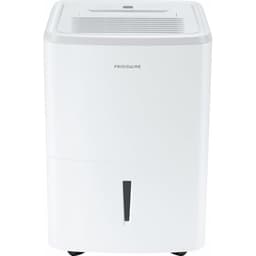
Frigidaire's current no-pump 50-pint: certified by exact model number, Wi-Fi equipped, and a 2.7 gallon bucket that is among the largest of any 50-pint unit we track.
Average draw
488 W
Computed from the ENERGY STAR certified entry for Frigidaire FHDD5034Y1 - the same model number as this listing: 49.71 pt/day at IEF 2.01 L/kWh. Frigidaire's Canadian product page states 115 V, 8.8 A and 470 W; those figures do not reconcile with each other and are nameplate rather than average values, so 488 W is the running-cost figure.
What is good
- Exact certified model match, so the 488 W figure describes this machine rather than a sibling
- 2.7 gallon bucket - roughly ten hours of condensate at full rated capacity if you ever run it without a hose
- Continuous drain, three fan speeds and operation down to 41F
- Wi-Fi and the Frigidaire app for scheduling and remote control
What is not
- Gravity only. The drain must be below the machine
- The Wi-Fi depends on Frigidaire's app remaining supported
- Frigidaire's own published wattage and amperage do not agree with each other
Who it is for
Someone with a floor drain who wants a certified, well-documented 50-pint unit and has a use for scheduling.
Skip it if
Skip it if the only drain is above the machine. That is the one job a gravity unit cannot do, whatever else it has.
GE
GE 50 Pint Dehumidifier with Pump
Best for: A lift and a hose length, both in writing
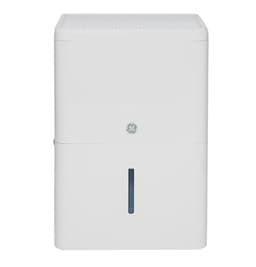
GE states both numbers a pump buyer needs - 15 feet of vertical lift and a 16 foot hose - which is the most complete pump specification of any 50-pint unit we track.
Average draw
Not published
Not published by GE. The ADHE50 series does not appear by name in the ENERGY STAR certified list and this listing makes no ENERGY STAR claim - its predecessor did. The certified 50-pint class runs 443-490 W with a median of 488 W; adding a pump does not change capacity or IEF on the certified units that have one.
What is good
- States a vertical lift and a hose length separately - the two constraints a pump route actually has
- The listing tells you when to choose the pump model, which is more guidance than most makers give
- Humidistat down to 30 percent, a 24-hour timer and Smart Dry fan control
- Bucket-full alarm and clean-filter alert
What is not
- No ENERGY STAR certification claimed, so there is no certified figure to compute running cost from
- 15 pint bucket is smaller than several rivals, which matters if the pump ever stops
- 5,000 sq ft coverage claim, up from 4,000 on its predecessor for the same capacity
Who it is for
Someone whose drain is up a wall or across a room and who wants the limits of the pump stated before buying rather than discovered after.
Skip it if
Skip it if the discharge point is more than 15 feet above the unit or needs more than the included 16 feet of hose. Those are the limits GE put in writing.
The middle option most people miss
An external condensate pump is a small box with a reservoir and a float switch that sits under the dehumidifier's gravity outlet and pumps the water wherever you need it. It costs a fraction of the premium for a built-in pump model, it is reusable when you replace the dehumidifier, and it can be serviced or replaced without touching the machine.
Two downsides. It is a second box and a second plug, which in a tidy basement corner matters. And when it fails, it overflows its own reservoir rather than shutting the dehumidifier down - so it wants siting somewhere a small spill is not a disaster.
If you already own a gravity-only dehumidifier you are happy with, this is almost always the right answer. Replacing a working machine to gain a built-in pump rarely makes economic sense.
FAQ
Questions
Do I need a dehumidifier with a pump?
Does a built-in pump use more electricity?
Can I add a pump to a dehumidifier that does not have one?
What happens if the pump fails?
Sources
Sources
Read next
- Setting up a continuous drainA five-step method, the plastic cap that causes most failures, and the sag that causes the rest.
- How far will the pump actually push it?Three of seven pump models state a lift. What they say, and how to plan when a maker states nothing.
- The best dehumidifiers with a built-in pumpFive pump-equipped units, ranked partly on which makers will state what their pump can actually reach.
- The best dehumidifiers for a basementFive basement units ranked on drainage first, with computed running costs and a unit we would not buy.
- The continuous drain has stopped workingSeven checks in order of likelihood, and the two that solve most cases without a tool.
- AlorAir Sentinel HDi65SThe pump makes a crawl space install possible - and it is the one AlorAir with no certified efficiency data.
- The best dehumidifiers with a drain hoseFive units with a usable gravity port, and the one check that decides whether a hose works in your room.
- The best dehumidifiers for a laundry roomA spun wash load holds about 4.7 pints of water and the sink is on the wall. Four pump-first picks for laundry rooms.