Reviews / Hisense
Hisense 50 Pint with Pump
On the certified numbers this is an ordinary 50-pint machine, which is not a criticism - the whole class is. What separates it is the warranty term and a stated operating floor three degrees below everyone else's.
#adThis page contains affiliate links. We earn a commission on qualifying purchases, at no cost to you, and it never changes a ranking. Full disclosure.

The short answer
ENERGY STAR certifies the ADH50KP26 at 49.95 pints a day and an Integrated Energy Factor of 2.01, which computes to 490 W - the middle of the 50-pint class. It has a built-in pump with a quick-connect hose, three modes, three fan speeds, a stated operating floor of 38F, and a two-year parts and labor warranty where most portables carry one year.
The warranty is the specification that separates it
Almost every portable dehumidifier in this category ships with a one-year warranty. Hisense's own limited warranty document for portable air conditioners and dehumidifiers sets the period out in one line - 'Two (2) years for parts and labor' - running from the date of original purchase. Hisense's product page for its 50-pint pump model repeats it, and the retailers that publish a term for this model number list two years. The Amazon listing, like most, states nothing.
That matters more here than it would on most appliances, and the reason is specific to this category. The part that ends a dehumidifier's life is the sealed refrigeration system, and it cannot be opened without recovery equipment and EPA Section 608 certification. On a portable at this price the labor alone approaches the cost of the machine, so a sealed-system fault outside warranty is usually the end of it. A second year of cover is a second year in which that failure is Hisense's problem rather than yours.
One detail in that document is worth reading before you count on it. The stated remedy is that Hisense will, at its sole discretion, provide a like-new or refurbished product of similar or better quality - a replacement, not necessarily a repair of the machine you own. For a sealed-system failure that is arguably the better outcome. It does mean the warranty promises you a working dehumidifier, not your dehumidifier.
It is also the only durability signal in this category that is actually published. Nobody releases failure-rate data for portable dehumidifiers, we have not run these machines for years, and any site ranking them on reliability is presenting an impression as a measurement. The warranty term is a contractual commitment you can read. Budget picks, costed over a season makes the same argument at more length.
The certified numbers, and what they do not say
The ADH50KP26 appears in the ENERGY STAR certified list under that exact model number - which means the running-cost figure below describes this machine rather than a sibling, something several units on this site cannot claim.
| Field | Value |
|---|---|
| Water removal capacity (DOE, 65F / 60% RH) | 49.95 pt/day |
| Integrated Energy Factor | 2.01 L/kWh |
| Average draw (computed) | 490 W |
| Estimated annual energy use | 526 kWh/yr |
| Refrigerant | HFC-32, GWP 675 |
| ENERGY STAR Most Efficient | No |
| Certified | 6 January 2026 |
| Certifying partner | Hisense (Guangdong) Air Conditioning Co. Ltd |
From the ENERGY STAR Certified Dehumidifiers product list, retrieved 2026-09-19. The 490 W is computed from the capacity and IEF above using the formula on the methodology page.
IEF 2.01 is simultaneously the floor and the norm of this class, which is the part worth understanding. Across the 165 certified portable units between 45 and 55 pints, efficiency runs from 2.01 to 2.24 - and 124 of them, three quarters of the class, are certified at exactly 2.01. The minimum is where almost everyone builds. So this machine is not efficient and it is not wasteful; it is where the category is, and the handful of units above 2.10 are the genuine exceptions.
One number that looks worse than it is
526 kWh/yr
ENERGY STAR estimated annual use - the highest of the certified 50-pint units we track
Against 504 for the Quilo, 515 for the Midea Cube, 520 for the Frigidaire pump model and 521 for the Frigidaire continuous-drain model. All five are certified at IEF 2.01. From the ENERGY STAR certified list, retrieved 2026-09-19.
Read carelessly that looks like the Hisense being the thirstiest of the group. It is not, and the explanation is worth understanding because it applies to every annual-use figure on every yellow label you will ever read.
All five are certified at the same published efficiency - IEF 2.01 - and at capacities within a third of a pint of each other. The whole spread from 504 to 526 kWh is about four percent, and it comes from small differences in capacity and from where each unit falls inside the rounding of that 2.01, not from one machine converting electricity into dry air noticeably better than another. The annual figure estimates energy consumed. The IEF measures efficiency. They are different questions and only the second one ranks machines.
Put the gap in money and it stops being an argument: 22 kWh at the US average residential rate of 18.34 cents is about four dollars a year. The hours you run the machine and the rate your utility charges move your actual bill by multiples of that. If you want to compare efficiency, compare IEF; if you want to compare bills, start with runtime. ENERGY STAR and IEF.
Hisense ADH50KP26, certified
(490 W / 1000) x 12 h x $0.1834/kWh = $1.08 per day
0.490
kWh per hour
$32.83
per month, 12 h/day
$65.65
per month, 24 h/day
Rate is the US residential average of 18.34 cents/kWh from the EIA Electric Power Monthly, June 2026. Yours will differ - use the calculator.
Quick picks
| # | Product | Best for | Draw | Price |
|---|---|---|---|---|
| 1 |  Hisense 50 Pint Dehumidifier with PumpA certified 50-pint pump unit that claims operation down to 38F - lower than the 41F most compressor units state - which is the specification that matters in a cold basement. Hisense 50 Pint Dehumidifier with PumpA certified 50-pint pump unit that claims operation down to 38F - lower than the 41F most compressor units state - which is the specification that matters in a cold basement. | A cold basement where the pump has to keep working | 490 W | $309.00View on Amazon #ad Price as of September 20, 2026. How we are funded |
| 2 |  Quilo 50 Pint Dehumidifier with PumpA certified 50-pint pump unit that puts its pump reach in writing - 15 feet, vertically or horizontally - and adds a laundry-drying mode nothing else we track offers. Quilo 50 Pint Dehumidifier with PumpA certified 50-pint pump unit that puts its pump reach in writing - 15 feet, vertically or horizontally - and adds a laundry-drying mode nothing else we track offers. | A laundry room or basement with the drain up a wall | 487 W | $269.99View on Amazon #ad Price as of September 20, 2026. How we are funded |
| 3 | 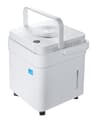 Midea Cube 50 Pint Dehumidifier with PumpThe stacking Midea Cube with a condensate pump added, which is the difference between a hose you can run and a hose you cannot. Midea Cube 50 Pint Dehumidifier with PumpThe stacking Midea Cube with a condensate pump added, which is the difference between a hose you can run and a hose you cannot. | A basement whose only drain is upstairs | 487 W |
Hisense
Hisense 50 Pint Dehumidifier with Pump
Best for: A cold basement where the pump has to keep working
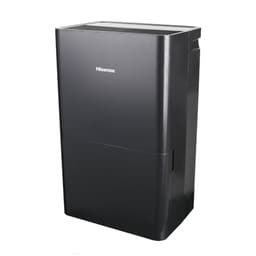
A certified 50-pint pump unit that claims operation down to 38F - lower than the 41F most compressor units state - which is the specification that matters in a cold basement.
Average draw
490 W
Computed from the ENERGY STAR certified entry for Hisense ADH50KP26 - the same model number as this listing: 49.95 pt/day at IEF 2.01 L/kWh. Hisense publishes no wattage on the listing.
What is good
- Claims operation down to 38F, three degrees below the usual compressor floor
- Exact certified model match, so the 490 W figure describes this machine
- Quick-connect hose included for the pump
- Three operating modes and three fan speeds, including an auto fan setting
What is not
- No pump lift, hose length or bucket capacity stated on the listing
- No Wi-Fi or app mentioned
- Below about 38F it is still a compressor unit, and a desiccant machine is the right tool
Who it is for
Someone with a cool basement or garage and a drain above the machine, where a few degrees of extra low-temperature headroom decides whether the unit keeps working in spring and autumn.
Skip it if
Skip it if your pump route is long or tall. Hisense does not state a lift, where GE and Quilo state 15 feet.
Quilo
Quilo 50 Pint Dehumidifier with Pump
Best for: A laundry room or basement with the drain up a wall
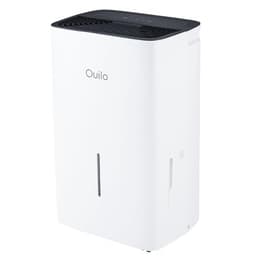
A certified 50-pint pump unit that puts its pump reach in writing - 15 feet, vertically or horizontally - and adds a laundry-drying mode nothing else we track offers.
Average draw
487 W
Computed from the ENERGY STAR certified entry for Quilo QLDAD50PWK - the same model number as this listing: 49.67 pt/day at IEF 2.01 L/kWh. Quilo publishes no wattage itself.
What is good
- States its pump reach - up to 15 feet vertically or horizontally - with the drain tube included
- Exact certified model match, so the 487 W figure describes this machine
- Dedicated laundry mode dries clothes and the room at the same time
- Child lock, thermal overload protection, auto defrost and a clean-filter alert
What is not
- Tank capacity is not stated on the listing
- No Wi-Fi or app is mentioned, so no remote alerts if the pump stops
- A newer brand name with no long track record under this name
Who it is for
Someone who needs a pump to reach a sink or window up to 15 feet away, especially in a laundry room where the drying mode earns its place.
Skip it if
Skip it if you want to be told on your phone when something stops. Nothing on the listing mentions connectivity.
Midea
Midea Cube 50 Pint Dehumidifier with Pump
Best for: A basement whose only drain is upstairs
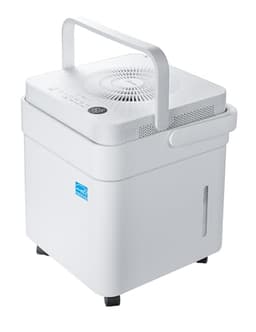
The stacking Midea Cube with a condensate pump added, which is the difference between a hose you can run and a hose you cannot.
Average draw
487 W
Computed from the ENERGY STAR certified entry for Midea MAD50PS1QWT-A, the pump variant of the same platform: 49.67 pt/day at IEF 2.01 L/kWh. The current retail revision is the -B; every Midea 50-pint Cube revision in the certified list, pump or not, computes to 487-490 W, so the pump does not move the number meaningfully. The pump itself only runs in bursts.
What is good
- Pump means the destination can be higher than the machine - a laundry sink, a window, a stack
- Identical DOE capacity and IEF to the non-pump Cube, so the pump costs you nothing in efficiency
- The split body still works, so you can also run it on gravity and keep the pump as the backup
- Certified 49.67 pt/day, an honest 50-pint rating
What is not
- Costs more than the identical machine without the pump
- A pump is one more thing that can fail, and when it does the unit stops rather than overflows
- No published wattage from Midea - the figure above is computed
Who it is for
Anyone whose drain is above the floor. That is most finished basements and nearly every crawl space.
Skip it if
Skip it if you already have a floor drain within hose reach and below the machine. You would be paying for a pump you will never switch on.
38F, and what a stated floor is actually worth
Every compressor dehumidifier condenses water on a chilled coil. As the room cools, that coil has to run colder to keep condensing, and at some point it ices faster than the defrost cycle can clear it - at which point the machine spends its day defrosting rather than drying.
Hisense states this unit operates down to 38F on the listing, its own product page for the sibling 50-pint pump model repeats it, and the retailers that publish a temperature range for this model number carry the same figure. That is the lowest stated floor of any unit in our registry. Frigidaire states 41F on both its current 50-pint models and the Pro Breeze mini stops below 41F; no other maker we track commits to a number at all, which is its own kind of answer.

Three degrees sounds trivial and in a heated basement it is. It matters in exactly one situation: an unheated space in spring and autumn that hovers around 40F, where a machine with a 41F floor is at its limit and this one is not. If your space spends real time below 38F, no compressor unit is the answer and a desiccant machine is. Desiccant versus compressor.
What Hisense does not publish
Three gaps, and the first one is the one that should decide whether you buy a pump model at all:
| Specification | Published? | Note |
|---|---|---|
| Pump lift or hose length | No | The listing says the pump routes water to a sink or window with an included quick-connect hose, and stops there. GE states 15 vertical feet and a 16 ft hose; Quilo states 15 feet |
| Bucket capacity | No | Not on the listing or on Hisense's own product pages |
| Noise level | No | Three fan speeds are listed; no dBA figure for any of them |
| Wattage | No | Normal for the category - the 490 W above is computed from certified data |
| Coverage | Yes - 4,500 sq ft | A marketing figure, as every coverage claim is |
| Low-temperature floor | Yes - 38F | The lowest stated in our registry |
| Warranty | Yes - 2 years parts and labor | Twice the category norm |
The missing pump figure is the important one. If your drain is a sink four feet up a wall it is probably fine; if the route has real height in it, buy a model that commits to a number. Pump lift and distance.
Who actually makes it
A fair question for a brand most American buyers know from televisions. The ENERGY STAR certification for this model is held by Hisense (Guangdong) Air Conditioning Co. Ltd - the air-conditioning arm of the Hisense group, not a licensee trading on the name. That is a checkable fact from the certification record rather than a marketing claim, and it is the honest answer to a question people reasonably ask.
One naming oddity we cannot explain: the listing calls it a Lift-Up portable dehumidifier and never says what Lift-Up refers to. We are not going to guess.
Who should buy something else
- Anyone whose drain is below the machine. A pump is cost and a moving part you do not need. A gravity unit with a hose runs indefinitely with nothing to fail. Pump versus gravity.
- Anyone whose pump route has real height in it. Hisense states no lift. Quilo states 15 feet and is certified at 487 W; GE states 15 vertical feet plus a 16 ft hose.
- Anyone who wants app control or alerts. Nothing on the listing mentions Wi-Fi, so a pump that stops overnight will not tell you.
- Anyone whose space is genuinely cold. 38F is a floor, not a comfort zone. Below it, a desiccant unit is the machine that keeps working.
- Anyone who needs a bucket figure before buying. If you will ever run it without the pump, that unpublished number is the one you would want.
What we did not do
We have not run this unit. No extraction test, no power meter, no sound measurement, and no check of how far the pump will actually push. Every figure above is either quoted from the listing and Hisense's own pages or computed from the ENERGY STAR certified record, with the sources below. Where Hisense publishes nothing, this page says so rather than filling the gap with a sibling model's number. How we work.
FAQ
Questions
Is Hisense a good dehumidifier brand?
How many watts does the Hisense 50 pint dehumidifier use?
What is the warranty on a Hisense dehumidifier?
Who makes Hisense dehumidifiers?
How high can the Hisense dehumidifier pump water?
Will the Hisense work in a cold basement?
Sources
Sources
- Hisense 50-Pint Lift-Up Portable Dehumidifier with Built-In Pump, ADH50KP26 - Amazon.com listing stating the built-in pump with included quick-connect hose, three modes, three fan speeds, operation to 38F, ENERGY STAR, 24.8 x 15.1 x 10.7 in, 40.3 lb (retrieved 2026-09-19)
- ENERGY STAR Certified Dehumidifiers list - Hisense ADH50KP26: 49.95 pt/day, IEF 2.01 L/kWh, 526 kWh/yr, HFC-32 (GWP 675), certified 6 January 2026, partner Hisense (Guangdong) Air Conditioning Co. Ltd (retrieved 2026-09-19)
- Hisense USA product page for its 50-pint built-in pump dehumidifier - two year warranty on parts and labor, operation at temperatures as low as 38F (retrieved 2026-09-19)
- Ace Hardware listing - Hisense 4500 sq ft 50 pt Dehumidifier with Pump, Mfr# ADH50KP26 (retrieved 2026-09-16)
- Limited Warranty for Hisense Portable Air Conditioners and Dehumidifiers, Hisense USA Corporation - warranty periods section: 'Air Conditioners & Dehumidifiers: Two (2) years for parts and labor'; remedy stated as a like-new or refurbished product at Hisense's sole discretion (retrieved 2026-09-19)
- Beach Audio product page for Hisense ADH50KP26 - retailer warranty term listed as 2 Year Limited (retrieved 2026-09-19)
- EIA Electric Power Monthly, Table 5.6.A, June 2026 - the electricity rate used
Read next
- The best dehumidifiers with a built-in pumpFive pump-equipped units, ranked partly on which makers will state what their pump can actually reach.
- How far will the pump actually push it?Three of seven pump models state a lift. What they say, and how to plan when a maker states nothing.
- Quilo 50 Pint with PumpA certified 487 W pump unit that states its reach - 15 feet, up or across - and adds a laundry mode.
- The best dehumidifiers for a laundry roomA spun wash load holds about 4.7 pints of water and the sink is on the wall. Four pump-first picks for laundry rooms.
- Desiccant or compressor?11.8 pints against 2.9 at 41F, and the crossover point where the obvious answer stops being right.
- IEF, and what an ENERGY STAR badge is worthWhat IEF measures, what it replaced, the real spread across 527 models, and what the badge saves.