Best / Roundup
The best dehumidifiers for a cold room
Every compressor dehumidifier has a temperature below which it stops being a dehumidifier and starts being a de-icer. Most makers will not tell you where that point is. Four will.
#adThis page contains affiliate links. We earn a commission on qualifying purchases, at no cost to you, and it never changes a ranking. Full disclosure.

The short answer
Below roughly 41F a compressor dehumidifier ices faster than it can defrost. The Hisense 50-pint pump model states the lowest compressor floor we have found at 38F, Frigidaire states 41F, and the Ivation 19-pint desiccant states a 33F to 104F range. Below the high 30s, a desiccant unit is not a preference - it is the only technology that keeps working.
Why cold breaks a compressor dehumidifier
A compressor dehumidifier is a small refrigerator with the door left open. Warm damp air passes over a coil chilled below the dew point, water condenses on the coil and runs into a bucket, and the dried air goes back out over the warm coil. It is elegant, it is cheap, and it depends on one condition: the coil has to be colder than the dew point but warm enough that the condensate stays liquid.
As the room cools, that gets harder. The coil has to run colder to keep condensing, and at some point the water freezes on it instead of running off. Ice insulates the coil, the machine stops collecting, and the defrost cycle kicks in: the compressor stops, the fan runs, the ice melts. Then it starts again. In a genuinely cold room a compressor unit can spend the majority of its day in that loop - drawing power, moving air, removing very little water.
Who actually states a number
| Unit | Type | Stated range | What it means in practice |
|---|---|---|---|
| Ivation 19 Pint Desiccant | Desiccant | 33F to 104F | The lowest published floor here, and the only unit that states a ceiling too |
| AEOCKY X1-Pro | Desiccant | 'Never frost', no figure | No coil to ice, but no committed number either |
| Hisense 50 Pint with Pump | Compressor | Down to 38F | The lowest stated floor of any compressor unit we track |
| Frigidaire 50 Pint | Compressor | Down to 41F | Stated on both current Frigidaire 50-pint models |
| Pro Breeze Electric Mini | Peltier | 59F to 86F, stops below 41F | Honest, and it rules the unit out of every cold space |
| AlorAir Sentinel HD55 | Compressor | Not stated | Auto defrost and 'low-temperature operation', with no figure attached |
| Everything else we track | Compressor | Not stated | Twenty-five units, no published floor |
Read from each current listing on 2026-09-21. 'Not stated' is the majority answer in this category, which is the single most useful thing to know before buying for an unheated space.
How we picked
- A published low-temperature figure, taken from the maker's own listing. No figure, no place at the top of this page.
- The technology, because below a certain point it is the only thing that matters: a desiccant wheel has no cold coil and therefore nothing to ice.
- What the machine does as it approaches its floor - auto defrost is table stakes, and a unit that spends most of its cycle defrosting is not removing water.
- Certified DOE capacity and computed draw where a model match exists, so a cold-room unit is still measured as a dehumidifier.
- What we did not do: we have not run any of these units in a cold room, measured extraction at low temperature, or verified a single floor claim with a thermometer.
We did not test these units. The full criteria and their weighting are on the methodology page.
Quick picks
| # | Product | Best for | Draw | Price |
|---|---|---|---|---|
| 1 |  Hisense 50 Pint Dehumidifier with PumpA certified 50-pint pump unit that claims operation down to 38F - lower than the 41F most compressor units state - which is the specification that matters in a cold basement. Hisense 50 Pint Dehumidifier with PumpA certified 50-pint pump unit that claims operation down to 38F - lower than the 41F most compressor units state - which is the specification that matters in a cold basement. | A cold basement where the pump has to keep working | 490 W | $309.00View on Amazon #ad Price as of September 21, 2026. How we are funded |
| 2 |  Ivation 19 Pint Desiccant DehumidifierThe only technology here that does not lose to the cold, which makes it the right answer in exactly the rooms where a compressor is the wrong one. Ivation 19 Pint Desiccant DehumidifierThe only technology here that does not lose to the cold, which makes it the right answer in exactly the rooms where a compressor is the wrong one. | An unheated garage in winter | Not published | $299.99View on Amazon #ad Price as of September 21, 2026. How we are funded |
| 3 |  AEOCKY X1-Pro Rotary Desiccant DehumidifierA desiccant wheel at a compressor price, which is the trade this category rarely offers - and it buys cold-weather operation with a 340 W heater rather than efficiency. AEOCKY X1-Pro Rotary Desiccant DehumidifierA desiccant wheel at a compressor price, which is the trade this category rarely offers - and it buys cold-weather operation with a 340 W heater rather than efficiency. | A cold room where a compressor would spend the day defrosting | 340 W | $129.99View on Amazon #ad Price as of September 21, 2026. How we are funded |
| 4 |  Frigidaire 50 Pint Dehumidifier with Wi-FiFrigidaire's current no-pump 50-pint: certified by exact model number, Wi-Fi equipped, and a 2.7 gallon bucket that is among the largest of any 50-pint unit we track. Frigidaire 50 Pint Dehumidifier with Wi-FiFrigidaire's current no-pump 50-pint: certified by exact model number, Wi-Fi equipped, and a 2.7 gallon bucket that is among the largest of any 50-pint unit we track. | A Frigidaire with a drain below it | 488 W | $319.00View on Amazon #ad Price as of September 21, 2026. How we are funded |
| 5 |  AlorAir Sentinel HD55 Crawl Space DehumidifierThe clearest example on this site of why the number on the box is not the number that matters: sold as 113 pints, certified at 36.33. AlorAir Sentinel HD55 Crawl Space DehumidifierThe clearest example on this site of why the number on the box is not the number that matters: sold as 113 pints, certified at 36.33. | A crawl space you cannot stand up in | 344 W |
Hisense
Hisense 50 Pint Dehumidifier with Pump
Best for: A cold basement where the pump has to keep working
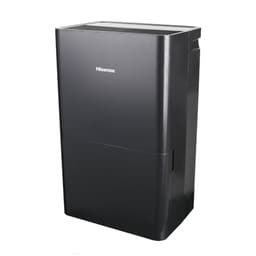
A certified 50-pint pump unit that claims operation down to 38F - lower than the 41F most compressor units state - which is the specification that matters in a cold basement.
Average draw
490 W
Computed from the ENERGY STAR certified entry for Hisense ADH50KP26 - the same model number as this listing: 49.95 pt/day at IEF 2.01 L/kWh. Hisense publishes no wattage on the listing.
What is good
- Claims operation down to 38F, three degrees below the usual compressor floor
- Exact certified model match, so the 490 W figure describes this machine
- Quick-connect hose included for the pump
- Three operating modes and three fan speeds, including an auto fan setting
What is not
- No pump lift, hose length or bucket capacity stated on the listing
- No Wi-Fi or app mentioned
- Below about 38F it is still a compressor unit, and a desiccant machine is the right tool
Who it is for
Someone with a cool basement or garage and a drain above the machine, where a few degrees of extra low-temperature headroom decides whether the unit keeps working in spring and autumn.
Skip it if
Skip it if your pump route is long or tall. Hisense does not state a lift, where GE and Quilo state 15 feet.
Ivation
Ivation 19 Pint Desiccant Dehumidifier
Best for: An unheated garage in winter
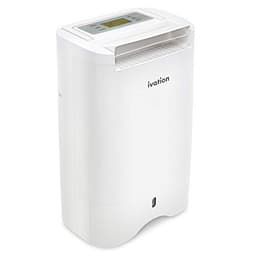
The only technology here that does not lose to the cold, which makes it the right answer in exactly the rooms where a compressor is the wrong one.
Average draw
Not published
Not published, and desiccant units are not represented in the ENERGY STAR certified dehumidifier list, which covers compressor portables and whole-home units. Desiccant machines use a resistive heater to regenerate the rotor, so their draw is roughly flat with temperature rather than falling off with it - the opposite trade to a compressor. We will not print a number for this one without a published source.
What is good
- Keeps extracting at temperatures where a compressor's coil ices and its output collapses
- No compressor, so it is quieter and lighter than any refrigerant unit here
- Continuous drain hose included
- Warm, dry exhaust, which is useful in a cold room and a nuisance in a warm one
What is not
- No published wattage, and desiccant units are generally less efficient than compressors at normal room temperature
- 410 sq ft coverage - this is a small-space machine
- It heats the room, which is the last thing a summer basement needs
Who it is for
Unheated garages, boats, sheds and crawl spaces in winter, where a compressor unit spends its time defrosting.
Skip it if
Skip it for a warm summer basement. Above roughly 65F a compressor removes more water per kWh, and the desiccant's waste heat works against you.
AEOCKY
AEOCKY X1-Pro Rotary Desiccant Dehumidifier
Best for: A cold room where a compressor would spend the day defrosting
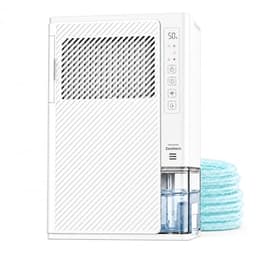
A desiccant wheel at a compressor price, which is the trade this category rarely offers - and it buys cold-weather operation with a 340 W heater rather than efficiency.
Average draw
340 W
Stated on the listing as a 340 W heat-based system. Desiccant dehumidifiers are not represented in the ENERGY STAR certified dehumidifier list at all - the program covers refrigerant units - so there is no certified figure to compute and no IEF to compare. 340 W for a stated peak of 10 pints a day is roughly a third of the water per watt that a certified 50-pint compressor manages at its own test condition, which is the honest cost of working in the cold.
What is good
- No coil means no icing, so it keeps working at temperatures that stall a compressor
- Light and small enough to actually move between a shed, a garage and a closet
- Publishes a wattage, which almost nothing in this category does
- Tank or continuous hose, with the hose in the box
What is not
- 340 W for 10 pints a day is poor water-per-watt next to any compressor unit above freezing
- The capacity figure is a lab peak, not a DOE test-condition rating, so it is not comparable to a pint number on a compressor box
- It warms the room - that is how the technology works, and the listing says so
- The listing copy is unusually aggressive marketing, which is not a reason to avoid it but is a reason to read the numbers rather than the adjectives
Who it is for
Someone drying a small unheated space - a shed, a boat, a garage in shoulder season - where a compressor unit would ice up and a mini Peltier box would do nothing.
Skip it if
Skip it for a heated basement. Above about 60F a 50-pint compressor removes five times the water for barely more power, and the running cost gap is not close.
Frigidaire
Frigidaire 50 Pint Dehumidifier with Wi-Fi
Best for: A Frigidaire with a drain below it
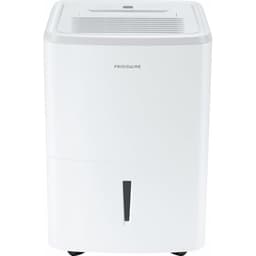
Frigidaire's current no-pump 50-pint: certified by exact model number, Wi-Fi equipped, and a 2.7 gallon bucket that is among the largest of any 50-pint unit we track.
Average draw
488 W
Computed from the ENERGY STAR certified entry for Frigidaire FHDD5034Y1 - the same model number as this listing: 49.71 pt/day at IEF 2.01 L/kWh. Frigidaire's Canadian product page states 115 V, 8.8 A and 470 W; those figures do not reconcile with each other and are nameplate rather than average values, so 488 W is the running-cost figure.
What is good
- Exact certified model match, so the 488 W figure describes this machine rather than a sibling
- 2.7 gallon bucket - roughly ten hours of condensate at full rated capacity if you ever run it without a hose
- Continuous drain, three fan speeds and operation down to 41F
- Wi-Fi and the Frigidaire app for scheduling and remote control
What is not
- Gravity only. The drain must be below the machine
- The Wi-Fi depends on Frigidaire's app remaining supported
- Frigidaire's own published wattage and amperage do not agree with each other
Who it is for
Someone with a floor drain who wants a certified, well-documented 50-pint unit and has a use for scheduling.
Skip it if
Skip it if the only drain is above the machine. That is the one job a gravity unit cannot do, whatever else it has.
AlorAir
AlorAir Sentinel HD55 Crawl Space Dehumidifier
Best for: A crawl space you cannot stand up in
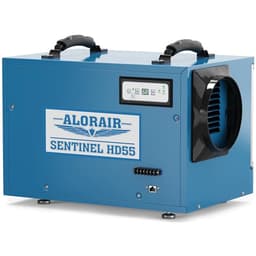
The clearest example on this site of why the number on the box is not the number that matters: sold as 113 pints, certified at 36.33.
Average draw
344 W
Computed from the ENERGY STAR certified entry ALORAIR Sentinel HD55S: 36.33 pt/day at IEF 2.08 L/kWh, 379 kWh a year. The retail listing is the HD55; the certified entry carries the S suffix. At IEF 2.08 it is more efficient than the median 50-pint portable while removing about three quarters as much water.
What is good
- Built low and flat to fit between floor joists, which no portable unit does
- Auto defrost and low-temperature operation, both essential in an unheated crawl space
- IEF 2.08 is above the 50-pint class median of 2.01 despite the smaller capacity
- No tank at all, so there is nothing to forget to empty
What is not
- The 113-pint headline is a saturation figure at 95F and 90% RH; the DOE-condition rating is 36.33
- 1,200 sq ft coverage, less than most 50-pint portables claim, for considerably more money
- Needs a drain or a condensate pump - there is no bucket fallback
Who it is for
Crawl spaces, low-clearance basements and unheated storage where a standing portable will not fit or will freeze.
Skip it if
Skip it for a normal basement. A 50-pint portable removes more water at the DOE condition for less money; you are paying for the form factor and the temperature range.
The three-degree question
38F
The lowest operating floor any compressor unit we track will put in writing
Hisense, on the ADH50KP26 listing, retrieved 2026-09-21. Frigidaire states 41F on both its current 50-pint models. No other compressor maker in our registry states a figure at all. The full Hisense reference.
Three degrees sounds like nothing, and in a heated basement it is nothing. It matters in exactly one place: an unheated space in spring and autumn that hovers around 40F. At that temperature a machine with a 41F floor is at its limit and a machine with a 38F floor is not. That is a narrow window, but it is the window most people are actually shopping for when they type 'low temperature dehumidifier'.
It is also worth saying plainly: 38F is a floor, not a comfort zone. A compressor unit at 39F is working, but it is working badly, defrosting often and removing a fraction of its rated water. If your space spends real time in the 30s, the honest answer is not a better compressor.
Where desiccant stops being an alternative and starts being the answer
A desiccant dehumidifier has no refrigeration circuit. Air passes through a wheel of moisture-absorbing material, a heater drives the captured water back out of the wheel, and that moist air is condensed and drained. There is no cold coil anywhere in the machine, so there is nothing for ice to form on. That is why the Ivation can state 33F and why the AEOCKY can call itself 'never frost'.
The cost is efficiency, and it is not a small cost. The AEOCKY states 340 W for a peak of 10 pints a day. A certified 50-pint compressor removes five times the water for about 145 W more. Above roughly 60F that comparison is not close and you should buy the compressor. Below about 40F the comparison does not exist, because the compressor is not removing water at all.
There is a side effect worth knowing about rather than being surprised by: a desiccant unit warms the room it is drying, because the heater is part of how it works. In a cold garage in February most people count that as a feature. Desiccant or compressor goes through the full trade.
What to do about a space that is genuinely below freezing
- Check whether you have a humidity problem or a condensation problem. Cold air holds very little water. A 34F garage at 70% relative humidity contains less moisture than a 70F bedroom at 40%, and the damage you are seeing may be condensation on cold surfaces rather than high absolute humidity. Dehumidifiers for condensation.
- Consider whether ventilation is the cheaper fix. In an unheated outbuilding, moving air is sometimes worth more than drying it, and it costs nothing to run. Dehumidifier or just open a window.
- If you are protecting specific things, protect them rather than the room. A sealed container with rechargeable desiccant does more for a toolbox or a gun safe than a machine fighting an uninsulated space. Dehumidifiers for gun safes.
- If you do need a machine, buy desiccant and accept the running cost. It is the only technology in this category that works there at all.
What we would skip
Any compressor unit sold for a garage whose maker states no temperature floor
A dehumidifier bought for an unheated space is bought for exactly one property: that it keeps working when the room gets cold. If the maker will not state the temperature at which it stops, that property is unverified, and you find out in November. Of the 31 units we track, four publish a figure. The rest publish nothing, and 'has auto defrost' is not a figure - every compressor unit here has auto defrost.
What we did not do
We have not put any of these machines in a cold room, measured extraction at low temperature, timed a defrost cycle or checked a single floor claim against a thermometer. Every temperature figure on this page is quoted from the maker's own listing, and where a maker states nothing this page says so rather than estimating on their behalf. How we work.
FAQ
Questions
What temperature is too cold for a dehumidifier?
Will a dehumidifier work in an unheated garage in winter?
Does auto defrost mean a dehumidifier works in the cold?
Are desiccant dehumidifiers better for cold rooms?
Do desiccant dehumidifiers heat the room?
Sources
Sources
- Ivation 19 Pint Small-Area Desiccant Dehumidifier, model IVADDH09 - Amazon.com listing stating operation in temperatures from 33F to 104F and coverage up to 410 sq ft (retrieved 2026-09-21)
- Hisense 50-Pint Dehumidifier with Built-In Pump, ADH50KP26 - Amazon.com listing stating low-temperature operation down to 38F (retrieved 2026-09-21)
- AEOCKY X1-Pro Rotary Desiccant Dehumidifier - Amazon.com listing stating rotary desiccant technology, a 340 W heat-based system, a 10 pint/day peak in constant lab conditions and 'never frost' operation (retrieved 2026-09-21)
- ENERGY STAR Certified Dehumidifiers list - the certified file contains no desiccant dehumidifiers; the program covers refrigerant units (retrieved 2026-09-21)
Read next
- Desiccant or compressor?11.8 pints against 2.9 at 41F, and the crossover point where the obvious answer stops being right.
- The best dehumidifiers for a garageFive garage options and the temperature at which the obvious compressor choice becomes the wrong one.
- Hisense 50 Pint with PumpCertified 49.95 pints at 490 W, rated to 38F, and a two-year warranty where most portables give one.
- The coil has iced upNormal below 60F, a filter problem above it, and the one cause that is a warranty call.
- The best crawl space dehumidifiersFour crawl space options, and the 3.1x gap between the pint number on the box and the certified one.
- Ivation 19 Pint DesiccantThe one technology that does not lose to the cold - and the one unit here with no published efficiency data at all.