Best / Roundup
The best dehumidifiers for a gun safe
The honest version of this page starts with what we do not sell. A safe interior is a job for a rechargeable desiccant or a low-wattage rod; what an actual dehumidifier fixes is the room the safe stands in.
#adThis page contains affiliate links. We earn a commission on qualifying purchases, at no cost to you, and it never changes a ranking. Full disclosure.
The short answer
Most safe interiors are handled by a rechargeable silica desiccant canister or a low-wattage warming rod, neither of which is a dehumidifier and neither of which we sell. What a dehumidifier does is condition the room the safe stands in, which is the larger half of the problem because a safe is not vapor-tight and its interior follows the room.
Why a steel box is a hard case
Three things make a safe worse than the room it stands in, and none of them is about the safe being badly made.
- 1It is a large thermal mass in contact with the floor. A heavy steel body bolted to a concrete slab tracks the slab's temperature, which through spring and early summer runs several degrees below the room's air. Anything colder than the dew point of the air touching it collects water - the same mechanism as a window, applied to the inside of a box.
- 2It is sealed against smoke and prying, not against vapor. The fire seals that make a safe worth buying do not stop water vapor migrating in over hours and days. Every door opening exchanges the interior air wholesale.
- 3Nothing inside moves. Still air against a cool steel wall is exactly the condition that produces surface corrosion on bluing and spotting on leather, long before anything visible happens to the room.
What conditioning the room actually buys you
A great deal, because the interior follows the room. Hold the space at 45 to 50 percent and the air that enters every time the door opens is already dry, the steel is less likely to sit below the dew point, and whatever desiccant you keep inside lasts several times longer between recharges.
The EPA's recommended indoor band is 30 to 50 percent relative humidity, below 60 in all cases. That guidance is written for mold and biological growth rather than for steel, but the target lands in the same place: a room held under 50 percent is a room where condensation on a cool surface becomes unlikely. Ideal humidity settings.
| Location | The real problem | What helps |
|---|---|---|
| Basement corner, on slab | Cold floor and cold exterior wall; the worst case | Room dehumidifier plus clearance underneath and behind. A 30-pint unit is usually enough for a small basement room |
| Closet or small dedicated room | Still air, no ventilation, no drain | A small unit sized to the room, emptied on a schedule you will actually keep |
| Unheated garage or outbuilding | Cold enough that a compressor unit ices rather than dries | Desiccant, which has no cold coil to freeze. Garages |
| Conditioned living space | Usually nothing - the house is already in band | A hygrometer to confirm, and a desiccant canister inside the box. No appliance needed |
Measure before you buy. A hygrometer costs less than a takeaway meal and will tell you in three days whether you have a problem at all.
How we judged these picks
Every unit here is chosen for the space around a safe, sized to a small or cold room rather than to a basement:
- Footprint, because a safe room is usually a corner, a closet or a converted cupboard.
- Behavior in the cold, because the rooms safes live in are the cold ones. Below about 41F a compressor unit ices faster than the defrost cycle clears it, and a desiccant machine is the one that still works.
- Unattended running, since nobody visits a safe daily. A tank you have to empty every day is a tank that will sit full.
- Honest capacity, from the post-2019 DOE rating rather than a saturation headline. What the pint rating means.
Quick picks
| # | Product | Best for | Draw | Price |
|---|---|---|---|---|
| 1 |  Pro Breeze Electric Mini DehumidifierA thermoelectric unit that removes about one pint a day, which is roughly one fiftieth of a 50-pint machine and needs saying out loud before anyone buys one for a basement. Pro Breeze Electric Mini DehumidifierA thermoelectric unit that removes about one pint a day, which is roughly one fiftieth of a 50-pint machine and needs saying out loud before anyone buys one for a basement. | A wardrobe, and honestly not much more | Not published | $42.99View on Amazon #ad Price as of September 14, 2026. How we are funded |
| 2 |  Ivation 13 Pint Desiccant DehumidifierThe small desiccant, for spaces that are cold and enclosed rather than large and damp. Ivation 13 Pint Desiccant DehumidifierThe small desiccant, for spaces that are cold and enclosed rather than large and damp. | A cold closet, attic or bathroom | Not published | $269.99View on Amazon #ad Price as of September 14, 2026. How we are funded |
| 3 |  hOmeLabs 8 Pint DehumidifierA real compressor unit at a size where most competitors sell thermoelectric toys, which makes it the smallest machine here that actually removes meaningful water. hOmeLabs 8 Pint DehumidifierA real compressor unit at a size where most competitors sell thermoelectric toys, which makes it the smallest machine here that actually removes meaningful water. | A closet, a boat, or a single small room | Not published |
Pro Breeze
Pro Breeze Electric Mini Dehumidifier
Best for: A wardrobe, and honestly not much more
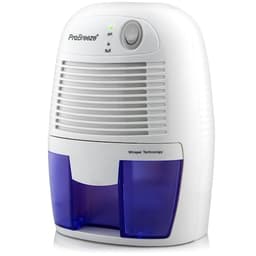
A thermoelectric unit that removes about one pint a day, which is roughly one fiftieth of a 50-pint machine and needs saying out loud before anyone buys one for a basement.
Average draw
Not published
Not published, and thermoelectric units are outside the ENERGY STAR dehumidifier program entirely. Peltier modules of this size draw far less than any compressor here - but less power and less water are the same fact, not two selling points. It removes 17 oz a day, which is 1.06 pints.
What is good
- Genuinely silent - there is no compressor to cycle on and off next to your head
- Small and light enough to sit on a shelf inside a wardrobe
- Auto shut-off when the 17 oz tank fills
- Cheap enough to buy two for two closets
What is not
- About one pint a day. A 50-pint unit removes fifty times as much
- Stops working below 41F, which rules out the unheated spaces people usually buy it for
- No drain option - the tank is the only outlet
Who it is for
A wardrobe, a gun safe, a bathroom cabinet, or a single small enclosed space with a musty smell.
Skip it if
Skip it for any room. This is the single most common mis-purchase in the category: it is not a small dehumidifier, it is a different class of device, and no number of them adds up to a basement machine.
Ivation
Ivation 13 Pint Desiccant Dehumidifier
Best for: A cold closet, attic or bathroom
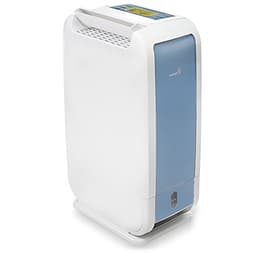
The small desiccant, for spaces that are cold and enclosed rather than large and damp.
Average draw
Not published
Not published. Not represented in the ENERGY STAR certified list, which does not cover desiccant units.
What is good
- Works in the cold, unlike every compressor unit on this site
- Small and light enough to move between an attic and a closet
- Continuous drain hose supported at this size, which the compressor minis do not offer
- Quiet - no compressor to cycle
What is not
- 270 sq ft is a genuinely small room
- No published wattage
- Warms the space it dries
Who it is for
Closets, attics, bathrooms and RV interiors in a cold climate.
Skip it if
Skip it if you need real capacity. Thirteen pints a day is a maintenance machine, not a recovery machine.
hOmeLabs
hOmeLabs 8 Pint Dehumidifier
Best for: A closet, a boat, or a single small room
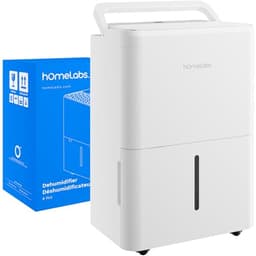
A real compressor unit at a size where most competitors sell thermoelectric toys, which makes it the smallest machine here that actually removes meaningful water.
Average draw
Not published
Not published. The certified 8-13 pint class runs 92-128 W with a median of 105 W across 39 models, and the median unit in that class uses 117 kWh a year.
What is good
- A compressor at 8 pints, so it keeps working where a Peltier unit stops
- Roughly a fifth of the power of a 50-pint machine
- Wi-Fi and auto shut-off, unusual at this size
- Small enough to sit in a wardrobe or a berth
What is not
- 1,800 sq ft coverage for 8 DOE pints is not a serious claim
- Bucket only - no continuous drain at this size
- Not ENERGY STAR certified, so no published IEF
Who it is for
Closets, gun safes, boat cabins, and single small rooms where a large machine is absurd.
Skip it if
Skip it for any room where you can feel the damp. Eight pints a day is a maintenance dose, not a cure.
What this costs to run
A small 20 to 22-pint unit in a safe room
(258 W / 1000) x 12 h x $0.1834/kWh = $0.57 per day
0.258
kWh per hour
$17.28
per month, 12 h/day
$34.57
per month, 24 h/day
Rate is the US residential average of 18.34 cents/kWh from the EIA Electric Power Monthly, June 2026. Yours will differ - use the calculator.
A thermoelectric mini is far below even that - on the order of 20 to 25 watts, or about a dollar a month running continuously. The desiccant option sits at the other end: it regenerates its rotor with a heater, publishes no wattage, and is the least efficient technology per liter removed. It is chosen for working in the cold, not for economy. Watts by size.
What we did not do
We have not opened a safe, measured interior humidity, or tested a desiccant canister. We have no relationship with any safe manufacturer. What this page contains is the published capacity and computed draw for each machine we do cover, the EPA's humidity guidance quoted with its source, and a clear statement of where our coverage stops. How we work.
What we would skip
Putting a compressor dehumidifier inside a safe
It will not fit, it needs a tank emptied, and it produces liquid water inside the one box you most want dry. Every machine on this page is for the space around the safe or, at most, a large walk-in vault - never the interior of a standing safe.
Any advice that skips the room and sells you a gadget
A safe is not sealed against water vapor. Its interior humidity tracks the room it stands in, with a lag. If the basement it lives in sits at 70 percent, anything you put inside the box is fighting a losing battle against the air that replaces it every time you open the door.
A dehumidifier as a substitute for moving the safe
A safe standing on a cold concrete slab against an exterior basement wall is in the worst possible place for condensation, and no machine changes the physics of that wall. A pallet or a rubber mat underneath and a few inches of clearance behind does more than most appliances.
How we picked
- Judged on conditioning the space a safe stands in, which is the part a dehumidifier can genuinely change.
- Physical size first - a safe usually sits in a closet, a basement corner or a small dedicated room.
- Low-temperature capability weighted, because a safe on a slab is in the coldest part of the house.
- Unattended running, since nobody visits a safe daily to empty a tank.
- Not tested by us. We do not sell desiccant canisters or rods and we make no recommendation about specific ones.
We did not test these units. The full criteria and their weighting are on the methodology page.
FAQ
Questions
What is the best dehumidifier for a gun safe?
What humidity should a gun safe be kept at?
Can you put a dehumidifier inside a gun safe?
Why does my gun safe get condensation?
Do I need a dehumidifier if my safe is in a heated living space?
Sources
Sources
Read next
- The best dehumidifiers for a closetOunces a day, not pints - and the first specification is whether there is an outlet at all.
- Desiccant or compressor?11.8 pints against 2.9 at 41F, and the crossover point where the obvious answer stops being right.
- The best dehumidifiers for a garageFive garage options and the temperature at which the obvious compressor choice becomes the wrong one.
- What to set it to45 to 50 percent, why lower is only more expensive, and the setting that doubles your bill.
- The best dehumidifiers for a basementFive basement units ranked on drainage first, with computed running costs and a unit we would not buy.