Best / Roundup
The best 30-pint dehumidifiers
A third less power than the basement machines, for rooms that are humid rather than wet. The trap is buying one for a room that needed the bigger unit.
#adThis page contains affiliate links. We earn a commission on qualifying purchases, at no cost to you, and it never changes a ranking. Full disclosure.

The short answer
A 30 to 32-pint dehumidifier draws about 318 watts, roughly 35% less than a 50-pint unit, and suits a bedroom, an apartment, a home office or a small basement that is humid rather than actively wet. It costs about $21 a month running 12 hours a day at the US average electricity rate.
Who this class is genuinely for
There is a real category of room here and it is bigger than people think: a space that smells slightly musty in August, where nothing is visibly wet and nothing is growing, but a hygrometer reads 62%. That room does not need a 50-pint compressor thumping away in the corner. It needs about 30 pints a day and quiet.
The efficiency case is real too. The certified 30-32 pint class averages 318 W against the 50-pint class's 488. Run 12 hours a day through a five-month damp season, that is a difference of about $55 - which on cheaper units is a meaningful fraction of the purchase price.
And who it is not for
If the floor is ever damp to the touch, if the walls sweat, if there is a white bloom on the block, or if the room has ever flooded, this is not the class. A dehumidifier that cannot reach its target humidity does not run at a reduced load - it runs flat out, forever, at its full draw. You get the worst of both: the smaller machine's capacity and none of its efficiency advantage.

Quick picks
| # | Product | Best for | Draw | Price |
|---|---|---|---|---|
| 1 |  hOmeLabs 32 Pint DehumidifierThe one hOmeLabs unit with a named entry in the ENERGY STAR list, so it is the one where the running cost is a published figure rather than a class estimate. hOmeLabs 32 Pint DehumidifierThe one hOmeLabs unit with a named entry in the ENERGY STAR list, so it is the one where the running cost is a published figure rather than a class estimate. | A bedroom that is damp but not wet | 318 W | |
| 2 |  Honeywell Smart Wi-Fi 30 Pint Dehumidifier (TP50AWKN)The anti-spill design is the actual selling point here, and it is a better reason to buy than the voice control the listing leads with. Honeywell Smart Wi-Fi 30 Pint Dehumidifier (TP50AWKN)The anti-spill design is the actual selling point here, and it is a better reason to buy than the voice control the listing leads with. | A room you want to run on a schedule | Not published | $311.16View on Amazon #ad Price as of October 17, 2026. How we are funded |
hOmeLabs
hOmeLabs 32 Pint Dehumidifier
Best for: A bedroom that is damp but not wet
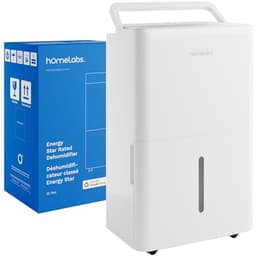
The one hOmeLabs unit with a named entry in the ENERGY STAR list, so it is the one where the running cost is a published figure rather than a class estimate.
Average draw
318 W
Computed from the ENERGY STAR certified entry hOmeLabs HME0089: 32.46 pt/day at IEF 2.01 L/kWh. This is the only hOmeLabs capacity in this registry with a named certified entry, which is why it is the only one carrying a number rather than a band.
What is good
- 318 W against the 50-pint class median of 488 W - about 35% less to run, hour for hour
- Named in the ENERGY STAR certified list, so its IEF is public
- Quiet enough for a bedroom in a way that a 50-pint compressor generally is not
- Wi-Fi and auto shut-off at a small-unit price
What is not
- 32 DOE pints is genuinely less water than 50 - undersizing a wet basement costs more than the machine saved
- Gravity drainage only
- 4,500 sq ft coverage for 32 pints is another claim to ignore
Who it is for
A bedroom, a home office, or a small basement that is humid rather than actively wet.
Skip it if
Skip it if the floor is ever damp to the touch or the walls sweat. That is a 50-pint problem, and a 32-pint machine will run continuously and still lose.
Honeywell
Honeywell Smart Wi-Fi 30 Pint Dehumidifier (TP50AWKN)
Best for: A room you want to run on a schedule
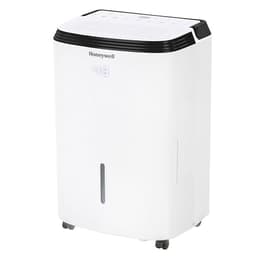
The anti-spill design is the actual selling point here, and it is a better reason to buy than the voice control the listing leads with.
Average draw
Not published
Not published. Honeywell's certified 32-pint entries, the TPFIT32AWK and TPFIT32WK, compute to 318 W at 32.46 pt/day and IEF 2.01. This is a different product line, so that figure sits in the note rather than in the spec table.
What is good
- Anti-spill bucket, which matters more than any app feature if the machine lives upstairs
- Scheduling through the app, so it can run when electricity is cheapest
- ENERGY STAR certified at a small-room capacity
- Alerts on the phone rather than only a beep in an empty room
What is not
- No published wattage, and the certified list carries a different Honeywell line
- 3,000 sq ft for 30 pints is an optimistic claim
- Depends on Honeywell's app remaining supported
Who it is for
An upstairs room or a rental where a spilled bucket is somebody's ceiling, and where scheduling is genuinely useful.
Skip it if
Skip it if the machine will sit on concrete next to a drain. You would be paying for spill protection and scheduling that a floor drain makes irrelevant.
The 30% setting, and why it is worth asking about
Most dehumidifiers will not set below 40% relative humidity. A few in this class go to 30%, and that sounds like a spec-sheet detail until you need it: drying out a space after a leak, keeping a storage room genuinely dry rather than merely comfortable, or protecting tools and paper. Waykar is the brand that has offered it most consistently, and both of its small units are stocked again on a 30 to 80 percent range - the 34-pint review documents what the feature actually buys you, including the gap between its headline and its certified capacity.
For ordinary living space it is not a feature you want to use. The EPA's guidance is to keep indoor humidity below 60% and ideally between 30 and 50; running a bedroom at 30% is dry enough to be uncomfortable and costs more to hold. Ideal humidity settings.
What we would skip
A 30-pint unit in a genuinely wet basement
This is the false economy of the category. An undersized machine never reaches its humidity target, so it never cycles off, so it runs at full draw all day and still loses. The 170 W you saved by not buying the 50-pint model gets spent several times over, and the basement stays damp.
Any unit here on bucket duty in a damp room
Tanks in this class run 0.62 to 0.66 gallons. At 30 pints a day that is roughly four hours before it is full. If there is nowhere to run a hose, you are signing up to empty it before work and after dinner, indefinitely.
How we picked
- Certified at 27 to 38 pints per day under the DOE procedure - the 30 to 35-pint band.
- Computed average draw where a named ENERGY STAR entry exists. The class runs 293 to 318 W.
- Tank size, because at this capacity most of these will be run on a bucket at least some of the time.
- How low the humidistat will set. Most stop at 40%; two of these go to 30%.
- Not tested by us. Figures quoted or computed, sources named.
We did not test these units. The full criteria and their weighting are on the methodology page.
FAQ
Questions
Is a 30-pint dehumidifier enough for a basement?
What was a 30-pint dehumidifier called before 2020?
How much does a 30-pint dehumidifier cost to run?
Sources
Sources
Read next
- The best dehumidifiers for a bedroomFour options for a room you sleep in, ranked on cycling behavior rather than a decibel figure nobody measured.
- The best dehumidifiers for an apartmentThree apartment-sized units chosen for tank ergonomics and run cost, because there is no floor drain.
- 30-pint versus 50-pint170 watts and $11 a month apart, with one failure mode that makes the cheaper machine cost more.
- What size dehumidifier do I need?A four-step method that uses measured humidity instead of the square-footage claim on the box.
- Dehumidifier running cost calculatorYour own rate, your own hours, and every default value shown on screen with its source.
- 20-pint versus 30-pint60 watts and $4 a month apart, with the efficiency running the other way. Where 20 pints genuinely works.
- Waykar 34 Pint ENERGY STARSets to 30% RH where most stop at 40 - and a 34-pint headline that is certified at 10.16.