Sizing / Comparison
30-pint versus 50-pint
A real $11 a month apart, and one failure mode that makes the cheaper machine the more expensive choice.
#adThis page contains affiliate links. We earn a commission on qualifying purchases, at no cost to you, and it never changes a ranking. Full disclosure.
The short answer
A 30-32 pint unit draws about 318 W against a 50-pint unit's 488, which is roughly $21 a month versus $32 at twelve hours a day. Choose the 30 for a room reading 60 to 68% humidity under about 1,500 sq ft. Choose the 50 for anything wetter, bigger, or below grade.
The two numbers, side by side
| 30-32 pint | 50 pint | Difference | |
|---|---|---|---|
| Certified models | 21 | 164 | - |
| Median draw | 318 W | 488 W | 170 W |
| Draw range | 293-318 W | 443-490 W | - |
| Median IEF | 2.01 L/kWh | 2.01 L/kWh | None |
| Median annual use | 343 kWh | 520 kWh | 177 kWh |
| Cost, 12 h/day, US average | $21.00/mo | $32.24/mo | $11.24/mo |
| Water removed per day | 30-32 pints | 50 pints | About 18 pints |
Note the identical median IEF. The larger machine is not less efficient at moving water - it moves more water per hour and costs more per hour to do it.
The failure mode that inverts the arithmetic
Everything above assumes both machines reach their humidity target and idle. That is what makes the comparison a straightforward trade of capacity against 170 watts.
An undersized machine never gets there. It runs continuously at full draw, twenty-four hours a day, and the room stays damp. At 318 W running permanently that is $42 a month - more than the correctly sized 50-pint unit costs at twelve hours - and you still have the problem you bought it to fix. What budget actually buys.
$42
Monthly cost of an undersized 30-pint unit running continuously
Against $32.24 for a correctly sized 50-pint unit at 12 hours a day. The cheaper machine costs more, and the room is still damp. Computed at the US average rate of 18.34 cents/kWh.
This is the whole argument for erring upward when you are unsure. Oversizing costs you slightly more per hour and some extra compressor cycling. Undersizing costs you more in absolute terms and does not solve the problem.

Quick picks
| # | Product | Best for | Draw | Price |
|---|---|---|---|---|
| 1 |  hOmeLabs 32 Pint DehumidifierThe one hOmeLabs unit with a named entry in the ENERGY STAR list, so it is the one where the running cost is a published figure rather than a class estimate. hOmeLabs 32 Pint DehumidifierThe one hOmeLabs unit with a named entry in the ENERGY STAR list, so it is the one where the running cost is a published figure rather than a class estimate. | A bedroom that is damp but not wet | 318 W | $234.99View on Amazon #ad Price as of October 16, 2026. How we are funded |
| 2 |  Midea Cube 50 Pint DehumidifierThe only unit here that solves the real basement problem, which is not capacity but where the water goes when you are not standing next to it. Midea Cube 50 Pint DehumidifierThe only unit here that solves the real basement problem, which is not capacity but where the water goes when you are not standing next to it. | A basement you visit once a month | 487 W | |
| 3 |  GE 50 Pint DehumidifierGE's current no-pump 50-pint, with a 30 percent humidistat floor and Smart Dry fan control - and no ENERGY STAR claim on the listing, which is the change worth noticing. GE 50 Pint DehumidifierGE's current no-pump 50-pint, with a 30 percent humidistat floor and Smart Dry fan control - and no ENERGY STAR claim on the listing, which is the change worth noticing. | A garage or shop with a floor drain | Not published |
hOmeLabs
hOmeLabs 32 Pint Dehumidifier
Best for: A bedroom that is damp but not wet
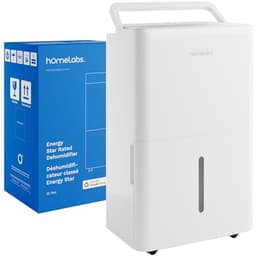
The one hOmeLabs unit with a named entry in the ENERGY STAR list, so it is the one where the running cost is a published figure rather than a class estimate.
Average draw
318 W
Computed from the ENERGY STAR certified entry hOmeLabs HME0089: 32.46 pt/day at IEF 2.01 L/kWh. This is the only hOmeLabs capacity in this registry with a named certified entry, which is why it is the only one carrying a number rather than a band.
What is good
- 318 W against the 50-pint class median of 488 W - about 35% less to run, hour for hour
- Named in the ENERGY STAR certified list, so its IEF is public
- Quiet enough for a bedroom in a way that a 50-pint compressor generally is not
- Wi-Fi and auto shut-off at a small-unit price
What is not
- 32 DOE pints is genuinely less water than 50 - undersizing a wet basement costs more than the machine saved
- Gravity drainage only
- 4,500 sq ft coverage for 32 pints is another claim to ignore
Who it is for
A bedroom, a home office, or a small basement that is humid rather than actively wet.
Skip it if
Skip it if the floor is ever damp to the touch or the walls sweat. That is a 50-pint problem, and a 32-pint machine will run continuously and still lose.
Midea
Midea Cube 50 Pint Dehumidifier
Best for: A basement you visit once a month
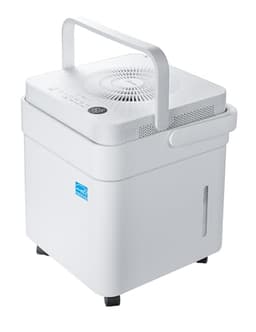
The only unit here that solves the real basement problem, which is not capacity but where the water goes when you are not standing next to it.
Average draw
487 W
Computed from the ENERGY STAR certified entry for Midea MAD50S1QWT-A, the 50 pt / 4,500 sq ft Cube without a pump: 49.67 pt/day at IEF 2.01 L/kWh. Midea's own US product page confirms MAD50S1QWT-A is this configuration. Midea publishes no wattage on the Amazon listing or on that page.
What is good
- The body separates, so the tank half can sit lower than the compressor half and the hose gets a genuine downhill run
- Certified at 49.67 pt/day, which is a real 50-pint machine rather than a saturation number
- IEF 2.01 L/kWh puts it exactly on the median for the 50-pint class - neither a bargain nor a penalty
- Wi-Fi that tells you it has stopped, which is the only smart feature that matters in a basement
What is not
- No pump, so the drain has to run downhill the whole way
- Midea publishes no wattage anywhere, so the 487 W above is computed rather than quoted
- The 4,500 sq ft coverage claim is marketing, not a spec - see the sizing guide
Who it is for
Someone with a floor drain, a sump, or a window well lower than the machine, who wants to set it once and stop thinking about it.
Skip it if
Skip it if the only drain in the room is higher than the unit. Without a pump, gravity is the entire drainage system, and no setting fixes an uphill hose.
GE
GE 50 Pint Dehumidifier
Best for: A garage or shop with a floor drain
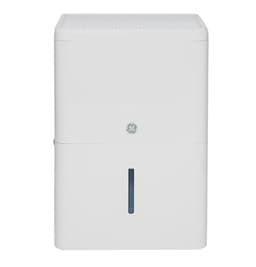
GE's current no-pump 50-pint, with a 30 percent humidistat floor and Smart Dry fan control - and no ENERGY STAR claim on the listing, which is the change worth noticing.
Average draw
Not published
Not published by GE. The ADHE50 series does not appear by name in the ENERGY STAR certified list and this listing makes no ENERGY STAR claim - its predecessor did. The certified 50-pint class runs 443-490 W with a median of 488 W, and a non-certified unit is more likely to sit at the top of that band than below it.
What is good
- Humidistat sets down to 30 percent where most units stop at 35 or 40
- Smart Dry adjusts fan speed to room humidity rather than running flat out
- Bucket-full alarm sounds for ten seconds rather than only lighting an icon
- Clean-filter alert, which is the maintenance nobody remembers to do
What is not
- No ENERGY STAR certification claimed, and no certified entry to compute a draw from
- Gravity drainage only
- A 5,000 sq ft coverage claim, up from its predecessor's 4,000 on the same capacity - a reminder that coverage claims are not a spec
Who it is for
A garage, workshop or utility room with a floor drain, where a low humidistat floor is useful and efficiency certification is not the deciding factor.
Skip it if
Skip it if it will run all season and efficiency matters. A certified 50-pint unit costs about $8 a month less by ENERGY STAR's own figure.
Where the 30-pint genuinely wins
- A bedroom. Not because of capacity but because of noise. A correctly sized 30-pint unit runs long steady cycles; an oversized 50-pint one starts and stops all night, which is the sound people actually complain about.
- An apartment you pay the bill for, where the moisture load is genuinely modest and $11 a month for five months is real money.
- A room above grade that reads 60 to 65% in summer and nothing worse. Most of the load in these rooms is occupancy - showering, cooking, drying laundry - rather than the structure.
- Where the unit has to be physically small. The 30-pint machines here are meaningfully lighter and more portable, which matters if it moves between rooms.
And where the 50-pint is not optional
Any basement. Any space reading above 68%. Anything over about 1,500 square feet. Anything with visible moisture. And any space where you want the machine to have headroom, because the humidity load is not constant - a wet August week can double it, and a machine with no headroom just runs longer.
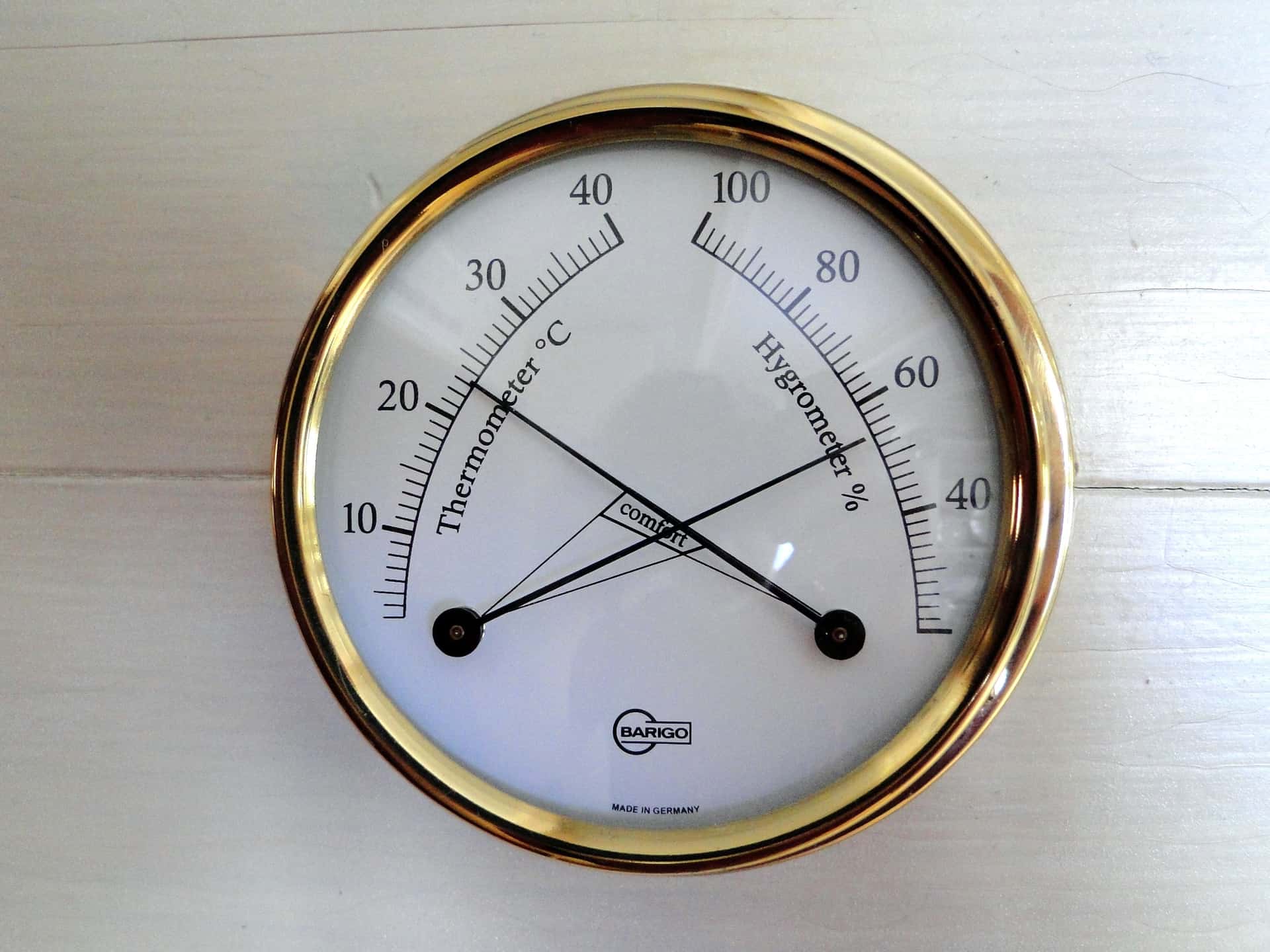
The way to settle it without guessing is to measure. A hygrometer costs about ten dollars and answers the question definitively in a week. The sizing method.
FAQ
Questions
Is a 30-pint dehumidifier enough for a basement?
How much more does a 50-pint dehumidifier cost to run?
Are 30-pint dehumidifiers quieter?
Sources
Sources
Read next
- What size dehumidifier do I need?A four-step method that uses measured humidity instead of the square-footage claim on the box.
- The best 30-pint dehumidifiersThe 30 to 34-pint class at about 318 W, and an honest account of when this is the wrong size.
- The best 50-pint dehumidifiersSix 50-pint units and the certified data behind them: a 443-490 W range and a coverage claim that varies 1.9x.
- Dehumidifier running cost calculatorYour own rate, your own hours, and every default value shown on screen with its source.
- Dehumidifier capacity chartCapacity class, pre-2020 equivalent, median watts and monthly cost, in one sourced reference table.
- 20-pint versus 30-pint60 watts and $4 a month apart, with the efficiency running the other way. Where 20 pints genuinely works.
- Sizing a dehumidifier for a large basementPortables stop at 50 pints, so a big basement is an air-distribution problem - and a floor-plan question, not a square-footage one.
- The best budget dehumidifiersThe electricity costs more than the machine. Five value picks, and the false economy that costs $49 a season.
- Midea Cube 20 vs 35 vs 50 pintSame body, same app, three sizes. The 20 is 18% less efficient per pint, and the 35 shares the 50's bucket.