Sizing / Comparison
Midea Cube 20 vs 35 vs 50 pint
The three Cubes look identical and share every feature on the box. What separates them is certified capacity, one efficiency figure that is not the same across the range, and a sizing mistake that makes the cheapest one the most expensive to own.
#adThis page contains affiliate links. We earn a commission on qualifying purchases, at no cost to you, and it never changes a ranking. Full disclosure.

The short answer
Buy the Cube 50 for a basement or anything reading above about 65 percent, the Cube 35 for a large damp room or a small basement in the low 60s, and the Cube 20 only for one small, mildly damp room. The 20 is certified at IEF 1.70 against 2.01 for the other two, so it uses about 18 percent more electricity per pint.
What is the same, and what is not
Read the three listings side by side and they are nearly word for word identical. All three have the lift-and-twist body that extends for use and nests for storage, Wi-Fi control through Midea's SmartHome app with Alexa and Google Assistant, an included drain hose for continuous drainage, and a 35 to 85 percent humidity range. None of them has a pump; that is a separate model.
So the choice is not about features. It comes down to four numbers, and every one of them below comes from the ENERGY STAR certified record or Midea's own listing, not from a coverage claim.
| Cube 20 | Cube 35 | Cube 50 | |
|---|---|---|---|
| Certified model | MAD20S1QWT | MAD35S1QGR-A | MAD50S1QWT-A |
| Certified capacity (DOE, 65F/60% RH) | 20.16 pt/day | 35.82 pt/day | 49.67 pt/day |
| Integrated Energy Factor | 1.70 | 2.01 | 2.01 |
| Average draw (computed) | 234 W | 351 W | 487 W |
| Electricity per pint removed | 0.279 kWh | 0.235 kWh | 0.235 kWh |
| Bucket | 3.2 gal (12 L) | 4.2 gal (15.9 L) | 4.2 gal (15.9 L) |
| Bucket fills at full rated capacity | about 30 h | about 22 h | about 16 h |
| Pre-2020 equivalent, per Midea | 30 pint | 50 pint | not stated |
| Coverage claim | 1,500 sq ft | 3,500 sq ft | 4,500 sq ft |
Capacity and IEF from the ENERGY STAR certified list; draw computed from them. Bucket, coverage and pre-2020 equivalents quoted from each Amazon listing. All retrieved 2026-09-17. How the wattage is computed.
The number that is not the same: efficiency
The 35 and the 50 are certified at an Integrated Energy Factor of 2.01 liters of water per kilowatt-hour. The 20 is certified at 1.70. That single figure means the smallest Cube spends about 18 percent more electricity for every pint it takes out of the air.
This is not a Midea quirk. Across the whole ENERGY STAR list, certified 20-22 pint portables run IEF 1.70 to 1.97, while certified 35 and 50-pint portables start at 2.01. Smaller compressor dehumidifiers are simply less efficient per pint, and the Cube 20 sits at the bottom of its class. ENERGY STAR and IEF.
+18%
Extra electricity per pint removed: Cube 20 against Cube 35 or 50
IEF 2.01 divided by IEF 1.70 is 1.18. Computed from the ENERGY STAR certified entries for MAD20S1QWT, MAD35S1QGR-A and MAD50S1QWT-A.
Per pint, the Cube 35 and Cube 50 are identical. Moving from the 35 to the 50 costs you nothing in efficiency - you are only paying for capacity you may or may not need.
What each one costs to run
| Cube 20 | Cube 35 | Cube 50 | |
|---|---|---|---|
| 12 hours a day, per month | $15.68 | $23.51 | $32.63 |
| 24 hours a day, per month | $31.35 | $47.03 | $65.25 |
30.44 days a month, as the site's calculator uses. EIA Electric Power Monthly, Table 5.6.A, June 2026. Your rate changes this more than your choice of Cube does. Calculate yours.
How to choose, by what you measured
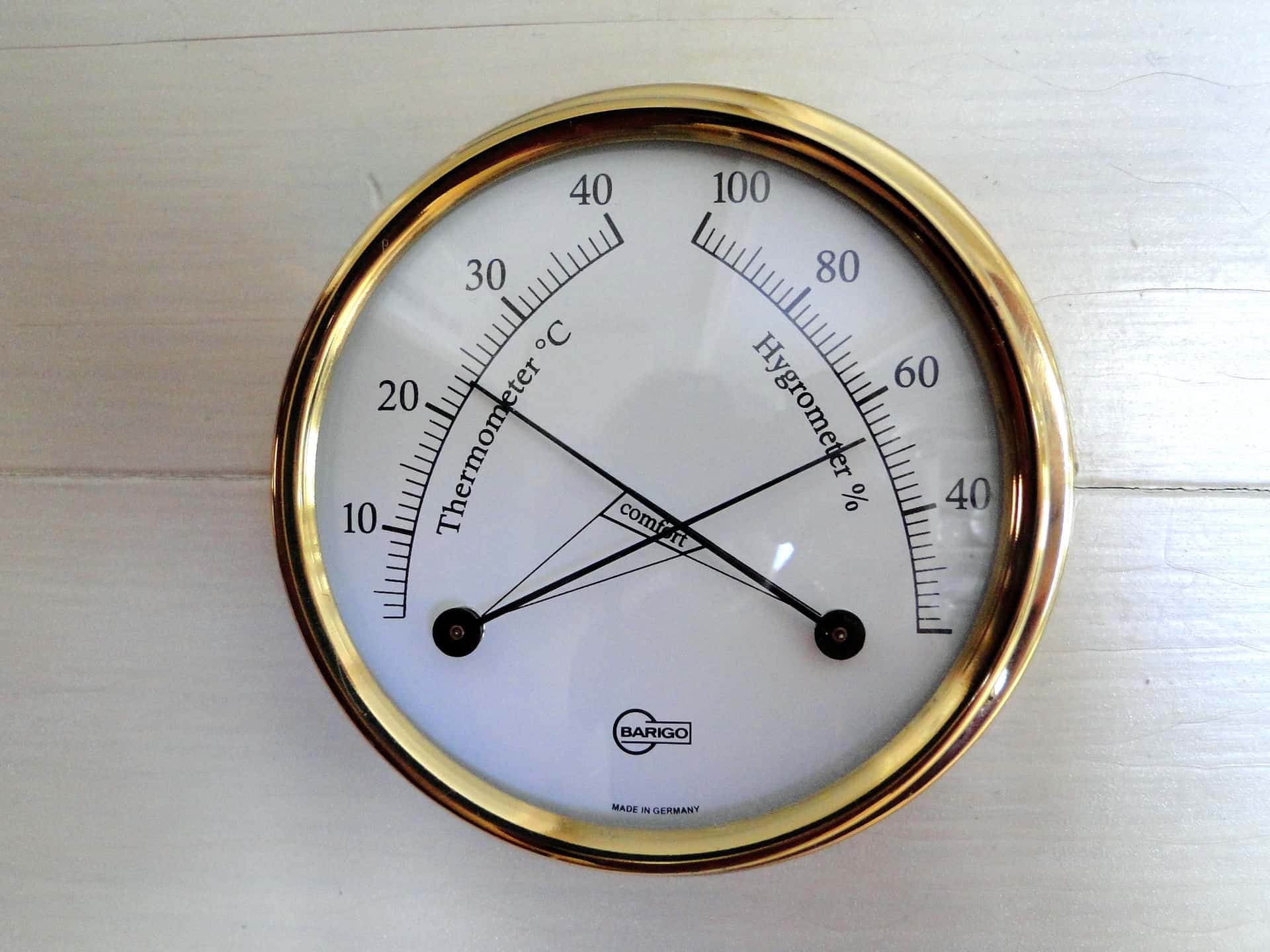
Size from a hygrometer reading, not from the square footage on the box. Take readings in the room for three or four days at the same time of day, then:
| Measured RH | Space | Cube |
|---|---|---|
| Under 60% | Any | Probably none - you may not need a dehumidifier |
| 60-65% | One above-grade room, bedroom or office sized | Cube 20 |
| 60-65% | A large room, an apartment, or a small basement | Cube 35 |
| 65-68% | Any basement or large open space | Cube 50 |
| Over 68%, or visible moisture | Any | Cube 50, plumbed, and find the water source |
| Any | Drain above the machine | Cube 50 with Pump - none of the three has one |
The EPA's recommended indoor band is 30 to 50 percent, and 60 percent is the level above which mold becomes likely. What size do I need.
Quick picks
| # | Product | Best for | Draw | Price |
|---|---|---|---|---|
| 1 |  Midea Cube 20 Pint DehumidifierThe smallest Cube, and the least efficient one: certified at IEF 1.70 against 2.01 for the 35 and 50, so every pint it removes costs about 18 percent more electricity. Midea Cube 20 Pint DehumidifierThe smallest Cube, and the least efficient one: certified at IEF 1.70 against 2.01 for the 35 and 50, so every pint it removes costs about 18 percent more electricity. | One small room that is only mildly damp | 234 W | $179.91View on Amazon #ad Price as of September 17, 2026. How we are funded |
| 2 |  Midea Cube 35 Pint DehumidifierThe middle Cube removes 78 percent more water than the 20 for 50 percent more power, and carries the same 4.2 gallon bucket as the 50 - which makes it the size most people between the two should buy. Midea Cube 35 Pint DehumidifierThe middle Cube removes 78 percent more water than the 20 for 50 percent more power, and carries the same 4.2 gallon bucket as the 50 - which makes it the size most people between the two should buy. | A damp room or a small, dry-ish basement | 351 W | |
| 3 |  Midea Cube 50 Pint DehumidifierThe only unit here that solves the real basement problem, which is not capacity but where the water goes when you are not standing next to it. Midea Cube 50 Pint DehumidifierThe only unit here that solves the real basement problem, which is not capacity but where the water goes when you are not standing next to it. | A basement you visit once a month | 487 W | $249.99View on Amazon #ad Price as of September 17, 2026. How we are funded |
| 4 | Midea Cube 50 Pint Dehumidifier with PumpSame machine as the Cube above with a condensate pump added, which is the difference between a hose you can run and a hose you cannot. | A basement whose only drain is upstairs | 487 W |
Midea
Midea Cube 20 Pint Dehumidifier
Best for: One small room that is only mildly damp
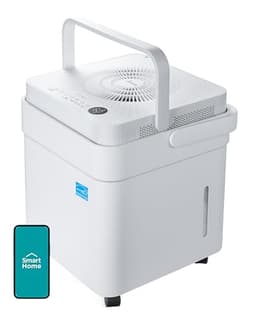
The smallest Cube, and the least efficient one: certified at IEF 1.70 against 2.01 for the 35 and 50, so every pint it removes costs about 18 percent more electricity.
Average draw
234 W
Computed from the ENERGY STAR certified entry for Midea MAD20S1QWT - the same model number as this listing: 20.16 pt/day at IEF 1.70 L/kWh. Midea publishes no wattage on the listing. The 20-22 pint certified class runs IEF 1.70 to 1.97, so this unit sits at the bottom of its own class.
What is good
- Lowest draw of any Cube at 234 W, which matters in a room where it runs most of the day
- Same lift-and-twist expandable body, Wi-Fi app and included drain hose as the larger Cubes
- 3.2 gallon bucket - about 30 hours at full rated capacity before it needs emptying
- The listing states its own pre-2020 equivalent, 30 pint, which matches ENERGY STAR's correlation table
What is not
- IEF 1.70 is the bottom of the certified 20-22 pint class - it uses about 18 percent more electricity per pint than the 35 or 50 Cube
- Undersized for any basement: running around the clock it costs about as much as a 50-pint Cube on half the hours and removes 20 pints to its 50
- No pump, so the drain must be below the machine
Who it is for
A single above-grade room reading in the low 60s - a bedroom, a home office, a bathroom that stays damp between showers.
Skip it if
Skip it for a basement or anything reading above about 65 percent. It will run continuously, never reach its target, and cost as much as the 50-pint Cube while doing less than half its work.
Midea
Midea Cube 35 Pint Dehumidifier
Best for: A damp room or a small, dry-ish basement
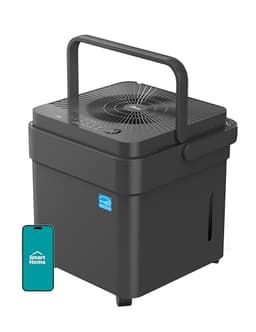
The middle Cube removes 78 percent more water than the 20 for 50 percent more power, and carries the same 4.2 gallon bucket as the 50 - which makes it the size most people between the two should buy.
Average draw
351 W
Computed from the ENERGY STAR certified entry for Midea MAD35S1QGR-A - the same model number as this listing: 35.82 pt/day at IEF 2.01 L/kWh. Midea publishes no wattage on the listing. Every certified 35-pint model we track runs IEF 2.01 to 2.09, so this is the class norm.
What is good
- Same IEF 2.01 as the 50-pint Cube, so per pint removed it is exactly as efficient
- 4.2 gallon bucket, identical to the 50 - about 22 hours at full rated capacity
- Lift-and-twist expandable body, Wi-Fi app and included drain hose
- About $9 a month less than the 50-pint Cube at twelve hours a day and the US average rate
What is not
- Midea's listing calls it similar to a 50 pint under the 2012 standard; ENERGY STAR's correlation table puts a current 35 nearer an old 60, so the maker's equivalence undersells it
- 3,500 sq ft is the most generous coverage claim per pint of the three Cubes - treat it as marketing
- No pump, so the drain must be below the machine
Who it is for
A large damp room, an apartment, or a small basement that reads in the low-to-mid 60s rather than the high 60s.
Skip it if
Skip it for a basement that reads above about 68 percent or shows visible moisture. That is 50-pint work, and the 50 costs little more to buy and nothing more per pint to run.
Midea
Midea Cube 50 Pint Dehumidifier
Best for: A basement you visit once a month
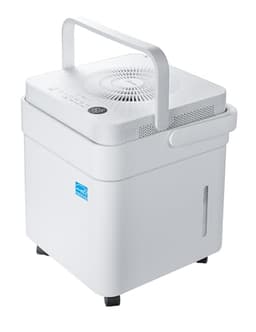
The only unit here that solves the real basement problem, which is not capacity but where the water goes when you are not standing next to it.
Average draw
487 W
Computed from the ENERGY STAR certified entry for Midea MAD50S1QWT-A, the 50 pt / 4,500 sq ft Cube without a pump: 49.67 pt/day at IEF 2.01 L/kWh. Midea's own US product page confirms MAD50S1QWT-A is this configuration. Midea publishes no wattage on the Amazon listing or on that page.
What is good
- The body separates, so the tank half can sit lower than the compressor half and the hose gets a genuine downhill run
- Certified at 49.67 pt/day, which is a real 50-pint machine rather than a saturation number
- IEF 2.01 L/kWh puts it exactly on the median for the 50-pint class - neither a bargain nor a penalty
- Wi-Fi that tells you it has stopped, which is the only smart feature that matters in a basement
What is not
- No pump, so the drain has to run downhill the whole way
- Midea publishes no wattage anywhere, so the 487 W above is computed rather than quoted
- The 4,500 sq ft coverage claim is marketing, not a spec - see the sizing guide
Who it is for
Someone with a floor drain, a sump, or a window well lower than the machine, who wants to set it once and stop thinking about it.
Skip it if
Skip it if the only drain in the room is higher than the unit. Without a pump, gravity is the entire drainage system, and no setting fixes an uphill hose.
Midea
Midea Cube 50 Pint Dehumidifier with Pump
Best for: A basement whose only drain is upstairs
Same machine as the Cube above with a condensate pump added, which is the difference between a hose you can run and a hose you cannot.
Average draw
487 W
Computed from the ENERGY STAR certified entry for Midea MAD50PS1QWT-A, the pump variant of the same platform: 49.67 pt/day at IEF 2.01 L/kWh. The current retail revision is the -B; every Midea 50-pint Cube revision in the certified list, pump or not, computes to 487-490 W, so the pump does not move the number meaningfully. The pump itself only runs in bursts.
What is good
- Pump means the destination can be higher than the machine - a laundry sink, a window, a stack
- Identical DOE capacity and IEF to the non-pump Cube, so the pump costs you nothing in efficiency
- The split body still works, so you can also run it on gravity and keep the pump as the backup
- Certified 49.67 pt/day, an honest 50-pint rating
What is not
- Costs more than the identical machine without the pump
- A pump is one more thing that can fail, and when it does the unit stops rather than overflows
- No published wattage from Midea - the figure above is computed
Who it is for
Anyone whose drain is above the floor. That is most finished basements and nearly every crawl space.
Skip it if
Skip it if you already have a floor drain within hose reach and below the machine. You would be paying for a pump you will never switch on.
The coverage claims do not scale with capacity
Midea claims 1,500, 3,500 and 4,500 square feet. Going from the 20 to the 35, the claim more than doubles - up 2.3 times - while certified capacity rises 1.8 times. Going from the 35 to the 50, the claim rises only 1.3 times while capacity rises 1.4 times. Per pint of certified capacity, the 35 is claimed to cover the most floor.
None of that means the 35 is a better machine per pint - it is identical to the 50 per pint. It means the square footage is a marketing figure with no test procedure behind it, exactly as it is across every brand we track. Coverage claims explained.
The pre-2020 labels, and one that undersells itself
Two of the three listings state an old-standard equivalent. The Cube 20 says it is similar to a 30 pint under the 2012 DOE standard, which matches ENERGY STAR's own correlation table exactly. The Cube 35 says it is similar to a 50 pint - but ENERGY STAR's table puts an old 50 at a new 30, and a new 35 closer to an old 60.
So if you are replacing an old 50-pint machine, Midea's own label would point you at the 35, while the certified correlation suggests the 35 is actually a little larger than what you had. Either is a sensible replacement for a room that an old 50 handled well. The pint rating, explained.
The bucket, if you will not run a hose
The expandable Cube design is built around a large bucket, and it matters most if you empty it by hand. The 35 and 50 share the same 4.2 gallon bucket; the 20 has a 3.2 gallon one. At full rated capacity that is roughly 30 hours for the 20, 22 for the 35 and 16 for the 50 - though in a room close to its target humidity, any of them collects far less and lasts far longer. All three include a drain hose, and running one to a floor drain removes the question entirely. Continuous drain setup.
What we did not do
We have not run any of the three. No noise measurement, no extraction test, and no check of how the expandable body behaves over years. Every capacity and efficiency figure is from ENERGY STAR's certified record, every wattage is computed from it with the formula shown on the methodology page, and every other specification is quoted from Midea's own listings. How we work.
FAQ
Questions
Which Midea Cube size should I buy?
Is the Midea Cube 20 pint enough for a basement?
What is the difference between the Midea Cube 35 and 50?
How many watts does a Midea Cube use?
Do the Midea Cube 20, 35 and 50 have a pump?
Sources
Sources
- ENERGY STAR Certified Dehumidifiers list - Midea MAD20S1QWT 20.16 pt/day IEF 1.70; MAD35S1QGR-A 35.82 pt/day IEF 2.01; MAD50S1QWT-A 49.67 pt/day IEF 2.01; certified 20-22 pint class IEF 1.70-1.97 (retrieved 2026-09-17)
- Midea Cube 20 Pint Dehumidifier, MAD20S1QWT - Amazon.com listing (retrieved 2026-09-17)
- Midea Cube 35 Pint Dehumidifier, MAD35S1QGR-A - Amazon.com listing (retrieved 2026-09-17)
- Midea Cube 50 Pint Dehumidifier, MAD50S1QWT-A - Amazon.com listing (retrieved 2026-09-17)
- ENERGY STAR - Dehumidifier Testing and Capacity: the 65F / 60% RH test condition and the old-to-new capacity correlation
- EIA Electric Power Monthly, Table 5.6.A, June 2026 - the electricity rate used
Read next
- Midea Cube 50 PintCertified 49.67 pt/day at 487 W, and the splitting body that solves a real drainage constraint.
- Midea Cube 50 Pint with PumpIdentical 487 W certified draw to the non-pump Cube, with the pump that decides where the water goes.
- 20-pint versus 30-pint60 watts and $4 a month apart, with the efficiency running the other way. Where 20 pints genuinely works.
- 30-pint versus 50-pint170 watts and $11 a month apart, with one failure mode that makes the cheaper machine cost more.
- The square footage on the box is not a specificationIdentical certified capacity, coverage claims 1.9x apart. What the number is, and what to size from instead.