Reviews / Midea
Midea Cube 50 Pint with Pump
Identical certified capacity and efficiency to the standard Cube, with a condensate pump added. The efficiency is free; the purchase price is not.
#adThis page contains affiliate links. We earn a commission on qualifying purchases, at no cost to you, and it never changes a ranking. Full disclosure.
The short answer
Certified as Midea MAD50PS1QWT-A at 49.67 pints per day and IEF 2.01, computing to 487 W - identical to the non-pump Cube. Adds a built-in condensate pump so the discharge can go up to a sink, a window or a standpipe.
The pump is free to run
This is worth stating because it is a common worry and it is unfounded. A condensate pump does not run continuously - it fires for a few seconds when its small reservoir fills, several times an hour at most. Every Midea 50-pint Cube revision in the certified list, pump or not, computes to between 487 and 490 W.
So the pump costs you at purchase and effectively nothing thereafter. The question is only whether you need it, and that is answered by looking at your drain rather than at the spec sheet. Pump versus gravity.
What Midea does not tell you about the pump
How far it will push. Midea states that a 16 foot drain tube is included and that the pump drains vertically or horizontally, but gives no lift height - and a hose length is not a lift. Of seven pump-equipped units in our registry, three state a lift: AlorAir 19.6 feet, GE 15 vertical feet and Quilo 15 feet.
That absence is a real constraint on planning. If your destination is a laundry sink a few feet up, any household condensate pump will manage it. If it is a window eight feet up at the far end of a basement, you are relying on a capability nobody has committed to in writing. In that situation an external condensate pump - which publishes a maximum head, because installers need one - is the better-specified option. Pump lift and distance.
Quick picks
| # | Product | Best for | Draw | Price |
|---|---|---|---|---|
| 1 |  Midea Cube 50 Pint Dehumidifier with PumpThe stacking Midea Cube with a condensate pump added, which is the difference between a hose you can run and a hose you cannot. Midea Cube 50 Pint Dehumidifier with PumpThe stacking Midea Cube with a condensate pump added, which is the difference between a hose you can run and a hose you cannot. | A basement whose only drain is upstairs | 487 W | $237.45View on Amazon #ad Price as of October 17, 2026. How we are funded |
| 2 |  Midea Cube 50 Pint DehumidifierThe only unit here that solves the real basement problem, which is not capacity but where the water goes when you are not standing next to it. Midea Cube 50 Pint DehumidifierThe only unit here that solves the real basement problem, which is not capacity but where the water goes when you are not standing next to it. | A basement you visit once a month | 487 W |
Midea
Midea Cube 50 Pint Dehumidifier with Pump
Best for: A basement whose only drain is upstairs
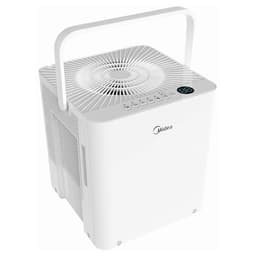
The stacking Midea Cube with a condensate pump added, which is the difference between a hose you can run and a hose you cannot.
Average draw
487 W
Computed from the ENERGY STAR certified entry for Midea MAD50PS1QWT-A, the pump variant of the same platform: 49.67 pt/day at IEF 2.01 L/kWh. The listing prints the unsuffixed MAD50PS1QWT, so the certified string carries a suffix the box does not; every Midea 50-pint revision in the certified list, pump or not, computes to 487-490 W, so neither the suffix nor the pump moves the number meaningfully. The pump itself only runs in bursts.
What is good
- Pump means the destination can be higher than the machine - a laundry sink, a window, a stack
- Identical DOE capacity and IEF to the non-pump Cube, so the pump costs you nothing in efficiency
- The split body still works, so you can also run it on gravity and keep the pump as the backup
- Certified 49.67 pt/day, an honest 50-pint rating
What is not
- Costs more than the identical machine without the pump
- A pump is one more thing that can fail, and when it does the unit stops rather than overflows
- No published wattage from Midea - the figure above is computed
Who it is for
Anyone whose drain is above the floor. That is most finished basements and nearly every crawl space.
Skip it if
Skip it if you already have a floor drain within hose reach and below the machine. You would be paying for a pump you will never switch on.
Midea
Midea Cube 50 Pint Dehumidifier
Best for: A basement you visit once a month
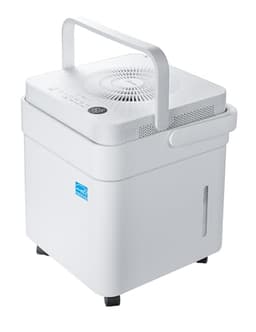
The only unit here that solves the real basement problem, which is not capacity but where the water goes when you are not standing next to it.
Average draw
487 W
Computed from the ENERGY STAR certified entry for Midea MAD50S1QWT-A, the 50 pt / 4,500 sq ft Cube without a pump: 49.67 pt/day at IEF 2.01 L/kWh. Midea's own US product page confirms MAD50S1QWT-A is this configuration. Midea publishes no wattage on the Amazon listing or on that page.
What is good
- The body separates, so the tank half can sit lower than the compressor half and the hose gets a genuine downhill run
- Certified at 49.67 pt/day, which is a real 50-pint machine rather than a saturation number
- IEF 2.01 L/kWh puts it exactly on the median for the 50-pint class - neither a bargain nor a penalty
- Wi-Fi that tells you it has stopped, which is the only smart feature that matters in a basement
What is not
- No pump, so the drain has to run downhill the whole way
- Midea publishes no wattage anywhere, so the 487 W above is computed rather than quoted
- The 4,500 sq ft coverage claim is marketing, not a spec - see the sizing guide
Who it is for
Someone with a floor drain, a sump, or a window well lower than the machine, who wants to set it once and stop thinking about it.
Skip it if
Skip it if the only drain in the room is higher than the unit. Without a pump, gravity is the entire drainage system, and no setting fixes an uphill hose.
The gravity fallback nobody mentions
The pump version keeps the gravity outlet and keeps the splitting body. That means you can run it as a gravity unit and never switch the pump on, or run gravity as the primary and reserve the pump for a route you cannot get a fall on.
It also means that if the pump fails, the machine is not bricked - reconnect the gravity hose and it is a standard Cube. That is a genuine argument for buying the pump version even when you do not currently need a pump, provided the premium is modest.
Certified data, and what is computed
Midea Cube 50 with Pump, certified as MAD50PS1QWT-A
(487 W / 1000) x 12 h x $0.1834/kWh = $1.07 per day
0.487
kWh per hour
$32.63
per month, 12 h/day
$65.25
per month, 24 h/day
Rate is the US residential average of 18.34 cents/kWh from the EIA Electric Power Monthly, June 2026. Yours will differ - use the calculator.
Note the retail revision currently sold is the -B rather than the -A. Both appear in the certified list and both compute to 487 W, so the mapping is safe - but it is the kind of suffix mismatch worth stating rather than papering over. Every wattage on this site names the exact certified model number it came from for this reason.
FAQ
Questions
Does the pump on the Midea Cube use more electricity?
How high can the Midea Cube pump water?
Can I use the pump version without the pump?
Sources
Sources
Read next
- The best dehumidifiers with a built-in pumpFive pump-equipped units, ranked partly on which makers will state what their pump can actually reach.
- Pump or gravity: decide this before anything elseA five-minute test that eliminates half the market, and the middle option most buyers miss.
- How far will the pump actually push it?Three of seven pump models state a lift. What they say, and how to plan when a maker states nothing.
- Midea Cube 50 PintCertified 49.67 pt/day at 487 W, and the splitting body that solves a real drainage constraint.
- The best dehumidifiers for a basementFive basement units ranked on drainage first, with computed running costs and a unit we would not buy.
- Midea Cube 20 vs 35 vs 50 pintSame body, same app, three sizes. The 20 is 18% less efficient per pint, and the 35 shares the 50's bucket.