Best / Roundup
The best dehumidifiers for a bedroom
A compressor cycling on and off four feet from your head is the problem nobody warns you about. Capacity is the easy part here; noise is the decision.
#adThis page contains affiliate links. We earn a commission on qualifying purchases, at no cost to you, and it never changes a ranking. Full disclosure.

The short answer
For a bedroom, a 30 to 32-pint compressor unit at around 318 watts is usually the right size and roughly the quietest a real dehumidifier gets. If the room only smells slightly musty, a thermoelectric mini is silent - but it removes about one pint a day against a compressor unit's thirty.
The noise problem, honestly
We have not measured any of these machines, and we are not going to print a decibel figure we did not record. What we can tell you is mechanical, and it is enough to make the decision.
A compressor dehumidifier makes two sounds. The fan is continuous and broadband, and most people habituate to it within a night or two - it is essentially white noise. The compressor is the problem: it starts and stops as the humidistat cycles, and a sound that changes is far more disruptive than a louder sound that does not. A machine that is oversized for the room cycles more often, because it hits the target faster and then shuts off.
That is the actual argument for a smaller unit in a bedroom, and it is the opposite of the usual buying advice. A correctly sized 30-pint machine in a mildly damp bedroom runs a long, steady cycle. An oversized 50-pint machine in the same room runs a short cycle every twenty minutes, all night.
The thermoelectric option, and its limit
Thermoelectric - Peltier - units have no compressor at all. They are effectively silent, and for a bedroom that is a real advantage rather than a marketing line. The limit is capacity: the Pro Breeze mini on this page removes 17 ounces a day, which is 1.06 pints. A 30-pint machine removes thirty.
So it is the right answer for exactly one situation: a small enclosed space with a faint musty smell and no measurable humidity problem. A wardrobe. An ensuite. A single closet. It is the wrong answer for a room, and the fact that its listing claims 215 square feet of coverage does not change that. Dehumidifier versus DampRid covers the same scale question from the other end.
Quick picks
| # | Product | Best for | Draw | Price |
|---|---|---|---|---|
| 1 |  hOmeLabs 32 Pint DehumidifierThe one hOmeLabs unit with a named entry in the ENERGY STAR list, so it is the one where the running cost is a published figure rather than a class estimate. hOmeLabs 32 Pint DehumidifierThe one hOmeLabs unit with a named entry in the ENERGY STAR list, so it is the one where the running cost is a published figure rather than a class estimate. | A bedroom that is damp but not wet | 318 W | |
| 2 |  Honeywell Smart Wi-Fi 30 Pint Dehumidifier (TP50AWKN)The anti-spill design is the actual selling point here, and it is a better reason to buy than the voice control the listing leads with. Honeywell Smart Wi-Fi 30 Pint Dehumidifier (TP50AWKN)The anti-spill design is the actual selling point here, and it is a better reason to buy than the voice control the listing leads with. | A room you want to run on a schedule | Not published | $311.16View on Amazon #ad Price as of October 17, 2026. How we are funded |
| 3 |  hOmeLabs 8 Pint DehumidifierA real compressor unit at a size where most competitors sell thermoelectric toys, which makes it the smallest machine here that actually removes meaningful water. hOmeLabs 8 Pint DehumidifierA real compressor unit at a size where most competitors sell thermoelectric toys, which makes it the smallest machine here that actually removes meaningful water. | A closet, a boat, or a single small room | Not published | $174.99View on Amazon #ad Price as of October 17, 2026. How we are funded |
| 4 |  Pro Breeze Electric Mini DehumidifierA thermoelectric unit that removes about one pint a day, which is roughly one fiftieth of a 50-pint machine and needs saying out loud before anyone buys one for a basement. Pro Breeze Electric Mini DehumidifierA thermoelectric unit that removes about one pint a day, which is roughly one fiftieth of a 50-pint machine and needs saying out loud before anyone buys one for a basement. | A wardrobe, and honestly not much more | 23 W | $43.99View on Amazon #ad Price as of October 17, 2026. How we are funded |
hOmeLabs
hOmeLabs 32 Pint Dehumidifier
Best for: A bedroom that is damp but not wet
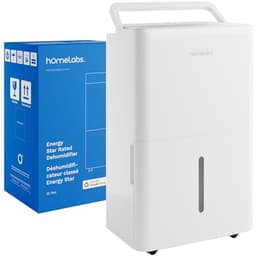
The one hOmeLabs unit with a named entry in the ENERGY STAR list, so it is the one where the running cost is a published figure rather than a class estimate.
Average draw
318 W
Computed from the ENERGY STAR certified entry hOmeLabs HME0089: 32.46 pt/day at IEF 2.01 L/kWh. This is the only hOmeLabs capacity in this registry with a named certified entry, which is why it is the only one carrying a number rather than a band.
What is good
- 318 W against the 50-pint class median of 488 W - about 35% less to run, hour for hour
- Named in the ENERGY STAR certified list, so its IEF is public
- Quiet enough for a bedroom in a way that a 50-pint compressor generally is not
- Wi-Fi and auto shut-off at a small-unit price
What is not
- 32 DOE pints is genuinely less water than 50 - undersizing a wet basement costs more than the machine saved
- Gravity drainage only
- 4,500 sq ft coverage for 32 pints is another claim to ignore
Who it is for
A bedroom, a home office, or a small basement that is humid rather than actively wet.
Skip it if
Skip it if the floor is ever damp to the touch or the walls sweat. That is a 50-pint problem, and a 32-pint machine will run continuously and still lose.
Honeywell
Honeywell Smart Wi-Fi 30 Pint Dehumidifier (TP50AWKN)
Best for: A room you want to run on a schedule
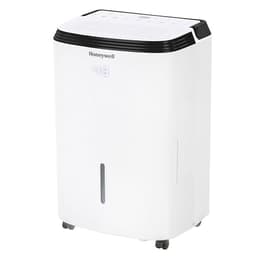
The anti-spill design is the actual selling point here, and it is a better reason to buy than the voice control the listing leads with.
Average draw
Not published
Not published. Honeywell's certified 32-pint entries, the TPFIT32AWK and TPFIT32WK, compute to 318 W at 32.46 pt/day and IEF 2.01. This is a different product line, so that figure sits in the note rather than in the spec table.
What is good
- Anti-spill bucket, which matters more than any app feature if the machine lives upstairs
- Scheduling through the app, so it can run when electricity is cheapest
- ENERGY STAR certified at a small-room capacity
- Alerts on the phone rather than only a beep in an empty room
What is not
- No published wattage, and the certified list carries a different Honeywell line
- 3,000 sq ft for 30 pints is an optimistic claim
- Depends on Honeywell's app remaining supported
Who it is for
An upstairs room or a rental where a spilled bucket is somebody's ceiling, and where scheduling is genuinely useful.
Skip it if
Skip it if the machine will sit on concrete next to a drain. You would be paying for spill protection and scheduling that a floor drain makes irrelevant.
hOmeLabs
hOmeLabs 8 Pint Dehumidifier
Best for: A closet, a boat, or a single small room
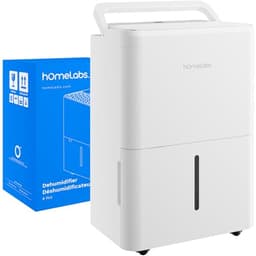
A real compressor unit at a size where most competitors sell thermoelectric toys, which makes it the smallest machine here that actually removes meaningful water.
Average draw
Not published
Not published. The certified 8-13 pint class runs 92-128 W with a median of 105 W across 39 models, and the median unit in that class uses 117 kWh a year.
What is good
- A compressor at 8 pints, so it keeps working where a Peltier unit stops
- Roughly a fifth of the power of a 50-pint machine
- Wi-Fi and auto shut-off, unusual at this size
- Small enough to sit in a wardrobe or a berth
What is not
- 1,800 sq ft coverage for 8 DOE pints is not a serious claim
- Bucket only - no continuous drain at this size
- Not ENERGY STAR certified, so no published IEF
Who it is for
Closets, gun safes, boat cabins, and single small rooms where a large machine is absurd.
Skip it if
Skip it for any room where you can feel the damp. Eight pints a day is a maintenance dose, not a cure.
Pro Breeze
Pro Breeze Electric Mini Dehumidifier
Best for: A wardrobe, and honestly not much more
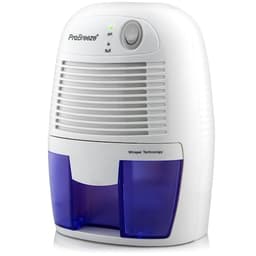
A thermoelectric unit that removes about one pint a day, which is roughly one fiftieth of a 50-pint machine and needs saying out loud before anyone buys one for a basement.
Average draw
23 W
Stated on the listing as 23 W. Thermoelectric units are outside the ENERGY STAR dehumidifier program, so this is the maker's figure rather than a computed one. A Peltier module draws far less than any compressor here - but less power and less water are the same fact, not two selling points.
What is good
- Genuinely silent - there is no compressor to cycle on and off next to your head
- Small and light enough to sit on a shelf inside a wardrobe
- Auto shut-off when the 17 oz tank fills
- Cheap enough to buy two for two closets
What is not
- About one pint a day. A 50-pint unit removes fifty times as much
- Stops working below 41F, which rules out the unheated spaces people usually buy it for
- No drain option - the tank is the only outlet
Who it is for
A wardrobe, a gun safe, a bathroom cabinet, or a single small enclosed space with a musty smell.
Skip it if
Skip it for any room. This is the single most common mis-purchase in the category: it is not a small dehumidifier, it is a different class of device, and no number of them adds up to a basement machine.
Practical bedroom setup
- Put it as far from the bed as the room allows, and preferably not on a hard floor that will transmit compressor vibration. A rubber mat under the feet costs almost nothing and helps more than any feature on the box.
- Set a realistic target. 50% is comfortable and achievable. Setting 40% in a bedroom means the machine chases a number it will struggle to hold, which means more running and more cycling.
- Run it before bed rather than during sleep if the room recovers slowly. A correctly sized unit can pull the room down in the evening and idle overnight.
- Use the timer if it has one. Two of the units here schedule from an app, which is one of the few genuinely useful smart features in this category.
- Empty the bucket in the evening, or run a hose. A full-bucket alarm at 3am is its own kind of problem.
What we would skip
A 50-pint basement unit moved upstairs
It is the most common thing people do and it is the wrong call. A 50-pint machine is sized and geared for a basement: a bigger compressor, a bigger fan, and a cycle that will wake you. It will also overshoot a bedroom's actual moisture load and spend the night starting and stopping, which is the noise pattern humans notice most.
A thermoelectric mini as your only bedroom dehumidifier
It is genuinely silent, which is why it is on this page at all. But it removes about one pint a day. If your bedroom has a real humidity problem, silence will not fix it and you will have spent money on a device that changes the reading by nothing you can measure.
How we picked
- Noise first: no compressor at all, or a small one, and a fan sized for a room rather than a basement.
- Power draw, because a bedroom unit may run all night. The 30-32 pint class is 318 W against a 50-pint unit's 488.
- A bucket that does not need emptying mid-sleep, or a hose route that does not cross the floor.
- Controls you can dim or silence. A bright display facing a bed is a real complaint.
- We have not measured the noise of any of these. Nobody should claim a decibel figure they did not record, and we have not recorded one.
We did not test these units. The full criteria and their weighting are on the methodology page.
FAQ
Questions
Are dehumidifiers loud enough to disturb sleep?
Is it safe to sleep in a room with a dehumidifier running?
What humidity should a bedroom be?
Can a dehumidifier help with allergies or mold in a bedroom?
Sources
Sources
Read next
- The best 30-pint dehumidifiersThe 30 to 34-pint class at about 318 W, and an honest account of when this is the wrong size.
- The quietest dehumidifiersFour quiet options, and a plain statement of what we can say about noise without having measured it.
- It is too loudWhich noises are the machine working, which are it failing, and four fixes that actually help.
- What to set it to45 to 50 percent, why lower is only more expensive, and the setting that doubles your bill.
- Dehumidifier or air purifier?One removes water and no particles; the other removes particles and no water. Not substitutes.
- The best dehumidifiers for a homeOne machine will not do a house - air does not cross closed doors. What each space needs, and what running three costs.
- The best dehumidifiers for dust mites and allergies401.2 mites per gram down to 6.7, in homes held under 51% humidity. Four units for the rooms where it matters.