Best / Roundup
The quietest dehumidifiers
This is the page where the honest answer is partly a refusal. We have not measured these machines and we are not going to print a decibel number we did not record - but there is a lot that can be said from how they work.
#adThis page contains affiliate links. We earn a commission on qualifying purchases, at no cost to you, and it never changes a ranking. Full disclosure.
The short answer
Thermoelectric mini units are effectively silent because they have no compressor - but they remove about one pint a day. Among real dehumidifiers, a correctly sized 30-pint unit is quieter in practice than an oversized 50-pint one, because it cycles less often.
What we will not do on this page
We have not put a sound meter in front of any of these machines. Publications that have - HouseFresh measures at three feet, RTINGS runs a full acoustic suite - are doing work we cannot match, and if you need a comparative decibel table, theirs are the numbers to use.
What we will not do is restate a manufacturer's dB claim as though it were a comparable measurement. Those figures are taken at unstated fan speeds and unstated distances, and putting a 33 dB claim next to a 42 dB claim in a table implies a comparison that does not exist.
What is true regardless of measurement
- 1No compressor means no cycling. A thermoelectric unit runs one small fan continuously. A desiccant unit runs a fan and a heater. Neither has the start-stop thump that people describe as the noise. This is a difference in kind, not degree.
- 2Steady beats loud. Human attention locks onto change. A fan running continuously at a moderate level disappears within a night; a compressor kicking in every twenty minutes does not, even if it is quieter in absolute terms.
- 3Correct sizing reduces cycling. An oversized unit hits its target fast and shuts off, then the room drifts back and it restarts. A correctly sized unit runs longer, steadier cycles.
- 4Hard floors transmit vibration. A compressor unit on tile or concrete puts its vibration into the structure. A rubber mat under the feet costs a few dollars and is the single cheapest improvement available.
- 5Fan speed options matter more than fan size. A machine that will hold a low speed continuously is quieter in use than one that only has high, even if the high speeds are similar.

Quick picks
| # | Product | Best for | Draw | Price |
|---|---|---|---|---|
| 1 |  Pro Breeze Electric Mini DehumidifierA thermoelectric unit that removes about one pint a day, which is roughly one fiftieth of a 50-pint machine and needs saying out loud before anyone buys one for a basement. Pro Breeze Electric Mini DehumidifierA thermoelectric unit that removes about one pint a day, which is roughly one fiftieth of a 50-pint machine and needs saying out loud before anyone buys one for a basement. | A wardrobe, and honestly not much more | 23 W | $43.99View on Amazon #ad Price as of October 17, 2026. How we are funded |
| 2 |  Ivation 13 Pint Desiccant DehumidifierThe small desiccant, for spaces that are cold and enclosed rather than large and damp. Ivation 13 Pint Desiccant DehumidifierThe small desiccant, for spaces that are cold and enclosed rather than large and damp. | A cold closet, attic or bathroom | Not published | $279.99View on Amazon #ad Price as of October 17, 2026. How we are funded |
| 3 |  hOmeLabs 8 Pint DehumidifierA real compressor unit at a size where most competitors sell thermoelectric toys, which makes it the smallest machine here that actually removes meaningful water. hOmeLabs 8 Pint DehumidifierA real compressor unit at a size where most competitors sell thermoelectric toys, which makes it the smallest machine here that actually removes meaningful water. | A closet, a boat, or a single small room | Not published | $174.99View on Amazon #ad Price as of October 17, 2026. How we are funded |
| 4 |  hOmeLabs 32 Pint DehumidifierThe one hOmeLabs unit with a named entry in the ENERGY STAR list, so it is the one where the running cost is a published figure rather than a class estimate. hOmeLabs 32 Pint DehumidifierThe one hOmeLabs unit with a named entry in the ENERGY STAR list, so it is the one where the running cost is a published figure rather than a class estimate. | A bedroom that is damp but not wet | 318 W |
Pro Breeze
Pro Breeze Electric Mini Dehumidifier
Best for: A wardrobe, and honestly not much more
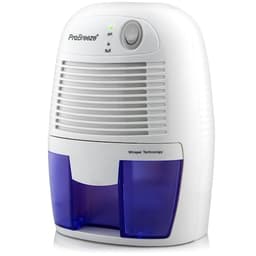
A thermoelectric unit that removes about one pint a day, which is roughly one fiftieth of a 50-pint machine and needs saying out loud before anyone buys one for a basement.
Average draw
23 W
Stated on the listing as 23 W. Thermoelectric units are outside the ENERGY STAR dehumidifier program, so this is the maker's figure rather than a computed one. A Peltier module draws far less than any compressor here - but less power and less water are the same fact, not two selling points.
What is good
- Genuinely silent - there is no compressor to cycle on and off next to your head
- Small and light enough to sit on a shelf inside a wardrobe
- Auto shut-off when the 17 oz tank fills
- Cheap enough to buy two for two closets
What is not
- About one pint a day. A 50-pint unit removes fifty times as much
- Stops working below 41F, which rules out the unheated spaces people usually buy it for
- No drain option - the tank is the only outlet
Who it is for
A wardrobe, a gun safe, a bathroom cabinet, or a single small enclosed space with a musty smell.
Skip it if
Skip it for any room. This is the single most common mis-purchase in the category: it is not a small dehumidifier, it is a different class of device, and no number of them adds up to a basement machine.
Ivation
Ivation 13 Pint Desiccant Dehumidifier
Best for: A cold closet, attic or bathroom
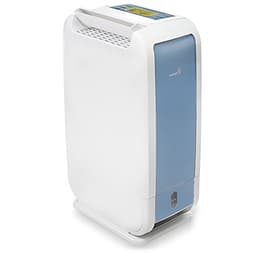
The small desiccant, for spaces that are cold and enclosed rather than large and damp.
Average draw
Not published
The listing states 470 W on high and 280 W on low at 120 V. Those are mode ratings rather than an average draw, and desiccant units are not represented in the ENERGY STAR certified list, so there is no certified figure to compute an average from.
What is good
- Works in the cold, unlike every compressor unit on this site
- Small and light enough to move between an attic and a closet
- Continuous drain hose supported at this size, which the compressor minis do not offer
- Quiet - no compressor to cycle
What is not
- 270 sq ft is a genuinely small room
- No published wattage
- Warms the space it dries
Who it is for
Closets, attics, bathrooms and RV interiors in a cold climate.
Skip it if
Skip it if you need real capacity. Thirteen pints a day is a maintenance machine, not a recovery machine.
hOmeLabs
hOmeLabs 8 Pint Dehumidifier
Best for: A closet, a boat, or a single small room
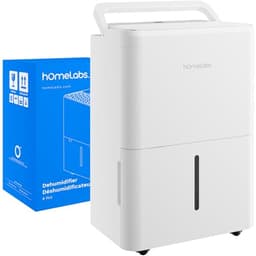
A real compressor unit at a size where most competitors sell thermoelectric toys, which makes it the smallest machine here that actually removes meaningful water.
Average draw
Not published
Not published. The certified 8-13 pint class runs 92-128 W with a median of 105 W across 39 models, and the median unit in that class uses 117 kWh a year.
What is good
- A compressor at 8 pints, so it keeps working where a Peltier unit stops
- Roughly a fifth of the power of a 50-pint machine
- Wi-Fi and auto shut-off, unusual at this size
- Small enough to sit in a wardrobe or a berth
What is not
- 1,800 sq ft coverage for 8 DOE pints is not a serious claim
- Bucket only - no continuous drain at this size
- Not ENERGY STAR certified, so no published IEF
Who it is for
Closets, gun safes, boat cabins, and single small rooms where a large machine is absurd.
Skip it if
Skip it for any room where you can feel the damp. Eight pints a day is a maintenance dose, not a cure.
hOmeLabs
hOmeLabs 32 Pint Dehumidifier
Best for: A bedroom that is damp but not wet
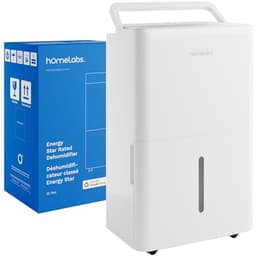
The one hOmeLabs unit with a named entry in the ENERGY STAR list, so it is the one where the running cost is a published figure rather than a class estimate.
Average draw
318 W
Computed from the ENERGY STAR certified entry hOmeLabs HME0089: 32.46 pt/day at IEF 2.01 L/kWh. This is the only hOmeLabs capacity in this registry with a named certified entry, which is why it is the only one carrying a number rather than a band.
What is good
- 318 W against the 50-pint class median of 488 W - about 35% less to run, hour for hour
- Named in the ENERGY STAR certified list, so its IEF is public
- Quiet enough for a bedroom in a way that a 50-pint compressor generally is not
- Wi-Fi and auto shut-off at a small-unit price
What is not
- 32 DOE pints is genuinely less water than 50 - undersizing a wet basement costs more than the machine saved
- Gravity drainage only
- 4,500 sq ft coverage for 32 pints is another claim to ignore
Who it is for
A bedroom, a home office, or a small basement that is humid rather than actively wet.
Skip it if
Skip it if the floor is ever damp to the touch or the walls sweat. That is a 50-pint problem, and a 32-pint machine will run continuously and still lose.
Choosing by room
- Bedroom - a 30 to 32-pint compressor unit sized to the room, on a mat, set to 50% rather than 40%. Or a thermoelectric unit if the problem is a smell rather than a measurable humidity level. Bedroom roundup.
- Home office on a video call - the fan is fine; the compressor is what your microphone picks up. Run it between calls, or use a smaller unit.
- Nursery - size it correctly, keep it across the room, and accept that any real dehumidifier makes some noise. Silent means thermoelectric, and thermoelectric means about one pint a day.
- Basement or garage - noise is not a constraint here and you should buy on capacity and drainage instead.
What we would skip
Any dehumidifier bought on a quoted dB figure alone
Manufacturer noise claims in this category are not measured to a common standard, are usually taken at the lowest fan speed, and never account for the compressor cycling - which is the sound people actually complain about. A 33 dB claim and a 42 dB claim from two different brands are not comparable numbers.
An oversized unit in a small room, for quietness
Counter-intuitively, a bigger machine is often the more annoying one. It reaches the humidity target quickly and shuts off, then restarts twenty minutes later. A sound that starts and stops is far more noticeable than a steady one, so oversizing buys you more compressor events, not fewer.
How we picked
- Whether there is a compressor at all. Thermoelectric and desiccant units have none, which is a categorical difference rather than a marginal one.
- Capacity relative to the room, because cycling frequency is the noise most people report.
- Fan size and speed options - a unit that will run low continuously is quieter in practice than one that only has high.
- We have not measured decibels. No chamber, no meter, and we will not restate another publisher's measurement as our own.
We did not test these units. The full criteria and their weighting are on the methodology page.
FAQ
Questions
How many decibels is a quiet dehumidifier?
Are desiccant dehumidifiers quieter than compressor ones?
Why does my dehumidifier get louder sometimes?
Sources
Sources
Read next
- It is too loudWhich noises are the machine working, which are it failing, and four fixes that actually help.
- The best dehumidifiers for a bedroomFour options for a room you sleep in, ranked on cycling behavior rather than a decibel figure nobody measured.
- Desiccant or compressor?11.8 pints against 2.9 at 41F, and the crossover point where the obvious answer stops being right.
- What size dehumidifier do I need?A four-step method that uses measured humidity instead of the square-footage claim on the box.
- The best dehumidifiers for dust mites and allergies401.2 mites per gram down to 6.7, in homes held under 51% humidity. Four units for the rooms where it matters.