Best / Roundup
The best 50-pint dehumidifiers
164 models are certified in this class and their efficiency spans a narrow band. What actually separates them is drainage, documentation and a coverage claim that ranges from 4,000 to 7,500 square feet for the same capacity.
#adThis page contains affiliate links. We earn a commission on qualifying purchases, at no cost to you, and it never changes a ranking. Full disclosure.

The short answer
A 50-pint dehumidifier removes 50 pints of water in 24 hours at 65F and 60% relative humidity, and draws about 488 watts doing it. That is the default machine for a US basement. The class used to be labeled 70-pint before the 2019 test change.
The class is more uniform than the marketing suggests
There are 164 certified 50-pint portable models in the ENERGY STAR list. Their Integrated Energy Factor runs from 2.01 to 2.20 liters per kWh, which computes to an average draw between 443 and 490 watts. The median is 488.
That is a spread of about ten percent across an entire product class from dozens of brands. There is a reason: these are commodity refrigeration appliances built by a handful of factories and sold under many labels. In the certified list, Waykar, KESNOS, YAUFEY and Fehom appear as a single joint entry against the same model numbers, because they are the same machines.
| Class | DOE capacity | Models | Median draw | Range | Median IEF | kWh/year |
|---|---|---|---|---|---|---|
| ~10 pint | 8-13 pt/day | 39 | 105 W | 92-128 W | 1.91 | 117 |
| ~16 pint | 14-18 pt/day | 44 | 167 W | 166-180 W | 1.89 | 181 |
| 20-22 pint | 19-23 pt/day | 51 | 258 W | 214-267 W | 1.7 | 276 |
| 25 pint | 23-27 pt/day | 127 | 265 W | 236-289 W | 1.79 | 285 |
| 30-32 pint | 27-33 pt/day | 21 | 318 W | 293-318 W | 2.01 | 343 |
| 35 pint | 33-38 pt/day | 73 | 351 W | 313-373 W | 2.01 | 375 |
| 40 pint | 38-45 pt/day | 5 | 401 W | 396-410 W | 2.21 | 432 |
| 50 pint | 45-52 pt/day | 164 | 488 W | 443-490 W | 2.01 | 520 |
Computed on 2026-09-01 from the ENERGY STAR certified product list (136 brands). Formula: liters/day = pints/day x 0.473176; kWh/day = liters/day / IEF; watts = kWh/day x 1000 / 24. Cross-check: dividing each model's published annual consumption by its computed draw gives a median implied run time of 1074 hours a year across the whole list. Source data.
| Unit | DOE pints | Drainage | Average draw | Where the figure comes from |
|---|---|---|---|---|
| Midea Cube 50 Pint Dehumidifier | 50 | gravity | 487 W | ENERGY STAR certified entry, computed |
| Midea Cube 50 Pint Dehumidifier with Pump | 50 | pump | 487 W | ENERGY STAR certified entry, computed |
| Midea Cube 20 Pint Dehumidifier | 20 | gravity | 234 W | ENERGY STAR certified entry, computed |
| Midea Cube 35 Pint Dehumidifier | 35 | gravity | 351 W | ENERGY STAR certified entry, computed |
| Frigidaire 50 Pint Dehumidifier with Pump and Wi-Fi | 50 | pump | 490 W | ENERGY STAR certified entry, computed |
| Hisense 50 Pint Dehumidifier with Pump | 50 | pump | 490 W | ENERGY STAR certified entry, computed |
| Frigidaire 50 Pint Dehumidifier with Wi-Fi | 50 | gravity | 488 W | ENERGY STAR certified entry, computed |
| GE 50 Pint Dehumidifier with Pump | 50 | pump | Not published | No named certified entry |
| GE 50 Pint Dehumidifier | 50 | gravity | Not published | No named certified entry |
| Quilo 50 Pint Dehumidifier with Pump | 50 | pump | 487 W | ENERGY STAR certified entry, computed |
| hOmeLabs 50 Pint Dehumidifier | 50 | gravity | Not published | No named certified entry |
| hOmeLabs 50 Pint Dehumidifier with Pump | 50 | pump | Not published | No named certified entry |
| hOmeLabs 32 Pint Dehumidifier | 32 | gravity | 318 W | ENERGY STAR certified entry, computed |
| Waykar 34 Pint ENERGY STAR Most Efficient Dehumidifier | 10 | gravity | 105 W | ENERGY STAR certified entry, computed |
| Waykar 120 Pint ENERGY STAR Dehumidifier | 32 | gravity | 318 W | ENERGY STAR certified entry, computed |
| Honeywell Smart Wi-Fi 30 Pint Dehumidifier (TP50AWKN) | 30 | gravity | Not published | No named certified entry |
| hOmeLabs 8 Pint Dehumidifier | 8 | bucket | Not published | No named certified entry |
| AlorAir Sentinel HD55 Crawl Space Dehumidifier | 36 | gravity | 344 W | ENERGY STAR certified entry, computed |
| AlorAir Sentinel HDi65S Crawl Space Dehumidifier with Pump | 55 | pump | Not published | No named certified entry |
| Waykar 80 Pint ENERGY STAR Dehumidifier | 50 | gravity | Not published | No named certified entry |
| Ivation 19 Pint Desiccant Dehumidifier | 19 | gravity | Not published | No named certified entry |
| Ivation 13 Pint Desiccant Dehumidifier | 13 | gravity | Not published | No named certified entry |
| Pro Breeze Electric Mini Dehumidifier | 1 | bucket | 23 W | Stated on the maker's listing |
| LG PuriCare 50 Pint Dehumidifier with Wi-Fi | 50 | gravity | 489 W | ENERGY STAR certified entry, computed |
| GoveeLife Smart Dehumidifier (H7151) | 50 | gravity | Not published | No named certified entry |
| AlorAir Sentinel HD35P Wi-Fi Crawl Space Dehumidifier with Pump | 35 | pump | Not published | No named certified entry |
| AEOCKY X1-Pro Rotary Desiccant Dehumidifier | 10 | gravity | 340 W | Stated on the maker's listing |
| DuraComfort 119 Pint Max Dehumidifier | 50 | gravity | 487 W | ENERGY STAR certified entry, computed |
| Yaufey 150 Pint Dehumidifier | 49 | gravity | 485 W | ENERGY STAR certified entry, computed |
| Waykar 145 Pint Dehumidifier with Pump | 49 | pump | Not published | No named certified entry |
| Waykar 70 Pint Crawl Space Dehumidifier with Pump | 24 | pump | 264 W | ENERGY STAR certified entry, computed |
| AlorAir Helios D35 Crawl Space Dehumidifier | 24 | gravity | 243 W | ENERGY STAR certified entry, computed |
17 of 32 map to a named entry in the ENERGY STAR certified list and carry a computed figure. The other 15 say so rather than borrowing a sibling model's number.
So what actually differs
- 1Drainage. Pump, gravity or bucket. This is the only difference that can make a unit unusable in your room rather than merely suboptimal.
- 2Bucket size. From 0.62 to 4.2 gallons across our registry, the top end being the Midea Cube's expandable tank. At 50 pints a day, a 1.7 gallon bucket is roughly six hours and a 0.62 gallon one is about two. If you are ever going to run on bucket duty, this is the number.
- 3Documentation. GE and Quilo print a pump reach. Frigidaire's own documents print two nameplate wattages that disagree with each other. Most print none of it.
- 4Minimum operating temperature. Frigidaire claims down to 41F on its Wi-Fi pump model. Below that, every compressor unit here is the wrong tool.
- 5Coverage claim. Which differs by 1.9x for identical certified capacity, and is therefore the one specification you should ignore entirely.

Quick picks
| # | Product | Best for | Draw | Price |
|---|---|---|---|---|
| 1 |  Midea Cube 50 Pint DehumidifierThe only unit here that solves the real basement problem, which is not capacity but where the water goes when you are not standing next to it. Midea Cube 50 Pint DehumidifierThe only unit here that solves the real basement problem, which is not capacity but where the water goes when you are not standing next to it. | A basement you visit once a month | 487 W | |
| 2 |  Frigidaire 50 Pint Dehumidifier with Wi-FiFrigidaire's current no-pump 50-pint: certified by exact model number, Wi-Fi equipped, and a 2.7 gallon bucket that is among the largest of any 50-pint unit we track. Frigidaire 50 Pint Dehumidifier with Wi-FiFrigidaire's current no-pump 50-pint: certified by exact model number, Wi-Fi equipped, and a 2.7 gallon bucket that is among the largest of any 50-pint unit we track. | A Frigidaire with a drain below it | 488 W | $308.14View on Amazon #ad Price as of October 17, 2026. How we are funded |
| 3 |  Waykar 80 Pint ENERGY STAR DehumidifierSold on an 80-pint headline that is a saturation figure; the DOE rating behind it is in the same 50-pint class as everything else on this page. Waykar 80 Pint ENERGY STAR DehumidifierSold on an 80-pint headline that is a saturation figure; the DOE rating behind it is in the same 50-pint class as everything else on this page. | A large open basement or a shop floor | Not published | |
| 4 |  hOmeLabs 50 Pint DehumidifierA capable 50-pint machine attached to the least plausible coverage claim on this page, and the gap between those two facts is worth understanding before you buy anything in this category. hOmeLabs 50 Pint DehumidifierA capable 50-pint machine attached to the least plausible coverage claim on this page, and the gap between those two facts is worth understanding before you buy anything in this category. | Reading a coverage claim critically | Not published | $269.99View on Amazon #ad Price as of October 17, 2026. How we are funded |
| 5 |  GE 50 Pint DehumidifierGE's current no-pump 50-pint, with a 30 percent humidistat floor and Smart Dry fan control - and no ENERGY STAR claim on the listing, which is the change worth noticing. GE 50 Pint DehumidifierGE's current no-pump 50-pint, with a 30 percent humidistat floor and Smart Dry fan control - and no ENERGY STAR claim on the listing, which is the change worth noticing. | A garage or shop with a floor drain | Not published | |
| 6 |  Quilo 50 Pint Dehumidifier with PumpA certified 50-pint pump unit that puts its pump reach in writing - 15 feet, vertically or horizontally - and adds a laundry-drying mode nothing else we track offers. Quilo 50 Pint Dehumidifier with PumpA certified 50-pint pump unit that puts its pump reach in writing - 15 feet, vertically or horizontally - and adds a laundry-drying mode nothing else we track offers. | A laundry room or basement with the drain up a wall | 487 W | $269.99View on Amazon #ad Price as of October 17, 2026. How we are funded |
Midea
Midea Cube 50 Pint Dehumidifier
Best for: A basement you visit once a month
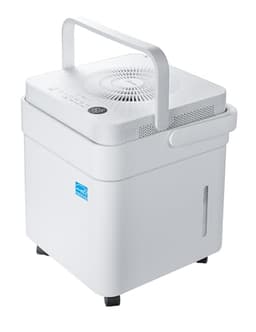
The only unit here that solves the real basement problem, which is not capacity but where the water goes when you are not standing next to it.
Average draw
487 W
Computed from the ENERGY STAR certified entry for Midea MAD50S1QWT-A, the 50 pt / 4,500 sq ft Cube without a pump: 49.67 pt/day at IEF 2.01 L/kWh. Midea's own US product page confirms MAD50S1QWT-A is this configuration. Midea publishes no wattage on the Amazon listing or on that page.
What is good
- The body separates, so the tank half can sit lower than the compressor half and the hose gets a genuine downhill run
- Certified at 49.67 pt/day, which is a real 50-pint machine rather than a saturation number
- IEF 2.01 L/kWh puts it exactly on the median for the 50-pint class - neither a bargain nor a penalty
- Wi-Fi that tells you it has stopped, which is the only smart feature that matters in a basement
What is not
- No pump, so the drain has to run downhill the whole way
- Midea publishes no wattage anywhere, so the 487 W above is computed rather than quoted
- The 4,500 sq ft coverage claim is marketing, not a spec - see the sizing guide
Who it is for
Someone with a floor drain, a sump, or a window well lower than the machine, who wants to set it once and stop thinking about it.
Skip it if
Skip it if the only drain in the room is higher than the unit. Without a pump, gravity is the entire drainage system, and no setting fixes an uphill hose.
Frigidaire
Frigidaire 50 Pint Dehumidifier with Wi-Fi
Best for: A Frigidaire with a drain below it
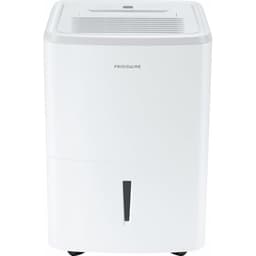
Frigidaire's current no-pump 50-pint: certified by exact model number, Wi-Fi equipped, and a 2.7 gallon bucket that is among the largest of any 50-pint unit we track.
Average draw
488 W
Computed from the ENERGY STAR certified entry for Frigidaire FHDD5034Y1 - the same model number as this listing: 49.71 pt/day at IEF 2.01 L/kWh. Frigidaire's Canadian product page states 115 V, 8.8 A and 470 W; those figures do not reconcile with each other and are nameplate rather than average values, so 488 W is the running-cost figure.
What is good
- Exact certified model match, so the 488 W figure describes this machine rather than a sibling
- 2.7 gallon bucket - roughly ten hours of condensate at full rated capacity if you ever run it without a hose
- Continuous drain, three fan speeds and operation down to 41F
- Wi-Fi and the Frigidaire app for scheduling and remote control
What is not
- Gravity only. The drain must be below the machine
- The Wi-Fi depends on Frigidaire's app remaining supported
- Frigidaire's own published wattage and amperage do not agree with each other
Who it is for
Someone with a floor drain who wants a certified, well-documented 50-pint unit and has a use for scheduling.
Skip it if
Skip it if the only drain is above the machine. That is the one job a gravity unit cannot do, whatever else it has.
Waykar
Waykar 80 Pint ENERGY STAR Dehumidifier
Best for: A large open basement or a shop floor
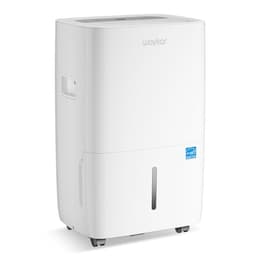
Sold on an 80-pint headline that is a saturation figure; the DOE rating behind it is in the same 50-pint class as everything else on this page.
Average draw
Not published
No published wattage. Waykar's certified 50-pint entries - JD026CE-150, CHWA150A/B/E, CTH150A/B and the YD-150 family - compute to between 443 W and 488 W. The identity of the exact certified model behind this listing is not stated, so the band stands in for a number.
What is good
- Sets to 30% RH, lower than most units will go
- 90-degree auto swing louvre, which genuinely helps in a long open basement
- Continuous drainage support and a larger tank than Waykar's smaller units
- Auto defrost for cold running
What is not
- The 80-pint headline is not a DOE rating and should not be compared against one
- No published wattage and no single certified model to map to
- 5,000 sq ft is the second-highest coverage claim in this registry
Who it is for
A large, open, genuinely wet basement or shop, where air movement matters as much as extraction.
Skip it if
Skip it if you are comparing it against a 50-pint unit on the strength of the 80. They are the same class of machine - the numbers are measured differently.
hOmeLabs
hOmeLabs 50 Pint Dehumidifier
Best for: Reading a coverage claim critically
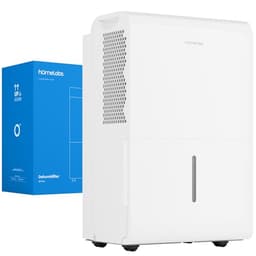
A capable 50-pint machine attached to the least plausible coverage claim on this page, and the gap between those two facts is worth understanding before you buy anything in this category.
Average draw
Not published
hOmeLabs publishes no wattage and has no 50-pint entry in the ENERGY STAR certified list - its certified models are the HME0088 at 24.48 pt/day (276 W) and the HME0089 at 32.46 pt/day (318 W). For a 50-pint compressor unit the certified class band is 443-490 W with a median of 488 W.
What is good
- States both numbers - 50 pints at the DOE condition and 120 at saturation - instead of quietly using the bigger one
- Wi-Fi control at a price below the Midea Cube
- Auto shut-off and a straightforward continuous-drain port
- Widely sold, so replacement filters are easy
What is not
- A 7,000 sq ft coverage claim for a 50-pint machine is roughly 50% higher than any comparable unit claims for the same capacity
- Not in the ENERGY STAR certified list at this capacity
- No published wattage
Who it is for
A budget-conscious buyer who understands that the coverage number is marketing and the pint number is the specification.
Skip it if
Skip it if you were buying it because of the 7,000 sq ft figure. Size from the room and the dampness, not from the largest number on the box - the sizing guide explains why.
GE
GE 50 Pint Dehumidifier
Best for: A garage or shop with a floor drain
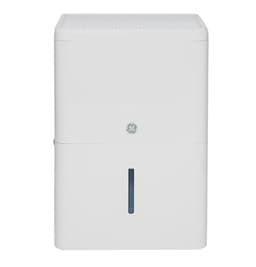
GE's current no-pump 50-pint, with a 30 percent humidistat floor and Smart Dry fan control - and no ENERGY STAR claim on the listing, which is the change worth noticing.
Average draw
Not published
Not published by GE. The ADHE50 series does not appear by name in the ENERGY STAR certified list and this listing makes no ENERGY STAR claim - its predecessor did. The certified 50-pint class runs 443-490 W with a median of 488 W, and a non-certified unit is more likely to sit at the top of that band than below it.
What is good
- Humidistat sets down to 30 percent where most units stop at 35 or 40
- Smart Dry adjusts fan speed to room humidity rather than running flat out
- Bucket-full alarm sounds for ten seconds rather than only lighting an icon
- Clean-filter alert, which is the maintenance nobody remembers to do
What is not
- No ENERGY STAR certification claimed, and no certified entry to compute a draw from
- Gravity drainage only
- A 5,000 sq ft coverage claim, up from its predecessor's 4,000 on the same capacity - a reminder that coverage claims are not a spec
Who it is for
A garage, workshop or utility room with a floor drain, where a low humidistat floor is useful and efficiency certification is not the deciding factor.
Skip it if
Skip it if it will run all season and efficiency matters. A certified 50-pint unit costs about $8 a month less by ENERGY STAR's own figure.
Quilo
Quilo 50 Pint Dehumidifier with Pump
Best for: A laundry room or basement with the drain up a wall
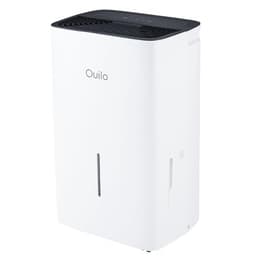
A certified 50-pint pump unit that puts its pump reach in writing - 15 feet, vertically or horizontally - and adds a laundry-drying mode nothing else we track offers.
Average draw
487 W
Computed from the ENERGY STAR certified entry for Quilo QLDAD50PWK - the same model number as this listing: 49.67 pt/day at IEF 2.01 L/kWh. Quilo publishes no wattage itself.
What is good
- States its pump reach - up to 15 feet vertically or horizontally - with the drain tube included
- Exact certified model match, so the 487 W figure describes this machine
- Dedicated laundry mode dries clothes and the room at the same time
- Child lock, thermal overload protection, auto defrost and a clean-filter alert
What is not
- Tank capacity is not stated on the listing
- No Wi-Fi or app is mentioned, so no remote alerts if the pump stops
- A newer brand name with no long track record under this name
Who it is for
Someone who needs a pump to reach a sink or window up to 15 feet away, especially in a laundry room where the drying mode earns its place.
Skip it if
Skip it if you want to be told on your phone when something stops. Nothing on the listing mentions connectivity.
What 50 pints costs to run
The median certified 50-pint unit
(488 W / 1000) x 12 h x $0.1834/kWh = $1.07 per day
0.488
kWh per hour
$32.69
per month, 12 h/day
$65.38
per month, 24 h/day
Rate is the US residential average of 18.34 cents/kWh from the EIA Electric Power Monthly, June 2026. Yours will differ - use the calculator.
Two things move that number more than the choice of machine does. The first is your electricity rate: at Nevada's 13.11 cents a month of 12-hour days is $23.05, and at Hawaii's 52.72 cents it is $92.68. The second is sizing - an undersized unit never reaches its target, never idles, and runs at full draw all day. Cost per month, by state. Two follow-on questions get asked constantly about this class: Midea against Frigidaire, and whether the brand name on the box means anything at all - the brand guide answers the second. A third is worth knowing before you shop: not every 50-pint on sale is in the certified file, and GE's current model is one that is not.
What we would skip
Any unit chosen on its square-footage claim
In our registry, 50-pint machines claim coverage from 4,000 to 7,500 square feet - a 1.9x spread for the same certified capacity. The pint rating is a measurement taken under a defined standard. The square footage is a marketing decision taken by a copywriter. Size from the pints and the dampness.
An 80-pint headline compared against a 50-pint rating
The Waykar on this page is sold as 80 pints and sits in the same DOE class as everything else here. That is not deceptive - both figures are real - but they are measured at different conditions, and comparing one against the other is comparing nothing.
How we picked
- Certified at 45 to 52 pints per day under the post-2019 DOE procedure. That is what 50-pint means.
- Computed average draw from the model's certified IEF, or the class band where no named entry exists.
- Drainage options, because within a class this narrow it is the real differentiator.
- What the maker publishes: a wattage, a pump reach, a minimum operating temperature, or nothing.
- Not tested by us. Every figure is quoted or computed, with the source named.
We did not test these units. The full criteria and their weighting are on the methodology page.
FAQ
Questions
Is a 50-pint dehumidifier big enough for a basement?
How much water should a 50-pint unit collect per day?
What was a 50-pint dehumidifier called before 2020?
Sources
Sources
Read next
- What the pint number on a dehumidifier actually meansThe 2019 DOE test change, the official conversion table, and the saturation rating that is 3x the certified one.
- 50-pint versus 70-pint: check the test firstThree different things a 70-pint claim can mean, and which one you are actually looking at.
- Dehumidifier capacity chartCapacity class, pre-2020 equivalent, median watts and monthly cost, in one sourced reference table.
- The best dehumidifiers for a basementFive basement units ranked on drainage first, with computed running costs and a unit we would not buy.
- How many watts a dehumidifier actually usesWattage for every capacity class, computed from certified data, with the formula and the cross-check.
- The square footage on the box is not a specificationIdentical certified capacity, coverage claims 1.9x apart. What the number is, and what to size from instead.
- Waykar 80 Pint ENERGY STARAn 80-pint headline that is a 50 on the comparable scale, plus a swing louvre that earns its place in a big room.
- hOmeLabs 50 Pint DehumidifierCertified 50 pints, sold as 7,000 sq ft - the widest gap between a measurement and a claim in our registry.