Reviews / hOmeLabs
hOmeLabs 50 Pint Dehumidifier
A capable, widely sold basement unit carrying the least plausible coverage figure of any machine we track. Both things are true at once, and the gap between them is the most useful thing about this listing.
#adThis page contains affiliate links. We earn a commission on qualifying purchases, at no cost to you, and it never changes a ranking. Full disclosure.
The short answer
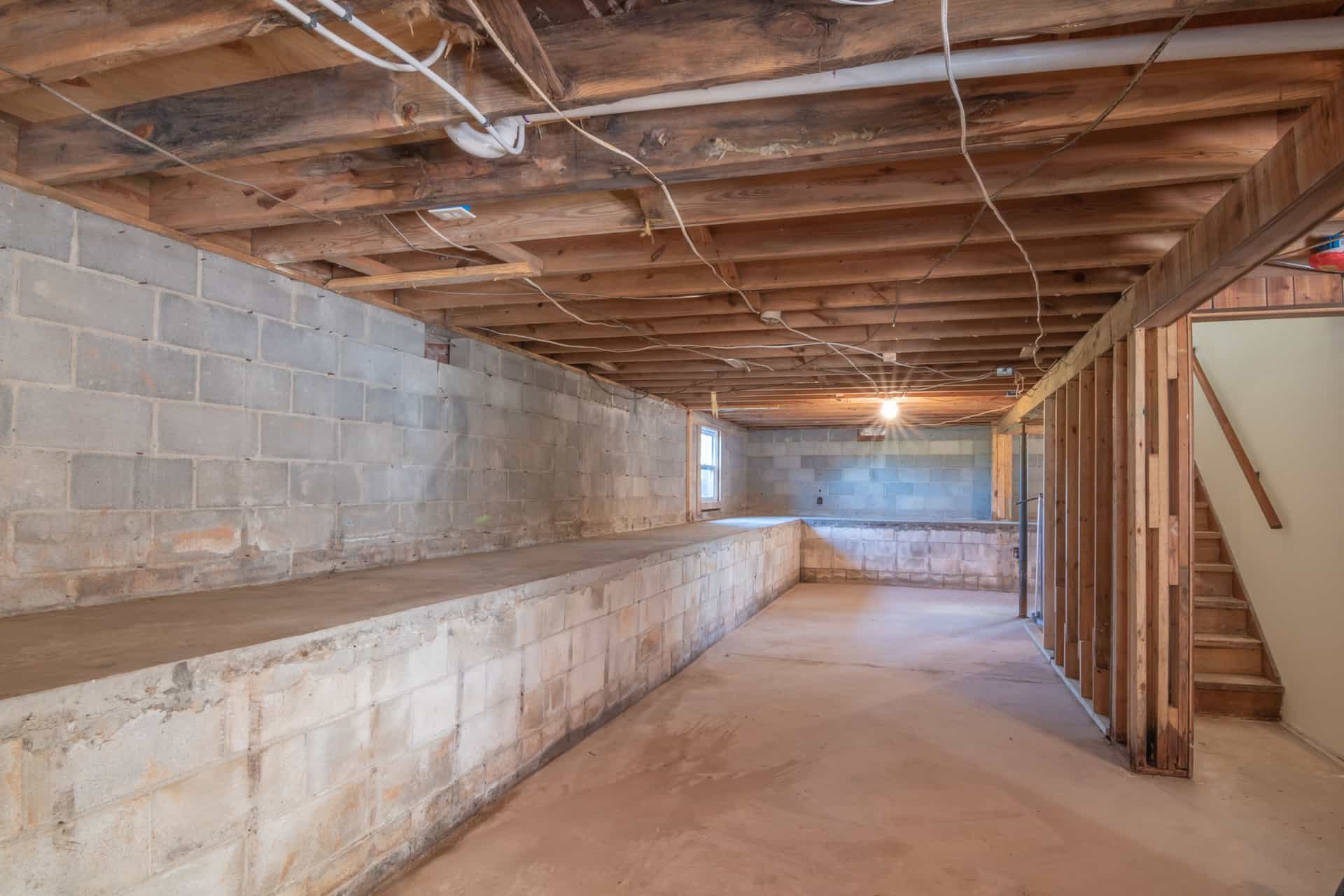
50 pints a day at the DOE test condition, a bucket or a gravity hose, Wi-Fi, and a 7,000 square foot coverage claim that is about 50 percent higher than any comparable 50-pint unit claims. hOmeLabs publishes no wattage and has no 50-pint entry in the ENERGY STAR certified list, so the class band of 443 to 490 W is the honest figure.
The thing it does better than most of its competitors
Before the criticism, credit where it is genuinely due. This listing prints both capacity numbers: 50 pints at the post-2019 DOE condition, and 120 pints at saturation - 95F and 90% relative humidity.
That is more honest than most of the category manages. The standard trick in this market is to lead with the saturation figure and leave the DOE rating in the fine print or out entirely, which is how a crawl space unit on this site ends up sold as 113 pints while its certified rating is 36.33. hOmeLabs shows you both and lets you see which is which. What the pint rating means.
And then there is the coverage claim
7,000 sq ft
Claimed coverage, for 50 certified pints a day
For the same certified capacity, GE claims 4,000, Midea 4,500 and Frigidaire 4,500. Waykar claims 5,000. hOmeLabs claims 7,000 for this unit and 7,500 for its pump sibling - a 1.9x spread across machines that remove the same amount of water under the same test.
There is no test procedure behind any coverage claim in this category. None. The DOE specifies how capacity is measured - 65F, 60% relative humidity, a defined chamber - and specifies nothing whatsoever about square footage. The coverage number is a marketing decision, and this is the clearest demonstration of that fact anywhere in our registry.
That does not make the machine bad. It makes the number meaningless. A 50-pint unit removes 50 pints a day whether the box says 4,000 or 7,000, and how far that goes in your house depends on how damp the space is, how sealed it is and how cold it is - none of which a square footage describes. Why coverage claims are not a specification.
Quick picks
| # | Product | Best for | Draw | Price |
|---|---|---|---|---|
| 1 |  hOmeLabs 50 Pint DehumidifierA capable 50-pint machine attached to the least plausible coverage claim on this page, and the gap between those two facts is worth understanding before you buy anything in this category. hOmeLabs 50 Pint DehumidifierA capable 50-pint machine attached to the least plausible coverage claim on this page, and the gap between those two facts is worth understanding before you buy anything in this category. | Reading a coverage claim critically | Not published | $269.99View on Amazon #ad Price as of September 14, 2026. How we are funded |
| 2 |  hOmeLabs 50 Pint Dehumidifier with PumpBucket, gravity hose and a built-in pump in a single unit, carrying the least supportable coverage claim in the category. hOmeLabs 50 Pint Dehumidifier with PumpBucket, gravity hose and a built-in pump in a single unit, carrying the least supportable coverage claim in the category. | All three drainage modes on one machine | Not published | $309.99View on Amazon #ad Price as of September 14, 2026. How we are funded |
| 3 |  hOmeLabs 32 Pint DehumidifierThe one hOmeLabs unit with a named entry in the ENERGY STAR list, so it is the one where the running cost is a published figure rather than a class estimate. hOmeLabs 32 Pint DehumidifierThe one hOmeLabs unit with a named entry in the ENERGY STAR list, so it is the one where the running cost is a published figure rather than a class estimate. | A bedroom that is damp but not wet | 318 W | $234.99View on Amazon #ad Price as of September 14, 2026. How we are funded |
hOmeLabs
hOmeLabs 50 Pint Dehumidifier
Best for: Reading a coverage claim critically
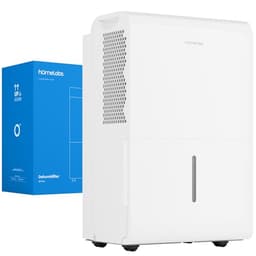
A capable 50-pint machine attached to the least plausible coverage claim on this page, and the gap between those two facts is worth understanding before you buy anything in this category.
Average draw
Not published
hOmeLabs publishes no wattage and has no 50-pint entry in the ENERGY STAR certified list - its certified models are the HME0088 at 24.48 pt/day (276 W) and the HME0089 at 32.46 pt/day (318 W). For a 50-pint compressor unit the certified class band is 443-490 W with a median of 488 W.
What is good
- States both numbers - 50 pints at the DOE condition and 120 at saturation - instead of quietly using the bigger one
- Wi-Fi control at a price below the Midea Cube
- Auto shut-off and a straightforward continuous-drain port
- Widely sold, so replacement filters are easy
What is not
- A 7,000 sq ft coverage claim for a 50-pint machine is roughly 50% higher than any comparable unit claims for the same capacity
- Not in the ENERGY STAR certified list at this capacity
- No published wattage
Who it is for
A budget-conscious buyer who understands that the coverage number is marketing and the pint number is the specification.
Skip it if
Skip it if you were buying it because of the 7,000 sq ft figure. Size from the room and the dampness, not from the largest number on the box - the sizing guide explains why.
hOmeLabs
hOmeLabs 50 Pint Dehumidifier with Pump
Best for: All three drainage modes on one machine
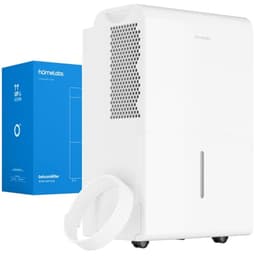
Bucket, gravity hose and a built-in pump in a single unit, carrying the least supportable coverage claim in the category.
Average draw
Not published
No published wattage and no 50-pint hOmeLabs entry in the ENERGY STAR certified list. Class band for certified 50-pint units is 443-490 W, median 488 W.
What is good
- All three drainage modes on one machine - bucket, gravity, or pump
- Drains upward, which is the whole point in a room whose only outlet is above the unit
- Same familiar controls as the rest of the hOmeLabs line
- Auto shut-off and continuous drainage set-up out of the box
What is not
- 7,500 sq ft coverage claim is the highest here and the least supportable
- No ENERGY STAR certification at this capacity, so no published IEF to compute a draw from
- Pump lift and hose length are not stated
Who it is for
Someone who needs a pump, wants the option of all three drainage modes, and is willing to ignore the coverage number entirely.
Skip it if
Skip it if efficiency matters to you. Without a certified IEF there is no published basis for a running-cost figure, and over a season that is real money.
hOmeLabs
hOmeLabs 32 Pint Dehumidifier
Best for: A bedroom that is damp but not wet
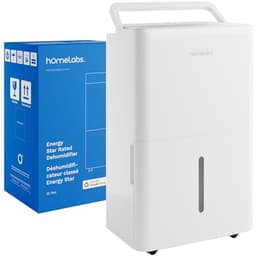
The one hOmeLabs unit with a named entry in the ENERGY STAR list, so it is the one where the running cost is a published figure rather than a class estimate.
Average draw
318 W
Computed from the ENERGY STAR certified entry hOmeLabs HME0089: 32.46 pt/day at IEF 2.01 L/kWh. This is the only hOmeLabs capacity in this registry with a named certified entry, which is why it is the only one carrying a number rather than a band.
What is good
- 318 W against the 50-pint class median of 488 W - about 35% less to run, hour for hour
- Named in the ENERGY STAR certified list, so its IEF is public
- Quiet enough for a bedroom in a way that a 50-pint compressor generally is not
- Wi-Fi and auto shut-off at a small-unit price
What is not
- 32 DOE pints is genuinely less water than 50 - undersizing a wet basement costs more than the machine saved
- Gravity drainage only
- 4,500 sq ft coverage for 32 pints is another claim to ignore
Who it is for
A bedroom, a home office, or a small basement that is humid rather than actively wet.
Skip it if
Skip it if the floor is ever damp to the touch or the walls sweat. That is a 50-pint problem, and a 32-pint machine will run continuously and still lose.
The wattage, and why we will not print one
hOmeLabs publishes no power figure for this unit, which is normal - of the 21 units we track, one prints a wattage on its listing.
It is a harder case than most, though, because hOmeLabs has no 50-pint entry in the ENERGY STAR certified list at all. Its certified models are the HME0088 at 24.48 pt/day and the HME0089 at 32.46 pt/day, which compute to 276 W and 318 W respectively. Neither of those describes this machine.
We could print 318 W and it would look authoritative. It would also be a different, smaller machine's number pinned onto this one, and that is exactly the sort of thing this site exists not to do. What we can say is that the certified 50-pint class runs 443 to 490 W across 164 models with a median of 488 W, and that a non-certified unit is more likely to sit at or above the top of that band than below it. How the wattages are computed.
The absence of certification is itself a data point worth weighing. ENERGY STAR's own claim is that certified dehumidifiers run about 20 percent more efficient than non-certified ones - on a 50-pint unit that is roughly $8 a month at twelve hours a day, or about $40 over a five-month season. ENERGY STAR and IEF.
Drainage: gravity, and that is the decision
A removable bucket and a continuous-drain port. No pump. That single fact determines whether this unit is usable in your room, and it is worth settling before anything else:
- If the drain is below the machine - a floor drain, a sump, a window well - run a hose and never think about it again. This is the configuration in which a dehumidifier's rated capacity is actually available to you. Drain hose picks.
- If the only drain is above the machine - a laundry sink, a standpipe on a wall - gravity cannot do it, and no setting changes that. The pump sibling exists for exactly this case. Pump versus gravity.
- If you plan to empty a bucket in a damp basement, reconsider. At 50 pints a day that is several trips daily, and a machine that is full is a machine that has stopped.
What it costs to run
The certified 50-pint class median, used in place of a published figure
(488 W / 1000) x 12 h x $0.1834/kWh = $1.07 per day
0.488
kWh per hour
$32.69
per month, 12 h/day
$65.38
per month, 24 h/day
Rate is the US residential average of 18.34 cents/kWh from the EIA Electric Power Monthly, June 2026. Yours will differ - use the calculator.
Treat that as a floor rather than a measurement, for the reason above: this unit is not certified, and the class band tops out at 490 W. Your electricity rate moves the number more than the machine does - the same draw is about $23 a month in Nevada and about $93 in Hawaii. Rates by state.
Who should buy something else
- Anyone whose drain is above the unit. No pump. The hOmeLabs pump model does the same job with the constraint removed.
- Anyone who needs a published efficiency figure. There is no certified entry and no stated wattage, so every running-cost number for this machine is a class band rather than a measurement. A certified unit is the better choice if that matters.
- Anyone buying on the 7,000 sq ft number. If that figure is what sold you, the comparison you made was not a comparison.
- Anyone conditioning a bedroom. A 50-pint compressor next to a bed is a mistake regardless of brand - a 30 to 32-pint unit at about 318 W is the right size and markedly quieter. The 30-pint class.
What we did not do
We have not run this unit. No extraction test, no power meter, no sound measurement, and no check of whether it actually holds a 7,000 square foot space - which it will not, but we have not proven that either. What this page adds is the certified data that exists, a plain statement of the data that does not, and the coverage claim placed beside its competitors so you can see the spread for yourself. How we work.
FAQ
Questions
Is the hOmeLabs 50 pint really 50 pints?
Does the hOmeLabs 50 pint really cover 7,000 square feet?
How many watts does the hOmeLabs 50 pint use?
Does the hOmeLabs 50 pint have a pump?
Is the hOmeLabs 50 pint ENERGY STAR certified?
Sources
Sources
- hOmeLabs 50 Pint Dehumidifier, 7,000 sq ft, max 120 pint at 95F / 90% RH - manufacturer listing (retrieved 2026-09-01)
- ENERGY STAR Certified Dehumidifiers product list - hOmeLabs' certified entries are the HME0088 (24.48 pt/day) and HME0089 (32.46 pt/day); no 50-pint model appears (retrieved 2026-09-01)
- ENERGY STAR - Dehumidifier Testing and Capacity: the 65F / 60% RH test condition and the absence of any coverage standard
- EIA Electric Power Monthly, Table 5.6.A, June 2026 - the electricity rate used
Read next
- The square footage on the box is not a specificationIdentical certified capacity, coverage claims 1.9x apart. What the number is, and what to size from instead.
- The best 50-pint dehumidifiersSix 50-pint units and the certified data behind them: a 443-490 W range and a coverage claim that varies 1.9x.
- hOmeLabs 32 PintThe one hOmeLabs unit with a certified entry, so the only one with a computed 318 W rather than a band.
- IEF, and what an ENERGY STAR badge is worthWhat IEF measures, what it replaced, the real spread across 527 models, and what the badge saves.
- The best dehumidifiers with a drain hoseFive units with a usable gravity port, and the one check that decides whether a hose works in your room.