Reviews / hOmeLabs
hOmeLabs 32 Pint
The only machine in hOmeLabs' line-up whose efficiency is a matter of public record, which makes it the only one where we can put a number rather than a band on the bill.
#adThis page contains affiliate links. We earn a commission on qualifying purchases, at no cost to you, and it never changes a ranking. Full disclosure.

The short answer
Certified as hOmeLabs HME0089 at 32.46 pints per day and IEF 2.01 L/kWh, computing to 318 W - about 35% less than a 50-pint unit's 488 W. Gravity drainage only. The 4,500 sq ft coverage claim is not a specification.
Why this one gets a number and its siblings do not
hOmeLabs has exactly two entries in the ENERGY STAR certified list: the HME0088 at 24.48 pints per day and the HME0089 at 32.46. Its 50-pint and 8-pint models are absent, which means there is no published IEF for either and no honest way to compute a wattage for them.
So this page carries 318 W and the hOmeLabs 50 Pint carries a class band instead. That asymmetry is not an editorial choice; it is what the published data supports. It is also a reason to prefer certified models generally: certification means the capacity and efficiency figures were verified rather than asserted.
hOmeLabs 32 Pint, certified as HME0089
(318 W / 1000) x 12 h x $0.1834/kWh = $0.70 per day
0.318
kWh per hour
$21.30
per month, 12 h/day
$42.61
per month, 24 h/day
Rate is the US residential average of 18.34 cents/kWh from the EIA Electric Power Monthly, June 2026. Yours will differ - use the calculator.
What 318 watts buys and costs
Against a 50-pint machine, this removes about 18 fewer pints a day and saves about $11 a month at twelve hours a day. Over a five-month season that is $56, which on a unit at this price point is a meaningful fraction of what it cost.
The trap is that the saving evaporates entirely if the machine is undersized for the room. An undersized unit never reaches its humidity target, never cycles off, and runs at its full 318 W around the clock - $42 a month, which is more than a correctly sized 50-pint unit costs at twelve hours. 30 versus 50 pint.
Quick picks
| # | Product | Best for | Draw | Price |
|---|---|---|---|---|
| 1 |  hOmeLabs 32 Pint DehumidifierThe one hOmeLabs unit with a named entry in the ENERGY STAR list, so it is the one where the running cost is a published figure rather than a class estimate. hOmeLabs 32 Pint DehumidifierThe one hOmeLabs unit with a named entry in the ENERGY STAR list, so it is the one where the running cost is a published figure rather than a class estimate. | A bedroom that is damp but not wet | 318 W | $234.99View on Amazon #ad Price as of October 16, 2026. How we are funded |
| 2 |  hOmeLabs 50 Pint DehumidifierA capable 50-pint machine attached to the least plausible coverage claim on this page, and the gap between those two facts is worth understanding before you buy anything in this category. hOmeLabs 50 Pint DehumidifierA capable 50-pint machine attached to the least plausible coverage claim on this page, and the gap between those two facts is worth understanding before you buy anything in this category. | Reading a coverage claim critically | Not published | $269.99View on Amazon #ad Price as of October 16, 2026. How we are funded |
| 3 |  hOmeLabs 8 Pint DehumidifierA real compressor unit at a size where most competitors sell thermoelectric toys, which makes it the smallest machine here that actually removes meaningful water. hOmeLabs 8 Pint DehumidifierA real compressor unit at a size where most competitors sell thermoelectric toys, which makes it the smallest machine here that actually removes meaningful water. | A closet, a boat, or a single small room | Not published | $174.99View on Amazon #ad Price as of October 16, 2026. How we are funded |
hOmeLabs
hOmeLabs 32 Pint Dehumidifier
Best for: A bedroom that is damp but not wet
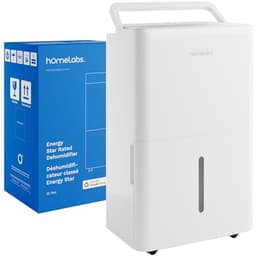
The one hOmeLabs unit with a named entry in the ENERGY STAR list, so it is the one where the running cost is a published figure rather than a class estimate.
Average draw
318 W
Computed from the ENERGY STAR certified entry hOmeLabs HME0089: 32.46 pt/day at IEF 2.01 L/kWh. This is the only hOmeLabs capacity in this registry with a named certified entry, which is why it is the only one carrying a number rather than a band.
What is good
- 318 W against the 50-pint class median of 488 W - about 35% less to run, hour for hour
- Named in the ENERGY STAR certified list, so its IEF is public
- Quiet enough for a bedroom in a way that a 50-pint compressor generally is not
- Wi-Fi and auto shut-off at a small-unit price
What is not
- 32 DOE pints is genuinely less water than 50 - undersizing a wet basement costs more than the machine saved
- Gravity drainage only
- 4,500 sq ft coverage for 32 pints is another claim to ignore
Who it is for
A bedroom, a home office, or a small basement that is humid rather than actively wet.
Skip it if
Skip it if the floor is ever damp to the touch or the walls sweat. That is a 50-pint problem, and a 32-pint machine will run continuously and still lose.
hOmeLabs
hOmeLabs 50 Pint Dehumidifier
Best for: Reading a coverage claim critically
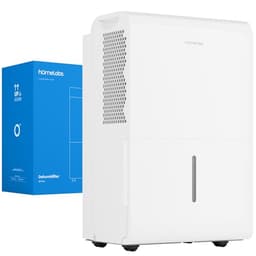
A capable 50-pint machine attached to the least plausible coverage claim on this page, and the gap between those two facts is worth understanding before you buy anything in this category.
Average draw
Not published
hOmeLabs publishes no wattage and has no 50-pint entry in the ENERGY STAR certified list - its certified models are the HME0088 at 24.48 pt/day (276 W) and the HME0089 at 32.46 pt/day (318 W). For a 50-pint compressor unit the certified class band is 443-490 W with a median of 488 W.
What is good
- States both numbers - 50 pints at the DOE condition and 120 at saturation - instead of quietly using the bigger one
- Wi-Fi control at a price below the Midea Cube
- Auto shut-off and a straightforward continuous-drain port
- Widely sold, so replacement filters are easy
What is not
- A 7,000 sq ft coverage claim for a 50-pint machine is roughly 50% higher than any comparable unit claims for the same capacity
- Not in the ENERGY STAR certified list at this capacity
- No published wattage
Who it is for
A budget-conscious buyer who understands that the coverage number is marketing and the pint number is the specification.
Skip it if
Skip it if you were buying it because of the 7,000 sq ft figure. Size from the room and the dampness, not from the largest number on the box - the sizing guide explains why.
hOmeLabs
hOmeLabs 8 Pint Dehumidifier
Best for: A closet, a boat, or a single small room
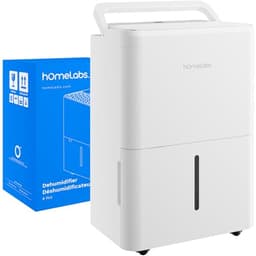
A real compressor unit at a size where most competitors sell thermoelectric toys, which makes it the smallest machine here that actually removes meaningful water.
Average draw
Not published
Not published. The certified 8-13 pint class runs 92-128 W with a median of 105 W across 39 models, and the median unit in that class uses 117 kWh a year.
What is good
- A compressor at 8 pints, so it keeps working where a Peltier unit stops
- Roughly a fifth of the power of a 50-pint machine
- Wi-Fi and auto shut-off, unusual at this size
- Small enough to sit in a wardrobe or a berth
What is not
- 1,800 sq ft coverage for 8 DOE pints is not a serious claim
- Bucket only - no continuous drain at this size
- Not ENERGY STAR certified, so no published IEF
Who it is for
Closets, gun safes, boat cabins, and single small rooms where a large machine is absurd.
Skip it if
Skip it for any room where you can feel the damp. Eight pints a day is a maintenance dose, not a cure.
The two numbers on the listing
hOmeLabs prints both: 32 pints at the DOE condition and up to 80 pints at 95F and 90% RH. That is the right behavior and worth noting, because most of the category prints only whichever number is larger.
The 4,500 square feet is a different matter. That is the same coverage claim Midea makes for a 50-pint machine, attached to a unit with roughly two thirds the capacity. It is not a lie because it is not a measurement of anything - coverage claims in our registry span 1.9x for identical certified capacity. Size from the room's measured humidity instead. Sizing method.
Who should buy it
A bedroom, a home office or a small basement measuring 60 to 68% relative humidity. It is quiet enough for a room you occupy in a way a 50-pint compressor generally is not, and the efficiency figure is public rather than inferred.
Not for a wet basement, not for anything with visible moisture, and not for anywhere you need a pump - it drains by gravity only.
FAQ
Questions
How many watts is the hOmeLabs 32 pint dehumidifier?
What does the hOmeLabs 32 pint cost to run?
Is 32 pints enough for a basement?
Sources
Sources
Read next
- The best 30-pint dehumidifiersThe 30 to 34-pint class at about 318 W, and an honest account of when this is the wrong size.
- 30-pint versus 50-pint170 watts and $11 a month apart, with one failure mode that makes the cheaper machine cost more.
- The best dehumidifiers for a bedroomFour options for a room you sleep in, ranked on cycling behavior rather than a decibel figure nobody measured.
- Dehumidifier running cost calculatorYour own rate, your own hours, and every default value shown on screen with its source.
- How many watts a dehumidifier actually usesWattage for every capacity class, computed from certified data, with the formula and the cross-check.
- Waykar 34 Pint ENERGY STARSets to 30% RH where most stop at 40 - and a 34-pint headline that is certified at 10.16.
- 20-pint versus 30-pint60 watts and $4 a month apart, with the efficiency running the other way. Where 20 pints genuinely works.
- hOmeLabs 50 Pint DehumidifierCertified 50 pints, sold as 7,000 sq ft - the widest gap between a measurement and a claim in our registry.