Sizing / Comparison
20-pint versus 30-pint
The smallest capacity anyone should consider for an actual room, against the smallest that reliably works in one. The gap in running cost is small; the gap in what they can achieve is not.
#adThis page contains affiliate links. We earn a commission on qualifying purchases, at no cost to you, and it never changes a ranking. Full disclosure.
The short answer
A 20-22 pint unit draws about 258 W and a 30-32 pint about 318 W - roughly $4 a month apart at 12 hours a day. The smaller class suits one small, mildly damp room. For anything below grade, or any room over about 1,000 square feet, 30 pints is the smallest that reliably works.
The two classes, from the certified data
| 20-22 pint | 30-32 pint | Difference | |
|---|---|---|---|
| Certified models | 51 | 21 | - |
| Median draw | 258 W | 318 W | 60 W |
| Draw range | 214-267 W | 293-318 W | - |
| Median IEF | 1.70 L/kWh | 2.01 L/kWh | The larger class is more efficient per liter |
| Median annual use | 276 kWh | 343 kWh | 67 kWh |
| Cost, 12 h/day, US average | $17.04/mo | $21.00/mo | $3.96/mo |
| Water removed per day | 20-22 pints | 30-32 pints | About 10 pints |
Note the IEF column. The bigger class is not just bigger, it moves more water per kilowatt-hour - 2.01 against 1.70. Buying down a class costs you efficiency as well as capacity.
Four dollars a month is the entire running-cost argument for the smaller machine, and it disappears the moment the smaller machine has to run longer to achieve the same thing. That is the whole comparison in one sentence.
What 20 pints is genuinely for
There is a real use case and it is narrower than the listings suggest:
- One room, above grade, mildly damp. A bedroom or a home office reading 60 to 65% in August, with no visible moisture anywhere.
- A room where the unit has to be small. These are physically smaller and lighter, which matters if it moves between rooms or lives on a shelf.
- A space you already dried out and now want to hold. Maintaining 50% is much less work than getting to 50% in the first place.
- Somewhere the noise matters more than the speed. A smaller compressor in a correctly sized room runs longer, gentler cycles.

Where it fails, and why the failure is expensive
Every figure in the table above assumes the machine reaches its humidity target and idles. An undersized unit never does. It runs continuously at full draw and the room stays where it was.
$34
Monthly cost of a 20-pint unit that never reaches its target
258 W running 24 hours a day at the US average rate of 18.34 cents/kWh. A correctly sized 30-pint unit at 12 hours costs $21.00 - so the cheaper machine costs 60% more and leaves the room damp. Computed from the ENERGY STAR class medians and the EIA rate.
That inversion is the reason this site keeps saying the same thing: undersizing is the most expensive mistake in the category, and it is more expensive than any efficiency difference between two correctly sized machines. The same arithmetic at the next size up.
The honest recommendation
| Measured RH | Room | Class |
|---|---|---|
| Under 60% | Any | Probably neither - you may not need a dehumidifier |
| 60-65% | One room, above grade, under ~800 sq ft | 20-22 pint is defensible |
| 60-68% | One room, above grade, 800-1,500 sq ft | 30-32 pint |
| Any | Below grade / basement | 30-32 pint minimum, usually 50 |
| Over 68%, or visible moisture | Any | 50 pint |
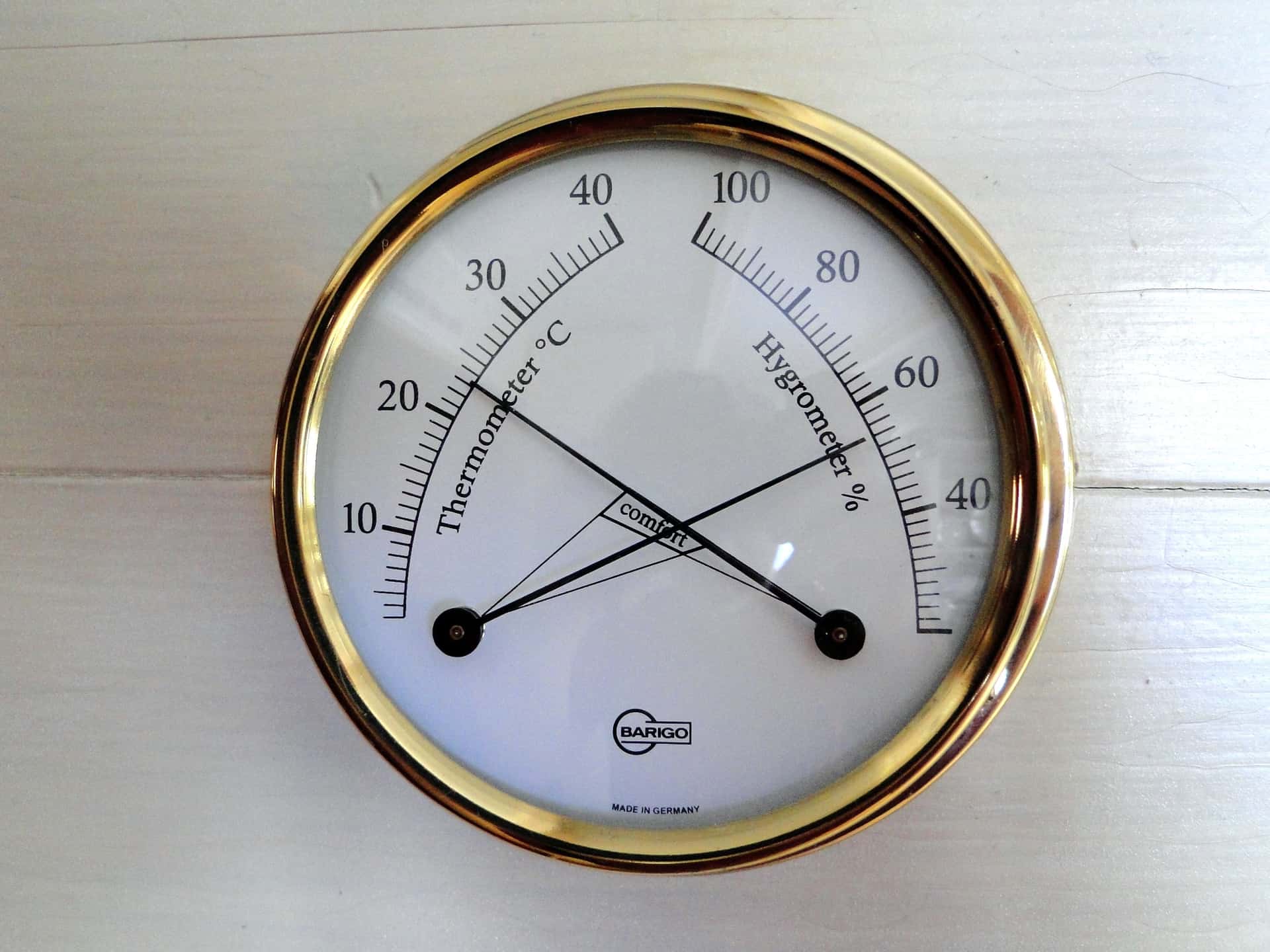
Measure first. A ten-dollar hygrometer over a week answers this better than any square-footage table on a box. The full method.
In practice, we would take the 30-pint class in almost every case where someone is genuinely choosing between the two. The running-cost gap is four dollars a month, the efficiency gap runs the other way, and the downside of guessing wrong is asymmetric - an oversized unit cycles a bit more, an undersized one simply does not work.
Quick picks
| # | Product | Best for | Draw | Price |
|---|---|---|---|---|
| 1 |  hOmeLabs 32 Pint DehumidifierThe one hOmeLabs unit with a named entry in the ENERGY STAR list, so it is the one where the running cost is a published figure rather than a class estimate. hOmeLabs 32 Pint DehumidifierThe one hOmeLabs unit with a named entry in the ENERGY STAR list, so it is the one where the running cost is a published figure rather than a class estimate. | A bedroom that is damp but not wet | 318 W | $234.99View on Amazon Listing withdrawn - this searches the model. #ad Price as of October 21, 2026. How we are funded |
| 2 |  Honeywell Smart Wi-Fi 30 Pint Dehumidifier (TP50AWKN)The anti-spill design is the actual selling point here, and it is a better reason to buy than the voice control the listing leads with. Honeywell Smart Wi-Fi 30 Pint Dehumidifier (TP50AWKN)The anti-spill design is the actual selling point here, and it is a better reason to buy than the voice control the listing leads with. | A room you want to run on a schedule | Not published | $290.60View on Amazon #ad Price as of October 21, 2026. How we are funded |
hOmeLabs
hOmeLabs 32 Pint Dehumidifier
Best for: A bedroom that is damp but not wet
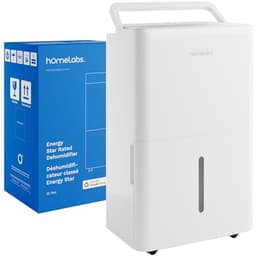
The one hOmeLabs unit with a named entry in the ENERGY STAR list, so it is the one where the running cost is a published figure rather than a class estimate.
Average draw
318 W
Computed from the ENERGY STAR certified entry hOmeLabs HME0089: 32.46 pt/day at IEF 2.01 L/kWh. This is the only hOmeLabs capacity in this registry with a named certified entry, which is why it is the only one carrying a number rather than a band.
What is good
- 318 W against the 50-pint class median of 488 W - about 35% less to run, hour for hour
- Named in the ENERGY STAR certified list, so its IEF is public
- Quiet enough for a bedroom in a way that a 50-pint compressor generally is not
- Wi-Fi and auto shut-off at a small-unit price
What is not
- 32 DOE pints is genuinely less water than 50 - undersizing a wet basement costs more than the machine saved
- Gravity drainage only
- 4,500 sq ft coverage for 32 pints is another claim to ignore
Who it is for
A bedroom, a home office, or a small basement that is humid rather than actively wet.
Skip it if
Skip it if the floor is ever damp to the touch or the walls sweat. That is a 50-pint problem, and a 32-pint machine will run continuously and still lose.
Honeywell
Honeywell Smart Wi-Fi 30 Pint Dehumidifier (TP50AWKN)
Best for: A room you want to run on a schedule
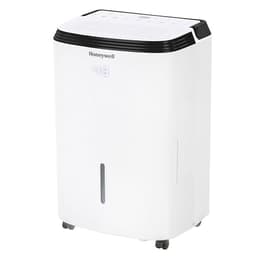
The anti-spill design is the actual selling point here, and it is a better reason to buy than the voice control the listing leads with.
Average draw
Not published
Not published. Honeywell's certified 32-pint entries, the TPFIT32AWK and TPFIT32WK, compute to 318 W at 32.46 pt/day and IEF 2.01. This is a different product line, so that figure sits in the note rather than in the spec table.
What is good
- Anti-spill bucket, which matters more than any app feature if the machine lives upstairs
- Scheduling through the app, so it can run when electricity is cheapest
- ENERGY STAR certified at a small-room capacity
- Alerts on the phone rather than only a beep in an empty room
What is not
- No published wattage, and the certified list carries a different Honeywell line
- 3,000 sq ft for 30 pints is an optimistic claim
- Depends on Honeywell's app remaining supported
Who it is for
An upstairs room or a rental where a spilled bucket is somebody's ceiling, and where scheduling is genuinely useful.
Skip it if
Skip it if the machine will sit on concrete next to a drain. You would be paying for spill protection and scheduling that a floor drain makes irrelevant.
One thing neither class can do
Work in the cold. Both are compressor machines, and a compressor's output falls sharply below about 60F and collapses near 41F. If the room you are sizing for is an unheated garage, shed or winter crawl space, the capacity question is the wrong question - the technology is. Desiccant versus compressor.
FAQ
Questions
Is a 20 pint dehumidifier big enough?
How much more does a 30 pint dehumidifier cost to run?
Which is more efficient, a 20 pint or a 30 pint?
What was a 20 pint dehumidifier called before 2020?
Sources
Sources
- ENERGY STAR Certified Dehumidifiers product list - 51 certified models in the 20-22 pint band and 21 in the 30-32 pint band, with per-model IEF and DOE capacity (retrieved 2026-09-01)
- ENERGY STAR - Dehumidifier Testing and Capacity: the old-to-new capacity correlation
- EIA Electric Power Monthly, Table 5.6.A, June 2026
Read next
- 30-pint versus 50-pint170 watts and $11 a month apart, with one failure mode that makes the cheaper machine cost more.
- What size dehumidifier do I need?A four-step method that uses measured humidity instead of the square-footage claim on the box.
- Dehumidifier capacity chartCapacity class, pre-2020 equivalent, median watts and monthly cost, in one sourced reference table.
- The best 30-pint dehumidifiersThe 30 to 34-pint class at about 318 W, and an honest account of when this is the wrong size.
- Dehumidifier running cost calculatorYour own rate, your own hours, and every default value shown on screen with its source.
- Midea Cube 20 vs 35 vs 50 pintSame body, same app, three sizes. The 20 is 18% less efficient per pint, and the 35 shares the 50's bucket.