Best / Buyer's guide
The best dehumidifier brands
There are 136 dehumidifier brand names in the US certification file and 77 companies certifying them. Some of those brands are manufacturers. Many of them are a name on a box from a factory that also supplies three other names.
#adThis page contains affiliate links. We earn a commission on qualifying purchases, at no cost to you, and it never changes a ranking. Full disclosure.

The short answer
Midea, Hisense, LG and TCL certify dehumidifiers under their own corporate names and make their own compressors. Frigidaire and GE are licensed brand names. Waykar, Yaufey, KESNOS and Fehom appear together on single certificates, meaning one factory and four labels. Of 136 brand names in the certified file, only 77 companies stand behind them.
The number that reframes the shelf
136 brands, 77 companies
Brand names in the ENERGY STAR certified dehumidifier file, against the companies that certify them
From the ENERGY STAR Certified Dehumidifiers list, 551 certified models, retrieved 2026-09-21. The partner field on each certificate names the company responsible for the measurement; the brand field names what it is sold as.
Search dehumidifiers on any large retailer and you will see dozens of brands you have never heard of, each with its own logo, its own product photography and its own confident capacity claim. It is reasonable to assume that many different companies are competing. The certification file says something narrower is going on.
Fifty-nine of the 551 certified entries list more than one brand name on the same certificate - the same measurement, the same model, sold under several labels. The clearest example: a single entry under the brand string 'waykar, KESNOS, YAUFEY, Fehom'. Four names, one machine, one test.
Who certifies what
| Certifying partner | Certified models | Brand names |
|---|---|---|
| Waykar | 66 | Waykar, KESNOS, Yaufey, Fehom |
| GD Midea Air-Conditioning Equipment Co., Ltd. | 49 | Midea (and its own licensees) |
| Zhejiang Hengjian Home Furnishing Co., Ltd | 39 | 13 brand names, including CONCETTA, DUMOS, edx, Gianna, IULULU, JIOABL |
| Hongkong Yoau International Trade Co., Ltd | 34 | Yoau, Shinco, UHOME |
| Hisense (Guangdong) Air Conditioning Co. Ltd | 30 | Hisense |
| JHS Inc | 26 | 12 brand names, including boglvr, DEVERSE, Fehom, Folanzy, GRIDR, KESNOS |
| Zhuhai Invitop Technology Co., Ltd. | 15 | 7 brand names, including Aeocky, Vellgoo, upstreman |
| The Home Depot | 13 | The retailer's own house brand |
From the ENERGY STAR Certified Dehumidifiers list, retrieved 2026-09-21. Counted by the partner field on each certificate. Note the last row: a retailer can be its own ENERGY STAR partner.
None of this is a scandal, and none of it is hidden - it is published, by the manufacturers, in a public file. Contract manufacturing is how most consumer appliances have been made for thirty years. But it does change what a brand name tells you, and it explains something buyers notice constantly: why four machines from four brands have the same body, the same control panel, the same coverage claim and the same certified capacity to two decimal places.
The three kinds of brand in this category
1. Manufacturers who certify under their own corporate name
Midea, Hisense, LG and TCL. These companies make refrigeration equipment at scale, hold the certificate under their own corporate entity, and put their name on the box. Midea's certifying partner is GD Midea Air-Conditioning Equipment Co., Ltd., with 49 certified models. Hisense's is Hisense (Guangdong) Air Conditioning Co. Ltd, with 30. That is the answer to 'who makes Hisense dehumidifiers?' - Hisense does, through its air-conditioning arm.
What this buys you is not automatically a better machine. What it buys you is a company with a service network, a warranty department that predates the product, and a name it cannot walk away from. The Hisense reference and the LG reference both work through what that does and does not mean.
2. Licensed heritage names
Frigidaire and GE are the two you will meet most often. These are long-established American appliance names now applied to dehumidifiers under license, and the machines behind them are built by appliance manufacturers rather than in a Frigidaire dehumidifier factory. The certified file makes the arrangement explicit: Frigidaire's ENERGY STAR partner is Electrolux Consumer Products, Inc., not Frigidaire. The name carries real weight - a retail network, a warranty process, spare parts - and it is worth paying something for. It is not evidence of a distinct engineering lineage.
One practical consequence we ran into directly: Frigidaire's own US and Canadian pages for the same model number publish different electrical specifications. The Frigidaire reference has the detail.
3. Amazon-native brands sharing a factory
Waykar, Yaufey, KESNOS, Fehom, Tehanld, Manastin, Aeocky, boglvr and dozens more. These are brand names that exist primarily as storefronts, and the certified file frequently shows several of them on one certificate or under one partner. Waykar is the largest single certifying partner in the entire file at 66 models, covering four brand names.
Again: not a reason to avoid them. Some of these machines are well specified, competitively priced and certified under strings you can check - the Yaufey JD026R-150 in the large capacity roundup is certified under exactly the model number on its listing, which is more than several better-known names manage. The reason to know is that brand loyalty in this tier is close to meaningless. If the KESNOS and the Yaufey share a certificate, choosing between them on brand reputation is choosing between two labels on the same box.
How we picked
- Who holds the certification. The ENERGY STAR file names an 'ENERGY STAR partner' for every model, and that is the company that stands behind the measurement - often not the name on the box.
- How many brands that partner certifies under. One company certifying a dozen brand names tells you something real about what you are buying.
- Whether the warranty term is published, and by whom - the manufacturer's own document beats a retailer's product page.
- Whether the brand's model numbers match its listings, because a brand whose strings line up can be checked and one whose strings do not, cannot.
- What we did not do: we have not tested any brand's reliability, and there is no failure-rate data in this category to test it against. Nothing on this page is a durability ranking.
We did not test these units. The full criteria and their weighting are on the methodology page.
Quick picks
| # | Product | Best for | Draw | Price |
|---|---|---|---|---|
| 1 | 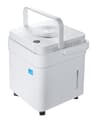 Midea Cube 50 Pint DehumidifierThe only unit here that solves the real basement problem, which is not capacity but where the water goes when you are not standing next to it. Midea Cube 50 Pint DehumidifierThe only unit here that solves the real basement problem, which is not capacity but where the water goes when you are not standing next to it. | A basement you visit once a month | 487 W | $249.99View on Amazon #ad Price as of September 21, 2026. How we are funded |
| 2 |  Hisense 50 Pint Dehumidifier with PumpA certified 50-pint pump unit that claims operation down to 38F - lower than the 41F most compressor units state - which is the specification that matters in a cold basement. Hisense 50 Pint Dehumidifier with PumpA certified 50-pint pump unit that claims operation down to 38F - lower than the 41F most compressor units state - which is the specification that matters in a cold basement. | A cold basement where the pump has to keep working | 490 W | $309.00View on Amazon #ad Price as of September 21, 2026. How we are funded |
| 3 |  LG PuriCare 50 Pint Dehumidifier with Wi-FiThe only connected unit here from a manufacturer that makes its own compressors, and the certified numbers say it is an ordinary 50-pint machine with an app on top. LG PuriCare 50 Pint Dehumidifier with Wi-FiThe only connected unit here from a manufacturer that makes its own compressors, and the certified numbers say it is an ordinary 50-pint machine with an app on top. | Someone who wants app control from a brand with a service network | 489 W | |
| 4 |  Frigidaire 50 Pint Dehumidifier with Wi-FiFrigidaire's current no-pump 50-pint: certified by exact model number, Wi-Fi equipped, and a 2.7 gallon bucket that is among the largest of any 50-pint unit we track. Frigidaire 50 Pint Dehumidifier with Wi-FiFrigidaire's current no-pump 50-pint: certified by exact model number, Wi-Fi equipped, and a 2.7 gallon bucket that is among the largest of any 50-pint unit we track. | A Frigidaire with a drain below it | 488 W | $319.00View on Amazon #ad Price as of September 21, 2026. How we are funded |
| 5 |  AlorAir Sentinel HD55 Crawl Space DehumidifierThe clearest example on this site of why the number on the box is not the number that matters: sold as 113 pints, certified at 36.33. AlorAir Sentinel HD55 Crawl Space DehumidifierThe clearest example on this site of why the number on the box is not the number that matters: sold as 113 pints, certified at 36.33. | A crawl space you cannot stand up in | 344 W | |
| 6 |  Waykar 80 Pint ENERGY STAR DehumidifierSold on an 80-pint headline that is a saturation figure; the DOE rating behind it is in the same 50-pint class as everything else on this page. Waykar 80 Pint ENERGY STAR DehumidifierSold on an 80-pint headline that is a saturation figure; the DOE rating behind it is in the same 50-pint class as everything else on this page. | A large open basement or a shop floor | Not published |
Midea
Midea Cube 50 Pint Dehumidifier
Best for: A basement you visit once a month
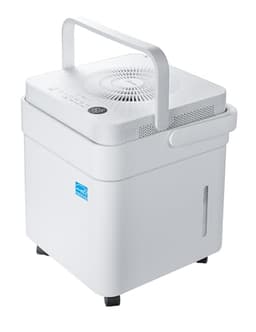
The only unit here that solves the real basement problem, which is not capacity but where the water goes when you are not standing next to it.
Average draw
487 W
Computed from the ENERGY STAR certified entry for Midea MAD50S1QWT-A, the 50 pt / 4,500 sq ft Cube without a pump: 49.67 pt/day at IEF 2.01 L/kWh. Midea's own US product page confirms MAD50S1QWT-A is this configuration. Midea publishes no wattage on the Amazon listing or on that page.
What is good
- The body separates, so the tank half can sit lower than the compressor half and the hose gets a genuine downhill run
- Certified at 49.67 pt/day, which is a real 50-pint machine rather than a saturation number
- IEF 2.01 L/kWh puts it exactly on the median for the 50-pint class - neither a bargain nor a penalty
- Wi-Fi that tells you it has stopped, which is the only smart feature that matters in a basement
What is not
- No pump, so the drain has to run downhill the whole way
- Midea publishes no wattage anywhere, so the 487 W above is computed rather than quoted
- The 4,500 sq ft coverage claim is marketing, not a spec - see the sizing guide
Who it is for
Someone with a floor drain, a sump, or a window well lower than the machine, who wants to set it once and stop thinking about it.
Skip it if
Skip it if the only drain in the room is higher than the unit. Without a pump, gravity is the entire drainage system, and no setting fixes an uphill hose.
Hisense
Hisense 50 Pint Dehumidifier with Pump
Best for: A cold basement where the pump has to keep working
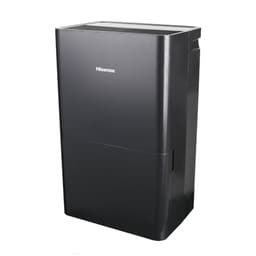
A certified 50-pint pump unit that claims operation down to 38F - lower than the 41F most compressor units state - which is the specification that matters in a cold basement.
Average draw
490 W
Computed from the ENERGY STAR certified entry for Hisense ADH50KP26 - the same model number as this listing: 49.95 pt/day at IEF 2.01 L/kWh. Hisense publishes no wattage on the listing.
What is good
- Claims operation down to 38F, three degrees below the usual compressor floor
- Exact certified model match, so the 490 W figure describes this machine
- Quick-connect hose included for the pump
- Three operating modes and three fan speeds, including an auto fan setting
What is not
- No pump lift, hose length or bucket capacity stated on the listing
- No Wi-Fi or app mentioned
- Below about 38F it is still a compressor unit, and a desiccant machine is the right tool
Who it is for
Someone with a cool basement or garage and a drain above the machine, where a few degrees of extra low-temperature headroom decides whether the unit keeps working in spring and autumn.
Skip it if
Skip it if your pump route is long or tall. Hisense does not state a lift, where GE and Quilo state 15 feet.
LG
LG PuriCare 50 Pint Dehumidifier with Wi-Fi
Best for: Someone who wants app control from a brand with a service network
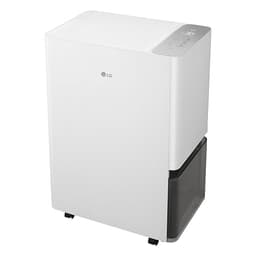
The only connected unit here from a manufacturer that makes its own compressors, and the certified numbers say it is an ordinary 50-pint machine with an app on top.
Average draw
489 W
Computed from the ENERGY STAR certified entry LG DT501BKR0: 49.81 pt/day at IEF 2.01 L/kWh, 526 kWh a year. The listing's model number is DT501BWR0 and the certified entry is DT501BKR0 - one character apart in what is almost certainly a color code. We have not seen LG confirm that in writing, so treat this as the certified figure for the same platform rather than an exact string match.
What is good
- App control from a manufacturer with a US service network, not a white-label brand
- A 1-Hour Boost mode, which none of the other connected units here offer
- Maintenance alerts through the app rather than a blinking light you have to notice
- Continuous drain option alongside the bucket
What is not
- No published coverage figure, no published wattage and no published noise level
- The certified entry is DT501BKR0 and the listing says DT501BWR0, so the match is one character short of exact
- No pump - the drain has to be below the machine
- Costs more than machines with identical certified capacity and efficiency
Who it is for
Someone who wants to check and change the setting from their phone and would rather buy that from LG than from a brand that exists only on Amazon.
Skip it if
Skip it if you need the water to go uphill. There is no pump, and at this price a pump model is within reach.
Frigidaire
Frigidaire 50 Pint Dehumidifier with Wi-Fi
Best for: A Frigidaire with a drain below it
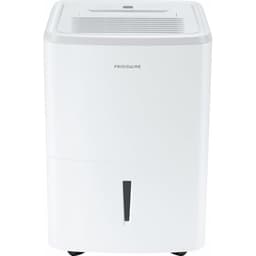
Frigidaire's current no-pump 50-pint: certified by exact model number, Wi-Fi equipped, and a 2.7 gallon bucket that is among the largest of any 50-pint unit we track.
Average draw
488 W
Computed from the ENERGY STAR certified entry for Frigidaire FHDD5034Y1 - the same model number as this listing: 49.71 pt/day at IEF 2.01 L/kWh. Frigidaire's Canadian product page states 115 V, 8.8 A and 470 W; those figures do not reconcile with each other and are nameplate rather than average values, so 488 W is the running-cost figure.
What is good
- Exact certified model match, so the 488 W figure describes this machine rather than a sibling
- 2.7 gallon bucket - roughly ten hours of condensate at full rated capacity if you ever run it without a hose
- Continuous drain, three fan speeds and operation down to 41F
- Wi-Fi and the Frigidaire app for scheduling and remote control
What is not
- Gravity only. The drain must be below the machine
- The Wi-Fi depends on Frigidaire's app remaining supported
- Frigidaire's own published wattage and amperage do not agree with each other
Who it is for
Someone with a floor drain who wants a certified, well-documented 50-pint unit and has a use for scheduling.
Skip it if
Skip it if the only drain is above the machine. That is the one job a gravity unit cannot do, whatever else it has.
AlorAir
AlorAir Sentinel HD55 Crawl Space Dehumidifier
Best for: A crawl space you cannot stand up in
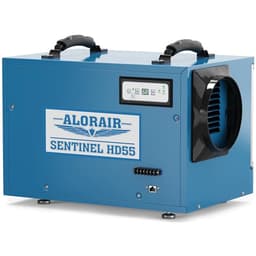
The clearest example on this site of why the number on the box is not the number that matters: sold as 113 pints, certified at 36.33.
Average draw
344 W
Computed from the ENERGY STAR certified entry ALORAIR Sentinel HD55S: 36.33 pt/day at IEF 2.08 L/kWh, 379 kWh a year. The retail listing is the HD55; the certified entry carries the S suffix. At IEF 2.08 it is more efficient than the median 50-pint portable while removing about three quarters as much water.
What is good
- Built low and flat to fit between floor joists, which no portable unit does
- Auto defrost and low-temperature operation, both essential in an unheated crawl space
- IEF 2.08 is above the 50-pint class median of 2.01 despite the smaller capacity
- No tank at all, so there is nothing to forget to empty
What is not
- The 113-pint headline is a saturation figure at 95F and 90% RH; the DOE-condition rating is 36.33
- 1,200 sq ft coverage, less than most 50-pint portables claim, for considerably more money
- Needs a drain or a condensate pump - there is no bucket fallback
Who it is for
Crawl spaces, low-clearance basements and unheated storage where a standing portable will not fit or will freeze.
Skip it if
Skip it for a normal basement. A 50-pint portable removes more water at the DOE condition for less money; you are paying for the form factor and the temperature range.
Waykar
Waykar 80 Pint ENERGY STAR Dehumidifier
Best for: A large open basement or a shop floor
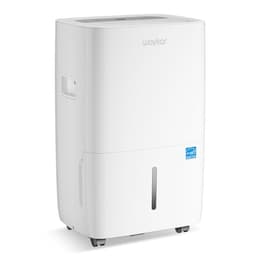
Sold on an 80-pint headline that is a saturation figure; the DOE rating behind it is in the same 50-pint class as everything else on this page.
Average draw
Not published
No published wattage. Waykar's certified 50-pint entries - JD026CE-150, CHWA150A/B/E, CTH150A/B and the YD-150 family - compute to between 443 W and 488 W. The identity of the exact certified model behind this listing is not stated, so the band stands in for a number.
What is good
- Sets to 30% RH, lower than most units will go
- 90-degree auto swing louvre, which genuinely helps in a long open basement
- Continuous drainage support and a larger tank than Waykar's smaller units
- Auto defrost for cold running
What is not
- The 80-pint headline is not a DOE rating and should not be compared against one
- No published wattage and no single certified model to map to
- 5,000 sq ft is the second-highest coverage claim in this registry
Who it is for
A large, open, genuinely wet basement or shop, where air movement matters as much as extraction.
Skip it if
Skip it if you are comparing it against a 50-pint unit on the strength of the 80. They are the same class of machine - the numbers are measured differently.
Warranty is the only brand signal that is actually published
Nobody publishes failure rates for portable dehumidifiers. Not the manufacturers, not the retailers, not the certification program. Any ranking of dehumidifier brands by reliability - including one on this site, if we ever published one - would be an impression presented as a measurement.
What is published is the warranty term, and it varies more than you would expect:
| Brand | Stated term | Where it is published |
|---|---|---|
| AlorAir | 6 years limited, first 2 years full | The product listing |
| Yaufey | 1 year full, 2 year extended, 5 year compressor | The product listing |
| Hisense | 2 years parts and labor | Hisense USA's own limited warranty document |
| Waykar | 5-year quality guarantee (wording varies by listing) | The product listing |
| Most of the category | 1 year | Where stated at all |
Read on 2026-09-21. The Hisense row is the strongest of these because the term comes from the manufacturer's own warranty document rather than a retailer's product page - the two do not always agree.
The reason this matters more here than on most appliances: the part that ends a dehumidifier's life is the sealed refrigeration system, and it cannot be opened without recovery equipment and EPA Section 608 certification. On a machine at this price the labor alone approaches the cost of replacement, so a sealed-system fault outside warranty is usually the end of the machine. Repair or replace does that arithmetic properly.
How to check a brand yourself, in two minutes
- 1Find the model number on the listing, not the brand name in the title.
- 2Search the ENERGY STAR certified list for that string. If it is there, read the capacity and the annual energy figure - both are independently measured.
- 3Look at the partner field on the certificate. That is the company that actually stands behind the machine. If it is a name you have never seen and the brand is a name you have never seen, they may not be the same name.
- 4Search the same partner name to see what else it certifies. This is how you discover that the four brands you were comparing are one factory.
- 5Then find the warranty term, and prefer the manufacturer's own document over a retailer's summary.
What we would skip
Any brand with no entry in the ENERGY STAR certified file at all
Certification is not a quality award - it is a capacity and efficiency measurement filed under a model number you can check. A brand that certifies nothing has no independently measured capacity for any of its machines, which means every pint figure it prints is its own. That is not automatically a bad product. It is automatically an unverifiable one, and in a category this full of inflated numbers that matters more than usual.
What we did not do
We have not tested a single machine from any of these brands, and we have no reliability data, because none exists publicly in this category. Everything above is counted from the public ENERGY STAR certified file or quoted from a manufacturer's own published warranty and listing copy. This page tells you who stands behind a measurement. It does not tell you whose compressor lasts longest, because nobody knows that. How we work.
FAQ
Questions
What is the best dehumidifier brand?
Who makes Waykar, Yaufey, KESNOS and Fehom dehumidifiers?
Are cheap Amazon dehumidifier brands any good?
Is Frigidaire a real dehumidifier manufacturer?
Does ENERGY STAR certification mean a dehumidifier is good?
Sources
Sources
- ENERGY STAR Certified Dehumidifiers list - 551 certified models, 136 distinct brand names, 77 distinct certifying partners, 59 entries naming more than one brand; partner model counts for Waykar (66), GD Midea (49), Zhejiang Hengjian (39), Hongkong Yoau (34), Hisense Guangdong (30), JHS Inc (26), Zhuhai Invitop (15), The Home Depot (13) (retrieved 2026-09-21)
- Limited Warranty for Hisense Portable Air Conditioners and Dehumidifiers, Hisense USA Corporation - 'Air Conditioners & Dehumidifiers: Two (2) years for parts and labor' (retrieved 2026-09-19)
- ALORAIR Sentinel HD35P Wifi crawlspace dehumidifier - Amazon.com listing stating a 6-year limited warranty with the first 2 years full coverage (retrieved 2026-09-21)
- Yaufey AYD1.5DPM commercial dehumidifier - Amazon.com listing stating 1-year full, 2-year extended and 5-year compressor coverage (retrieved 2026-09-21)
Read next
- Repair or replace a dehumidifier?Sealed system, or everything else? The dividing line that decides it, and why a new unit will not pay for itself.
- The best large capacity dehumidifiersNot one certified portable exceeds 50 pints a day. What the 70, 119 and 150 pint headlines measure, and which to buy.
- LG PuriCare 50 Pint with Wi-FiCertified 49.81 pints at 489 W - class-typical numbers. The ThinQ alerts and LG's own name on the certificate are the reasons to consider it.
- Hisense 50 Pint with PumpCertified 49.95 pints at 490 W, rated to 38F, and a two-year warranty where most portables give one.
- IEF, and what an ENERGY STAR badge is worthWhat IEF measures, what it replaced, the real spread across 527 models, and what the badge saves.
- What the pint number on a dehumidifier actually meansThe 2019 DOE test change, the official conversion table, and the saturation rating that is 3x the certified one.