Compare / Decision
Repair or replace a dehumidifier?
Two questions decide this and neither is about the age of the machine. Is the fault in the sealed system, and is the unit still under warranty? Everything else is a filter, a float or a fan.
#adThis page contains affiliate links. We earn a commission on qualifying purchases, at no cost to you, and it never changes a ranking. Full disclosure.

The short answer
If the fault is in the sealed refrigeration system - a leak, a failed compressor - replace it: opening that circuit needs recovery equipment and EPA Section 608 certification, and the labor alone approaches the price of a new machine. Almost everything else is a filter, a float switch, a fan or a blocked drain, and is worth fixing. Do not replace a working unit to save energy; the whole certified 50-pint class is within about sixteen dollars a year of itself.
The one question that settles it
A portable dehumidifier is two machines in one box. There is a sealed refrigeration circuit - compressor, coils, refrigerant - and there is everything else: a fan, a humidistat, a float switch, a filter, a bucket, a control board, a drain port. The dividing line between those two is also the dividing line between repair and replace, and it has almost nothing to do with how old the unit is.
The sealed system cannot be opened casually. Recovering and recharging refrigerant requires equipment and, in the United States, EPA Section 608 technician certification. There is no home fix, no part you order, and no way for a general handyman to legally do it. On a machine at this price the labor alone approaches replacement cost, which is why a sealed-system fault is usually the end of a portable dehumidifier's life.
Everything on the other side of that line is ordinary appliance repair, and a surprising amount of it is not repair at all - it is maintenance that was skipped.
| Symptom | Usual cause | Verdict |
|---|---|---|
| Runs, fan turns, collects nothing, coil never gets cold | Refrigerant loss or a failed compressor | Replace |
| Runs but collects far less than it used to | Clogged filter or dirty coils, far more often than refrigerant | Clean it first - maintenance |
| Ices up constantly in a normal room | Restricted airflow, or the room is below the unit's temperature floor | Fix, or wrong machine - icing up |
| Stops as though the bucket is full when it is not | Float switch stuck or mis-seated bucket | Fix - a cheap part or no part at all |
| Water on the floor | Blocked drain, sagging hose, cracked tray | Fix - leaking |
| Will not get below 60 percent | Usually not a fault at all | Neither - why |
| Blowing warm air | Normal. That is how the machine works | Neither - why |
| Loud, rattling, or buzzing | Fan, mounting or a compressor on its way out | Depends - too loud |
The last two rows matter more than they look. A meaningful share of 'my dehumidifier is broken' is a machine working exactly as designed in conditions the owner did not expect.
Check the warranty before you check anything else
This is the step people skip, and in this category it is worth real money because the terms are not uniform. Most portable dehumidifiers carry one year. Several do not.
| Brand | Stated term | Source of the term |
|---|---|---|
| AlorAir | 6 years limited, first 2 years full | Product listing |
| Yaufey | 1 year full, 2 year extended, 5 year compressor | Product listing |
| Hisense | 2 years parts and labor | Hisense USA's own limited warranty document |
| Most of the category | 1 year | Where a term is stated at all |
Read 2026-09-21. A five or six year compressor term changes this decision completely: the one fault that would otherwise end the machine becomes the manufacturer's problem. The brand guide has the full picture.
Worth reading the small print as well as the number. Hisense's warranty document, for example, states that the remedy is a like-new or refurbished product at Hisense's discretion rather than a repair of the machine you own. For a sealed-system failure that is arguably the better outcome - but it is a replacement promise, not a repair promise.
Do not replace a working dehumidifier to save energy
This is the advice that gets given constantly and, within this category, does not hold up. The reason is that portable dehumidifiers are astonishingly similar to one another.
444 to 530 kWh
The full annual energy range of the certified 50-pint class - 165 models, best to worst
From the ENERGY STAR Certified Dehumidifiers list, retrieved 2026-09-21. At the US average residential rate of 18.34 cents per kWh, the gap between the most and least efficient certified 50-pint machine on the market is about sixteen dollars a year.
Sixteen dollars a year, between the best and worst certified machine in the class. And the class is even tighter than that range suggests: 124 of those 165 models sit at exactly the same efficiency, an IEF of 2.01. Three quarters of the market is one number.
So if your existing unit works, replacing it with a new one will not pay for itself in electricity. It may never pay for itself at all. There are good reasons to replace a functioning dehumidifier - you need a pump, you need it quieter, you want alerts, the drain configuration is wrong for the room - but the energy bill is not one of them. IEF and what an ENERGY STAR badge is worth.
Before you decide, do these four things
- 1Wash the filter and look at the coils. A clogged filter is the single most common cause of 'it stopped working properly', and it costs nothing. Cleaning and maintenance.
- 2Check the room temperature. If the space is below the unit's temperature floor, the machine is not faulty, it is out of its range. Only four of the units we track publish a floor at all. Dehumidifiers for cold rooms.
- 3Check the drain path end to end. A sag in a hose holds water and stops the flow, which looks exactly like a pump failure. The drain has stopped working.
- 4Find the warranty term and the purchase date. On a two-year or five-year compressor term, a fault you were about to write the machine off for may be covered.
Quick picks
| # | Product | Best for | Draw | Price |
|---|---|---|---|---|
| 1 | 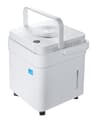 Midea Cube 50 Pint DehumidifierThe only unit here that solves the real basement problem, which is not capacity but where the water goes when you are not standing next to it. Midea Cube 50 Pint DehumidifierThe only unit here that solves the real basement problem, which is not capacity but where the water goes when you are not standing next to it. | A basement you visit once a month | 487 W | $249.99View on Amazon #ad Price as of September 21, 2026. How we are funded |
| 2 |  Frigidaire 50 Pint Dehumidifier with Wi-FiFrigidaire's current no-pump 50-pint: certified by exact model number, Wi-Fi equipped, and a 2.7 gallon bucket that is among the largest of any 50-pint unit we track. Frigidaire 50 Pint Dehumidifier with Wi-FiFrigidaire's current no-pump 50-pint: certified by exact model number, Wi-Fi equipped, and a 2.7 gallon bucket that is among the largest of any 50-pint unit we track. | A Frigidaire with a drain below it | 488 W | $319.00View on Amazon #ad Price as of September 21, 2026. How we are funded |
| 3 |  Quilo 50 Pint Dehumidifier with PumpA certified 50-pint pump unit that puts its pump reach in writing - 15 feet, vertically or horizontally - and adds a laundry-drying mode nothing else we track offers. Quilo 50 Pint Dehumidifier with PumpA certified 50-pint pump unit that puts its pump reach in writing - 15 feet, vertically or horizontally - and adds a laundry-drying mode nothing else we track offers. | A laundry room or basement with the drain up a wall | 487 W | $269.99View on Amazon #ad Price as of September 21, 2026. How we are funded |
Midea
Midea Cube 50 Pint Dehumidifier
Best for: A basement you visit once a month
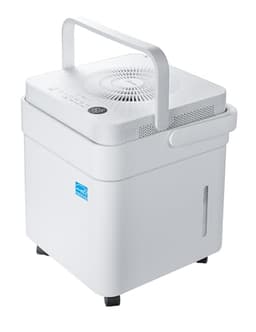
The only unit here that solves the real basement problem, which is not capacity but where the water goes when you are not standing next to it.
Average draw
487 W
Computed from the ENERGY STAR certified entry for Midea MAD50S1QWT-A, the 50 pt / 4,500 sq ft Cube without a pump: 49.67 pt/day at IEF 2.01 L/kWh. Midea's own US product page confirms MAD50S1QWT-A is this configuration. Midea publishes no wattage on the Amazon listing or on that page.
What is good
- The body separates, so the tank half can sit lower than the compressor half and the hose gets a genuine downhill run
- Certified at 49.67 pt/day, which is a real 50-pint machine rather than a saturation number
- IEF 2.01 L/kWh puts it exactly on the median for the 50-pint class - neither a bargain nor a penalty
- Wi-Fi that tells you it has stopped, which is the only smart feature that matters in a basement
What is not
- No pump, so the drain has to run downhill the whole way
- Midea publishes no wattage anywhere, so the 487 W above is computed rather than quoted
- The 4,500 sq ft coverage claim is marketing, not a spec - see the sizing guide
Who it is for
Someone with a floor drain, a sump, or a window well lower than the machine, who wants to set it once and stop thinking about it.
Skip it if
Skip it if the only drain in the room is higher than the unit. Without a pump, gravity is the entire drainage system, and no setting fixes an uphill hose.
Frigidaire
Frigidaire 50 Pint Dehumidifier with Wi-Fi
Best for: A Frigidaire with a drain below it
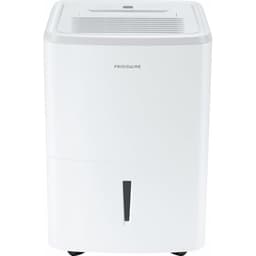
Frigidaire's current no-pump 50-pint: certified by exact model number, Wi-Fi equipped, and a 2.7 gallon bucket that is among the largest of any 50-pint unit we track.
Average draw
488 W
Computed from the ENERGY STAR certified entry for Frigidaire FHDD5034Y1 - the same model number as this listing: 49.71 pt/day at IEF 2.01 L/kWh. Frigidaire's Canadian product page states 115 V, 8.8 A and 470 W; those figures do not reconcile with each other and are nameplate rather than average values, so 488 W is the running-cost figure.
What is good
- Exact certified model match, so the 488 W figure describes this machine rather than a sibling
- 2.7 gallon bucket - roughly ten hours of condensate at full rated capacity if you ever run it without a hose
- Continuous drain, three fan speeds and operation down to 41F
- Wi-Fi and the Frigidaire app for scheduling and remote control
What is not
- Gravity only. The drain must be below the machine
- The Wi-Fi depends on Frigidaire's app remaining supported
- Frigidaire's own published wattage and amperage do not agree with each other
Who it is for
Someone with a floor drain who wants a certified, well-documented 50-pint unit and has a use for scheduling.
Skip it if
Skip it if the only drain is above the machine. That is the one job a gravity unit cannot do, whatever else it has.
Quilo
Quilo 50 Pint Dehumidifier with Pump
Best for: A laundry room or basement with the drain up a wall
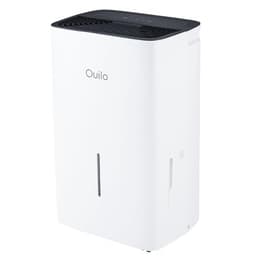
A certified 50-pint pump unit that puts its pump reach in writing - 15 feet, vertically or horizontally - and adds a laundry-drying mode nothing else we track offers.
Average draw
487 W
Computed from the ENERGY STAR certified entry for Quilo QLDAD50PWK - the same model number as this listing: 49.67 pt/day at IEF 2.01 L/kWh. Quilo publishes no wattage itself.
What is good
- States its pump reach - up to 15 feet vertically or horizontally - with the drain tube included
- Exact certified model match, so the 487 W figure describes this machine
- Dedicated laundry mode dries clothes and the room at the same time
- Child lock, thermal overload protection, auto defrost and a clean-filter alert
What is not
- Tank capacity is not stated on the listing
- No Wi-Fi or app is mentioned, so no remote alerts if the pump stops
- A newer brand name with no long track record under this name
Who it is for
Someone who needs a pump to reach a sink or window up to 15 feet away, especially in a laundry room where the drying mode earns its place.
Skip it if
Skip it if you want to be told on your phone when something stops. Nothing on the listing mentions connectivity.
If you are replacing, replace deliberately
The most common mistake in replacement is buying the same machine again, in a room that was telling you something. If the old unit's bucket was the problem, buy for drainage rather than capacity. If it iced up every autumn, the issue was temperature, not pints. If you never knew it had stopped, that is an argument for alerts. And if it simply was not big enough, note that nothing in this category is certified above 50 pints a day, so the answer may be a second unit rather than a bigger one.
What we did not do
We have not taken a dehumidifier apart, priced a repair, or collected failure data - none is published in this category, by anyone. The warranty terms are quoted from the documents and listings that publish them, the energy figures are counted from the ENERGY STAR certified file, and the fault list is a mapping of symptoms to the maintenance pages on this site rather than a diagnosis of your machine. How we work.
FAQ
Questions
Is it worth repairing a dehumidifier?
How long should a dehumidifier last?
Will a new dehumidifier save me money on electricity?
My dehumidifier stopped collecting water. Is it dead?
Can I recharge the refrigerant in my dehumidifier myself?
Sources
Sources
- ENERGY STAR Certified Dehumidifiers list - the certified 50-pint class (45-55 pint, portable): 165 models, annual energy 444 to 530 kWh, 124 of 165 certified at exactly IEF 2.01 (retrieved 2026-09-21)
- Limited Warranty for Hisense Portable Air Conditioners and Dehumidifiers, Hisense USA Corporation - two years parts and labor, remedy stated as a like-new or refurbished product at Hisense's sole discretion (retrieved 2026-09-19)
- EIA Electric Power Monthly, Table 5.6.A, June 2026 - the residential electricity rate used
Read next
- It is not collecting any waterEight checks in order. The first four take a minute each and none of them is a fault.
- Keeping it workingFour jobs on four schedules, and the five-minute one that prevents most faults on this hub.
- The best dehumidifier brands136 brand names, 77 companies. Who makes their own machines, who shares a factory, and how to check in two minutes.
- IEF, and what an ENERGY STAR badge is worthWhat IEF measures, what it replaced, the real spread across 527 models, and what the badge saves.
- What the pint number on a dehumidifier actually meansThe 2019 DOE test change, the official conversion table, and the saturation rating that is 3x the certified one.
- There is water on the floorUnplug it, then six causes in order. Most are the drain rather than the machine.