Best / Roundup
The best large capacity dehumidifiers
Every machine on this page is sold on a number between 70 and 150. Every machine on this page removes about 50 pints a day at the test that regulators use. That is not a scandal, it is a different test - and once you know which is which, the tier is easy to shop.
#adThis page contains affiliate links. We earn a commission on qualifying purchases, at no cost to you, and it never changes a ranking. Full disclosure.
The short answer
There is no such thing as a 150-pint portable dehumidifier. Across all 527 certified portable models, the highest DOE capacity on record is exactly 50.00 pints a day. Headlines of 70, 119, 145 and 150 pints are saturation figures measured at around 95F and 90% relative humidity. Above 50 DOE pints the answer is a ducted whole-house unit, not a portable.
The number that ends the argument
0 of 527
Certified portable dehumidifiers rated above 50.0 pints a day at the DOE test condition
From the ENERGY STAR Certified Dehumidifiers list, 527 portable models, retrieved 2026-09-21. The maximum capacity in the entire file is exactly 50.00 pt/day, shared by a handful of models. Ducted whole-home units are a separate category and do go higher - the largest is a Santa Fe at 172.13 pints.
That is the whole page in one line, and it is checkable. The file is public, it is machine-readable, and every manufacturer selling into the US market has models in it. If a portable dehumidifier could be certified at 90 pints a day, someone among 136 brands would have done it and advertised the certificate. Nobody has.
So what are the big numbers? They are real measurements taken at a different condition. The DOE test that produces the certified figure runs at 65F and 60% relative humidity - a cool, moderately damp basement. The saturation figure that produces the headline runs at roughly 95F and 90% relative humidity - a hot, nearly saturated room. Warmer air holds far more water, so the same hardware pulls two to three times as much of it out. Neither number is a lie. Only one of them describes your basement.
The model number usually tells on the title
Here is the tell that makes this tier easy to read. Manufacturers in this category use a factory platform code in the model number, and that code frequently contains the saturation figure. Once it is in the model number it becomes the marketing headline, and the DOE rating quietly stays where it always was.
| Listing headline | Model number | DOE capacity (certified) | Exact string match? |
|---|---|---|---|
| DuraComfort 119 Pint Max | DH50PB | 49.66 pt/day | Yes |
| Yaufey 150 Pint | JD026R-150 | 49.47 pt/day | Yes |
| Yaufey 70 Pints, ENERGY STAR | AYD1.5DPM | 24.00 pt/day (AYD1.5D) | Suffix differs |
| Waykar 145 Pints | JD026CE-145PM | 49.47 pt/day (JD026CE-150) | No - sibling only |
| AlorAir 113 Pints | Sentinel HD55 | 36.33 pt/day (HD55S) | Suffix differs |
| Waykar 80 Pint | Not stated on the listing | Class band, 443-488 W | No |
Certified figures from the ENERGY STAR Certified Dehumidifiers list, retrieved 2026-09-21. The DuraComfort row is the cleanest illustration on the site: the model number is literally DH50, the title says 119, and the certified entry under that exact string says 49.66.
We ran this across the whole file to check it was not cherry-picking. Of the 527 certified portables, 99 carry a three-digit number in the 100s somewhere in the model string - the 150s, the 155s, the 130s. Forty-nine of those are rated at 45 DOE pints or more. Not one of the 99 is rated above 50.
How we picked
- The DOE capacity from the ENERGY STAR certified list, matched to the model number on the listing - not the number in the product title.
- Whether the listing states the test condition behind its headline figure. '145 pints at 95F and 90% RH' is a real disclosure; '119 Pint Max' with no condition is not.
- Average draw computed from the certified IEF where an exact model match exists, so the running cost is this machine's rather than a sibling's.
- Drainage, because nothing in this tier is a bucket machine in practice - if you are buying big, you are running it continuously.
- What we did not do: we have not run any of these units, measured extraction, or tested a single capacity claim. Every figure is quoted from a listing or computed from the certified file, and both are linked.
We did not test these units. The full criteria and their weighting are on the methodology page.
Quick picks
| # | Product | Best for | Draw | Price |
|---|---|---|---|---|
| 1 |  Yaufey 150 Pint DehumidifierAnother exact model match with a headline three times its certified rating - JD026R-150 is in the file at 49.47 pints, and the 150 in the name is the model number, not the capacity. Yaufey 150 Pint DehumidifierAnother exact model match with a headline three times its certified rating - JD026R-150 is in the file at 49.47 pints, and the 150 in the name is the model number, not the capacity. | A big open basement where you want the largest certified 50-pint class unit | 485 W | $325.99View on Amazon #ad Price as of September 21, 2026. How we are funded |
| 2 |  DuraComfort 119 Pint Max DehumidifierThe clearest case on this site of a headline and a model number contradicting each other: the listing says 119 pints, the model is DH50PB, and DH50PB is certified at 49.66. DuraComfort 119 Pint Max DehumidifierThe clearest case on this site of a headline and a model number contradicting each other: the listing says 119 pints, the model is DH50PB, and DH50PB is certified at 49.66. | A large basement, once you know what the 119 actually refers to | 487 W | $249.90View on Amazon #ad Price as of September 21, 2026. How we are funded |
| 3 |  Waykar 145 Pint Dehumidifier with PumpThe only unit in this tier with a pump, and the only one whose listing states the condition behind its headline - 145 pints at 95F and 90% RH, which is not the test anyone's basement runs. Waykar 145 Pint Dehumidifier with PumpThe only unit in this tier with a pump, and the only one whose listing states the condition behind its headline - 145 pints at 95F and 90% RH, which is not the test anyone's basement runs. | The big-number tier when the water has to go uphill | Not published | |
| 4 |  Yaufey 70 Pint Commercial Dehumidifier with PumpA metal-bodied crawl space unit with a genuinely useful pump spec - and an ENERGY STAR claim whose certified entry is rated at 24 pints, not 70. Yaufey 70 Pint Commercial Dehumidifier with PumpA metal-bodied crawl space unit with a genuinely useful pump spec - and an ENERGY STAR claim whose certified entry is rated at 24 pints, not 70. | A crawl space or workshop that needs a metal box and a pump | 264 W | $359.98View on Amazon #ad Price as of September 21, 2026. How we are funded |
| 5 |  Waykar 80 Pint ENERGY STAR DehumidifierSold on an 80-pint headline that is a saturation figure; the DOE rating behind it is in the same 50-pint class as everything else on this page. Waykar 80 Pint ENERGY STAR DehumidifierSold on an 80-pint headline that is a saturation figure; the DOE rating behind it is in the same 50-pint class as everything else on this page. | A large open basement or a shop floor | Not published | |
| 6 |  AlorAir Sentinel HD55 Crawl Space DehumidifierThe clearest example on this site of why the number on the box is not the number that matters: sold as 113 pints, certified at 36.33. AlorAir Sentinel HD55 Crawl Space DehumidifierThe clearest example on this site of why the number on the box is not the number that matters: sold as 113 pints, certified at 36.33. | A crawl space you cannot stand up in | 344 W |
Yaufey
Yaufey 150 Pint Dehumidifier
Best for: A big open basement where you want the largest certified 50-pint class unit
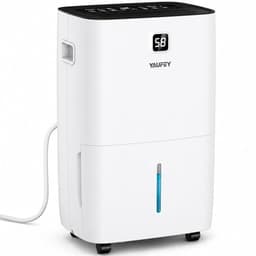
Another exact model match with a headline three times its certified rating - JD026R-150 is in the file at 49.47 pints, and the 150 in the name is the model number, not the capacity.
Average draw
485 W
Computed from the ENERGY STAR certified entry YAUFEY JD026R-150: 49.47 pt/day at IEF 2.01 L/kWh, 507 kWh a year. Exact model-number match. Note what the '-150' in the model number is doing: it is a factory platform code that also became the marketing headline.
What is good
- Exact certified model match, so both the 485 W and the 507 kWh/yr describe this machine
- 507 kWh/yr is at the efficient end of the certified 50-pint class, which runs 444 to 530
- Lighter than most of this tier at 38.5 lb
- Shipped and sold by Amazon rather than a third-party storefront
What is not
- The 150 is a model code that reads as a capacity, and the listing does nothing to correct the impression
- An 8,000 sq ft coverage claim on a 49-pint machine is not a specification, it is a marketing decision
- No pump
- No published wattage or noise figure from Yaufey - the numbers here are computed and certified, not stated
Who it is for
Someone who wants the most efficient certified unit in this tier and does not care what the box says, as long as the file backs it up.
Skip it if
Skip it if you genuinely need more than about 50 pints a day removed. Nothing in this tier delivers that, whatever the title says.
DuraComfort
DuraComfort 119 Pint Max Dehumidifier
Best for: A large basement, once you know what the 119 actually refers to
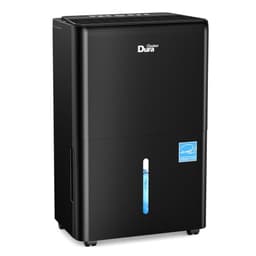
The clearest case on this site of a headline and a model number contradicting each other: the listing says 119 pints, the model is DH50PB, and DH50PB is certified at 49.66.
Average draw
487 W
Computed from the ENERGY STAR certified entry DuraComfort DH50PB: 49.66 pt/day at IEF 2.01 L/kWh, 516 kWh a year. This is an exact model-number match - the string on the listing and the string in the certified file are the same - which is why the 119 in the title is worth taking seriously as a marketing number rather than a measurement.
What is good
- An exact certified model match, so the 487 W is this machine's number and not a sibling's
- Auto defrost, which is what lets a compressor unit keep working in a cool basement
- Casters and recessed handles - at 44 lb that matters
- Drain hose in the box
What is not
- The '119 Pint Max' headline is not the DOE rating and the listing never says what condition produced it
- No coverage figure and no noise figure published
- No pump - gravity only
- Sold through the brand's own storefront rather than shipped by Amazon
Who it is for
Someone shopping the big-number tier who wants the machine whose paperwork actually lines up - you can check this one against the certified file yourself in thirty seconds.
Skip it if
Skip it if you were buying the 119. You are getting a competent 50-pint machine, and if that is not enough water you need a second unit, not a bigger number.
Waykar
Waykar 145 Pint Dehumidifier with Pump
Best for: The big-number tier when the water has to go uphill
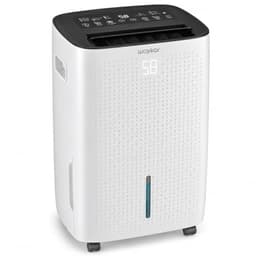
The only unit in this tier with a pump, and the only one whose listing states the condition behind its headline - 145 pints at 95F and 90% RH, which is not the test anyone's basement runs.
Average draw
Not published
No published wattage, and JD026CE-145PM does not appear by name in the ENERGY STAR certified list. Its immediate siblings do: JD026CE-150 and JD026CE-150PM are both certified at 49.47 pt/day and IEF 2.01, which computes to 485 W. The pump variant almost certainly sits alongside them, but the certified file does not carry this exact string and we do not pin one unit's number on another.
What is good
- States the test condition behind its headline figure, which is more than most of this tier does
- A built-in pump, so the drain can be above the machine
- Temperature and overload protection that suspends operation rather than failing
- Shipped and sold by Amazon
What is not
- The exact model string is not in the certified file, so its wattage is a sibling's figure and we will not present it as this machine's
- 145 pints at 95F / 90% RH tells you almost nothing about a 65F basement
- The pump reach is given as a metric range, 1 to 5 meters, which is a wide way to describe a specification
- No noise figure published
Who it is for
Someone shopping the big numbers who also needs a pump, and who would rather have the test condition printed than hidden.
Skip it if
Skip it if you want a computed running cost. The certified siblings suggest about 485 W, but this exact model is not in the file and this site will not pin a sibling's number to it.
Yaufey
Yaufey 70 Pint Commercial Dehumidifier with Pump
Best for: A crawl space or workshop that needs a metal box and a pump
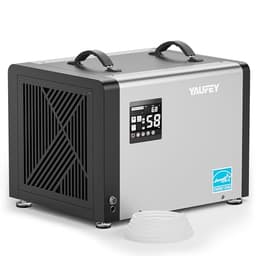
A metal-bodied crawl space unit with a genuinely useful pump spec - and an ENERGY STAR claim whose certified entry is rated at 24 pints, not 70.
Average draw
264 W
Computed from the ENERGY STAR certified entry YAUFEY AYD1.5D: 24.00 pt/day at IEF 1.79 L/kWh, 290 kWh a year. The listing's model is AYD1.5DPM - the same string with a PM pump suffix - and the listing claims ENERGY STAR certification, so the certified entry it is claiming is almost certainly this one. Worth stating plainly: that entry is rated at 24 pints a day at the DOE condition, and the listing headline says 70.
What is good
- Both hoses in the box - a 16.4 ft pump hose and a 6.56 ft gravity hose
- A corrosion-resistant metal body rather than the usual plastic shell
- 10-90% RH control, which is a wider band than any portable here offers
- 264 W computed from a certified entry, so the running cost is a real number
What is not
- The 70-pint headline is a 95F / 90% RH figure; the certified DOE rating behind it is 24 pints a day
- At 24 DOE pints it removes roughly half what a 50-pint portable does, for a higher price
- No tank at all - if the drain fails, the unit stops
- No published noise figure
Who it is for
Someone with a crawl space or a workshop who wants a metal-bodied unit, a real pump specification, and is buying on the 24-pint reality rather than the 70-pint headline.
Skip it if
Skip it for a normal basement. A certified 50-pint portable removes twice the water for less money, and you can read its rating off the same file.
Waykar
Waykar 80 Pint ENERGY STAR Dehumidifier
Best for: A large open basement or a shop floor
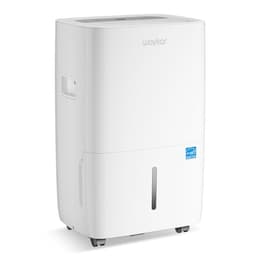
Sold on an 80-pint headline that is a saturation figure; the DOE rating behind it is in the same 50-pint class as everything else on this page.
Average draw
Not published
No published wattage. Waykar's certified 50-pint entries - JD026CE-150, CHWA150A/B/E, CTH150A/B and the YD-150 family - compute to between 443 W and 488 W. The identity of the exact certified model behind this listing is not stated, so the band stands in for a number.
What is good
- Sets to 30% RH, lower than most units will go
- 90-degree auto swing louvre, which genuinely helps in a long open basement
- Continuous drainage support and a larger tank than Waykar's smaller units
- Auto defrost for cold running
What is not
- The 80-pint headline is not a DOE rating and should not be compared against one
- No published wattage and no single certified model to map to
- 5,000 sq ft is the second-highest coverage claim in this registry
Who it is for
A large, open, genuinely wet basement or shop, where air movement matters as much as extraction.
Skip it if
Skip it if you are comparing it against a 50-pint unit on the strength of the 80. They are the same class of machine - the numbers are measured differently.
AlorAir
AlorAir Sentinel HD55 Crawl Space Dehumidifier
Best for: A crawl space you cannot stand up in
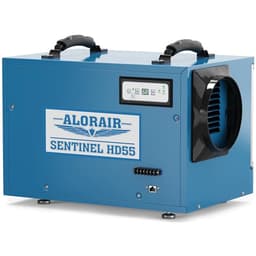
The clearest example on this site of why the number on the box is not the number that matters: sold as 113 pints, certified at 36.33.
Average draw
344 W
Computed from the ENERGY STAR certified entry ALORAIR Sentinel HD55S: 36.33 pt/day at IEF 2.08 L/kWh, 379 kWh a year. The retail listing is the HD55; the certified entry carries the S suffix. At IEF 2.08 it is more efficient than the median 50-pint portable while removing about three quarters as much water.
What is good
- Built low and flat to fit between floor joists, which no portable unit does
- Auto defrost and low-temperature operation, both essential in an unheated crawl space
- IEF 2.08 is above the 50-pint class median of 2.01 despite the smaller capacity
- No tank at all, so there is nothing to forget to empty
What is not
- The 113-pint headline is a saturation figure at 95F and 90% RH; the DOE-condition rating is 36.33
- 1,200 sq ft coverage, less than most 50-pint portables claim, for considerably more money
- Needs a drain or a condensate pump - there is no bucket fallback
Who it is for
Crawl spaces, low-clearance basements and unheated storage where a standing portable will not fit or will freeze.
Skip it if
Skip it for a normal basement. A 50-pint portable removes more water at the DOE condition for less money; you are paying for the form factor and the temperature range.
What the tier actually costs to run
Because the hardware in this tier is 50-pint hardware, the running cost is 50-pint running cost. That is the quiet good news: you are not buying a machine that will double your bill, because you are not buying a machine that is twice as big.
Yaufey JD026R-150, certified
(485 W / 1000) x 12 h x $0.1834/kWh = $1.07 per day
0.485
kWh per hour
$32.49
per month, 12 h/day
$64.98
per month, 24 h/day
Rate is the US residential average of 18.34 cents/kWh from the EIA Electric Power Monthly, June 2026. Yours will differ - use the calculator.
Two of the units here carry an exact certified match and therefore a real annual figure: the Yaufey JD026R-150 at 507 kWh a year, and the DuraComfort DH50PB at 516. For context, the certified 50-pint class as a whole runs from 444 to 530 kWh a year with a median of 520, so both sit at the efficient end of an extremely tight field. What it costs per month has the arithmetic in full, and the calculator will do it at your own rate.
When you genuinely do need more than 50 pints
Sometimes the answer really is more capacity, and buying a bigger headline will not get it. Two honest routes exist:
- Run two units. Two certified 50-pint machines in different parts of a large basement remove more water than any single portable on the market, cost less than one whole-house unit, and fail independently. This is the answer far more often than people expect.
- Move to a ducted whole-house unit. This is the only category where the big numbers are also certified numbers: the whole-home section of the same file tops out at 172.13 pints a day for a Santa Fe unit, with Aprilaire and Healthy Climate models certified at 105. They cost several times a portable and generally want an installer. Whole house dehumidifiers.
How to shop this tier in five minutes
- 1Find the model number on the listing. Not the title - the model number, usually in the specifications block or the bullet points.
- 2Search the ENERGY STAR certified list for that exact string. It is a public JSON file and the product finder has a search box.
- 3Read the capacity column, not the title. If the string is not in the file, the machine is not certified and no independent capacity figure for it exists.
- 4Ignore the square-footage claim entirely. In this tier it ranges from 5,000 to 8,000 sq ft across machines with near-identical certified capacity. Coverage claims explained.
- 5Decide on drainage before price. Everything here is meant to run continuously; if the drain is above the machine you need the pump model, and that decision outranks a twenty-dollar difference. Pump or gravity.
What we would skip
Any big-number unit whose model string is not in the ENERGY STAR certified file
This tier is where capacity claims are loosest, so it is the tier where a checkable model number matters most. Two of the units below - the DuraComfort DH50PB and the Yaufey JD026R-150 - appear in the certified file under the exact string printed on the listing, which means you can verify their real capacity and their real annual energy use yourself in about thirty seconds. Where the string is absent, you are taking a 145-pint headline entirely on trust.
What we did not do
We have not run any of these machines, measured extraction at any condition, or verified a single saturation claim. What we have done is match each listing's model number against the government certification file and report both numbers side by side, with the file linked. Where a model string is not in the file, this page says so rather than borrowing a sibling's rating. How we work.
FAQ
Questions
Is there a 150 pint portable dehumidifier?
What is the highest capacity dehumidifier I can buy?
Why does my dehumidifier say 145 pints when it removes far less?
Are large capacity dehumidifiers more expensive to run?
Should I buy one big dehumidifier or two smaller ones?
Sources
Sources
- ENERGY STAR Certified Dehumidifiers list - the full certified product file; 527 portable models, maximum DOE capacity 50.00 pt/day, 99 portables carrying a 100-series number in the model string, none rated above 50; whole-home maximum 172.13 pt/day (Santa Fe 4046180) (retrieved 2026-09-21)
- 10 CFR Part 430 Subpart B Appendix X1 - the DOE uniform test method for dehumidifiers, which sets the 65F / 60% RH condition behind every certified capacity figure
- EIA Electric Power Monthly, Table 5.6.A, June 2026 - the residential electricity rate used
Read next
- What the pint number on a dehumidifier actually meansThe 2019 DOE test change, the official conversion table, and the saturation rating that is 3x the certified one.
- 50-pint versus 70-pint: check the test firstThree different things a 70-pint claim can mean, and which one you are actually looking at.
- Whole house dehumidifiersIEF 2.22 to 3.26 against a portable's 2.01, and 52 to 172 pints - but sold through contractors, not online.
- The best dehumidifiers for a basementFive basement units ranked on drainage first, with computed running costs and a unit we would not buy.
- The square footage on the box is not a specificationIdentical certified capacity, coverage claims 1.9x apart. What the number is, and what to size from instead.
- What it costs per day, month and yearPer day, month, season and year, for every capacity class and every plausible schedule.