Sizing / Comparison
50-pint versus 70-pint: check the test first
This is the most misleading comparison in the category, because half the time the two numbers describe the same machine measured under two different standards.
#adThis page contains affiliate links. We earn a commission on qualifying purchases, at no cost to you, and it never changes a ranking. Full disclosure.
The short answer
Before comparing, establish which standard each rating uses. A 70-pint rating from before 2020 is today's 40 to 45 pints. A 70-pint rating advertised today is usually a saturation figure at 95F and 90% RH. A modern 50-pint DOE rating is the certified, comparable one.
The three ways a unit can be called 70 pints
- 1A pre-2020 DOE rating. Tested at 80F. ENERGY STAR's correlation maps it to 40 to 45 pints under the current procedure. If you are replacing a 70-pint machine bought in 2017, its modern equivalent is a 50-pint unit, and manufacturers themselves usually make that pairing.
- 2A saturation rating. Measured at 95F and 90% RH, a condition no US basement reaches. This is how most crawl space and commercial units are marketed, and it is why one on this site is sold as 113 pints and certified at 36.33.
- 3A genuine current DOE rating above 50. These exist but are rare in the household portable class - 50 pints is effectively the ceiling, with 164 of 527 certified portable models sitting there.

| Labeled before 2020 | The same hardware now | Change |
|---|---|---|
| 30 pint | 20 pint | Identical machine, cooler test, smaller number |
| 40 pint | 25 pint | Identical machine, cooler test, smaller number |
| 50 pint | 30 pint | Identical machine, cooler test, smaller number |
| 55 pint | 30-35 pint | Identical machine, cooler test, smaller number |
| 60 pint | 35 pint | Identical machine, cooler test, smaller number |
| 70 pint | 40-45 pint | Identical machine, cooler test, smaller number |
| 90 pint | 55 pint | Identical machine, cooler test, smaller number |
Published by ENERGY STAR as the approximate correlation between the two test procedures. It is not our conversion and it is not a rule of thumb - it is the official mapping. Source.
| Labeled before 2020 | The same hardware now |
|---|---|
| 80 pint | 70 pint |
| 100 pint | 85 pint |
| 120 pint | 100 pint |
| 140 pint | 115 pint |
| 160 pint | 135 pint |
| 200 pint | 170 pint |
Whole-home units lost proportionally less because they were already tested closer to their real operating condition.
So what should you actually buy
For a normal damp US basement, a current 50-pint DOE-rated unit. It is the top of the household class, it draws a median 488 W, and it is what a 2018 buying guide meant when it said 70 pints.
If you have found a listing claiming 70 or 80 pints and it is priced like a 50-pint unit, look for the test condition. If the listing says 95F and 90% RH, it is a 50-pint machine wearing a bigger number. If it says nothing, treat it as a saturation figure - that is the convention when a maker omits the condition. The best large capacity dehumidifiers ranks that tier on certified capacity instead of headline.
Quick picks
| # | Product | Best for | Draw | Price |
|---|---|---|---|---|
| 1 |  Midea Cube 50 Pint DehumidifierThe only unit here that solves the real basement problem, which is not capacity but where the water goes when you are not standing next to it. Midea Cube 50 Pint DehumidifierThe only unit here that solves the real basement problem, which is not capacity but where the water goes when you are not standing next to it. | A basement you visit once a month | 487 W | |
| 2 |  Waykar 80 Pint ENERGY STAR DehumidifierSold on an 80-pint headline that is a saturation figure; the DOE rating behind it is in the same 50-pint class as everything else on this page. Waykar 80 Pint ENERGY STAR DehumidifierSold on an 80-pint headline that is a saturation figure; the DOE rating behind it is in the same 50-pint class as everything else on this page. | A large open basement or a shop floor | Not published | |
| 3 |  AlorAir Sentinel HD55 Crawl Space DehumidifierThe clearest example on this site of why the number on the box is not the number that matters: sold as 113 pints, certified at 36.33. AlorAir Sentinel HD55 Crawl Space DehumidifierThe clearest example on this site of why the number on the box is not the number that matters: sold as 113 pints, certified at 36.33. | A crawl space you cannot stand up in | 344 W |
Midea
Midea Cube 50 Pint Dehumidifier
Best for: A basement you visit once a month
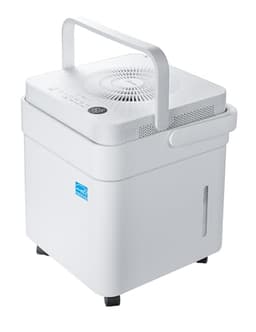
The only unit here that solves the real basement problem, which is not capacity but where the water goes when you are not standing next to it.
Average draw
487 W
Computed from the ENERGY STAR certified entry for Midea MAD50S1QWT-A, the 50 pt / 4,500 sq ft Cube without a pump: 49.67 pt/day at IEF 2.01 L/kWh. Midea's own US product page confirms MAD50S1QWT-A is this configuration. Midea publishes no wattage on the Amazon listing or on that page.
What is good
- The body separates, so the tank half can sit lower than the compressor half and the hose gets a genuine downhill run
- Certified at 49.67 pt/day, which is a real 50-pint machine rather than a saturation number
- IEF 2.01 L/kWh puts it exactly on the median for the 50-pint class - neither a bargain nor a penalty
- Wi-Fi that tells you it has stopped, which is the only smart feature that matters in a basement
What is not
- No pump, so the drain has to run downhill the whole way
- Midea publishes no wattage anywhere, so the 487 W above is computed rather than quoted
- The 4,500 sq ft coverage claim is marketing, not a spec - see the sizing guide
Who it is for
Someone with a floor drain, a sump, or a window well lower than the machine, who wants to set it once and stop thinking about it.
Skip it if
Skip it if the only drain in the room is higher than the unit. Without a pump, gravity is the entire drainage system, and no setting fixes an uphill hose.
Waykar
Waykar 80 Pint ENERGY STAR Dehumidifier
Best for: A large open basement or a shop floor
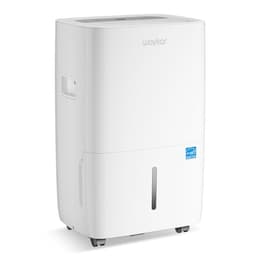
Sold on an 80-pint headline that is a saturation figure; the DOE rating behind it is in the same 50-pint class as everything else on this page.
Average draw
Not published
No published wattage. Waykar's certified 50-pint entries - JD026CE-150, CHWA150A/B/E, CTH150A/B and the YD-150 family - compute to between 443 W and 488 W. The identity of the exact certified model behind this listing is not stated, so the band stands in for a number.
What is good
- Sets to 30% RH, lower than most units will go
- 90-degree auto swing louvre, which genuinely helps in a long open basement
- Continuous drainage support and a larger tank than Waykar's smaller units
- Auto defrost for cold running
What is not
- The 80-pint headline is not a DOE rating and should not be compared against one
- No published wattage and no single certified model to map to
- 5,000 sq ft is the second-highest coverage claim in this registry
Who it is for
A large, open, genuinely wet basement or shop, where air movement matters as much as extraction.
Skip it if
Skip it if you are comparing it against a 50-pint unit on the strength of the 80. They are the same class of machine - the numbers are measured differently.
AlorAir
AlorAir Sentinel HD55 Crawl Space Dehumidifier
Best for: A crawl space you cannot stand up in
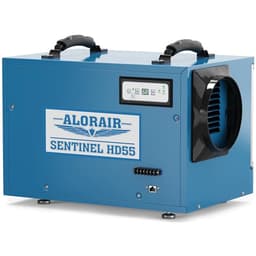
The clearest example on this site of why the number on the box is not the number that matters: sold as 113 pints, certified at 36.33.
Average draw
344 W
Computed from the ENERGY STAR certified entry ALORAIR Sentinel HD55S: 36.33 pt/day at IEF 2.08 L/kWh, 379 kWh a year. The retail listing is the HD55; the certified entry carries the S suffix. At IEF 2.08 it is more efficient than the median 50-pint portable while removing about three quarters as much water.
What is good
- Built low and flat to fit between floor joists, which no portable unit does
- Auto defrost and low-temperature operation, both essential in an unheated crawl space
- IEF 2.08 is above the 50-pint class median of 2.01 despite the smaller capacity
- No tank at all, so there is nothing to forget to empty
What is not
- The 113-pint headline is a saturation figure at 95F and 90% RH; the DOE-condition rating is 36.33
- 1,200 sq ft coverage, less than most 50-pint portables claim, for considerably more money
- Needs a drain or a condensate pump - there is no bucket fallback
Who it is for
Crawl spaces, low-clearance basements and unheated storage where a standing portable will not fit or will freeze.
Skip it if
Skip it for a normal basement. A 50-pint portable removes more water at the DOE condition for less money; you are paying for the form factor and the temperature range.
When you genuinely need more than 50 DOE pints
There are real cases: a large open basement over about 2,500 square feet that stays above 70% humidity, a space being dried after a flood, or a whole house where individual room units are not practical. Two options, both of which leave the portable class:
- Two portable units in different parts of the space. Cheaper, redundant when one fails, and each can be sited near its own drain. Less efficient per pint than one large machine, but far more practical.
- A ducted whole-home dehumidifier. The certified ones run 65 to 105 DOE pints at 461 to 1,088 W and IEF around 2.35, which is better than any portable. They are installed into ductwork rather than plugged in, are dealer-distributed rather than sold on Amazon, and cost several times a portable.
What is not a solution is buying a crawl space unit on the strength of its saturation rating and putting it in a basement. On the DOE scale, the 113-pint AlorAir is a 36-pint machine - less capacity than a 50-pint portable, for considerably more money. It earns its price on form factor and cold-weather operation, neither of which a normal basement needs.
FAQ
Questions
Is a 70-pint dehumidifier better than a 50-pint?
Can I still buy a 70-pint dehumidifier?
My old dehumidifier was 70 pints. What do I replace it with?
Sources
Sources
Read next
- What the pint number on a dehumidifier actually meansThe 2019 DOE test change, the official conversion table, and the saturation rating that is 3x the certified one.
- 30-pint versus 50-pint170 watts and $11 a month apart, with one failure mode that makes the cheaper machine cost more.
- Dehumidifier capacity chartCapacity class, pre-2020 equivalent, median watts and monthly cost, in one sourced reference table.
- The best 50-pint dehumidifiersSix 50-pint units and the certified data behind them: a 443-490 W range and a coverage claim that varies 1.9x.
- The best crawl space dehumidifiersFour crawl space options, and the 3.1x gap between the pint number on the box and the certified one.