Compare / Comparison
Dehumidifier or air purifier?
They are regularly bought as substitutes for one another and they have almost no overlap. One takes water out of the air. The other takes particles out and leaves the water exactly where it was.
#adThis page contains affiliate links. We earn a commission on qualifying purchases, at no cost to you, and it never changes a ranking. Full disclosure.
The short answer
An air purifier passes air through a filter to remove particles - dust, pollen, smoke, spores - and returns it with the same amount of water vapor. A dehumidifier removes water vapor and has only a coarse dust filter protecting its coil. Neither substitutes for the other.
What each one actually does
| Dehumidifier | Air purifier | |
|---|---|---|
| Removes water vapor | Yes - 8 to 50 pints a day by class | No. None at all |
| Removes airborne particles | Only what its coarse coil filter catches | Yes - that is the entire function |
| Helps with mold | Yes, by removing the humidity mold needs | Captures spores already in the air; does nothing about the cause |
| Helps with dust mites | Yes - they need humidity above roughly 60 percent | Captures allergen particles already airborne |
| Helps with smoke or cooking smells | No | Yes, with an activated carbon stage |
| Effect on the room | Drier, slightly warmer | Neither drier nor warmer, just cleaner |
| Typical draw | 105-488 W by class | Varies widely by model and fan speed |
The mold question, where the confusion starts
Most people who consider both are thinking about mold, and the two machines address genuinely different parts of it.
Mold needs moisture. The EPA's guidance is to keep indoor relative humidity below 60 percent and ideally between 30 and 50, precisely because that removes the condition growth depends on. A dehumidifier is the machine that does that, and it is addressing the cause.
An air purifier with a good filter captures spores that are already airborne. That can matter for someone reacting to them, and it does nothing whatever about the colony on the wall or the humidity feeding it. Run a purifier in a 70 percent basement and it will filter spores indefinitely while the source keeps producing more.
The filter on a dehumidifier is not an air filter
Worth stating because listings blur it. The filter on a household dehumidifier exists to keep dust off the evaporator coil, not to clean the air you breathe. It is coarse, usually washable, and nothing like the HEPA-class media in a purifier. AlorAir's crawl space units, for instance, specify a MERV-1 filter, which is at the bottom of the rating scale by design - it protects the coil and is not pretending to do anything else.
Keeping it clean matters a great deal for the machine's own performance, because a clogged filter starves the coil and collapses extraction. It does not make the machine an air cleaner. Cleaning and maintenance.
Quick picks
| # | Product | Best for | Draw | Price |
|---|---|---|---|---|
| 1 |  hOmeLabs 32 Pint DehumidifierThe one hOmeLabs unit with a named entry in the ENERGY STAR list, so it is the one where the running cost is a published figure rather than a class estimate. hOmeLabs 32 Pint DehumidifierThe one hOmeLabs unit with a named entry in the ENERGY STAR list, so it is the one where the running cost is a published figure rather than a class estimate. | A bedroom that is damp but not wet | 318 W | $234.99View on Amazon #ad Price as of October 16, 2026. How we are funded |
| 2 |  Midea Cube 50 Pint DehumidifierThe only unit here that solves the real basement problem, which is not capacity but where the water goes when you are not standing next to it. Midea Cube 50 Pint DehumidifierThe only unit here that solves the real basement problem, which is not capacity but where the water goes when you are not standing next to it. | A basement you visit once a month | 487 W |
hOmeLabs
hOmeLabs 32 Pint Dehumidifier
Best for: A bedroom that is damp but not wet
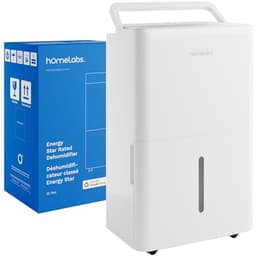
The one hOmeLabs unit with a named entry in the ENERGY STAR list, so it is the one where the running cost is a published figure rather than a class estimate.
Average draw
318 W
Computed from the ENERGY STAR certified entry hOmeLabs HME0089: 32.46 pt/day at IEF 2.01 L/kWh. This is the only hOmeLabs capacity in this registry with a named certified entry, which is why it is the only one carrying a number rather than a band.
What is good
- 318 W against the 50-pint class median of 488 W - about 35% less to run, hour for hour
- Named in the ENERGY STAR certified list, so its IEF is public
- Quiet enough for a bedroom in a way that a 50-pint compressor generally is not
- Wi-Fi and auto shut-off at a small-unit price
What is not
- 32 DOE pints is genuinely less water than 50 - undersizing a wet basement costs more than the machine saved
- Gravity drainage only
- 4,500 sq ft coverage for 32 pints is another claim to ignore
Who it is for
A bedroom, a home office, or a small basement that is humid rather than actively wet.
Skip it if
Skip it if the floor is ever damp to the touch or the walls sweat. That is a 50-pint problem, and a 32-pint machine will run continuously and still lose.
Midea
Midea Cube 50 Pint Dehumidifier
Best for: A basement you visit once a month
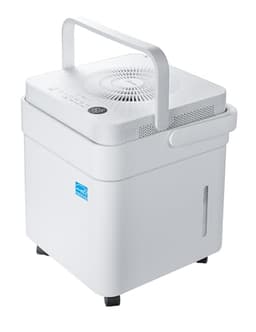
The only unit here that solves the real basement problem, which is not capacity but where the water goes when you are not standing next to it.
Average draw
487 W
Computed from the ENERGY STAR certified entry for Midea MAD50S1QWT-A, the 50 pt / 4,500 sq ft Cube without a pump: 49.67 pt/day at IEF 2.01 L/kWh. Midea's own US product page confirms MAD50S1QWT-A is this configuration. Midea publishes no wattage on the Amazon listing or on that page.
What is good
- The body separates, so the tank half can sit lower than the compressor half and the hose gets a genuine downhill run
- Certified at 49.67 pt/day, which is a real 50-pint machine rather than a saturation number
- IEF 2.01 L/kWh puts it exactly on the median for the 50-pint class - neither a bargain nor a penalty
- Wi-Fi that tells you it has stopped, which is the only smart feature that matters in a basement
What is not
- No pump, so the drain has to run downhill the whole way
- Midea publishes no wattage anywhere, so the 487 W above is computed rather than quoted
- The 4,500 sq ft coverage claim is marketing, not a spec - see the sizing guide
Who it is for
Someone with a floor drain, a sump, or a window well lower than the machine, who wants to set it once and stop thinking about it.
Skip it if
Skip it if the only drain in the room is higher than the unit. Without a pump, gravity is the entire drainage system, and no setting fixes an uphill hose.
Which to buy, by symptom
- Musty smell, condensation, damp surfaces, a hygrometer above 60 percent - dehumidifier. The purifier will not touch any of it.
- Hay fever, pet dander, visible dust, cooking or smoke smells - purifier. The dehumidifier will not touch any of it.
- Damp basement and an allergy sufferer using the room - both, and the dehumidifier first, because it removes the condition producing the spores.
- Neither symptom, just a general feeling that the air is bad - measure before buying. A hygrometer costs ten dollars and rules half of this out.
Running both
There is no conflict. They can share a room and do not interfere with one another - the dehumidifier's exhaust is dry air, which the purifier is happy to filter. Two things worth knowing: the dehumidifier adds a little heat, and the purifier's filter will load faster in a room with a lot of airborne dust, which is a maintenance cost rather than a problem.
FAQ
Questions
Does an air purifier remove humidity?
Will a dehumidifier help with allergies?
Do I need both a dehumidifier and an air purifier?
Does a dehumidifier clean the air?
Sources
Sources
Read next
- Dehumidifier or humidifier?Opposite machines, one letter apart, and why the wrong one makes the problem worse.
- What to set it to45 to 50 percent, why lower is only more expensive, and the setting that doubles your bill.
- Keeping it workingFour jobs on four schedules, and the five-minute one that prevents most faults on this hub.
- The best dehumidifiers for a bedroomFour options for a room you sleep in, ranked on cycling behavior rather than a decibel figure nobody measured.
- The best dehumidifiers for a basementFive basement units ranked on drainage first, with computed running costs and a unit we would not buy.
- The best dehumidifiers for dust mites and allergies401.2 mites per gram down to 6.7, in homes held under 51% humidity. Four units for the rooms where it matters.