Compare / Comparison
Dehumidifier or humidifier?
They differ by one letter and do opposite things. Buying the wrong one does not leave you where you started - it actively makes the problem worse.
#adThis page contains affiliate links. We earn a commission on qualifying purchases, at no cost to you, and it never changes a ranking. Full disclosure.

The short answer
A dehumidifier removes water vapor from the air. A humidifier adds it. If your relative humidity is above 60 percent you want a dehumidifier; below about 30 percent you want a humidifier. Between 30 and 50 percent you probably want neither.
Which one, decided by a ten-dollar instrument
Buy a hygrometer, leave it in the room for a week, and read it morning and evening. That is the whole diagnostic, and it costs about ten dollars.
| Reading | You want | Because |
|---|---|---|
| Above 60% | A dehumidifier | Above 60 percent is where mold, dust mites and several pests thrive - the EPA's stated threshold |
| 50-60% | Probably a dehumidifier | Comfortable but at the top of the recommended band, and it will drift higher in summer |
| 30-50% | Neither | This is the EPA's ideal range. Running anything is spending money to leave it where it is |
| Below 30% | A humidifier | Dry enough to be uncomfortable - static, dry throats, and it will shrink timber and joinery |
The EPA's guidance is to keep indoor relative humidity below 60 percent, ideally between 30 and 50 percent.
The symptoms, which are easier to read than the words
| Too humid - dehumidifier | Too dry - humidifier |
|---|---|
| Condensation on windows in warm weather | Static shocks off door handles |
| A musty smell in a closed room | Dry throat or nose on waking |
| Black spotting in grout or on window reveals | Cracked lips, itchy skin |
| Paper and cardboard that feels soft | Timber floors or furniture opening at joints |
| Clothes in a wardrobe that never feel quite dry | Instruments going out of tune |
| Floors or walls damp to the touch | More static in fabric than usual |
Why the wrong one is worse than nothing
This is the part that makes the confusion expensive rather than merely wasteful. A humidifier in a damp basement is adding water to a space that already has too much - feeding exactly the mold growth the owner was trying to stop, and doing it with electricity. If that is the problem you actually have, start with the best dehumidifiers for mold.
The reverse case is gentler but real: a dehumidifier in an already-dry winter room can take a house from uncomfortable to genuinely dry, at 488 watts for a 50-pint machine. Neither mistake is neutral.
Quick picks
| # | Product | Best for | Draw | Price |
|---|---|---|---|---|
| 1 |  hOmeLabs 32 Pint DehumidifierThe one hOmeLabs unit with a named entry in the ENERGY STAR list, so it is the one where the running cost is a published figure rather than a class estimate. hOmeLabs 32 Pint DehumidifierThe one hOmeLabs unit with a named entry in the ENERGY STAR list, so it is the one where the running cost is a published figure rather than a class estimate. | A bedroom that is damp but not wet | 318 W | |
| 2 |  Midea Cube 50 Pint DehumidifierThe only unit here that solves the real basement problem, which is not capacity but where the water goes when you are not standing next to it. Midea Cube 50 Pint DehumidifierThe only unit here that solves the real basement problem, which is not capacity but where the water goes when you are not standing next to it. | A basement you visit once a month | 487 W |
hOmeLabs
hOmeLabs 32 Pint Dehumidifier
Best for: A bedroom that is damp but not wet
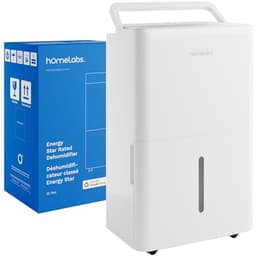
The one hOmeLabs unit with a named entry in the ENERGY STAR list, so it is the one where the running cost is a published figure rather than a class estimate.
Average draw
318 W
Computed from the ENERGY STAR certified entry hOmeLabs HME0089: 32.46 pt/day at IEF 2.01 L/kWh. This is the only hOmeLabs capacity in this registry with a named certified entry, which is why it is the only one carrying a number rather than a band.
What is good
- 318 W against the 50-pint class median of 488 W - about 35% less to run, hour for hour
- Named in the ENERGY STAR certified list, so its IEF is public
- Quiet enough for a bedroom in a way that a 50-pint compressor generally is not
- Wi-Fi and auto shut-off at a small-unit price
What is not
- 32 DOE pints is genuinely less water than 50 - undersizing a wet basement costs more than the machine saved
- Gravity drainage only
- 4,500 sq ft coverage for 32 pints is another claim to ignore
Who it is for
A bedroom, a home office, or a small basement that is humid rather than actively wet.
Skip it if
Skip it if the floor is ever damp to the touch or the walls sweat. That is a 50-pint problem, and a 32-pint machine will run continuously and still lose.
Midea
Midea Cube 50 Pint Dehumidifier
Best for: A basement you visit once a month
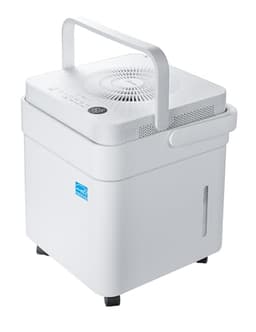
The only unit here that solves the real basement problem, which is not capacity but where the water goes when you are not standing next to it.
Average draw
487 W
Computed from the ENERGY STAR certified entry for Midea MAD50S1QWT-A, the 50 pt / 4,500 sq ft Cube without a pump: 49.67 pt/day at IEF 2.01 L/kWh. Midea's own US product page confirms MAD50S1QWT-A is this configuration. Midea publishes no wattage on the Amazon listing or on that page.
What is good
- The body separates, so the tank half can sit lower than the compressor half and the hose gets a genuine downhill run
- Certified at 49.67 pt/day, which is a real 50-pint machine rather than a saturation number
- IEF 2.01 L/kWh puts it exactly on the median for the 50-pint class - neither a bargain nor a penalty
- Wi-Fi that tells you it has stopped, which is the only smart feature that matters in a basement
What is not
- No pump, so the drain has to run downhill the whole way
- Midea publishes no wattage anywhere, so the 487 W above is computed rather than quoted
- The 4,500 sq ft coverage claim is marketing, not a spec - see the sizing guide
Who it is for
Someone with a floor drain, a sump, or a window well lower than the machine, who wants to set it once and stop thinking about it.
Skip it if
Skip it if the only drain in the room is higher than the unit. Without a pump, gravity is the entire drainage system, and no setting fixes an uphill hose.
How each one actually works
A dehumidifier is a small refrigeration circuit. A fan pulls room air over a coil chilled below the dew point, water condenses onto it and drains away, and the dried air passes over a hot coil on the way out. The room ends up drier and slightly warmer, and the machine draws 105 to 488 watts depending on capacity. The full mechanism.
A humidifier does the opposite by evaporating or atomizing water into the air, either with a wick and a fan, an ultrasonic transducer, or a heating element. Most draw far less power than a dehumidifier because evaporation is cheaper than refrigeration - though the warm-mist type, which boils water, is an exception.
One machine that is neither
An air purifier. It filters particles - dust, pollen, smoke - and returns the air with exactly the same amount of water vapor in it. It cannot make a room drier or wetter, and it is regularly bought by people who wanted one of the other two. Dehumidifier versus air purifier. If the reason you are asking is a wood floor, the decision turns on a published humidity band rather than on which machine you prefer - the best dehumidifiers for hardwood floors sets it out.
FAQ
Questions
What is the difference between a humidifier and a dehumidifier?
How do I know if I need a humidifier or a dehumidifier?
Can a dehumidifier make a room too dry?
Do I need both a humidifier and a dehumidifier?
Sources
Sources
Read next
- Dehumidifier or air purifier?One removes water and no particles; the other removes particles and no water. Not substitutes.
- What to set it to45 to 50 percent, why lower is only more expensive, and the setting that doubles your bill.
- How a dehumidifier actually worksThe refrigeration cycle, why the machine warms the room, and why cold air defeats it.
- What size dehumidifier do I need?A four-step method that uses measured humidity instead of the square-footage claim on the box.
- The best dehumidifiers for a basementFive basement units ranked on drainage first, with computed running costs and a unit we would not buy.
- Are dehumidifiers worth it?Worth it above 60% humidity, a waste below 50. The four cases each way, with the running cost attached.