Best / Roundup
The best dehumidifiers for hardwood floors
Every other page on this site pushes you toward drier air. This is the one where drier is a way to damage something expensive, and the specification that protects you is one most buyers never look at.
#adThis page contains affiliate links. We earn a commission on qualifying purchases, at no cost to you, and it never changes a ranking. Full disclosure.
The short answer
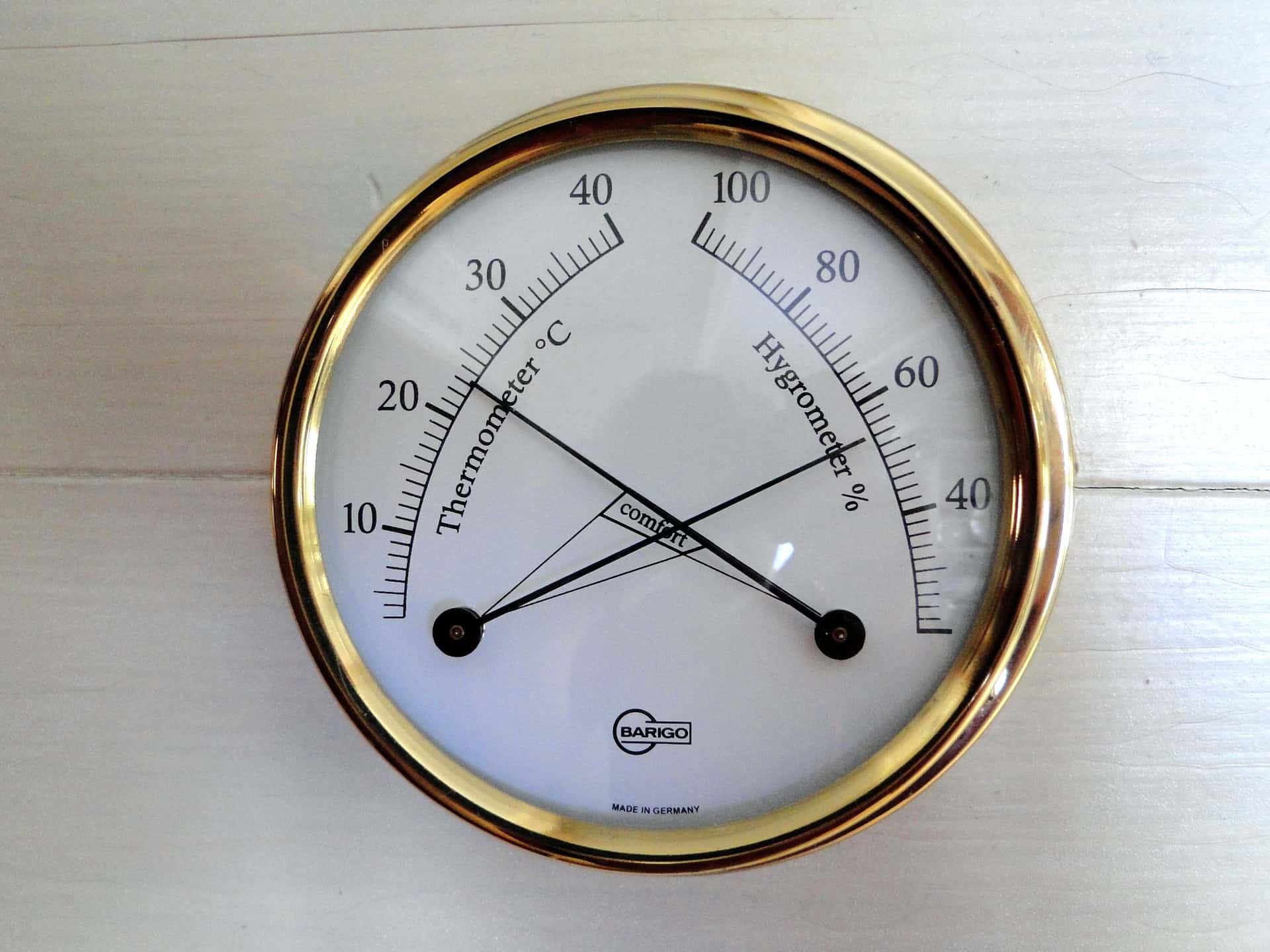
Buy on the humidistat's lower limit. The Maple Flooring Manufacturers Association tells installers to hold relative humidity inside a 15 percent band - it gives 35 to 50 percent as the example - and warns that excessive shrinkage or expansion may occur outside that variance. Midea's Cube line and Frigidaire's 50-pint both stop at 35 percent. Several units we track will take a room to 30, and one to 10.
Why this page runs backwards
Every other roundup here is about removing water. Damp basements, musty crawl spaces, condensation on glass - in all of them, drier is better and the only question is how efficiently you get there. Wood is different, and the difference is not a matter of degree.
A wood floor is a hygroscopic material that was kiln-dried to a moisture content matched to a normal indoor environment, then nailed or glued down. It gives water up to dry air and takes it back from damp air, and it changes size when it does. Too damp and the boards swell, press against each other and cup. Too dry and they shrink, and you get gaps you can drop a coin into. The damage in the second direction is the one a dehumidifier can cause.
A 15 percent band
What the Maple Flooring Manufacturers Association tells the trade to hold, not a single target number
MFMA's position statement specifies indoor temperatures between 55 and 75 degrees and says relative humidity "should be maintained within a 15% range. For example, between 35% and 50%", warning that "excessive shrinkage and/or expansion may occur with indoor relativity humidity in excess of a 15% variance". Retrieved 2026-09-27.
Read that carefully, because it is not the advice usually repeated. MFMA does not give a magic number to hit - it gives a band width. What damages a floor is the swing between wet and dry, not the absolute reading on any given day. A house that sits at 48 percent all year is kinder to wood than one that oscillates between 30 and 60, even though the second one averages the same.
The specification that does the work
Here is the thing almost nobody checks when buying: a dehumidifier's humidistat has a floor, the floor varies by machine, and it is occasionally published. Over a wood floor that number is a safety rail. A machine that physically will not target below 35 percent cannot over-dry the room, however carelessly it is set or however long it is left.
| Unit | Stated range | Lower bound against MFMA's 35 percent |
|---|---|---|
| Midea Cube 50, 35 and 20 | 35-85% RH | At the bound. Cannot over-dry |
| Frigidaire 50 Pint | 35-85% RH | At the bound. Cannot over-dry |
| AEOCKY X1-Pro | 40-80% RH | Above the bound - the most conservative here |
| GE 50 Pint and GE 50 with Pump | 30-70% RH | Five points below. Fine if you set it, risky if you do not |
| Waykar 34, 80 and 145 | 30-80% RH | Five points below |
| Yaufey 150 Pint | 30-80% RH, in 5% steps | Five points below |
| Yaufey 70 Pint commercial | 10-90% RH | Advertised as a feature. Wrong tool for a wood floor |
| Everything else we track | Not published | Unknown, which over a wood floor is its own answer |
Read from each current listing on 2026-09-27. The Yaufey row is not a criticism of that machine - a 10 percent floor is genuinely useful in a warehouse or a drying job. It is a criticism of putting it in a living room with oak in it.
Note what the table does not contain: most of the category. Twelve of the 32 units in our registry publish a numeric humidity range; the other twenty publish nothing, or a word like humidistat with no figures attached. On this page that absence is disqualifying, because the whole purchase turns on it.
How we picked
- The humidistat's LOWER bound, taken from the maker's own listing. This is the whole page: over a wood floor the risk runs in the drying direction, and a machine that cannot go below 35 percent cannot over-dry the room.
- Whether the maker publishes a range at all. Several do not, which on this page is a disqualification rather than an inconvenience.
- How long it runs unattended, because stability matters more than speed here - a floor is damaged by the swing, not by the average.
- Certified DOE capacity and computed draw where a model match exists, so a wood-floor pick is still judged as a dehumidifier.
- What we did not do: we have not tested any of these units, measured room humidity over a season, or inspected a wood floor. Every figure is quoted or computed, and every source is linked.
We did not test these units. The full criteria and their weighting are on the methodology page.
Quick picks
| # | Product | Best for | Draw | Price |
|---|---|---|---|---|
| 1 |  Midea Cube 50 Pint DehumidifierThe only unit here that solves the real basement problem, which is not capacity but where the water goes when you are not standing next to it. Midea Cube 50 Pint DehumidifierThe only unit here that solves the real basement problem, which is not capacity but where the water goes when you are not standing next to it. | A basement you visit once a month | 487 W | |
| 2 |  Frigidaire 50 Pint Dehumidifier with Wi-FiFrigidaire's current no-pump 50-pint: certified by exact model number, Wi-Fi equipped, and a 2.7 gallon bucket that is among the largest of any 50-pint unit we track. Frigidaire 50 Pint Dehumidifier with Wi-FiFrigidaire's current no-pump 50-pint: certified by exact model number, Wi-Fi equipped, and a 2.7 gallon bucket that is among the largest of any 50-pint unit we track. | A Frigidaire with a drain below it | 488 W | |
| 3 |  Midea Cube 35 Pint DehumidifierThe middle Cube removes 78 percent more water than the 20 for 50 percent more power, and carries the same 4.2 gallon bucket as the 50 - which makes it the size most people between the two should buy. Midea Cube 35 Pint DehumidifierThe middle Cube removes 78 percent more water than the 20 for 50 percent more power, and carries the same 4.2 gallon bucket as the 50 - which makes it the size most people between the two should buy. | A damp room or a small, dry-ish basement | 351 W | |
| 4 |  AEOCKY X1-Pro Rotary Desiccant DehumidifierA desiccant wheel at a compressor price, which is the trade this category rarely offers - and it buys cold-weather operation with a 340 W heater rather than efficiency. AEOCKY X1-Pro Rotary Desiccant DehumidifierA desiccant wheel at a compressor price, which is the trade this category rarely offers - and it buys cold-weather operation with a 340 W heater rather than efficiency. | A cold room where a compressor would spend the day defrosting | 340 W |
Midea
Midea Cube 50 Pint Dehumidifier
Best for: A basement you visit once a month
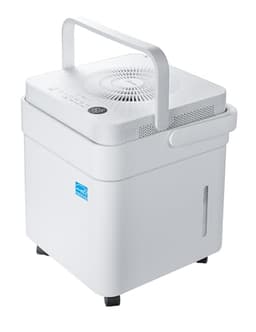
The only unit here that solves the real basement problem, which is not capacity but where the water goes when you are not standing next to it.
Average draw
487 W
Computed from the ENERGY STAR certified entry for Midea MAD50S1QWT-A, the 50 pt / 4,500 sq ft Cube without a pump: 49.67 pt/day at IEF 2.01 L/kWh. Midea's own US product page confirms MAD50S1QWT-A is this configuration. Midea publishes no wattage on the Amazon listing or on that page.
What is good
- The body separates, so the tank half can sit lower than the compressor half and the hose gets a genuine downhill run
- Certified at 49.67 pt/day, which is a real 50-pint machine rather than a saturation number
- IEF 2.01 L/kWh puts it exactly on the median for the 50-pint class - neither a bargain nor a penalty
- Wi-Fi that tells you it has stopped, which is the only smart feature that matters in a basement
What is not
- No pump, so the drain has to run downhill the whole way
- Midea publishes no wattage anywhere, so the 487 W above is computed rather than quoted
- The 4,500 sq ft coverage claim is marketing, not a spec - see the sizing guide
Who it is for
Someone with a floor drain, a sump, or a window well lower than the machine, who wants to set it once and stop thinking about it.
Skip it if
Skip it if the only drain in the room is higher than the unit. Without a pump, gravity is the entire drainage system, and no setting fixes an uphill hose.
Frigidaire
Frigidaire 50 Pint Dehumidifier with Wi-Fi
Best for: A Frigidaire with a drain below it
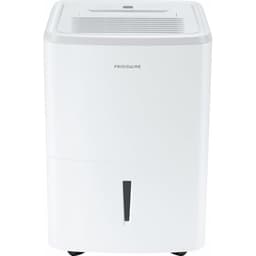
Frigidaire's current no-pump 50-pint: certified by exact model number, Wi-Fi equipped, and a 2.7 gallon bucket that is among the largest of any 50-pint unit we track.
Average draw
488 W
Computed from the ENERGY STAR certified entry for Frigidaire FHDD5034Y1 - the same model number as this listing: 49.71 pt/day at IEF 2.01 L/kWh. Frigidaire's Canadian product page states 115 V, 8.8 A and 470 W; those figures do not reconcile with each other and are nameplate rather than average values, so 488 W is the running-cost figure.
What is good
- Exact certified model match, so the 488 W figure describes this machine rather than a sibling
- 2.7 gallon bucket - roughly ten hours of condensate at full rated capacity if you ever run it without a hose
- Continuous drain, three fan speeds and operation down to 41F
- Wi-Fi and the Frigidaire app for scheduling and remote control
What is not
- Gravity only. The drain must be below the machine
- The Wi-Fi depends on Frigidaire's app remaining supported
- Frigidaire's own published wattage and amperage do not agree with each other
Who it is for
Someone with a floor drain who wants a certified, well-documented 50-pint unit and has a use for scheduling.
Skip it if
Skip it if the only drain is above the machine. That is the one job a gravity unit cannot do, whatever else it has.
Midea
Midea Cube 35 Pint Dehumidifier
Best for: A damp room or a small, dry-ish basement
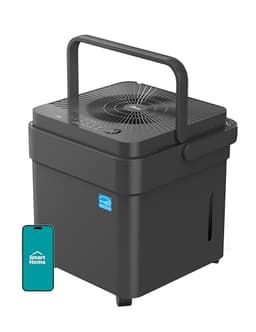
The middle Cube removes 78 percent more water than the 20 for 50 percent more power, and carries the same 4.2 gallon bucket as the 50 - which makes it the size most people between the two should buy.
Average draw
351 W
Computed from the ENERGY STAR certified entry for Midea MAD35S1QGR-A - the same model number as this listing: 35.82 pt/day at IEF 2.01 L/kWh. Midea publishes no wattage on the listing. Every certified 35-pint model we track runs IEF 2.01 to 2.09, so this is the class norm.
What is good
- Same IEF 2.01 as the 50-pint Cube, so per pint removed it is exactly as efficient
- 4.2 gallon bucket, identical to the 50 - about 22 hours at full rated capacity
- Lift-and-twist expandable body, Wi-Fi app and included drain hose
- About $9 a month less than the 50-pint Cube at twelve hours a day and the US average rate
What is not
- Midea's listing calls it similar to a 50 pint under the 2012 standard; ENERGY STAR's correlation table puts a current 35 nearer an old 60, so the maker's equivalence undersells it
- 3,500 sq ft is the most generous coverage claim per pint of the three Cubes - treat it as marketing
- No pump, so the drain must be below the machine
Who it is for
A large damp room, an apartment, or a small basement that reads in the low-to-mid 60s rather than the high 60s.
Skip it if
Skip it for a basement that reads above about 68 percent or shows visible moisture. That is 50-pint work, and the 50 costs little more to buy and nothing more per pint to run.
AEOCKY
AEOCKY X1-Pro Rotary Desiccant Dehumidifier
Best for: A cold room where a compressor would spend the day defrosting
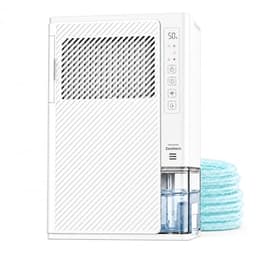
A desiccant wheel at a compressor price, which is the trade this category rarely offers - and it buys cold-weather operation with a 340 W heater rather than efficiency.
Average draw
340 W
Stated on the listing as a 340 W heat-based system. Desiccant dehumidifiers are not represented in the ENERGY STAR certified dehumidifier list at all - the program covers refrigerant units - so there is no certified figure to compute and no IEF to compare. 340 W for a stated peak of 10 pints a day is roughly a third of the water per watt that a certified 50-pint compressor manages at its own test condition, which is the honest cost of working in the cold.
What is good
- No coil means no icing, so it keeps working at temperatures that stall a compressor
- Light and small enough to actually move between a shed, a garage and a closet
- Publishes a wattage, which almost nothing in this category does
- Tank or continuous hose, with the hose in the box
What is not
- 340 W for 10 pints a day is poor water-per-watt next to any compressor unit above freezing
- The capacity figure is a lab peak, not a DOE test-condition rating, so it is not comparable to a pint number on a compressor box
- It warms the room - that is how the technology works, and the listing says so
- The listing copy is unusually aggressive marketing, which is not a reason to avoid it but is a reason to read the numbers rather than the adjectives
Who it is for
Someone drying a small unheated space - a shed, a boat, a garage in shoulder season - where a compressor unit would ice up and a mini Peltier box would do nothing.
Skip it if
Skip it for a heated basement. Above about 60F a 50-pint compressor removes five times the water for barely more power, and the running cost gap is not close.
Continuous mode is the trap
Every machine here has a continuous or "dry" mode that ignores the humidistat entirely and runs until you stop it. It exists for a reason - after a leak, in a crawl space, drying a new build - and it is precisely the mode you must not leave running in a room with a wood floor.
This matters more than the humidistat floor for one reason: in continuous mode the floor does not apply. A Midea Cube that cannot target below 35 percent will still take a room well past it if you put it in continuous and go on holiday. The safety rail only works when the machine is being asked to hold a number.
- Set a target, never continuous, in any room with a wood floor. 45 percent is a sensible middle of MFMA's example band.
- Buy a separate hygrometer and put it on the floor, not on the machine. The reading at the dehumidifier's intake is the air it is about to dry, not the air the boards are sitting in.
- Expect to change the setting twice a year. Holding one number through a humid August and a dry January means the machine is fighting in summer and the furnace is fighting in winter.
- Watch the gaps in late winter. That is when a heated house is at its driest, and it is when over-drying shows up. What to set it to.
What this costs to hold
Less than a damp basement, and for a straightforward reason: a machine holding 45 percent in a finished room cycles off most of the time. The running-cost figures on this site are for a unit working at its rated condition, which a wood-floor installation mostly is not.
Midea Cube 50, certified - at full duty, which this job is not
(487 W / 1000) x 12 h x $0.1834/kWh = $1.07 per day
0.487
kWh per hour
$32.63
per month, 12 h/day
$65.25
per month, 24 h/day
Rate is the US residential average of 18.34 cents/kWh from the EIA Electric Power Monthly, June 2026. Yours will differ - use the calculator.
Treat that as the ceiling rather than the bill. A unit that runs four hours a day to hold a setpoint costs a third of the twelve-hour figure. What it costs per month and the calculator at your own rate.

When the dehumidifier is the wrong purchase
- Your floors are gapping in winter. That is a dryness problem, and a dehumidifier makes it worse. You want a humidifier, and this site will cheerfully send you away. Dehumidifier or humidifier.
- Cupping across a whole floor with no obvious leak. Water is usually coming from below - a crawl space or slab - and the fix is down there, not in the room. The best dehumidifiers for a crawl space.
- One damp patch by a door or a radiator. That is a local source, not a room-humidity problem.
- A newly installed floor still acclimating. Follow the installer's specification, not a generic number off the internet including this one.
What we would skip
Any unit whose humidistat goes below 35 percent, unless you will never touch the dial
This is the inverse of every other roundup on this site. A machine that can hold 10 percent relative humidity is a more capable machine, and over a wood floor it is a liability - the Yaufey commercial unit in our registry advertises a 10 to 90 percent range as a feature. Set that wrong, or leave it in continuous mode through a dry winter, and the floor shrinks. A humidistat that physically stops at 35 percent cannot make that mistake.
What we did not do
We have not tested any of these machines, measured relative humidity over a season, or inspected a wood floor before and after. The humidity band is quoted from MFMA's published position statement, the humidistat ranges are read from each manufacturer's current listing, and the capacity and power figures come from the ENERGY STAR certified file. Where a maker publishes no range, this page records that rather than guessing at it. How we work.
FAQ
Questions
What humidity should I keep a house with hardwood floors at?
Can a dehumidifier damage hardwood floors?
What humidistat setting is safe for wood floors?
Which dehumidifiers cannot over-dry a room?
My wood floor is cupping - do I need a dehumidifier?
Sources
Sources
- Humidity and Environmental Recommendations - Maple Flooring Manufacturers Association position statement, specifying indoor temperatures between 55 and 75 degrees and relative humidity maintained within a 15% range, "for example, between 35% and 50%", and warning of excessive shrinkage or expansion beyond a 15% variance (retrieved 2026-09-27)
- Humidistat ranges read from each manufacturer's current Amazon listing on 2026-09-27: Midea Cube 35-85%, Frigidaire 50-pint 35-85%, GE ADHE50BWF 30-70%, Waykar 30-80%, AEOCKY X1-Pro 40-80%, Yaufey AYD1.5DPM 10-90%
- ENERGY STAR Certified Dehumidifiers list - the capacity and efficiency figures behind every computed wattage on this page (retrieved 2026-09-27)
- EIA Electric Power Monthly, Table 5.6.A, June 2026 - the residential electricity rate used
Read next
- What to set it to45 to 50 percent, why lower is only more expensive, and the setting that doubles your bill.
- Dehumidifier or humidifier?Opposite machines, one letter apart, and why the wrong one makes the problem worse.
- The best dehumidifiers for a basementFive basement units ranked on drainage first, with computed running costs and a unit we would not buy.
- The best crawl space dehumidifiersFour crawl space options, and the 3.1x gap between the pint number on the box and the certified one.
- Midea Cube 50 PintCertified 49.67 pt/day at 487 W, and the splitting body that solves a real drainage constraint.
- What it costs per day, month and yearPer day, month, season and year, for every capacity class and every plausible schedule.