Best / Roundup
The best dehumidifiers for a home
The query assumes one machine covers a house. It does not, and the reason is physical rather than commercial. Here is how to work out what your home actually needs, and what it costs to run once you have.
#adThis page contains affiliate links. We earn a commission on qualifying purchases, at no cost to you, and it never changes a ranking. Full disclosure.
The short answer
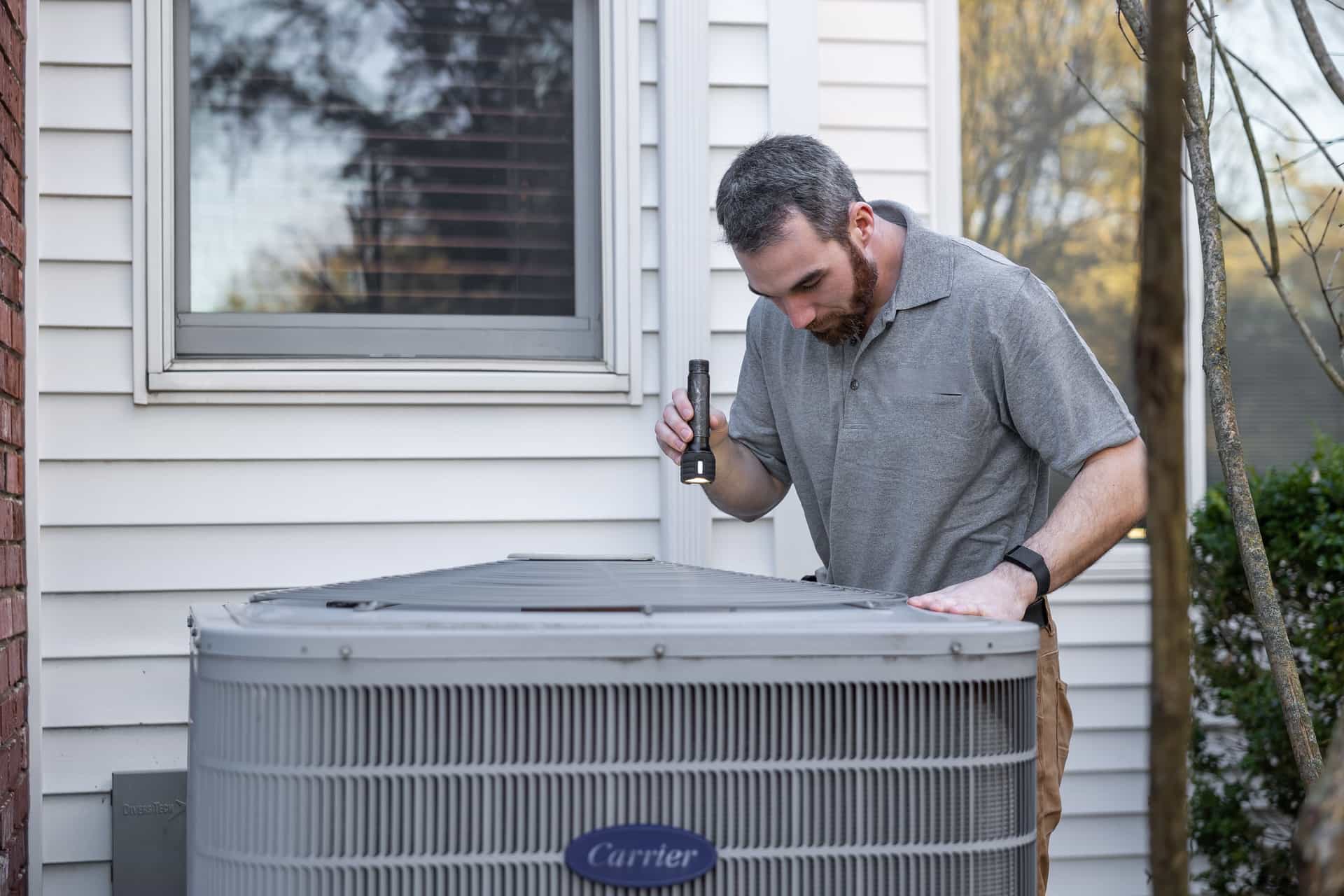
No portable dehumidifier dries a whole house. Air does not travel through closed doors, so a machine conditions the space it stands in and little else. Most homes with a real problem need one 50-pint unit where the moisture originates - usually a basement or crawl space - and, if other rooms are also damp, a smaller unit in each. The alternative is a ducted whole-home unit, which is a contractor purchase.
The assumption inside the question
Nearly everyone searching for a dehumidifier for their home is picturing one appliance, placed somewhere central, quietly fixing the house. Every retail listing encourages that picture by printing a coverage figure in square feet, and 4,500 or 5,000 square feet is larger than most American homes.
The figure is not a lie so much as a category error. A dehumidifier can only remove water from air that physically passes through it. In one open room that is nearly all of the air, and the machine works as advertised. Add a closed door and the room behind it is a separate air volume that the machine never sees. Add a floor and you have added a second one, with the additional complication that moist air rises and cool air sinks, so the basement and the second bedroom are not exchanging air in any useful way either.
That is why the honest version of this page is not a ranked list of one machine. It is a way of working out how many air volumes in your house have a problem, and what each of them needs.
Step one: find where the water is coming from
Before buying anything, buy a hygrometer - they cost less than a takeaway meal - and take a reading in every room you are worried about, at the same time of day, for three or four days. You are looking for two things: which rooms are actually above 60% relative humidity, and whether the number is worst somewhere specific.
The EPA's recommended indoor band is 30 to 50% relative humidity, and 60% is the level above which mold growth becomes likely on ordinary surfaces. A room reading 55% does not need a machine. A room reading 72% does.
In most houses with a genuine whole-home damp feeling, the readings are not evenly distributed. One space - a basement, a crawl space, an unvented bathroom, a laundry - is markedly worse, and it is the source. Condition the source and the rest of the house often improves without any further hardware, because you have stopped adding moisture to the building rather than chasing it around. Ideal humidity settings.
Step two: match a machine to each volume
| Space | Typical class | Average draw | The constraint that decides it |
|---|---|---|---|
| Damp basement | 50 pint | 488 W | Where the water goes. A basement unit should be plumbed, not emptied. |
| Large open-plan floor | 50 pint, high airflow | 443-488 W | Air distribution. One machine in a corner conditions a corner. |
| Bedroom or study | 30-32 pint | 318 W | Noise, then capacity. A 50-pint compressor next to a bed is a mistake. |
| Apartment or single damp room | 20-30 pint | 258-318 W | Bucket size, because there is usually nowhere to drain. |
| Crawl space | Low-profile 50 pint | ~344 W | Height, and whether the water can go anywhere downhill. |
| Unheated garage or shed | Desiccant | Not published | Temperature. Below about 41F a compressor unit ices and stops working. |
| Wardrobe, safe, cabinet | Thermoelectric mini | Under 25 W | Nothing else fits, and nothing else is needed. |
Class draw figures are computed from the ENERGY STAR certified list: 164 certified 50-pint models at IEF 2.01 to 2.20, 21 certified 30-32 pint models at IEF 2.01, 51 certified 20-22 pint models at IEF 1.70. How the arithmetic works.
Quick picks
| # | Product | Best for | Draw | Price |
|---|---|---|---|---|
| 1 |  Midea Cube 50 Pint Dehumidifier with PumpThe stacking Midea Cube with a condensate pump added, which is the difference between a hose you can run and a hose you cannot. Midea Cube 50 Pint Dehumidifier with PumpThe stacking Midea Cube with a condensate pump added, which is the difference between a hose you can run and a hose you cannot. | A basement whose only drain is upstairs | 487 W | $241.09View on Amazon #ad Price as of October 21, 2026. How we are funded |
| 2 |  hOmeLabs 32 Pint DehumidifierThe one hOmeLabs unit with a named entry in the ENERGY STAR list, so it is the one where the running cost is a published figure rather than a class estimate. hOmeLabs 32 Pint DehumidifierThe one hOmeLabs unit with a named entry in the ENERGY STAR list, so it is the one where the running cost is a published figure rather than a class estimate. | A bedroom that is damp but not wet | 318 W | $234.99View on Amazon Listing withdrawn - this searches the model. #ad Price as of October 21, 2026. How we are funded |
| 3 |  Waykar 80 Pint ENERGY STAR DehumidifierSold on an 80-pint headline that is a saturation figure; the DOE rating behind it is in the same 50-pint class as everything else on this page. Waykar 80 Pint ENERGY STAR DehumidifierSold on an 80-pint headline that is a saturation figure; the DOE rating behind it is in the same 50-pint class as everything else on this page. | A large open basement or a shop floor | Not published | |
| 4 |  AlorAir Sentinel HD55 Crawl Space DehumidifierThe clearest example on this site of why the number on the box is not the number that matters: sold as 113 pints, certified at 36.33. AlorAir Sentinel HD55 Crawl Space DehumidifierThe clearest example on this site of why the number on the box is not the number that matters: sold as 113 pints, certified at 36.33. | A crawl space you cannot stand up in | 344 W | |
| 5 |  Ivation 19 Pint Desiccant DehumidifierThe only technology here that does not lose to the cold, which makes it the right answer in exactly the rooms where a compressor is the wrong one. Ivation 19 Pint Desiccant DehumidifierThe only technology here that does not lose to the cold, which makes it the right answer in exactly the rooms where a compressor is the wrong one. | An unheated garage in winter | Not published | $299.99View on Amazon #ad Price as of October 21, 2026. How we are funded |
Midea
Midea Cube 50 Pint Dehumidifier with Pump
Best for: A basement whose only drain is upstairs
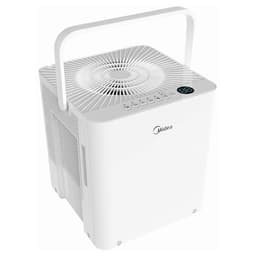
The stacking Midea Cube with a condensate pump added, which is the difference between a hose you can run and a hose you cannot.
Average draw
487 W
Computed from the ENERGY STAR certified entry for Midea MAD50PS1QWT-A, the pump variant of the same platform: 49.67 pt/day at IEF 2.01 L/kWh. The listing prints the unsuffixed MAD50PS1QWT, so the certified string carries a suffix the box does not; every Midea 50-pint revision in the certified list, pump or not, computes to 487-490 W, so neither the suffix nor the pump moves the number meaningfully. The pump itself only runs in bursts.
What is good
- Pump means the destination can be higher than the machine - a laundry sink, a window, a stack
- Identical DOE capacity and IEF to the non-pump Cube, so the pump costs you nothing in efficiency
- The split body still works, so you can also run it on gravity and keep the pump as the backup
- Certified 49.67 pt/day, an honest 50-pint rating
What is not
- Costs more than the identical machine without the pump
- A pump is one more thing that can fail, and when it does the unit stops rather than overflows
- No published wattage from Midea - the figure above is computed
Who it is for
Anyone whose drain is above the floor. That is most finished basements and nearly every crawl space.
Skip it if
Skip it if you already have a floor drain within hose reach and below the machine. You would be paying for a pump you will never switch on.
hOmeLabs
hOmeLabs 32 Pint Dehumidifier
Best for: A bedroom that is damp but not wet
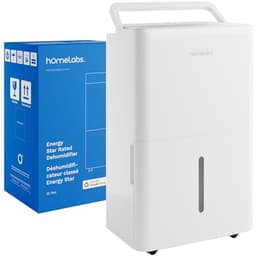
The one hOmeLabs unit with a named entry in the ENERGY STAR list, so it is the one where the running cost is a published figure rather than a class estimate.
Average draw
318 W
Computed from the ENERGY STAR certified entry hOmeLabs HME0089: 32.46 pt/day at IEF 2.01 L/kWh. This is the only hOmeLabs capacity in this registry with a named certified entry, which is why it is the only one carrying a number rather than a band.
What is good
- 318 W against the 50-pint class median of 488 W - about 35% less to run, hour for hour
- Named in the ENERGY STAR certified list, so its IEF is public
- Quiet enough for a bedroom in a way that a 50-pint compressor generally is not
- Wi-Fi and auto shut-off at a small-unit price
What is not
- 32 DOE pints is genuinely less water than 50 - undersizing a wet basement costs more than the machine saved
- Gravity drainage only
- 4,500 sq ft coverage for 32 pints is another claim to ignore
Who it is for
A bedroom, a home office, or a small basement that is humid rather than actively wet.
Skip it if
Skip it if the floor is ever damp to the touch or the walls sweat. That is a 50-pint problem, and a 32-pint machine will run continuously and still lose.
Waykar
Waykar 80 Pint ENERGY STAR Dehumidifier
Best for: A large open basement or a shop floor
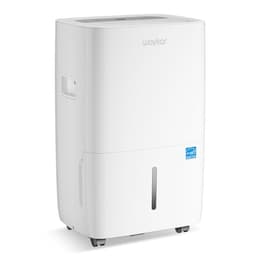
Sold on an 80-pint headline that is a saturation figure; the DOE rating behind it is in the same 50-pint class as everything else on this page.
Average draw
Not published
No published wattage. Waykar's certified 50-pint entries - JD026CE-150, CHWA150A/B/E, CTH150A/B and the YD-150 family - compute to between 443 W and 488 W. The identity of the exact certified model behind this listing is not stated, so the band stands in for a number.
What is good
- Sets to 30% RH, lower than most units will go
- 90-degree auto swing louvre, which genuinely helps in a long open basement
- Continuous drainage support and a larger tank than Waykar's smaller units
- Auto defrost for cold running
What is not
- The 80-pint headline is not a DOE rating and should not be compared against one
- No published wattage and no single certified model to map to
- 5,000 sq ft is the second-highest coverage claim in this registry
Who it is for
A large, open, genuinely wet basement or shop, where air movement matters as much as extraction.
Skip it if
Skip it if you are comparing it against a 50-pint unit on the strength of the 80. They are the same class of machine - the numbers are measured differently.
AlorAir
AlorAir Sentinel HD55 Crawl Space Dehumidifier
Best for: A crawl space you cannot stand up in
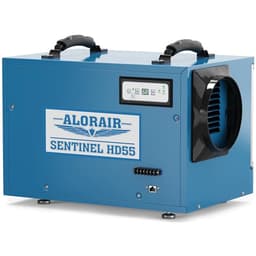
The clearest example on this site of why the number on the box is not the number that matters: sold as 113 pints, certified at 36.33.
Average draw
344 W
Computed from the ENERGY STAR certified entry ALORAIR Sentinel HD55S: 36.33 pt/day at IEF 2.08 L/kWh, 379 kWh a year. The retail listing is the HD55; the certified entry carries the S suffix. At IEF 2.08 it is more efficient than the median 50-pint portable while removing about three quarters as much water.
What is good
- Built low and flat to fit between floor joists, which no portable unit does
- Auto defrost and low-temperature operation, both essential in an unheated crawl space
- IEF 2.08 is above the 50-pint class median of 2.01 despite the smaller capacity
- No tank at all, so there is nothing to forget to empty
What is not
- The 113-pint headline is a saturation figure at 95F and 90% RH; the DOE-condition rating is 36.33
- 1,200 sq ft coverage, less than most 50-pint portables claim, for considerably more money
- Needs a drain or a condensate pump - there is no bucket fallback
Who it is for
Crawl spaces, low-clearance basements and unheated storage where a standing portable will not fit or will freeze.
Skip it if
Skip it for a normal basement. A 50-pint portable removes more water at the DOE condition for less money; you are paying for the form factor and the temperature range.
Ivation
Ivation 19 Pint Desiccant Dehumidifier
Best for: An unheated garage in winter
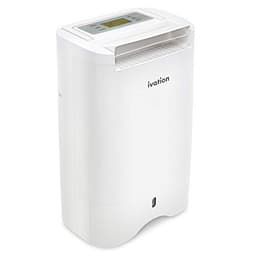
The only technology here that does not lose to the cold, which makes it the right answer in exactly the rooms where a compressor is the wrong one.
Average draw
Not published
Not published, and desiccant units are not represented in the ENERGY STAR certified dehumidifier list, which covers compressor portables and whole-home units. Desiccant machines use a resistive heater to regenerate the rotor, so their draw is roughly flat with temperature rather than falling off with it - the opposite trade to a compressor. We will not print a number for this one without a published source.
What is good
- Keeps extracting at temperatures where a compressor's coil ices and its output collapses
- No compressor, so it is quieter and lighter than any refrigerant unit here
- Continuous drain hose included
- Warm, dry exhaust, which is useful in a cold room and a nuisance in a warm one
What is not
- No published wattage, and desiccant units are generally less efficient than compressors at normal room temperature
- 410 sq ft coverage - this is a small-space machine
- It heats the room, which is the last thing a summer basement needs
Who it is for
Unheated garages, boats, sheds and crawl spaces in winter, where a compressor unit spends its time defrosting.
Skip it if
Skip it for a warm summer basement. Above roughly 65F a compressor removes more water per kWh, and the desiccant's waste heat works against you.
What running several machines actually costs
This is the part that gets left out of room-by-room advice, and it is the strongest argument against solving a whole-house problem with portables.
A 50-pint unit in the basement and two 32-pint units upstairs is 488 plus 318 plus 318 watts, or 1,124 W with everything running. On the twelve-hour schedule this site uses throughout, that is about $74 a month at the US average residential rate - the sum of $32.24, $21.00 and $21.00.
Three portables running together
(1124 W / 1000) x 12 h x $0.1834/kWh = $2.47 per day
1.124
kWh per hour
$75.30
per month, 12 h/day
$150.60
per month, 24 h/day
Rate is the US residential average of 18.34 cents/kWh from the EIA Electric Power Monthly, June 2026. Yours will differ - use the calculator.
For comparison, a certified 65-pint whole-home unit draws about 545 W and covers the conditioned volume through the existing ductwork - roughly half the running cost of three portables, for more capacity. Certified whole-home units run at IEF 2.22 to 3.26 against the 50-pint portable class median of 2.01, which is a genuine efficiency advantage rather than a marketing one.
That does not automatically make ducted the right answer. It has an installed cost we will not quote because it depends entirely on your house, it requires ducted HVAC to exist already, and it is a contractor purchase rather than something you order online. But if you are contemplating three portables, the arithmetic is worth doing before you buy the first one. Whole house dehumidifiers.
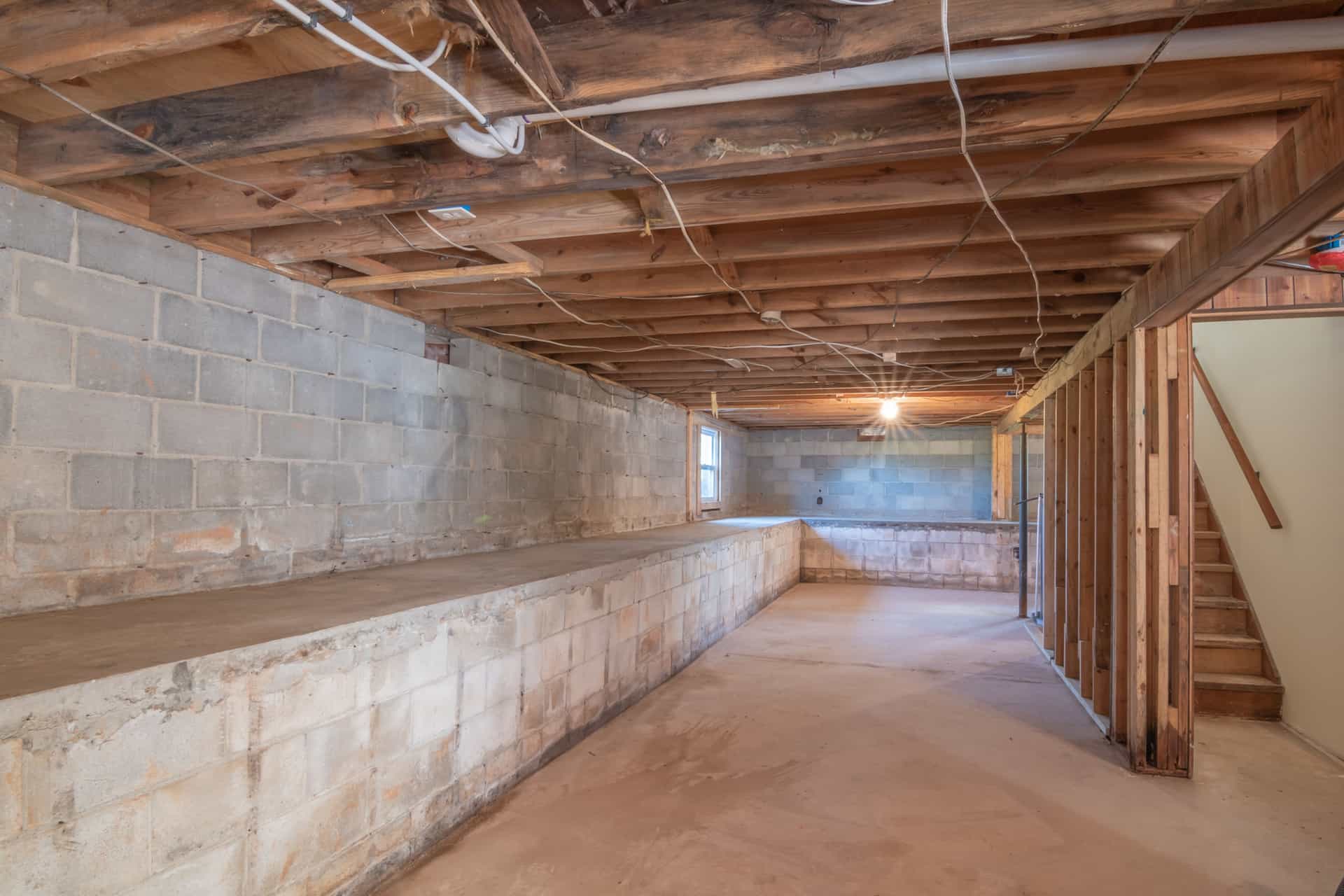
The three decisions that matter more than the brand
- 1Where the water goes. This is first because it is the only constraint that cannot be fixed after purchase. A gravity-drain unit needs somewhere downhill to send water; a crawl space usually has nowhere, and a laundry sink four feet up a wall is uphill. Get this wrong and you own a bucket you empty twice a day forever. Pump versus gravity.
- 2The DOE pint rating, not the headline. Since June 2019 portables have been tested at 65F and 60% RH rather than 80F, and ratings on identical hardware fell roughly 25 to 30 percent. Some listings still lead with a saturation figure measured at 95F and 90% RH: one crawl space unit on this site is sold as 113 pints and certified at 36.33. The pint rating, explained.
- 3Whether the room is warm. Every compressor dehumidifier - which is nearly all of them - condenses water on a cold coil, and below about 41F that coil ices faster than the defrost cycle clears it. In an unheated garage through winter, the machine that works is a desiccant. Desiccant versus compressor.
Sizing up is usually the cheaper mistake
When a room falls between two classes, the instinct is to buy the smaller machine because it costs less to buy and less per hour to run. In a damp room that instinct is expensive.
A correctly sized unit reaches its humidity target and cycles down, so it spends much of the day idle. An undersized one never reaches the target, never idles, and runs at full draw around the clock. A 32-pint unit running permanently at 318 W costs about $42 a month - more than a correctly sized 50-pint unit costs on a twelve-hour schedule - and the room is still damp. The cheaper machine turns out to be the more expensive one. 30 versus 50 pint.
What we have not done
We have not tested any of these units. There is no chamber here, no power meter and no sound meter, and we do not pretend otherwise. What this page is built from is the manufacturer documentation for every unit named, each model's certified capacity and Integrated Energy Factor pulled from the ENERGY STAR product list, and the arithmetic shown rather than asserted. Every number names its source and you can redo the sum. How we pick.
What we would skip
A single portable bought to cover a whole house
This is the most common mistake in the category and it is a physics problem, not a product problem. A portable dehumidifier conditions the air that reaches it. Closed doors, stairwells and floor separations mean most of the house's air never does. The machine hits its target in the room it stands in, cycles down, and every other room stays exactly as damp as it was.
Anything chosen on a square-footage claim
Units with identical certified capacity claim coverage figures 1.9x apart in our registry - the same 50 DOE pints sold as 4,000 sq ft by one brand and 7,500 by another. There is no test procedure behind any of those numbers. Size from the pint rating and the measured humidity instead.
A thermoelectric mini for any room you actually live in
The small silent units sold for closets remove on the order of a pint a day against a 50-pint unit's fifty. In a wardrobe or a gun safe that is the right machine. In a bedroom or a basement it is a decoration.
How we picked
- Every unit here is a real, currently-listed product, checked against its manufacturer listing.
- Capacity is the post-2019 DOE rating where a certified entry exists, never a saturation headline.
- Average draw is computed from the model's certified capacity and Integrated Energy Factor, or given as the class band where no named entry exists. Where nothing is published we say so.
- Chosen to cover the distinct jobs a house contains, not ranked against one another - they are not competitors.
- Not tested by us. Every figure is quoted or computed, with the source named.
We did not test these units. The full criteria and their weighting are on the methodology page.
FAQ
Questions
Can one dehumidifier work for a whole house?
How many dehumidifiers do I need for my house?
What size dehumidifier do I need for a 2,000 sq ft house?
Where should I put a dehumidifier in a two-story house?
How much does it cost to run dehumidifiers in a whole house?
Sources
Sources
- ENERGY STAR Certified Dehumidifiers product list - 527 certified portable models and 24 whole-home models with per-model DOE capacity and IEF (retrieved 2026-09-01)
- ENERGY STAR - Dehumidifier Testing and Capacity: the 2019 change to a 65F test condition
- US EPA, Mold Course Chapter 2 - the 30 to 50 percent recommended indoor band
- EIA Electric Power Monthly, Table 5.6.A, June 2026 - the electricity rate used
Read next
- The best dehumidifiers for a basementFive basement units ranked on drainage first, with computed running costs and a unit we would not buy.
- Whole house dehumidifiersIEF 2.22 to 3.26 against a portable's 2.01, and 52 to 172 pints - but sold through contractors, not online.
- Dehumidifier capacity chartCapacity class, pre-2020 equivalent, median watts and monthly cost, in one sourced reference table.
- The square footage on the box is not a specificationIdentical certified capacity, coverage claims 1.9x apart. What the number is, and what to size from instead.
- Dehumidifier running cost calculatorYour own rate, your own hours, and every default value shown on screen with its source.