Sizing / Guide
Sizing a dehumidifier for a large basement
Portable capacity tops out at the 50-pint class, so a genuinely large basement is not a bigger-machine problem. It is a question about how many separate volumes of air you actually have.
#adThis page contains affiliate links. We earn a commission on qualifying purchases, at no cost to you, and it never changes a ranking. Full disclosure.
The short answer
For a large open basement, one 50-pint unit with continuous drainage handles most of them - the DOE class tops out there for portables. What decides it is not floor area but whether the space is one connected volume: partition walls and closed doors create separate air volumes that a single machine never reaches, and those need their own unit rather than a bigger one.
Stop thinking in square feet
Every listing in this category invites you to match a square footage to a machine, and it is the wrong model of the problem for two reasons.
The first is that the numbers are not real. Units with identical certified capacity claim coverage figures 1.9x apart in our registry - the same 50 DOE pints sold as 4,000 square feet by one brand and 7,500 by another. There is no test procedure behind any of them. Coverage claims explained.
The second is that floor area does not describe the job. A 1,200 square foot basement that is genuinely wet needs more machine than a 2,000 square foot one that reads 62 percent. What the machine has to do is remove water at the rate the space produces it, and that rate depends on dampness, ground contact and ventilation - not on how far the walls are apart.
The measurement that does describe it
| Measured RH, below grade | Space | Class |
|---|---|---|
| Under 60% | Any | You may not need a machine at all. Watch it through the most humid month |
| 60-65% | One open volume, up to about 1,500 sq ft | 30-32 pint at about 318 W |
| 60-68% | One open volume, 1,500 sq ft and up | 50 pint at about 488 W - the default answer |
| Over 68%, or visible moisture | One open volume, any size | 50 pint, plumbed, plus find the water source |
| Any | Two or more closed-off areas | A unit per area. This is the real answer for most large basements |
Take readings in each part of the basement over three or four days at the same time of day. A single reading at the bottom of the stairs describes the bottom of the stairs.
Note what the last row does. Once a basement is partitioned - a laundry room, a storage room, a finished area behind a door - you no longer have a large basement. You have several small ones that happen to share a slab, and the sizing question resets for each of them.
Why a bigger portable is not available
This surprises people who expect the answer to a big room to be a big machine. Since the DOE moved the test condition to 65F and 60 percent relative humidity in June 2019, the largest household portable class is 50 pints a day. Ratings fell roughly 25 to 30 percent on physically unchanged hardware, which is why the machine that used to be labeled 70-pint is now labeled 50.
Listings sold as 80, 120 or 150 pints are quoting a saturation figure measured at 95F and 90 percent relative humidity - a condition no US basement reaches. One unit on this site is sold as 113 pints and certified at 36.33. So when you compare an 80-pint headline against a 50-pint rating you are comparing two different measurements, and on a common scale they are usually the same class. The pint rating, explained.
One 50-pint unit, or two smaller ones?
The question people actually want answered. Here is the arithmetic, honestly:
| One 50-pint | Two 30-32 pint | |
|---|---|---|
| Combined DOE capacity | 50 pt/day | About 64 pt/day |
| Combined draw | 488 W | 636 W |
| Running cost, 12 h/day | About $32 a month | About $42 a month |
| Purchase cost | One machine | Two machines |
| Reaches two separate rooms | No | Yes - and this is the only reason to do it |
| Air distribution in one open space | Better - one bigger fan | Two small fans, two corners |
Draw figures computed from the ENERGY STAR certified list: the 50-pint class median is 488 W, the 30-32 pint class about 318 W. Cost at the US average residential rate of 18.34 cents per kWh.
So in one open volume, a single 50-pint unit wins on every axis that matters - less power, less money, one machine to maintain, better air movement. Two units only make sense when there are genuinely two volumes.
That is the whole decision, and it is decided by your floor plan rather than by your square footage. 30 versus 50 pint.
Air distribution, which nobody puts on a box
A dehumidifier can only remove water from air that physically passes through it. In a long open basement with the machine in one corner, the far end is drying only as fast as the air circulates - and below grade, with no HVAC supply and nothing driving movement, that can be slow.
- Put the unit centrally if you can, rather than in the corner where the drain happens to be. A slightly longer hose run is worth more than a slightly shorter one in the wrong place.
- A cheap box fan aimed down the length of the room does more for a large basement than 20 extra pints of capacity. This is the highest-value ten dollars in the category.
- Leave interior doors open wherever you can. Every closed door is a separate air volume and a separate sizing problem.
- Do not block the intake or exhaust. A machine pushed against a wall or boxed behind storage re-breathes its own air and, on some units, trips its overload protection.
Drainage matters more as the space gets bigger
A 50-pint unit at full rate fills a 1.7 gallon bucket in roughly six hours. In a large damp basement that means a machine that spends most of its life switched off with a full tank while the humidity climbs back - which is the single most common reason a correctly sized unit appears not to work.
Plumb it. A gravity hose to a floor drain or a sump costs nothing to run and has nothing to fail; if the only drain is above the machine, a pump model is not a luxury but a requirement. Drain hose picks, pump versus gravity.
Quick picks
| # | Product | Best for | Draw | Price |
|---|---|---|---|---|
| 1 |  Midea Cube 50 Pint DehumidifierThe only unit here that solves the real basement problem, which is not capacity but where the water goes when you are not standing next to it. Midea Cube 50 Pint DehumidifierThe only unit here that solves the real basement problem, which is not capacity but where the water goes when you are not standing next to it. | A basement you visit once a month | 487 W | $303.56View on Amazon #ad Price as of September 14, 2026. How we are funded |
| 2 |  Waykar 80 Pint ENERGY STAR DehumidifierSold on an 80-pint headline that is a saturation figure; the DOE rating behind it is in the same 50-pint class as everything else on this page. Waykar 80 Pint ENERGY STAR DehumidifierSold on an 80-pint headline that is a saturation figure; the DOE rating behind it is in the same 50-pint class as everything else on this page. | A large open basement or a shop floor | Not published | |
| 3 | 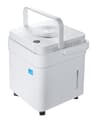 Midea Cube 50 Pint Dehumidifier with PumpSame machine as the Cube above with a condensate pump added, which is the difference between a hose you can run and a hose you cannot. Midea Cube 50 Pint Dehumidifier with PumpSame machine as the Cube above with a condensate pump added, which is the difference between a hose you can run and a hose you cannot. | A basement whose only drain is upstairs | 487 W | |
| 4 |  AlorAir Sentinel HDi65S Crawl Space Dehumidifier with PumpA low-clearance unit with the condensate pump built in, which is the only sane configuration for a space whose floor is the lowest point on the property. AlorAir Sentinel HDi65S Crawl Space Dehumidifier with PumpA low-clearance unit with the condensate pump built in, which is the only sane configuration for a space whose floor is the lowest point on the property. | A crawl space with nowhere for water to go | Not published | |
| 5 |  hOmeLabs 50 Pint DehumidifierA capable 50-pint machine attached to the least plausible coverage claim on this page, and the gap between those two facts is worth understanding before you buy anything in this category. hOmeLabs 50 Pint DehumidifierA capable 50-pint machine attached to the least plausible coverage claim on this page, and the gap between those two facts is worth understanding before you buy anything in this category. | Reading a coverage claim critically | Not published | $269.99View on Amazon #ad Price as of September 14, 2026. How we are funded |
Midea
Midea Cube 50 Pint Dehumidifier
Best for: A basement you visit once a month
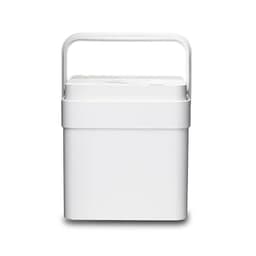
The only unit here that solves the real basement problem, which is not capacity but where the water goes when you are not standing next to it.
Average draw
487 W
Computed from the ENERGY STAR certified entry for Midea MAD50S1QWT-A, the 50 pt / 4,500 sq ft Cube without a pump: 49.67 pt/day at IEF 2.01 L/kWh. Midea's own US product page confirms MAD50S1QWT-A is this configuration. Midea publishes no wattage on the Amazon listing or on that page.
What is good
- The body separates, so the tank half can sit lower than the compressor half and the hose gets a genuine downhill run
- Certified at 49.67 pt/day, which is a real 50-pint machine rather than a saturation number
- IEF 2.01 L/kWh puts it exactly on the median for the 50-pint class - neither a bargain nor a penalty
- Wi-Fi that tells you it has stopped, which is the only smart feature that matters in a basement
What is not
- No pump, so the drain has to run downhill the whole way
- Midea publishes no wattage anywhere, so the 487 W above is computed rather than quoted
- The 4,500 sq ft coverage claim is marketing, not a spec - see the sizing guide
Who it is for
Someone with a floor drain, a sump, or a window well lower than the machine, who wants to set it once and stop thinking about it.
Skip it if
Skip it if the only drain in the room is higher than the unit. Without a pump, gravity is the entire drainage system, and no setting fixes an uphill hose.
Waykar
Waykar 80 Pint ENERGY STAR Dehumidifier
Best for: A large open basement or a shop floor
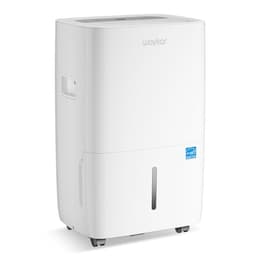
Sold on an 80-pint headline that is a saturation figure; the DOE rating behind it is in the same 50-pint class as everything else on this page.
Average draw
Not published
No published wattage. Waykar's certified 50-pint entries - JD026CE-150, CHWA150A/B/E, CTH150A/B and the YD-150 family - compute to between 443 W and 488 W. The identity of the exact certified model behind this listing is not stated, so the band stands in for a number.
What is good
- Sets to 30% RH, lower than most units will go
- 90-degree auto swing louvre, which genuinely helps in a long open basement
- Continuous drainage support and a larger tank than Waykar's smaller units
- Auto defrost for cold running
What is not
- The 80-pint headline is not a DOE rating and should not be compared against one
- No published wattage and no single certified model to map to
- 5,000 sq ft is the second-highest coverage claim in this registry
Who it is for
A large, open, genuinely wet basement or shop, where air movement matters as much as extraction.
Skip it if
Skip it if you are comparing it against a 50-pint unit on the strength of the 80. They are the same class of machine - the numbers are measured differently.
Midea
Midea Cube 50 Pint Dehumidifier with Pump
Best for: A basement whose only drain is upstairs
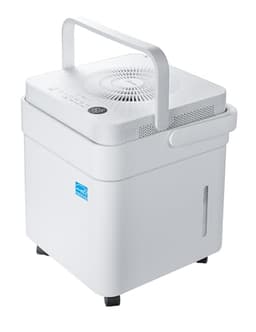
Same machine as the Cube above with a condensate pump added, which is the difference between a hose you can run and a hose you cannot.
Average draw
487 W
Computed from the ENERGY STAR certified entry for Midea MAD50PS1QWT-A, the pump variant of the same platform: 49.67 pt/day at IEF 2.01 L/kWh. The current retail revision is the -B; every Midea 50-pint Cube revision in the certified list, pump or not, computes to 487-490 W, so the pump does not move the number meaningfully. The pump itself only runs in bursts.
What is good
- Pump means the destination can be higher than the machine - a laundry sink, a window, a stack
- Identical DOE capacity and IEF to the non-pump Cube, so the pump costs you nothing in efficiency
- The split body still works, so you can also run it on gravity and keep the pump as the backup
- Certified 49.67 pt/day, an honest 50-pint rating
What is not
- Costs more than the identical machine without the pump
- A pump is one more thing that can fail, and when it does the unit stops rather than overflows
- No published wattage from Midea - the figure above is computed
Who it is for
Anyone whose drain is above the floor. That is most finished basements and nearly every crawl space.
Skip it if
Skip it if you already have a floor drain within hose reach and below the machine. You would be paying for a pump you will never switch on.
AlorAir
AlorAir Sentinel HDi65S Crawl Space Dehumidifier with Pump
Best for: A crawl space with nowhere for water to go
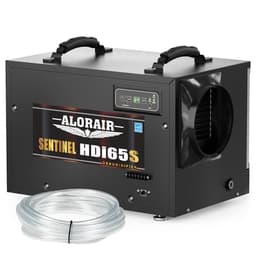
A low-clearance unit with the condensate pump built in, which is the only sane configuration for a space whose floor is the lowest point on the property.
Average draw
Not published
Not published, and the HDi65S does not appear by name in the ENERGY STAR certified list - AlorAir's certified entries are the Sentinel HD55S (344 W), the Helios D35 (243 W) and the Sentinel Pro35X (221 W). Given the HD55S computes to 344 W at 36 DOE pints, a genuinely larger AlorAir unit sits above that. We are not going to put a figure on it without a source.
What is good
- Condensate pump built in, so the discharge can go up and out rather than down and nowhere
- Compact enough for low-clearance crawl spaces and joist bays
- Auto defrost, MERV-1 filter, cETL listed
- Optional remote monitoring, which matters for a machine nobody looks at
What is not
- No published wattage and no named ENERGY STAR entry
- The 120-pint headline is a saturation number, as with every unit in this class
- Expensive relative to a portable of comparable DOE capacity
Who it is for
Encapsulated crawl spaces and sub-floor voids with no gravity drain, where the alternative is a bucket nobody will ever empty.
Skip it if
Skip it if you have a floor drain below the unit. The HD55 does the same job on gravity for less, and has a certified efficiency figure this one lacks.
hOmeLabs
hOmeLabs 50 Pint Dehumidifier
Best for: Reading a coverage claim critically
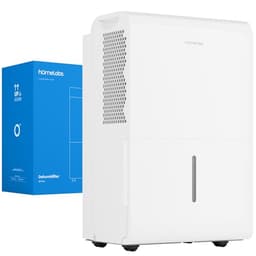
A capable 50-pint machine attached to the least plausible coverage claim on this page, and the gap between those two facts is worth understanding before you buy anything in this category.
Average draw
Not published
hOmeLabs publishes no wattage and has no 50-pint entry in the ENERGY STAR certified list - its certified models are the HME0088 at 24.48 pt/day (276 W) and the HME0089 at 32.46 pt/day (318 W). For a 50-pint compressor unit the certified class band is 443-490 W with a median of 488 W.
What is good
- States both numbers - 50 pints at the DOE condition and 120 at saturation - instead of quietly using the bigger one
- Wi-Fi control at a price below the Midea Cube
- Auto shut-off and a straightforward continuous-drain port
- Widely sold, so replacement filters are easy
What is not
- A 7,000 sq ft coverage claim for a 50-pint machine is roughly 50% higher than any comparable unit claims for the same capacity
- Not in the ENERGY STAR certified list at this capacity
- No published wattage
Who it is for
A budget-conscious buyer who understands that the coverage number is marketing and the pint number is the specification.
Skip it if
Skip it if you were buying it because of the 7,000 sq ft figure. Size from the room and the dampness, not from the largest number on the box - the sizing guide explains why.
What a large basement costs to hold dry
One 50-pint unit, twelve hours a day
(488 W / 1000) x 12 h x $0.1834/kWh = $1.07 per day
0.488
kWh per hour
$32.69
per month, 12 h/day
$65.38
per month, 24 h/day
Rate is the US residential average of 18.34 cents/kWh from the EIA Electric Power Monthly, June 2026. Yours will differ - use the calculator.
Two things move that more than the machine does. Your electricity rate, which runs from 13.11 cents in Nevada to 52.72 cents in Hawaii; and whether the unit is correctly sized, because an undersized one never reaches its target, never idles and draws full power around the clock. Work out yours.
What we did not do
We have not measured a basement, tested air distribution or run any of these units. Every capacity and wattage above is quoted from the manufacturer or computed from the ENERGY STAR certified list with the arithmetic shown, and every figure names its source. How we work.
FAQ
Questions
What size dehumidifier do I need for a large basement?
Is one big dehumidifier better than two small ones?
Do I need a 70 pint dehumidifier for a 2,000 sq ft basement?
Why is one end of my basement still damp?
How many square feet will a 50 pint dehumidifier cover?
Sources
Sources
- ENERGY STAR Certified Dehumidifiers product list - class capacities and IEF used for the 30-pint and 50-pint figures (retrieved 2026-09-01)
- ENERGY STAR - Dehumidifier Testing and Capacity: the 2019 move to a 65F / 60% RH test condition
- EIA Electric Power Monthly, Table 5.6.A, June 2026 - the electricity rate used
Read next
- What size dehumidifier do I need?A four-step method that uses measured humidity instead of the square-footage claim on the box.
- The square footage on the box is not a specificationIdentical certified capacity, coverage claims 1.9x apart. What the number is, and what to size from instead.
- The best dehumidifiers for a basementFive basement units ranked on drainage first, with computed running costs and a unit we would not buy.
- 30-pint versus 50-pint170 watts and $11 a month apart, with one failure mode that makes the cheaper machine cost more.
- Whole house dehumidifiersIEF 2.22 to 3.26 against a portable's 2.01, and 52 to 172 pints - but sold through contractors, not online.