Best / Roundup
The best budget dehumidifiers
In this category the purchase price is the smaller number. A 50-pint unit costs about $161 in electricity over a five-month season, which is why the cheapest machine on the shelf is routinely the most expensive one to own.
#adThis page contains affiliate links. We earn a commission on qualifying purchases, at no cost to you, and it never changes a ranking. Full disclosure.

The short answer
The best budget dehumidifier is the smallest one that is still big enough for the room. Purchase price differences across this category are usually smaller than the electricity difference over a single damp season - a 50-pint unit averages 488 watts and costs about $32 a month at twelve hours a day - so a cheap machine that runs constantly because it is undersized is the most expensive option available.
The number that decides whether a cheap machine was cheap
Almost every buying guide in this category compares sticker prices and stops. That works for a toaster. It does not work for an appliance that runs for months at a time, because the running cost is the same order of magnitude as the purchase price - and it recurs every year.
A 50-pint unit, twelve hours a day
(488 W / 1000) x 12 h x $0.1834/kWh = $1.07 per day
0.488
kWh per hour
$32.69
per month, 12 h/day
$65.38
per month, 24 h/day
Rate is the US residential average of 18.34 cents/kWh from the EIA Electric Power Monthly, June 2026. Yours will differ - use the calculator.
$161
Electricity for one 50-pint unit over a five-month damp season
488 W at twelve hours a day, at the US average residential rate of 18.34 cents per kWh (EIA Electric Power Monthly, Table 5.6.A, June 2026). A 30 to 32-pint unit at 318 W is about $105 over the same season. Both recur every year the machine is in service.
Set that beside the price spread between a budget unit and a mid-range one in the same capacity class, and the conclusion is uncomfortable for anyone shopping on sticker alone: the electricity is usually the bigger number, and the class you buy moves it far more than the brand does.
How we judged value on this page
| Criterion | Why it ranks where it does |
|---|---|
| Correct size for the room | First by a distance. Getting this wrong converts a cheap machine into a permanently running one at full draw, which costs more per month than the correctly sized larger unit it replaced |
| Computed average draw | Second. Within a class the spread is small, but between classes it is large: 258 W for a 20-22 pint, 318 W for a 30-32, 488 W for a 50 |
| Drainage | Third, and it is a value criterion rather than a convenience one. A machine you stop emptying is a machine you stop using |
| ENERGY STAR certification | Fourth. Worth about 20 percent on the energy bill by ENERGY STAR's own figure, which on a season is real money |
| Purchase price | Fifth. It is the number everyone starts with and the one that matters least over the life of the machine |
| Coverage claim | Not used at all. It varies 1.9x for identical certified capacity and has no test procedure behind it |
Class wattages computed from the ENERGY STAR certified list. How the arithmetic works.
What each price bracket actually buys
People search this category by bracket - under fifty, under a hundred, under two hundred, under three hundred - so it is worth saying plainly what kind of machine lives in each. We are describing classes rather than quoting any product's price; the live price for every unit on this page is in its buy button and nowhere else.
- The sub-$50 bracket is thermoelectric. No compressor, no refrigerant, and roughly a pint a day. That is the correct machine for a wardrobe, a gun safe or a single cabinet, and it is not a dehumidifier in the sense that a basement needs one. Closets.
- The sub-$100 bracket is mostly still thermoelectric, with slightly bigger tanks. Same physics, same scale.
- The sub-$200 bracket is where real refrigeration starts - small compressor units in the 8 to 22-pint range for a single room. This is the first bracket where you are buying a machine that can actually change a room's humidity.
- The sub-$300 bracket is where the 30-pint and 50-pint classes live, and where nearly everyone shopping for a basement should be looking. It is also where the running-cost difference between classes starts to dominate the purchase price difference.
- Above that you are buying a form factor or a pump - crawl space units, commercial cases, built-in condensate pumps - rather than more water removal.

Why the cheap units are often the same machines
This is the most useful thing we can tell a budget buyer, and it is visible in the public certification data rather than being an opinion.
Portable dehumidifiers are commodity refrigeration - a compressor, a coil, a fan and a humidistat - built by a small number of factories and sold under many labels. In the ENERGY STAR certified list, Waykar, KESNOS, YAUFEY and Fehom appear as a single joint entry against the same model numbers, because they are the same machines. Across the entire 164-model certified 50-pint class the Integrated Energy Factor runs from 2.01 to 2.20 - a spread of about ten percent.
So the honest budget advice is not to hunt for a secret bargain brand. It is to pick the right capacity class, take a certified unit, make sure you can plumb it, and stop paying attention to the badge. ENERGY STAR and IEF.
Quick picks
| # | Product | Best for | Draw | Price |
|---|---|---|---|---|
| 1 |  hOmeLabs 32 Pint DehumidifierThe one hOmeLabs unit with a named entry in the ENERGY STAR list, so it is the one where the running cost is a published figure rather than a class estimate. hOmeLabs 32 Pint DehumidifierThe one hOmeLabs unit with a named entry in the ENERGY STAR list, so it is the one where the running cost is a published figure rather than a class estimate. | A bedroom that is damp but not wet | 318 W | $234.99View on Amazon #ad Price as of September 14, 2026. How we are funded |
| 2 |  Waykar 80 Pint ENERGY STAR DehumidifierSold on an 80-pint headline that is a saturation figure; the DOE rating behind it is in the same 50-pint class as everything else on this page. Waykar 80 Pint ENERGY STAR DehumidifierSold on an 80-pint headline that is a saturation figure; the DOE rating behind it is in the same 50-pint class as everything else on this page. | A large open basement or a shop floor | Not published | |
| 3 | 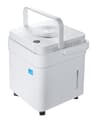 Midea Cube 50 Pint Dehumidifier with PumpSame machine as the Cube above with a condensate pump added, which is the difference between a hose you can run and a hose you cannot. Midea Cube 50 Pint Dehumidifier with PumpSame machine as the Cube above with a condensate pump added, which is the difference between a hose you can run and a hose you cannot. | A basement whose only drain is upstairs | 487 W | |
| 4 |  hOmeLabs 8 Pint DehumidifierA real compressor unit at a size where most competitors sell thermoelectric toys, which makes it the smallest machine here that actually removes meaningful water. hOmeLabs 8 Pint DehumidifierA real compressor unit at a size where most competitors sell thermoelectric toys, which makes it the smallest machine here that actually removes meaningful water. | A closet, a boat, or a single small room | Not published | |
| 5 |  Pro Breeze Electric Mini DehumidifierA thermoelectric unit that removes about one pint a day, which is roughly one fiftieth of a 50-pint machine and needs saying out loud before anyone buys one for a basement. Pro Breeze Electric Mini DehumidifierA thermoelectric unit that removes about one pint a day, which is roughly one fiftieth of a 50-pint machine and needs saying out loud before anyone buys one for a basement. | A wardrobe, and honestly not much more | Not published | $42.99View on Amazon #ad Price as of September 14, 2026. How we are funded |
hOmeLabs
hOmeLabs 32 Pint Dehumidifier
Best for: A bedroom that is damp but not wet
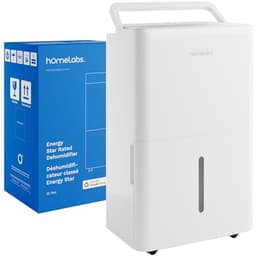
The one hOmeLabs unit with a named entry in the ENERGY STAR list, so it is the one where the running cost is a published figure rather than a class estimate.
Average draw
318 W
Computed from the ENERGY STAR certified entry hOmeLabs HME0089: 32.46 pt/day at IEF 2.01 L/kWh. This is the only hOmeLabs capacity in this registry with a named certified entry, which is why it is the only one carrying a number rather than a band.
What is good
- 318 W against the 50-pint class median of 488 W - about 35% less to run, hour for hour
- Named in the ENERGY STAR certified list, so its IEF is public
- Quiet enough for a bedroom in a way that a 50-pint compressor generally is not
- Wi-Fi and auto shut-off at a small-unit price
What is not
- 32 DOE pints is genuinely less water than 50 - undersizing a wet basement costs more than the machine saved
- Gravity drainage only
- 4,500 sq ft coverage for 32 pints is another claim to ignore
Who it is for
A bedroom, a home office, or a small basement that is humid rather than actively wet.
Skip it if
Skip it if the floor is ever damp to the touch or the walls sweat. That is a 50-pint problem, and a 32-pint machine will run continuously and still lose.
Waykar
Waykar 80 Pint ENERGY STAR Dehumidifier
Best for: A large open basement or a shop floor
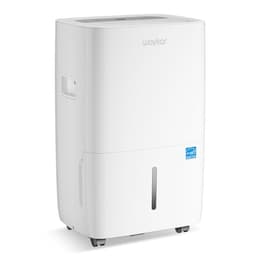
Sold on an 80-pint headline that is a saturation figure; the DOE rating behind it is in the same 50-pint class as everything else on this page.
Average draw
Not published
No published wattage. Waykar's certified 50-pint entries - JD026CE-150, CHWA150A/B/E, CTH150A/B and the YD-150 family - compute to between 443 W and 488 W. The identity of the exact certified model behind this listing is not stated, so the band stands in for a number.
What is good
- Sets to 30% RH, lower than most units will go
- 90-degree auto swing louvre, which genuinely helps in a long open basement
- Continuous drainage support and a larger tank than Waykar's smaller units
- Auto defrost for cold running
What is not
- The 80-pint headline is not a DOE rating and should not be compared against one
- No published wattage and no single certified model to map to
- 5,000 sq ft is the second-highest coverage claim in this registry
Who it is for
A large, open, genuinely wet basement or shop, where air movement matters as much as extraction.
Skip it if
Skip it if you are comparing it against a 50-pint unit on the strength of the 80. They are the same class of machine - the numbers are measured differently.
Midea
Midea Cube 50 Pint Dehumidifier with Pump
Best for: A basement whose only drain is upstairs
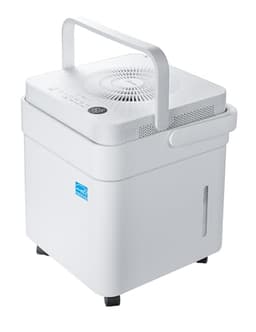
Same machine as the Cube above with a condensate pump added, which is the difference between a hose you can run and a hose you cannot.
Average draw
487 W
Computed from the ENERGY STAR certified entry for Midea MAD50PS1QWT-A, the pump variant of the same platform: 49.67 pt/day at IEF 2.01 L/kWh. The current retail revision is the -B; every Midea 50-pint Cube revision in the certified list, pump or not, computes to 487-490 W, so the pump does not move the number meaningfully. The pump itself only runs in bursts.
What is good
- Pump means the destination can be higher than the machine - a laundry sink, a window, a stack
- Identical DOE capacity and IEF to the non-pump Cube, so the pump costs you nothing in efficiency
- The split body still works, so you can also run it on gravity and keep the pump as the backup
- Certified 49.67 pt/day, an honest 50-pint rating
What is not
- Costs more than the identical machine without the pump
- A pump is one more thing that can fail, and when it does the unit stops rather than overflows
- No published wattage from Midea - the figure above is computed
Who it is for
Anyone whose drain is above the floor. That is most finished basements and nearly every crawl space.
Skip it if
Skip it if you already have a floor drain within hose reach and below the machine. You would be paying for a pump you will never switch on.
hOmeLabs
hOmeLabs 8 Pint Dehumidifier
Best for: A closet, a boat, or a single small room
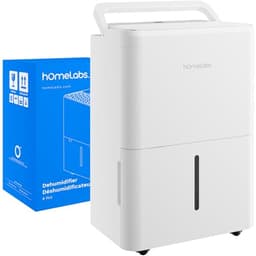
A real compressor unit at a size where most competitors sell thermoelectric toys, which makes it the smallest machine here that actually removes meaningful water.
Average draw
Not published
Not published. The certified 8-13 pint class runs 92-128 W with a median of 105 W across 39 models, and the median unit in that class uses 117 kWh a year.
What is good
- A compressor at 8 pints, so it keeps working where a Peltier unit stops
- Roughly a fifth of the power of a 50-pint machine
- Wi-Fi and auto shut-off, unusual at this size
- Small enough to sit in a wardrobe or a berth
What is not
- 1,800 sq ft coverage for 8 DOE pints is not a serious claim
- Bucket only - no continuous drain at this size
- Not ENERGY STAR certified, so no published IEF
Who it is for
Closets, gun safes, boat cabins, and single small rooms where a large machine is absurd.
Skip it if
Skip it for any room where you can feel the damp. Eight pints a day is a maintenance dose, not a cure.
Pro Breeze
Pro Breeze Electric Mini Dehumidifier
Best for: A wardrobe, and honestly not much more
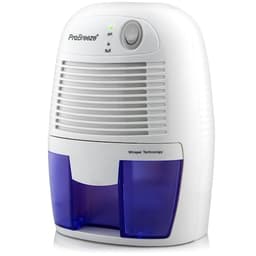
A thermoelectric unit that removes about one pint a day, which is roughly one fiftieth of a 50-pint machine and needs saying out loud before anyone buys one for a basement.
Average draw
Not published
Not published, and thermoelectric units are outside the ENERGY STAR dehumidifier program entirely. Peltier modules of this size draw far less than any compressor here - but less power and less water are the same fact, not two selling points. It removes 17 oz a day, which is 1.06 pints.
What is good
- Genuinely silent - there is no compressor to cycle on and off next to your head
- Small and light enough to sit on a shelf inside a wardrobe
- Auto shut-off when the 17 oz tank fills
- Cheap enough to buy two for two closets
What is not
- About one pint a day. A 50-pint unit removes fifty times as much
- Stops working below 41F, which rules out the unheated spaces people usually buy it for
- No drain option - the tank is the only outlet
Who it is for
A wardrobe, a gun safe, a bathroom cabinet, or a single small enclosed space with a musty smell.
Skip it if
Skip it for any room. This is the single most common mis-purchase in the category: it is not a small dehumidifier, it is a different class of device, and no number of them adds up to a basement machine.
The false economy, with the arithmetic
Worth walking through, because it is the mistake the word budget causes most often. Someone with a damp basement buys a 30-pint unit instead of a 50-pint one to save on the purchase.
| Correctly sized 50-pint | Undersized 30-pint | |
|---|---|---|
| Average draw | 488 W | 318 W |
| Hours it actually runs | About 12 a day - it reaches target and cycles off | 24 - it never reaches target |
| Cost per month | About $32 | About $42 |
| Cost over a five-month season | About $161 | About $210 |
| Is the basement dry? | Yes | No |
Computed at the US average residential rate of 18.34 cents per kWh. The smaller machine costs more per month, costs more per season, and does not solve the problem it was bought for. 30 versus 50 pint.
Reliability, and why we will not rank on it
People searching for a budget dehumidifier very often search for a reliable or long-lasting one in the same session, and it is a fair instinct: a machine that fails in year two was not a bargain.
We are not going to rank these units on it. There is no published failure-rate data for this category, we have not run any of these machines, and we have no returns pile to count. Any site presenting a durability ranking for portable dehumidifiers is presenting an impression as a measurement.
What we can point at are two facts that are actually published. The first is the warranty: most portables in this category carry one year, and AlorAir publishes six years on its crawl space units - a real, contractual difference rather than a vibe. The second is that the sealed refrigeration system is the part that ends a machine's life, it cannot be opened without recovery equipment and EPA Section 608 certification, and on a low-cost portable the economics of that repair almost never work. That makes the warranty term the most concrete durability signal available to a buyer. Frigidaire error codes walks through what a sealed-system fault actually means.
Where spending more is genuinely worth it
- 1A pump, if your only drain is above the machine. This is not a premium feature, it is the thing that makes the installation possible. Gravity does not climb. Pump versus gravity.
- 2A certified unit, if it will run all season. About 20 percent on the energy bill by ENERGY STAR's own figure.
- 3The larger class, if the room is genuinely wet. See the table above - it is cheaper per month, not more expensive.
- 4A desiccant machine, if the room is cold. Below about 41F a compressor unit ices and stops doing useful work, so a cheap compressor for an unheated garage is a season of paying for nothing. Desiccant versus compressor.
Where it is not
- Wi-Fi and app control. Pleasant, and on a basement unit the only genuinely useful smart feature is a notification that it has stopped.
- A higher coverage claim. No test procedure, 1.9x spread, no information. Why.
- A bigger headline pint number. An 80 or 120-pint badge on a portable is a saturation figure measured at 95F and 90 percent humidity. On the DOE scale those units usually sit in the same 50-pint class as everything else. The pint rating, explained.
- Brand, within a class. The certified data shows a ten percent efficiency spread across 164 models and four brands sharing one certification entry.
What we did not do
We have not tested any of these units, measured a power draw, or tracked a failure rate. There is no chamber here and no returns shelf. What this page is built from is each model's certified capacity and Integrated Energy Factor from the ENERGY STAR product list, the running-cost arithmetic shown rather than asserted, and the EIA's published electricity rate. Prices come from a live data layer and appear only inside the buy buttons, never in this prose. How we work.
What we would skip
The cheapest machine that is too small for the room
The single most expensive mistake in this category, and it is made by people trying to save money. An undersized unit never reaches its humidity target, so it never cycles off, so it draws full power around the clock. A 30-pint unit running permanently costs about $42 a month - more than a correctly sized 50-pint unit costs on a twelve-hour schedule - and the room stays damp. You paid less and got nothing.
A thermoelectric mini bought as a cheap room dehumidifier
These are genuinely inexpensive and they are genuinely useful, but only in an enclosed space. A mini removes on the order of one pint a day against a 50-pint unit's fifty. In a wardrobe that is the right machine; bought for a damp basement because it was the cheapest thing labeled dehumidifier, it is money thrown away.
Anything chosen on the square-footage claim because it looks like more per dollar
Coverage claims in our registry vary 1.9x for identical certified capacity - the same 50 DOE pints sold as 4,000 square feet by one brand and 7,500 by another. There is no test procedure behind any of them. Buying the biggest number per dollar means buying the boldest copywriter.
A non-certified unit, if you will run it all season
ENERGY STAR's own figure is that certified dehumidifiers are about 20 percent more efficient than non-certified ones. On a 50-pint machine that is roughly $8 a month at twelve hours a day, or about $40 over a five-month season - enough to erase most of a purchase-price saving on its own.
How we picked
- Judged on total cost over a damp season, not on the sticker: purchase price plus the electricity the machine will actually draw.
- Capacity from the post-2019 DOE rating, so the value comparison is like for like rather than headline against headline.
- Average draw computed from the model's certified capacity and Integrated Energy Factor, or the certified class band where a maker publishes neither.
- Drainage counted as value, because a machine you stop using because of the bucket cost you everything you paid.
- No reliability ranking. Nobody publishes failure-rate data for this category and we have not collected any - see the section below.
- Not tested by us. Every figure is quoted or computed, with the source named.
We did not test these units. The full criteria and their weighting are on the methodology page.
FAQ
Questions
What is the best budget dehumidifier?
How much does a cheap dehumidifier cost to run?
Is it worth paying more for an ENERGY STAR dehumidifier?
What can you get for under $100?
Which dehumidifier brand is most reliable?
Are cheap dehumidifiers all the same machine?
Sources
Sources
- ENERGY STAR Certified Dehumidifiers product list - 164 certified 50-pint models at IEF 2.01 to 2.20, the 30-32 and 20-22 pint class figures, and the joint Waykar/KESNOS/YAUFEY/Fehom entry (retrieved 2026-09-01)
- ENERGY STAR - Dehumidifiers: certified models are about 20 percent more efficient than non-certified ones, and the 65F / 60% RH test condition
- EIA Electric Power Monthly, Table 5.6.A, June 2026 - the electricity rate used throughout
Read next
- Dehumidifier running cost calculatorYour own rate, your own hours, and every default value shown on screen with its source.
- 30-pint versus 50-pint170 watts and $11 a month apart, with one failure mode that makes the cheaper machine cost more.
- The most energy-efficient dehumidifiersWhat Integrated Energy Factor buys, measured across 527 certified models, and the four things that save more.
- Are dehumidifiers worth it?Worth it above 60% humidity, a waste below 50. The four cases each way, with the running cost attached.
- Running it for lessSix changes ranked by what they save, three that save nothing, and one that costs you money.