Compare / Head to head
Hisense vs Midea, 50 pint
Two certified 50-pint machines, measured under the same government test, land a quarter of a pint apart. One of them states how cold it will keep working in. That is the whole decision.
#adThis page contains affiliate links. We earn a commission on qualifying purchases, at no cost to you, and it never changes a ranking. Full disclosure.
The short answer
Buy the Hisense 50 Pint with Pump if the space is cool - it is the only one of the two that states a low-temperature floor, 38F, where most compressor units stop at 41F, and it has the pump as standard. Buy the Midea Cube 50 if the space is warm and you visit it rarely, because its split body holds a 4.2 gallon bucket and it publishes a 35-85 percent humidistat range. On capacity there is nothing between them: 49.95 certified pints against 49.67, three watts apart.
The measurements, side by side
| Hisense 50 Pint with Pump | Midea Cube 50 | |
|---|---|---|
| Certified model | ADH50KP26 | MAD50S1QWT-A |
| DOE capacity | 49.95 pt/day | 49.67 pt/day |
| Integrated Energy Factor | 2.01 L/kWh | 2.01 L/kWh |
| Average draw (computed) | 490 W | 487 W |
| Annual energy use | 526 kWh/yr | 515 kWh/yr |
| Refrigerant | HFC-32 (GWP 675, lower GWP) | HFC-32 (GWP 675, lower GWP) |
| Date certified | 6 January 2026 | 20 October 2025 |
| Certifying partner | Hisense (Guangdong) Air Conditioning Co. Ltd | GD Midea Air-Conditioning Equipment Co., Ltd. |
| Models that partner certifies | 30 | 54 |
From the ENERGY STAR Certified Dehumidifiers list, retrieved 2026-10-17. The wattage is computed from certified capacity and IEF using the formula on the methodology page. Both makers publish no wattage of their own.
A quarter of a pint a day. Three watts. Eleven kilowatt-hours a year, which is about two dollars at the US average residential rate. If you are choosing between these two on how much water they remove or what they cost to run, there is nothing to choose - and that is not a quirk of this pairing. Three quarters of the certified 50-pint class sits at exactly IEF 2.01, which is what the whole category looks like once the marketing is stripped off.
$2 a year
The difference in electricity between these two machines, at the US average rate
526 kWh/yr against 515 kWh/yr, at 18.34 cents per kWh from the EIA Electric Power Monthly, June 2026. Running either one hour more or less per day moves your bill by several times this. The calculator will do it at your rate.
So what does separate them
Temperature: Hisense states a number, Midea does not
This is the real difference, and it is the one most comparisons of these two brands never reach. Hisense's listing states operation down to 38F. The usual floor stated across this category is 41F, and below whatever that floor is a compressor coil ices faster than the defrost cycle can clear it - at which point the machine is cycling on a frozen coil rather than removing water.
Three degrees sounds like nothing. In a basement or an attached garage in spring and autumn it is the difference between a machine that works through the shoulder seasons and one that spends them defrosting. Why cold breaks a compressor dehumidifier, and what icing up actually looks like.
Midea publishes no low-temperature figure for the Cube line. That is not evidence it is worse - it is almost certainly the same 41F-class hardware as everything else - but on a page comparing two machines, a stated specification beats an unstated one.
The body: Midea's is the genuinely different one
The Cube is the only meaningfully different physical design in this class. It splits and stacks: the collection section separates, which is why its bucket is 4.2 gallons against a conventional portable's one-and-a-bit, and the unit occupies less floor when stacked. In a basement you check monthly, that is not styling - it is the difference between emptying a bucket weekly and not thinking about it.
Hisense's is a conventional portable with a lift-up handle. It is not worse; it is the shape the rest of the category is.
The pump: standard on the Hisense, a separate model on the Midea
The Hisense unit we track has the pump built in, with a quick-connect hose. Midea sells the pump as a different Cube - the MAD50PS1QWT, certified at the same 49.67 pints and the same IEF - which keeps the split body and adds a stated 16 foot drain tube on top of the oversized bucket.
Neither maker publishes what its pump can actually lift, which is the specification you buy a pump for. GE and Quilo both state 15 feet. If your drain route has real height in it, that omission should outrank brand preference on both of these. How far will the pump actually push it.
The humidistat: Midea publishes a range, Hisense does not
Midea states 35 to 85 percent. Hisense states three modes and three fan speeds but no humidity range. Only 13 of the 32 units we track publish a numeric range at all, so Midea is in the better half here - and if you are holding a room to a specific number rather than just drying it out, that matters. Where it matters most.
Quick picks
| # | Product | Best for | Draw | Price |
|---|---|---|---|---|
| 1 |  Hisense 50 Pint Dehumidifier with PumpA certified 50-pint pump unit that claims operation down to 38F - lower than the 41F most compressor units state - which is the specification that matters in a cold basement. Hisense 50 Pint Dehumidifier with PumpA certified 50-pint pump unit that claims operation down to 38F - lower than the 41F most compressor units state - which is the specification that matters in a cold basement. | A cold basement where the pump has to keep working | 490 W | $308.95View on Amazon #ad Price as of October 17, 2026. How we are funded |
| 2 | 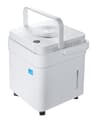 Midea Cube 50 Pint DehumidifierThe only unit here that solves the real basement problem, which is not capacity but where the water goes when you are not standing next to it. Midea Cube 50 Pint DehumidifierThe only unit here that solves the real basement problem, which is not capacity but where the water goes when you are not standing next to it. | A basement you visit once a month | 487 W | |
| 3 |  Midea Cube 50 Pint Dehumidifier with PumpThe stacking Midea Cube with a condensate pump added, which is the difference between a hose you can run and a hose you cannot. Midea Cube 50 Pint Dehumidifier with PumpThe stacking Midea Cube with a condensate pump added, which is the difference between a hose you can run and a hose you cannot. | A basement whose only drain is upstairs | 487 W | $248.89View on Amazon #ad Price as of October 17, 2026. How we are funded |
Hisense
Hisense 50 Pint Dehumidifier with Pump
Best for: A cold basement where the pump has to keep working
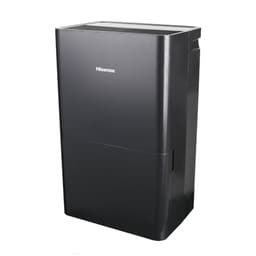
A certified 50-pint pump unit that claims operation down to 38F - lower than the 41F most compressor units state - which is the specification that matters in a cold basement.
Average draw
490 W
Computed from the ENERGY STAR certified entry for Hisense ADH50KP26 - the same model number as this listing: 49.95 pt/day at IEF 2.01 L/kWh. Hisense publishes no wattage on the listing.
What is good
- Claims operation down to 38F, three degrees below the usual compressor floor
- Exact certified model match, so the 490 W figure describes this machine
- Quick-connect hose included for the pump
- Three operating modes and three fan speeds, including an auto fan setting
What is not
- No pump lift, hose length or bucket capacity stated on the listing
- No Wi-Fi or app mentioned
- Below about 38F it is still a compressor unit, and a desiccant machine is the right tool
Who it is for
Someone with a cool basement or garage and a drain above the machine, where a few degrees of extra low-temperature headroom decides whether the unit keeps working in spring and autumn.
Skip it if
Skip it if your pump route is long or tall. Hisense does not state a lift, where GE and Quilo state 15 feet.
Midea
Midea Cube 50 Pint Dehumidifier
Best for: A basement you visit once a month
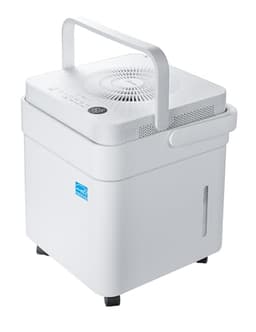
The only unit here that solves the real basement problem, which is not capacity but where the water goes when you are not standing next to it.
Average draw
487 W
Computed from the ENERGY STAR certified entry for Midea MAD50S1QWT-A, the 50 pt / 4,500 sq ft Cube without a pump: 49.67 pt/day at IEF 2.01 L/kWh. Midea's own US product page confirms MAD50S1QWT-A is this configuration. Midea publishes no wattage on the Amazon listing or on that page.
What is good
- The body separates, so the tank half can sit lower than the compressor half and the hose gets a genuine downhill run
- Certified at 49.67 pt/day, which is a real 50-pint machine rather than a saturation number
- IEF 2.01 L/kWh puts it exactly on the median for the 50-pint class - neither a bargain nor a penalty
- Wi-Fi that tells you it has stopped, which is the only smart feature that matters in a basement
What is not
- No pump, so the drain has to run downhill the whole way
- Midea publishes no wattage anywhere, so the 487 W above is computed rather than quoted
- The 4,500 sq ft coverage claim is marketing, not a spec - see the sizing guide
Who it is for
Someone with a floor drain, a sump, or a window well lower than the machine, who wants to set it once and stop thinking about it.
Skip it if
Skip it if the only drain in the room is higher than the unit. Without a pump, gravity is the entire drainage system, and no setting fixes an uphill hose.
Midea
Midea Cube 50 Pint Dehumidifier with Pump
Best for: A basement whose only drain is upstairs
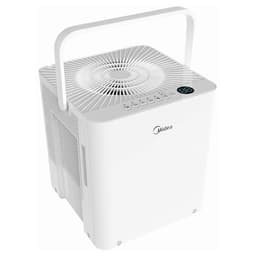
The stacking Midea Cube with a condensate pump added, which is the difference between a hose you can run and a hose you cannot.
Average draw
487 W
Computed from the ENERGY STAR certified entry for Midea MAD50PS1QWT-A, the pump variant of the same platform: 49.67 pt/day at IEF 2.01 L/kWh. The listing prints the unsuffixed MAD50PS1QWT, so the certified string carries a suffix the box does not; every Midea 50-pint revision in the certified list, pump or not, computes to 487-490 W, so neither the suffix nor the pump moves the number meaningfully. The pump itself only runs in bursts.
What is good
- Pump means the destination can be higher than the machine - a laundry sink, a window, a stack
- Identical DOE capacity and IEF to the non-pump Cube, so the pump costs you nothing in efficiency
- The split body still works, so you can also run it on gravity and keep the pump as the backup
- Certified 49.67 pt/day, an honest 50-pint rating
What is not
- Costs more than the identical machine without the pump
- A pump is one more thing that can fail, and when it does the unit stops rather than overflows
- No published wattage from Midea - the figure above is computed
Who it is for
Anyone whose drain is above the floor. That is most finished basements and nearly every crawl space.
Skip it if
Skip it if you already have a floor drain within hose reach and below the machine. You would be paying for a pump you will never switch on.
Who stands behind it
Both certify under the manufacturer's own corporate name, which is more than several heritage badges in this category manage. Midea's partner entry is GD Midea Air-Conditioning Equipment Co., Ltd. with 54 certified dehumidifier models - the second-deepest file of any partner. Hisense's is Hisense (Guangdong) Air Conditioning Co. Ltd with 30.
Both also certify other badges from the same file: Midea's partner entry covers Midea and PELONIS; Hisense's covers Hisense, Mora and fridgemaster. That is normal, and it is the single most useful thing the certified file tells you about who actually made a machine. The brand guide has the wider map.
How to decide in one question
| If your situation is... | Buy |
|---|---|
| A cool basement or garage, used through spring and autumn | Hisense - the only one of the two with a stated low-temperature floor, 38F |
| A basement you check rarely, with no drain nearby | Midea Cube - the 4.2 gallon split bucket is the largest practical advantage in the class |
| The drain is above the machine | Hisense, which has the pump as standard - or the Midea Cube pump model, which also keeps the big bucket |
| You want to hold the room at a specific humidity | Midea - it publishes a 35-85% range; Hisense publishes none |
| The drain route has real height in it | Neither, on the published evidence. Neither states a pump lift; GE and Quilo state 15 ft |
| You are choosing on capacity or running cost | Neither. A quarter of a pint and two dollars a year separate them |
What we did not do
We have not run either machine, measured extraction, or compared them in a room - and in particular we have not tested the 38F claim, which is the specification this page turns on. Every capacity, efficiency and annual energy figure here is read from the ENERGY STAR certified file under the model number each maker publishes, and every feature claim is quoted from the maker's own listing. Where neither states a figure - pump lift on both, humidistat range on the Hisense, low-temperature floor on the Midea - this page says so. How we work.
FAQ
Questions
Is Hisense or Midea better for a 50 pint dehumidifier?
Which is cheaper to run, Hisense or Midea?
Who makes Hisense dehumidifiers?
Does the Hisense really work at 38F?
Does the Midea Cube remove more water because of the big bucket?
Do either of them state how high the pump will lift?
Sources
Sources
- ENERGY STAR Certified Dehumidifiers list - Hisense ADH50KP26 at 49.95 pt/day, IEF 2.01 L/kWh, 526 kWh/yr, HFC-32, certified 2026-01-06, partner Hisense (Guangdong) Air Conditioning Co. Ltd (30 certified models); Midea MAD50S1QWT-A and MAD50PS1QWT-A at 49.67 pt/day, IEF 2.01 L/kWh, 515 kWh/yr, HFC-32, certified 2025-10-20, partner GD Midea Air-Conditioning Equipment Co., Ltd. (54 certified models) (retrieved 2026-10-17)
- Hisense 50-Pint Lift-Up Portable Dehumidifier with Built-In Pump, ADH50KP26 - Amazon.com listing stating a built-in pump with quick-connect hose, Auto/Continuous/Manual modes, 3 fan speeds, operation to 38F and a 4,500 sq ft coverage claim
- Midea Cube 50 Pint Dehumidifier, MAD50S1QWT-A - Amazon.com listing stating 50 pints, 4,500 sq ft, a 35-85% humidity range, a 4.2 gallon bucket and an included drain hose
- EIA Electric Power Monthly, Table 5.6.A, June 2026 - the residential electricity rate used
Read next
- Hisense 50 Pint with PumpCertified 49.95 pints at 490 W, rated to 38F, and a two-year warranty where most portables give one.
- Midea Cube 50 PintCertified 49.67 pt/day at 487 W, and the splitting body that solves a real drainage constraint.
- Midea vs Frigidaire, 50 pint49.67 pints against 49.71, both at IEF 2.01. The measurements tie, so here is what actually decides it.
- The best 50-pint dehumidifiersSix 50-pint units and the certified data behind them: a 443-490 W range and a coverage claim that varies 1.9x.
- The best dehumidifiers for a cold roomFour makers state a temperature floor and twenty-five do not. What each claims, and when to change technology.
- How far will the pump actually push it?Three of seven pump models state a lift. What they say, and how to plan when a maker states nothing.