Best / Roundup
The best dehumidifiers for books and paper
Every household guide tells you to keep a room under 60 percent. The federal standard for storing paper and bound volumes stops at 50. That ten-point gap is the entire reason this is a different purchase.
#adThis page contains affiliate links. We earn a commission on qualifying purchases, at no cost to you, and it never changes a ranking. Full disclosure.
The short answer
For a spare room or a home library, buy the Midea Cube 35 Pint - it publishes a 35-85 percent humidistat range, so you can actually set and hold the top of the federal band, and its 4.2 gallon split bucket is not one you empty weekly. For a storage room you rarely enter, the AlorAir Helios D35 is the better machine: gravity drain, memory restart after a power cut, and an exact certified efficiency figure. The number to hold is 50 percent, not 60.
The number, and why it is not 60 percent
Nearly every household humidity guide, this site's included, points at the EPA's advice to keep indoor air below 60 percent relative humidity. That is sound advice for a house. It is not the number for paper.
The US National Archives publishes the band it holds its own collections at, by material class. For "Paper: Textual records including bound volumes" in long-term storage, the specification is 50 to 65F and 30 to 50 percent relative humidity. The same table gives that same 30-50 percent band to "most modern books" among artifact holdings, and loosens it only for rooms people actually work in, where it allows 50 to 75F and 30 to 55 percent.
30-50%
The federal relative-humidity band for paper records and bound volumes
From NARA 1571 Supplement 2, Temperature, Relative Humidity and Air Pollutant Tables, effective 17 January 2023, Table 1, Textual Holdings Storage, Low Sensitivity. The accompanying temperature band is 50-65F. Holdings work rooms - the realistic analogue of a room in a house - are allowed 50-75F and 30-55%.
There is a second federal number worth knowing, and it is the one that explains why a book room goes wrong in August rather than in January. The Code of Federal Regulations, setting out how agencies must store paper records, lists the conditions that contribute to mold growth. Two of them are numeric: relative humidity above 70 percent, and extreme heat combined with relative humidity above 55 percent.
| Number | Source | What it is actually telling you |
|---|---|---|
| Below 60% | EPA household guidance | Keeps a house from growing mold on its surfaces. The right target for a living room, and ten points too loose for a collection. |
| 30-50% | NARA 1571 Supplement 2, paper and bound volumes | The preservation band. This is the setting to aim at, and the reason you need a humidistat that reaches it rather than one that stops at 60. |
| Above 55% with heat | 36 CFR 1234.14, mold risk factors for paper records | The failure condition. A closed-up room in summer hits heat and 55 percent together long before it hits 70 percent humidity on its own. |
The three are not in conflict - they answer different questions. The federal bands are preservation targets for decades of storage; the EPA figure is a mold threshold for a dwelling.
What that makes you shop for
| Criterion | Why it comes where it does |
|---|---|
| A published humidistat range | First. You are buying the ability to hold 45-50 percent, so you need to know the control sets there. Midea publishes 35-85%, GE 30-70%, Waykar 30-80%. Most of the category publishes nothing, and a unit whose range is a mystery cannot be judged against a band. |
| Unattended operation | Second. A collection room is, almost by definition, a room nobody is in. That means continuous drainage rather than a bucket, and it means restarting itself after a power cut - because a machine that stays off after a summer outage has handed the room back to August. |
| Capacity matched to the space | Third, and smaller than you would guess. A spare room or a basement corner is a 20 to 35 pint job. Oversizing works against you: a machine that satisfies its humidistat in a few minutes short-cycles around the target instead of holding it. What size you actually need. |
| Noise | Fourth, and only if you read in there. A home library doubles as a room someone sits in; a storage room does not. The quiet picks if this is the deciding factor. |
| A low humidistat floor | Not a criterion here, which surprises people. Consumer units bottom out at 30 to 40 percent and the federal band's floor is 30, so the over-drying worry does not bite for paper the way it does for hardwood floors. Parchment and vellum are more sensitive and sit outside what this page covers. |
Quick picks
| # | Product | Best for | Draw | Price |
|---|---|---|---|---|
| 1 |  Midea Cube 35 Pint DehumidifierThe middle Cube removes 78 percent more water than the 20 for 50 percent more power, and carries the same 4.2 gallon bucket as the 50 - which makes it the size most people between the two should buy. Midea Cube 35 Pint DehumidifierThe middle Cube removes 78 percent more water than the 20 for 50 percent more power, and carries the same 4.2 gallon bucket as the 50 - which makes it the size most people between the two should buy. | A damp room or a small, dry-ish basement | 351 W | |
| 2 |  Waykar 34 Pint ENERGY STAR Most Efficient DehumidifierAn ENERGY STAR Most Efficient unit that still sets to 30% RH - and a 34-pint headline that the listing itself attributes to 95F and 90% humidity, against a certified 10.16. Waykar 34 Pint ENERGY STAR Most Efficient DehumidifierAn ENERGY STAR Most Efficient unit that still sets to 30% RH - and a 34-pint headline that the listing itself attributes to 95F and 90% humidity, against a certified 10.16. | Drying a small space below 40% relative humidity | 105 W | |
| 3 |  GE 50 Pint DehumidifierGE's current no-pump 50-pint, with a 30 percent humidistat floor and Smart Dry fan control - and no ENERGY STAR claim on the listing, which is the change worth noticing. GE 50 Pint DehumidifierGE's current no-pump 50-pint, with a 30 percent humidistat floor and Smart Dry fan control - and no ENERGY STAR claim on the listing, which is the change worth noticing. | A garage or shop with a floor drain | Not published | |
| 4 |  AlorAir Helios D35 Crawl Space DehumidifierAlorAir's certified 1,000 sq ft unit: same coverage as the Wi-Fi model, a real efficiency figure behind it, a published noise level, and no pump. AlorAir Helios D35 Crawl Space DehumidifierAlorAir's certified 1,000 sq ft unit: same coverage as the Wi-Fi model, a real efficiency figure behind it, a published noise level, and no pump. | The same crawl space, without paying for the radio | 243 W | |
| 5 | 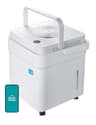 Midea Cube 20 Pint DehumidifierThe smallest Cube, and the least efficient one: certified at IEF 1.70 against 2.01 for the 35 and 50, so every pint it removes costs about 18 percent more electricity. Midea Cube 20 Pint DehumidifierThe smallest Cube, and the least efficient one: certified at IEF 1.70 against 2.01 for the 35 and 50, so every pint it removes costs about 18 percent more electricity. | One small room that is only mildly damp | 234 W | $199.00View on Amazon #ad Price as of October 17, 2026. How we are funded |
Midea
Midea Cube 35 Pint Dehumidifier
Best for: A damp room or a small, dry-ish basement
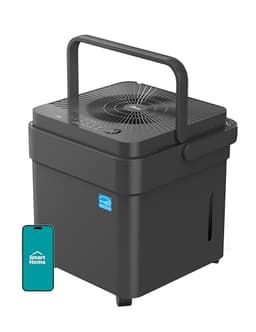
The middle Cube removes 78 percent more water than the 20 for 50 percent more power, and carries the same 4.2 gallon bucket as the 50 - which makes it the size most people between the two should buy.
Average draw
351 W
Computed from the ENERGY STAR certified entry for Midea MAD35S1QGR-A - the same model number as this listing: 35.82 pt/day at IEF 2.01 L/kWh. Midea publishes no wattage on the listing. Every certified 35-pint model we track runs IEF 2.01 to 2.09, so this is the class norm.
What is good
- Same IEF 2.01 as the 50-pint Cube, so per pint removed it is exactly as efficient
- 4.2 gallon bucket, identical to the 50 - about 22 hours at full rated capacity
- Lift-and-twist expandable body, Wi-Fi app and included drain hose
- About $9 a month less than the 50-pint Cube at twelve hours a day and the US average rate
What is not
- Midea's listing calls it similar to a 50 pint under the 2012 standard; ENERGY STAR's correlation table puts a current 35 nearer an old 60, so the maker's equivalence undersells it
- 3,500 sq ft is the most generous coverage claim per pint of the three Cubes - treat it as marketing
- No pump, so the drain must be below the machine
Who it is for
A large damp room, an apartment, or a small basement that reads in the low-to-mid 60s rather than the high 60s.
Skip it if
Skip it for a basement that reads above about 68 percent or shows visible moisture. That is 50-pint work, and the 50 costs little more to buy and nothing more per pint to run.
Waykar
Waykar 34 Pint ENERGY STAR Most Efficient Dehumidifier
Best for: Drying a small space below 40% relative humidity
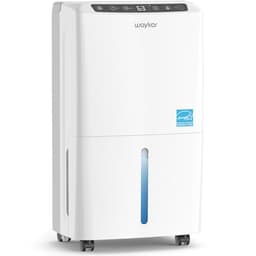
An ENERGY STAR Most Efficient unit that still sets to 30% RH - and a 34-pint headline that the listing itself attributes to 95F and 90% humidity, against a certified 10.16.
Average draw
105 W
Computed from the ENERGY STAR certified entry Waykar PD160B-PRO: 10.16 pt/day at IEF 1.91 L/kWh, 144 kWh a year, certified 14 October 2025 and flagged ENERGY STAR Most Efficient. This is an exact model-number match - the string on the listing and the string in the certified file are the same - which is why this unit now carries a figure where the previous listing could only carry a class band.
What is good
- ENERGY STAR Most Efficient, which only a small minority of certified models carry
- An exact certified model match, so the 105 W and the 144 kWh/yr describe this machine
- Still sets to 30% RH where most humidistats stop at 40
- Publishes a noise figure - 38 dB minimum - which almost nothing in this category does
- Drain hose in the box, plus a washable filter and a child lock
What is not
- The 34-pint headline is a saturation figure; the certified DOE rating is 10.16, a third of it
- A 2,000 sq ft coverage claim on a 10-pint machine is not credible
- The listing claims it saves 'approximately $1,000 annually' on electricity. At 144 kWh a year it costs about $26 a year to run in total, so there is no $1,000 to save
- 0.62 gallon tank and gravity drainage only
Who it is for
A bedroom, a closet, a boat or a store room you want genuinely dry rather than merely comfortable - and where 10 certified pints a day is enough.
Skip it if
Skip it for a basement. Ten certified pints is a small-room machine whatever the box says, and a damp below-grade room wants a certified 50.
GE
GE 50 Pint Dehumidifier
Best for: A garage or shop with a floor drain
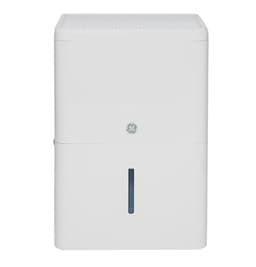
GE's current no-pump 50-pint, with a 30 percent humidistat floor and Smart Dry fan control - and no ENERGY STAR claim on the listing, which is the change worth noticing.
Average draw
Not published
Not published by GE. The ADHE50 series does not appear by name in the ENERGY STAR certified list and this listing makes no ENERGY STAR claim - its predecessor did. The certified 50-pint class runs 443-490 W with a median of 488 W, and a non-certified unit is more likely to sit at the top of that band than below it.
What is good
- Humidistat sets down to 30 percent where most units stop at 35 or 40
- Smart Dry adjusts fan speed to room humidity rather than running flat out
- Bucket-full alarm sounds for ten seconds rather than only lighting an icon
- Clean-filter alert, which is the maintenance nobody remembers to do
What is not
- No ENERGY STAR certification claimed, and no certified entry to compute a draw from
- Gravity drainage only
- A 5,000 sq ft coverage claim, up from its predecessor's 4,000 on the same capacity - a reminder that coverage claims are not a spec
Who it is for
A garage, workshop or utility room with a floor drain, where a low humidistat floor is useful and efficiency certification is not the deciding factor.
Skip it if
Skip it if it will run all season and efficiency matters. A certified 50-pint unit costs about $8 a month less by ENERGY STAR's own figure.
AlorAir
AlorAir Helios D35 Crawl Space Dehumidifier
Best for: The same crawl space, without paying for the radio
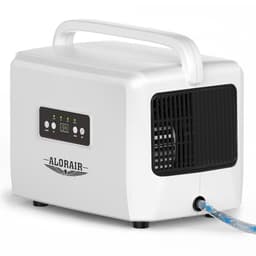
AlorAir's certified 1,000 sq ft unit: same coverage as the Wi-Fi model, a real efficiency figure behind it, a published noise level, and no pump.
Average draw
243 W
Computed from the ENERGY STAR certified entry ALORAIR Helios D35: 24.00 pt/day at IEF 1.95 L/kWh, 274 kWh a year, certified 2 February 2026. This is an exact model-number match - the string on the listing and the string in the certified file are the same - which is the difference between this unit and the Sentinel HD35P, whose figure does not exist.
What is good
- An exact certified model match, so the 243 W and the 274 kWh/yr describe this machine and not a sibling
- Publishes a noise figure - below 52 dB - where almost nothing in this category does
- 25 lb, which is the difference between carrying it into a crawl space and dragging it
- Auto defrost and memory restart after a power cut, which matters in a space nobody checks
- Six-year limited warranty, the longest term we track
What is not
- No pump - gravity drainage only, so the drain has to be below the machine
- No Wi-Fi and no remote monitoring, which is the thing a crawl space most wants
- The 70-pint headline is a saturation figure; the certified DOE rating is 24
- MERV-1 filtration is dust protection for the machine, not air cleaning for you
Who it is for
Someone with a crawl space or small basement, a drain at or below floor level, and no interest in paying for connectivity they will not use.
Skip it if
Skip it if the water has to go uphill, or if the whole point is being told remotely that the machine stopped. Those are the two things this model deliberately does not do.
Midea
Midea Cube 20 Pint Dehumidifier
Best for: One small room that is only mildly damp
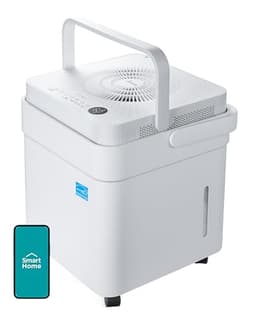
The smallest Cube, and the least efficient one: certified at IEF 1.70 against 2.01 for the 35 and 50, so every pint it removes costs about 18 percent more electricity.
Average draw
234 W
Computed from the ENERGY STAR certified entry for Midea MAD20S1QWT - the same model number as this listing: 20.16 pt/day at IEF 1.70 L/kWh. Midea publishes no wattage on the listing. The 20-22 pint certified class runs IEF 1.70 to 1.97, so this unit sits at the bottom of its own class.
What is good
- Lowest draw of any Cube at 234 W, which matters in a room where it runs most of the day
- Same lift-and-twist expandable body, Wi-Fi app and included drain hose as the larger Cubes
- 3.2 gallon bucket - about 30 hours at full rated capacity before it needs emptying
- The listing states its own pre-2020 equivalent, 30 pint, which matches ENERGY STAR's correlation table
What is not
- IEF 1.70 is the bottom of the certified 20-22 pint class - it uses about 18 percent more electricity per pint than the 35 or 50 Cube
- Undersized for any basement: running around the clock it costs about as much as a 50-pint Cube on half the hours and removes 20 pints to its 50
- No pump, so the drain must be below the machine
Who it is for
A single above-grade room reading in the low 60s - a bedroom, a home office, a bathroom that stays damp between showers.
Skip it if
Skip it for a basement or anything reading above about 65 percent. It will run continuously, never reach its target, and cost as much as the 50-pint Cube while doing less than half its work.
The one pick that breaks the first rule, and why it is here
The AlorAir Helios D35 does not publish a humidistat range, which by the criteria above should disqualify it. It is on the list because it is the only unit we track that publishes the *second* requirement outright: it drains by gravity with no tank to fill, and it restarts from memory after a power cut. For a crawl space, an outbuilding or a store room nobody opens between seasons, that combination is worth more than a printed range on a dial you will set once.
It is also the only small unit here whose efficiency figure is an exact model-number match in the ENERGY STAR certified file rather than a class estimate - 24.00 pints a day at IEF 1.95, 274 kWh a year, and an ENERGY STAR Most Efficient designation, which 47 of the 182 certified units in its capacity class hold. The full reference.
Mold on books, which is the search that brings most people here
If there is already visible growth on a collection, a dehumidifier is the thing that stops it getting worse, not the thing that fixes it. That is the same distinction the mold page makes, and the EPA's water-damage table is unusually direct about paper in particular.
- For items without collection value, the EPA's instruction is "discard books and papers". That is a harder line than most people expect, and it exists because porous material does not reliably come clean.
- For items that matter, the same table offers two routes: "Photocopy valuable/important items, discard originals", or "Freeze (in frost-free freezer or meat locker) or freeze-dry". Freezing buys time - it stops growth advancing while you decide - rather than reversing anything.
- For the room, bring it inside 30-50 percent and keep it there. Growth that has stopped advancing is a different problem from growth that is spreading, and the humidistat is what holds the difference.
- Do not seal damp books into boxes or bags. An enclosure around wet paper is a microclimate at close to 100 percent humidity, which is the one condition worse than the open shelf it came off.
What holding the band costs
A collection room is a year-round job rather than a summer one, so the running cost is worth knowing before you commit. The 20 to 35 pint class the picks sit in draws well under a basement machine's 488 W.
The Midea Cube 35, at its certified draw
(351 W / 1000) x 12 h x $0.1834/kWh = $0.77 per day
0.351
kWh per hour
$23.51
per month, 12 h/day
$47.03
per month, 24 h/day
Rate is the US residential average of 18.34 cents/kWh from the EIA Electric Power Monthly, June 2026. Yours will differ - use the calculator.
Treat the 12-hour column as the realistic one. A machine holding a band in a room that is not actively wet spends a good part of the day satisfied and idle, which is the opposite of the water-damage case where you read the 24-hour figure. The full wattage ledger, and the calculator at your own rate.
What we did not do
We have not stored a collection, logged a room's humidity across a year, or tested any of these humidistats against a calibrated reference - and the last of those is the honest gap in this page, because a control that reads three points high is a control holding 53 percent while telling you 50. Buy a separate hygrometer and check it. Every capacity and efficiency figure here is read from the ENERGY STAR certified file, every humidistat range is quoted from the maker's own listing, and every storage figure is quoted from the federal standard that publishes it. How we work.
What we would skip
A unit that publishes neither a humidistat range nor a restart behavior
This is the one category where the control *is* the product, and most of this category sells you a dial. Only 13 of the 32 units we track publish a numeric humidity range. A machine that tells you neither where its humidistat sets nor what it does after a power cut cannot be judged against a band at all - and those are the only two things this job asks of it.
A 50-pint basement machine for a bookcase
A closed bookcase or a single closet does not have the air volume to need it, and a machine that satisfies its humidistat in four minutes and shuts off is not holding a band - it is oscillating around one. The federal point is stability, not capacity.
A thermoelectric mini with no humidistat at all
The small silent units that suit a damp wardrobe run until their tank fills, with no humidity target to hold. For a wardrobe that is fine. For a collection it is the wrong instrument: you cannot hold 45 percent with a machine that has no idea what 45 percent is. Where those units do belong.
Leaving it on the bucket in a room you visit monthly
A full bucket is a stopped machine, and a stopped machine in a book room in July is the exact condition the standard is written to prevent. If the collection lives somewhere you do not walk past daily, the unit needs a hose or a pump, full stop. Setting up a continuous drain.
A dehumidifier, if the room is simply hot
NARA's standard sets temperature alongside humidity, and it is specific about the cost of getting it wrong: acidic papers "have a usable life of only decades if stored at temperatures at or above 70F". A dehumidifier adds heat to a room rather than removing it. If your attic is the problem, the attic is the problem.
How we picked
- Criteria stated before the picks: a published humidistat range that covers the federal band, then unattended operation, then capacity matched to a storage space rather than a house, then noise if it shares a room with a reader.
- The target band is quoted from the US National Archives' own storage standard and the mold thresholds from the Code of Federal Regulations, not from collector forums.
- Humidistat ranges are read off each maker's published listing. Four of the five picks publish one; the fifth is named as a deliberate exception and the reason is given.
- Capacity from each model's ENERGY STAR certified entry at the DOE test condition, never a saturation headline - which on this page means saying plainly that one pick's 34-pint badge is a certified 10.16.
- Not tested by us. We have not stored a collection, measured a room's stability over a season, or tested a humidistat's accuracy against a calibrated reference - and we say so rather than implying otherwise.
We did not test these units. The full criteria and their weighting are on the methodology page.
FAQ
Questions
What humidity should books be stored at?
At what humidity does mold grow on books?
Can a dehumidifier remove mold that is already on books?
What size dehumidifier do I need for a book room?
Can a dehumidifier make a room too dry for books?
Is temperature or humidity more important for storing paper?
Sources
Sources
- US National Archives, NARA 1571 Supplement 2: Temperature, Relative Humidity and Air Pollutant Tables, effective 17 January 2023 - Table 1, Textual Holdings Storage, Low Sensitivity: "Paper: Textual records including bound volumes", 50-65F, 30-50% RH; Holdings Work Rooms 50-75F, 30-55%; "Acidic papers, magnetic media, and many films and plastics have a usable life of only decades if stored at temperatures at or above 70F"; guidance "supports moving away from setpoints towards bands" (retrieved 2026-10-17)
- 36 CFR 1234.14, environmental controls for records storage facilities - factors contributing to mold growth include relative humidity above 70%, and extreme heat combined with relative humidity above 55% (retrieved 2026-10-17)
- US EPA, Mold Remediation in Schools and Commercial Buildings, Chapter 4, Table 1 - books and papers: "For non-valuable items, discard books and papers", "Photocopy valuable/important items, discard originals", "Freeze (in frost-free freezer or meat locker) or freeze-dry" (retrieved 2026-10-17)
- US EPA, A Brief Guide to Mold, Moisture and Your Home - "keep indoor humidity below 60 percent (ideally between 30 and 50 percent) relative humidity" (retrieved 2026-10-17)
- ENERGY STAR Certified Dehumidifiers list - Midea MAD35S1QGR-A at 35.82 pt/day and IEF 2.01 (378 kWh/yr); ALORAIR Helios D35 at 24.00 pt/day and IEF 1.95 (274 kWh/yr), ENERGY STAR Most Efficient, 47 of 182 certified units in the 19-27 pint class hold that designation (retrieved 2026-10-17)
- EIA Electric Power Monthly, Table 5.6.A, June 2026 - the residential electricity rate used
Read next
- What to set it to45 to 50 percent, why lower is only more expensive, and the setting that doubles your bill.
- The best dehumidifiers for hardwood floorsThe one room where drier is damage. Buy on the humidistat's lower bound - and only seven units we track publish one.
- The best dehumidifiers for a closetOunces a day, not pints - and the first specification is whether there is an outlet at all.
- The best dehumidifiers for moldA dehumidifier removes the humidity mold needs - it does not kill mold. Five units ranked on unattended running and cold-room performance.
- AlorAir Helios D35The rare crawl space unit whose own model string is in the certified file: 24.00 pt/day, 243 W, Most Efficient, no pump.
- What size dehumidifier do I need?A four-step method that uses measured humidity instead of the square-footage claim on the box.