Best / Roundup
The best dehumidifiers for a laundry room
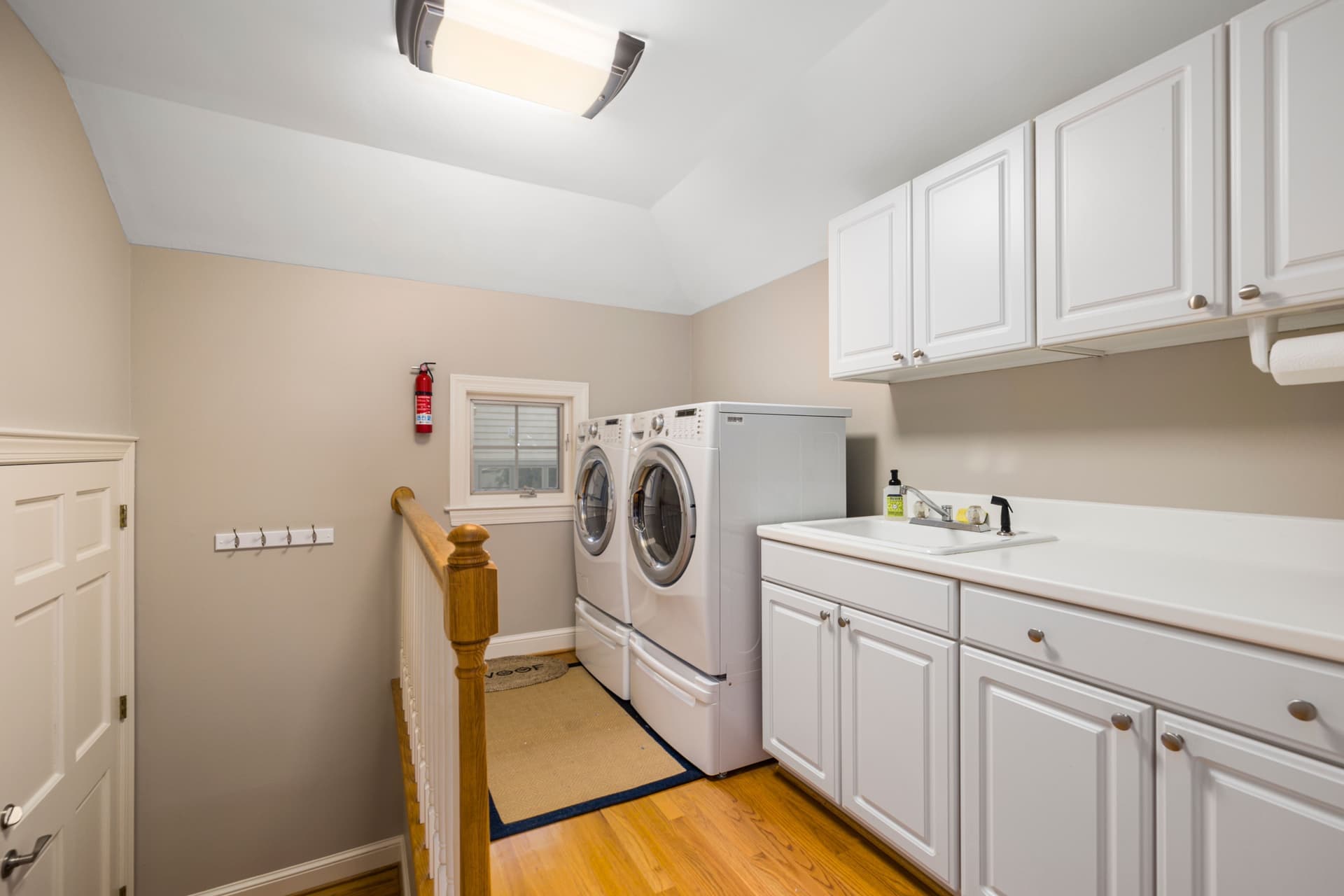
A laundry room has two problems no other room has at once: it is handed several pints of water every time a load comes out of the washer, and the only drain in it is usually a sink on the wall. Both decide the purchase.
#adThis page contains affiliate links. We earn a commission on qualifying purchases, at no cost to you, and it never changes a ranking. Full disclosure.
The short answer
For most laundry rooms, a 50-pint dehumidifier with a built-in pump that can reach the utility sink. The federal clothes-dryer test load, spun, still holds about 4.7 pints of water, so a small unit cannot keep pace with drying clothes indoors. If the laundry has a floor drain below the machine, a gravity unit with a large bucket does the same job without a pump.
How much water a load of laundry actually puts in the room
This is the number the whole page rests on, so it is worth getting from a source rather than a guess. The US Department of Energy's test procedure for clothes dryers specifies a standard test load of 8.45 pounds of cloth, bone dry, dampened to an initial remaining moisture content of 57.5 percent before drying begins. That is meant to represent a load as it comes out of a washer's spin cycle.
4.7 pints
Water in one federal test load of laundry, after the spin cycle
8.45 lb of bone-dry cloth at 57.5 percent remaining moisture is about 4.9 lb of water - roughly 4.7 US pints, or 2.2 liters. From 10 CFR Part 430, Subpart B, Appendix D2, sections 2.7.1 and 2.7.2. A real load varies with fabric and washer; this is the standardized figure, not a measurement of yours.
Dry that load on a rack indoors and all of that water ends up in the room air. Do it three or four times a week in a closed laundry room and the room is handed well over a gallon of water a week from laundry alone, before counting a washer that is left shut and damp, or a basement slab under it.
It is also why laundry is one of the most common causes of condensation on the coldest window in the house. Condensation.
How we judged the picks, in order
| Criterion | Why it comes where it does |
|---|---|
| Where the water can go | First, and not close. Laundry rooms usually drain into a sink or standpipe on the wall, above the machine. That makes a built-in pump the default rather than a luxury - unless there is a floor drain below the unit. |
| Capacity against a real load | Second. About 4.7 pints per load means a 50-pint class machine, which removes roughly two pints an hour at the DOE test condition, rather than a small unit that would be overwhelmed. |
| Operating temperature | Third. Basement laundry rooms are often cool. Below about 41F a compressor coil ices faster than it defrosts, so the stated low-temperature floor matters. |
| Running cost | Fourth. All four picks are certified at 487 to 490 W, so this separates them very little - but it separates the whole class sharply from undersized alternatives that run all day. |
| A laundry setting | A bonus rather than a criterion. One pick has a dedicated laundry mode; we note it, and we note that nothing on the listing says how it works. |
Coverage claims are not used. Units with identical certified capacity claim coverage 1.9x apart in our registry. Why.
Quick picks
| # | Product | Best for | Draw | Price |
|---|---|---|---|---|
| 1 |  Quilo 50 Pint Dehumidifier with PumpA certified 50-pint pump unit that puts its pump reach in writing - 15 feet, vertically or horizontally - and adds a laundry-drying mode nothing else we track offers. Quilo 50 Pint Dehumidifier with PumpA certified 50-pint pump unit that puts its pump reach in writing - 15 feet, vertically or horizontally - and adds a laundry-drying mode nothing else we track offers. | A laundry room or basement with the drain up a wall | 487 W | $269.99View on Amazon #ad Price as of September 17, 2026. How we are funded |
| 2 |  Midea Cube 50 Pint Dehumidifier with PumpSame machine as the Cube above with a condensate pump added, which is the difference between a hose you can run and a hose you cannot. Midea Cube 50 Pint Dehumidifier with PumpSame machine as the Cube above with a condensate pump added, which is the difference between a hose you can run and a hose you cannot. | A basement whose only drain is upstairs | 487 W | |
| 3 |  Frigidaire 50 Pint Dehumidifier with Wi-FiFrigidaire's current no-pump 50-pint: certified by exact model number, Wi-Fi equipped, and a 2.7 gallon bucket that is among the largest of any 50-pint unit we track. Frigidaire 50 Pint Dehumidifier with Wi-FiFrigidaire's current no-pump 50-pint: certified by exact model number, Wi-Fi equipped, and a 2.7 gallon bucket that is among the largest of any 50-pint unit we track. | A Frigidaire with a drain below it | 488 W | |
| 4 |  Hisense 50 Pint Dehumidifier with PumpA certified 50-pint pump unit that claims operation down to 38F - lower than the 41F most compressor units state - which is the specification that matters in a cold basement. Hisense 50 Pint Dehumidifier with PumpA certified 50-pint pump unit that claims operation down to 38F - lower than the 41F most compressor units state - which is the specification that matters in a cold basement. | A cold basement where the pump has to keep working | 490 W | $309.00View on Amazon #ad Price as of September 17, 2026. How we are funded |
Quilo
Quilo 50 Pint Dehumidifier with Pump
Best for: A laundry room or basement with the drain up a wall
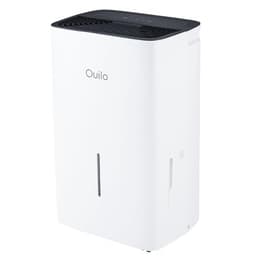
A certified 50-pint pump unit that puts its pump reach in writing - 15 feet, vertically or horizontally - and adds a laundry-drying mode nothing else we track offers.
Average draw
487 W
Computed from the ENERGY STAR certified entry for Quilo QLDAD50PWK - the same model number as this listing: 49.67 pt/day at IEF 2.01 L/kWh. Quilo publishes no wattage itself.
What is good
- States its pump reach - up to 15 feet vertically or horizontally - with the drain tube included
- Exact certified model match, so the 487 W figure describes this machine
- Dedicated laundry mode dries clothes and the room at the same time
- Child lock, thermal overload protection, auto defrost and a clean-filter alert
What is not
- Tank capacity is not stated on the listing
- No Wi-Fi or app is mentioned, so no remote alerts if the pump stops
- A newer brand name with no long track record under this name
Who it is for
Someone who needs a pump to reach a sink or window up to 15 feet away, especially in a laundry room where the drying mode earns its place.
Skip it if
Skip it if you want to be told on your phone when something stops. Nothing on the listing mentions connectivity.
Midea
Midea Cube 50 Pint Dehumidifier with Pump
Best for: A basement whose only drain is upstairs
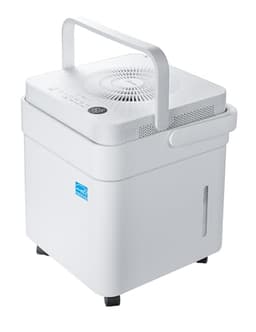
Same machine as the Cube above with a condensate pump added, which is the difference between a hose you can run and a hose you cannot.
Average draw
487 W
Computed from the ENERGY STAR certified entry for Midea MAD50PS1QWT-A, the pump variant of the same platform: 49.67 pt/day at IEF 2.01 L/kWh. The current retail revision is the -B; every Midea 50-pint Cube revision in the certified list, pump or not, computes to 487-490 W, so the pump does not move the number meaningfully. The pump itself only runs in bursts.
What is good
- Pump means the destination can be higher than the machine - a laundry sink, a window, a stack
- Identical DOE capacity and IEF to the non-pump Cube, so the pump costs you nothing in efficiency
- The split body still works, so you can also run it on gravity and keep the pump as the backup
- Certified 49.67 pt/day, an honest 50-pint rating
What is not
- Costs more than the identical machine without the pump
- A pump is one more thing that can fail, and when it does the unit stops rather than overflows
- No published wattage from Midea - the figure above is computed
Who it is for
Anyone whose drain is above the floor. That is most finished basements and nearly every crawl space.
Skip it if
Skip it if you already have a floor drain within hose reach and below the machine. You would be paying for a pump you will never switch on.
Frigidaire
Frigidaire 50 Pint Dehumidifier with Wi-Fi
Best for: A Frigidaire with a drain below it
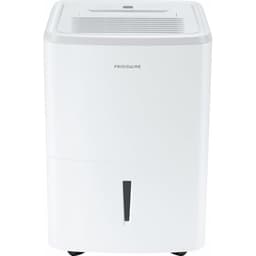
Frigidaire's current no-pump 50-pint: certified by exact model number, Wi-Fi equipped, and a 2.7 gallon bucket that is among the largest of any 50-pint unit we track.
Average draw
488 W
Computed from the ENERGY STAR certified entry for Frigidaire FHDD5034Y1 - the same model number as this listing: 49.71 pt/day at IEF 2.01 L/kWh. Frigidaire's Canadian product page states 115 V, 8.8 A and 470 W; those figures do not reconcile with each other and are nameplate rather than average values, so 488 W is the running-cost figure.
What is good
- Exact certified model match, so the 488 W figure describes this machine rather than a sibling
- 2.7 gallon bucket - roughly ten hours of condensate at full rated capacity if you ever run it without a hose
- Continuous drain, three fan speeds and operation down to 41F
- Wi-Fi and the Frigidaire app for scheduling and remote control
What is not
- Gravity only. The drain must be below the machine
- The Wi-Fi depends on Frigidaire's app remaining supported
- Frigidaire's own published wattage and amperage do not agree with each other
Who it is for
Someone with a floor drain who wants a certified, well-documented 50-pint unit and has a use for scheduling.
Skip it if
Skip it if the only drain is above the machine. That is the one job a gravity unit cannot do, whatever else it has.
Hisense
Hisense 50 Pint Dehumidifier with Pump
Best for: A cold basement where the pump has to keep working
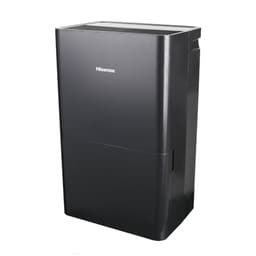
A certified 50-pint pump unit that claims operation down to 38F - lower than the 41F most compressor units state - which is the specification that matters in a cold basement.
Average draw
490 W
Computed from the ENERGY STAR certified entry for Hisense ADH50KP26 - the same model number as this listing: 49.95 pt/day at IEF 2.01 L/kWh. Hisense publishes no wattage on the listing.
What is good
- Claims operation down to 38F, three degrees below the usual compressor floor
- Exact certified model match, so the 490 W figure describes this machine
- Quick-connect hose included for the pump
- Three operating modes and three fan speeds, including an auto fan setting
What is not
- No pump lift, hose length or bucket capacity stated on the listing
- No Wi-Fi or app mentioned
- Below about 38F it is still a compressor unit, and a desiccant machine is the right tool
Who it is for
Someone with a cool basement or garage and a drain above the machine, where a few degrees of extra low-temperature headroom decides whether the unit keeps working in spring and autumn.
Skip it if
Skip it if your pump route is long or tall. Hisense does not state a lift, where GE and Quilo state 15 feet.
Drying clothes with a dehumidifier: what it can and cannot do
A dehumidifier does not dry clothes directly. It lowers the humidity of the air around them, which lets water evaporate from the fabric faster than it would in a damp, closed room. That distinction sets realistic expectations.
- The machine is rarely the bottleneck. A 50-pint unit can remove roughly two pints an hour at the DOE test condition, which is more than one load gives off in that time. What limits drying is how fast water leaves the fabric - which depends on airflow over it, how thickly it is hung, and the fabric itself.
- Airflow matters more than capacity. Hang the load with space between items and point the dehumidifier's exhaust across the rack. A fan helps more than a larger machine would.
- Close the door. A dehumidifier drying clothes in a room open to the rest of the house is trying to dry the whole house. A closed laundry room lets it work on the air the clothes are actually in.
- It adds warmth, and that helps. Every watt the machine draws ends up as heat in the room, and warmer air takes up water faster. Why it blows warm air.
Pump or gravity in a laundry room
The decision is made by where your drain is, and it is worth checking before anything else:
- 1Utility sink or standpipe on the wall - the usual laundry layout. Both sit above a portable dehumidifier's outlet. You need a pump, and you need to know it can reach. The Quilo states 15 feet vertically or horizontally; the Midea Cube includes a 16 foot drain tube. Pump lift and distance.
- 2Floor drain below the machine - common in basement laundries. A gravity hose to it runs indefinitely with no moving parts, and a pump adds cost and a failure point you do not need. Setting up a continuous drain.
- 3No drain you can reach - a bucket unit, emptied after laundry days. Choose the largest bucket you can find, because a full bucket stops the machine exactly when the room is wettest.
What it costs to run
A certified 50-pint unit in a laundry room
(488 W / 1000) x 12 h x $0.1834/kWh = $1.07 per day
0.488
kWh per hour
$32.69
per month, 12 h/day
$65.38
per month, 24 h/day
Rate is the US residential average of 18.34 cents/kWh from the EIA Electric Power Monthly, June 2026. Yours will differ - use the calculator.
A laundry room rarely needs twelve hours a day, every day. Running the machine for the few hours after each load, with the humidistat set around 45 to 50 percent, is closer to how most people use one here - which cuts the figure above substantially. Calculate yours.
Who should buy something else
- Anyone drying laundry in a laundry closet with no room to spare. A 50-pint unit is a large appliance. Consider whether the load can dry in a larger room with the door shut instead. Closets.
- Anyone with an unheated laundry below about 41F. Every compressor unit here ices. A desiccant machine keeps working in the cold. Desiccant versus compressor.
- Anyone whose problem is a smell rather than wet clothes. A musty laundry room is often a washer left shut and damp. Musty smells.
What we did not do
We have not tested any of these units, timed a load drying, or tried the Quilo's laundry mode. The water content of a wash load is the federal test procedure's standardized figure, quoted with its section numbers. Capacities and wattages come from each model's ENERGY STAR certified entry, and the pump and drainage details are quoted from each current listing. How we work.
What we would skip
A thermoelectric mini for drying clothes
One standard wash load, spun, still holds roughly 4.7 pints of water. A thermoelectric mini removes on the order of a pint a day or less. It cannot keep up with a single load, let alone a week of them - the clothes dry at the speed of the room, and the room gets wetter while they do.
A gravity-only unit in a laundry room with no floor drain
Most laundry rooms drain into a utility sink or a standpipe on the wall, both of which sit above a portable dehumidifier's outlet. Water does not climb. A gravity unit there becomes a bucket you empty after every load, and a bucket you forget is a machine that has stopped. Pump versus gravity.
Venting a dryer into the room to save energy
It is sometimes suggested as a way to keep the heat indoors in winter. It also puts every drop of water from the load straight into the room air - the exact problem a dehumidifier is then bought to solve - along with lint. If the dryer vents indoors, fix the vent before buying anything.
How we picked
- Criteria stated before the picks: where the water goes first, then capacity against a real wash load, then operating temperature, then running cost.
- Capacity from each model's ENERGY STAR certified entry at the DOE test condition, never a saturation headline.
- Average draw computed from certified capacity and Integrated Energy Factor for every pick - all four are certified under their own model numbers.
- The water a wash load holds is taken from the federal clothes-dryer test procedure, not estimated.
- Not tested by us. We have not timed a load drying and we do not publish a drying time. Every figure is quoted or computed, with the source named.
We did not test these units. The full criteria and their weighting are on the methodology page.
FAQ
Questions
Does a dehumidifier help dry clothes indoors?
How much water is in a load of laundry?
What size dehumidifier do I need for a laundry room?
Should a laundry room dehumidifier have a pump?
What is laundry mode on a dehumidifier?
Sources
Sources
- 10 CFR Part 430, Subpart B, Appendix D2 - Uniform Test Method for Clothes Dryers: section 2.7.1 test load 8.45 lb bone dry, section 2.7.2 initial remaining moisture content 57.5 percent (retrieved 2026-09-16)
- ENERGY STAR Certified Dehumidifiers list - Quilo QLDAD50PWK 49.67 pt/day, Midea MAD50PS1QWT-A 49.67 pt/day, Frigidaire FHDD5034Y1 49.71 pt/day, Hisense ADH50KP26 49.95 pt/day, all IEF 2.01 (retrieved 2026-09-16)
- Quilo 50-Pint ENERGY STAR Dehumidifier, QLDAD50PWK - Amazon.com listing stating a laundry comfort mode and a 15 ft drain pump, vertical or horizontal (retrieved 2026-09-16)
- Midea Cube 50 Pint with Pump, MAD50PS1QWT-A - Amazon.com listing stating the pump drains vertically or horizontally with a 16 ft drain tube included (retrieved 2026-09-16)
- EIA Electric Power Monthly, Table 5.6.A, June 2026 - the electricity rate used
Read next
- The best dehumidifiers with a built-in pumpFive pump-equipped units, ranked partly on which makers will state what their pump can actually reach.
- Pump or gravity: decide this before anything elseA five-minute test that eliminates half the market, and the middle option most buyers miss.
- The best dehumidifiers for condensationCondensation is a cold surface meeting a high dew point. Four units, and the cases where glass is the real problem.
- Quilo 50 Pint with PumpA certified 487 W pump unit that states its reach - 15 feet, up or across - and adds a laundry mode.
- It is blowing warm airWarm exhaust is the design, not a fault. Where the heat comes from, and the one case that is genuinely wrong.