Best / Roundup
The best dehumidifiers for a musty smell
The smell is not the problem. It is the exhaust of a problem - something organic staying wet long enough to grow. A machine that dries the air stops the process; it does not undo what is already there.
#adThis page contains affiliate links. We earn a commission on qualifying purchases, at no cost to you, and it never changes a ranking. Full disclosure.
The short answer
A musty smell is produced by microbial growth on something damp - joists, carpet backing, cardboard, drywall paper. A dehumidifier removes the humidity that growth depends on, which stops it spreading and stops the smell being renewed. It does not remove the smell already in the material, and it does not replace finding the water source.
What the smell actually is
That basement smell is not dust and it is not old air. It is the by-product of living things - mold and mildew - metabolizing something organic that has stayed wet. Paper facing on drywall, the backing of a carpet, a cardboard box on a concrete floor, the underside of a floorboard. Keep those materials above roughly 60% relative humidity for long enough and the process starts.
That is why the EPA's own guidance on hidden mold lists a building that smells moldy alongside visible staining as a reason to investigate. The nose detects it before the eye does, because the growth is usually behind, under or inside something.
Find the source before you buy anything
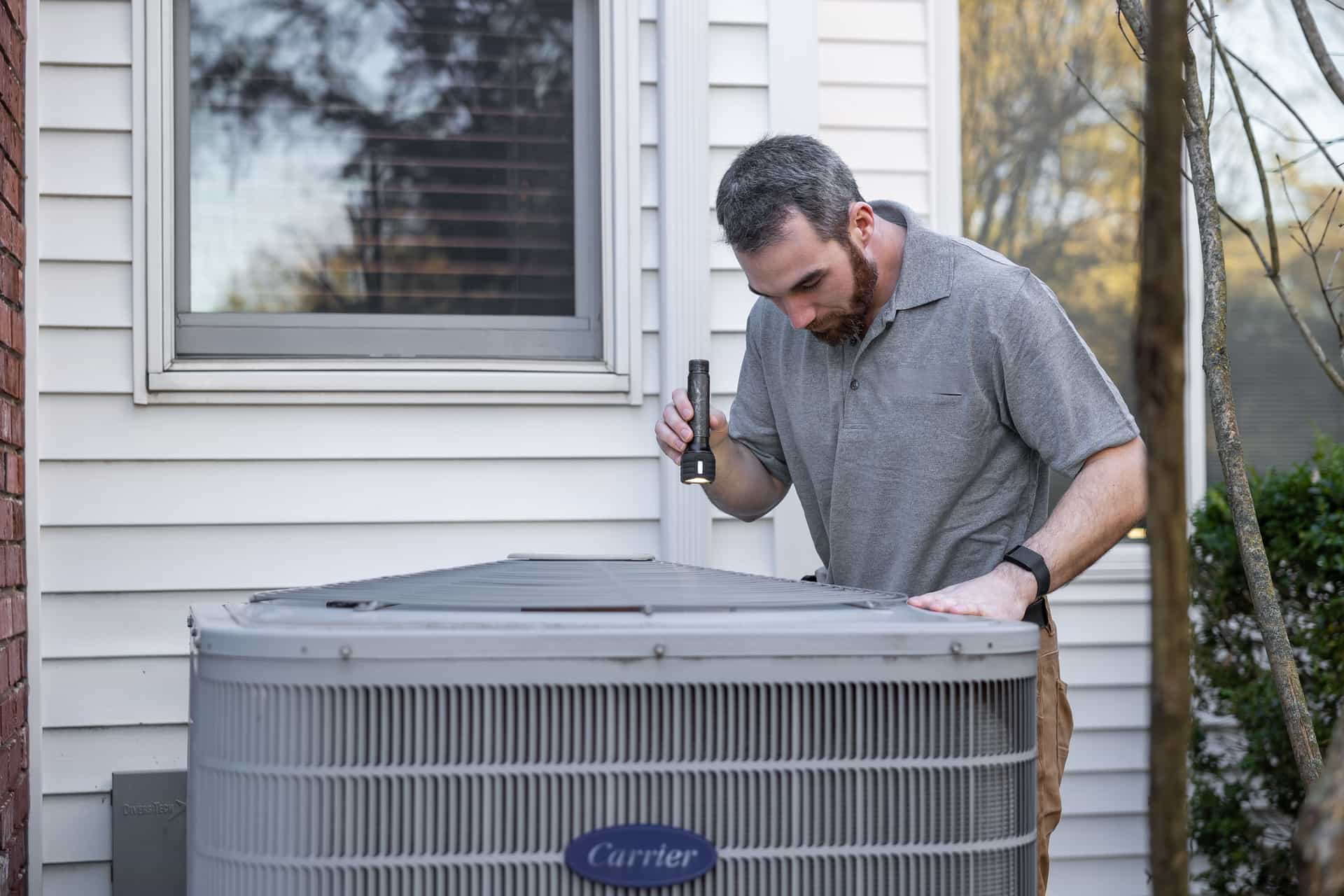
Twenty minutes, a flashlight and a cheap hygrometer will tell you more than any product page. Work through these in order, because they are ranked by how often they turn out to be the answer:
- 1Take readings, not impressions. Put a hygrometer in the room for three or four days and read it at the same time each day. Anything consistently above 60% is a growth condition. Anything at 55% and falling is not your problem.
- 2Follow your nose downward. Musty smells travel up. A ground-floor smell very often originates in a crawl space or basement below it, and conditioning the source fixes the floor above for free. Crawl spaces.
- 3Check outside, on a wet day. A downspout emptying at the foundation, a grade that slopes toward the house, a blocked gutter. This is the single most common root cause of a damp basement and it costs nothing to correct.
- 4Look where a dryer or bathroom fan discharges. A dryer vented into a crawl space or a fan terminating in a joist bay pumps gallons of water a week into the building. No dehumidifier wins that fight.
- 5Lift anything organic off a concrete floor. Cardboard, carpet and stored paper sitting on slab wick moisture out of it continuously and are usually the actual thing that smells.
What the dehumidifier is actually doing
It is removing the condition, and that distinction is worth holding onto because it sets your expectations correctly.
- It stops the growth spreading. Below the EPA's 60% line the biology does not have what it needs, and the colony stops expanding.
- It stops the smell being renewed. The odor compounds are produced continuously by active growth. Stop the growth and production stops.
- It dries out material that is already wet, slowly. Joists and drywall give up moisture to drier air over weeks, not hours.
- It does not remove odor already absorbed into soft furnishings, carpet or cardboard. Those need cleaning or discarding. This is the part that disappoints people.
- It does not kill existing mold. Dormant is not dead. Re-wet it and it resumes. The mold roundup covers that distinction in full.
How we judged the picks
This is a different specification list from a general roundup, because the job is different. A musty space needs a machine that runs unattended for weeks:
| Criterion | Why it comes where it does |
|---|---|
| Where the water goes | First, and not close. A bucket machine stops when the bucket is full, which in a damp basement is a few hours. Every hour it is stopped, the humidity climbs back. |
| Capacity at the DOE condition | Second. The room is usually cool and genuinely wet, which is exactly where an undersized unit never catches up. |
| Low-temperature operation | Third. Below about 60F a compressor's output falls off, and musty spaces are usually the coldest ones in the house. |
| Running cost | Fourth. This machine will run for months, so the draw matters more than it does for seasonal use. |
| Noise | Last. Nobody is sitting in the room. This is the one roundup where we would take a louder machine for more capacity. |
Coverage claims are deliberately absent from this list. Units with identical certified capacity claim square footages 1.9x apart in our registry, so the number carries no information. Why.
Quick picks
| # | Product | Best for | Draw | Price |
|---|---|---|---|---|
| 1 |  Midea Cube 50 Pint Dehumidifier with PumpSame machine as the Cube above with a condensate pump added, which is the difference between a hose you can run and a hose you cannot. Midea Cube 50 Pint Dehumidifier with PumpSame machine as the Cube above with a condensate pump added, which is the difference between a hose you can run and a hose you cannot. | A basement whose only drain is upstairs | 487 W | |
| 2 |  hOmeLabs 50 Pint DehumidifierA capable 50-pint machine attached to the least plausible coverage claim on this page, and the gap between those two facts is worth understanding before you buy anything in this category. hOmeLabs 50 Pint DehumidifierA capable 50-pint machine attached to the least plausible coverage claim on this page, and the gap between those two facts is worth understanding before you buy anything in this category. | Reading a coverage claim critically | Not published | $269.99View on Amazon #ad Price as of September 14, 2026. How we are funded |
| 3 |  AlorAir Sentinel HD55 Crawl Space DehumidifierThe clearest example on this site of why the number on the box is not the number that matters: sold as 113 pints, certified at 36.33. AlorAir Sentinel HD55 Crawl Space DehumidifierThe clearest example on this site of why the number on the box is not the number that matters: sold as 113 pints, certified at 36.33. | A crawl space you cannot stand up in | 344 W | |
| 4 |  hOmeLabs 32 Pint DehumidifierThe one hOmeLabs unit with a named entry in the ENERGY STAR list, so it is the one where the running cost is a published figure rather than a class estimate. hOmeLabs 32 Pint DehumidifierThe one hOmeLabs unit with a named entry in the ENERGY STAR list, so it is the one where the running cost is a published figure rather than a class estimate. | A bedroom that is damp but not wet | 318 W | $234.99View on Amazon #ad Price as of September 14, 2026. How we are funded |
Midea
Midea Cube 50 Pint Dehumidifier with Pump
Best for: A basement whose only drain is upstairs
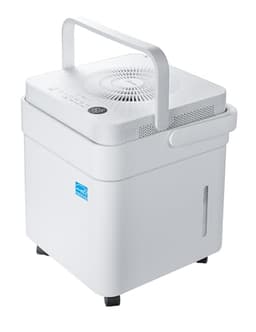
Same machine as the Cube above with a condensate pump added, which is the difference between a hose you can run and a hose you cannot.
Average draw
487 W
Computed from the ENERGY STAR certified entry for Midea MAD50PS1QWT-A, the pump variant of the same platform: 49.67 pt/day at IEF 2.01 L/kWh. The current retail revision is the -B; every Midea 50-pint Cube revision in the certified list, pump or not, computes to 487-490 W, so the pump does not move the number meaningfully. The pump itself only runs in bursts.
What is good
- Pump means the destination can be higher than the machine - a laundry sink, a window, a stack
- Identical DOE capacity and IEF to the non-pump Cube, so the pump costs you nothing in efficiency
- The split body still works, so you can also run it on gravity and keep the pump as the backup
- Certified 49.67 pt/day, an honest 50-pint rating
What is not
- Costs more than the identical machine without the pump
- A pump is one more thing that can fail, and when it does the unit stops rather than overflows
- No published wattage from Midea - the figure above is computed
Who it is for
Anyone whose drain is above the floor. That is most finished basements and nearly every crawl space.
Skip it if
Skip it if you already have a floor drain within hose reach and below the machine. You would be paying for a pump you will never switch on.
hOmeLabs
hOmeLabs 50 Pint Dehumidifier
Best for: Reading a coverage claim critically
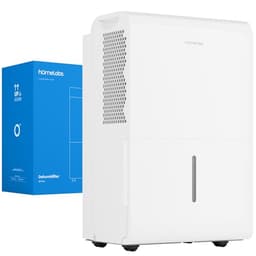
A capable 50-pint machine attached to the least plausible coverage claim on this page, and the gap between those two facts is worth understanding before you buy anything in this category.
Average draw
Not published
hOmeLabs publishes no wattage and has no 50-pint entry in the ENERGY STAR certified list - its certified models are the HME0088 at 24.48 pt/day (276 W) and the HME0089 at 32.46 pt/day (318 W). For a 50-pint compressor unit the certified class band is 443-490 W with a median of 488 W.
What is good
- States both numbers - 50 pints at the DOE condition and 120 at saturation - instead of quietly using the bigger one
- Wi-Fi control at a price below the Midea Cube
- Auto shut-off and a straightforward continuous-drain port
- Widely sold, so replacement filters are easy
What is not
- A 7,000 sq ft coverage claim for a 50-pint machine is roughly 50% higher than any comparable unit claims for the same capacity
- Not in the ENERGY STAR certified list at this capacity
- No published wattage
Who it is for
A budget-conscious buyer who understands that the coverage number is marketing and the pint number is the specification.
Skip it if
Skip it if you were buying it because of the 7,000 sq ft figure. Size from the room and the dampness, not from the largest number on the box - the sizing guide explains why.
AlorAir
AlorAir Sentinel HD55 Crawl Space Dehumidifier
Best for: A crawl space you cannot stand up in
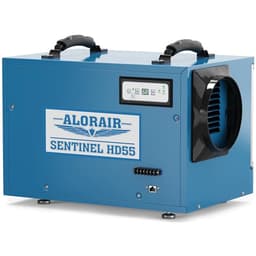
The clearest example on this site of why the number on the box is not the number that matters: sold as 113 pints, certified at 36.33.
Average draw
344 W
Computed from the ENERGY STAR certified entry ALORAIR Sentinel HD55S: 36.33 pt/day at IEF 2.08 L/kWh, 379 kWh a year. The retail listing is the HD55; the certified entry carries the S suffix. At IEF 2.08 it is more efficient than the median 50-pint portable while removing about three quarters as much water.
What is good
- Built low and flat to fit between floor joists, which no portable unit does
- Auto defrost and low-temperature operation, both essential in an unheated crawl space
- IEF 2.08 is above the 50-pint class median of 2.01 despite the smaller capacity
- No tank at all, so there is nothing to forget to empty
What is not
- The 113-pint headline is a saturation figure at 95F and 90% RH; the DOE-condition rating is 36.33
- 1,200 sq ft coverage, less than most 50-pint portables claim, for considerably more money
- Needs a drain or a condensate pump - there is no bucket fallback
Who it is for
Crawl spaces, low-clearance basements and unheated storage where a standing portable will not fit or will freeze.
Skip it if
Skip it for a normal basement. A 50-pint portable removes more water at the DOE condition for less money; you are paying for the form factor and the temperature range.
hOmeLabs
hOmeLabs 32 Pint Dehumidifier
Best for: A bedroom that is damp but not wet
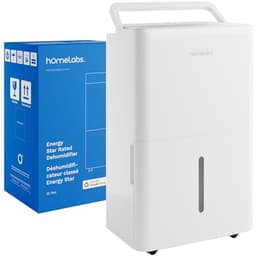
The one hOmeLabs unit with a named entry in the ENERGY STAR list, so it is the one where the running cost is a published figure rather than a class estimate.
Average draw
318 W
Computed from the ENERGY STAR certified entry hOmeLabs HME0089: 32.46 pt/day at IEF 2.01 L/kWh. This is the only hOmeLabs capacity in this registry with a named certified entry, which is why it is the only one carrying a number rather than a band.
What is good
- 318 W against the 50-pint class median of 488 W - about 35% less to run, hour for hour
- Named in the ENERGY STAR certified list, so its IEF is public
- Quiet enough for a bedroom in a way that a 50-pint compressor generally is not
- Wi-Fi and auto shut-off at a small-unit price
What is not
- 32 DOE pints is genuinely less water than 50 - undersizing a wet basement costs more than the machine saved
- Gravity drainage only
- 4,500 sq ft coverage for 32 pints is another claim to ignore
Who it is for
A bedroom, a home office, or a small basement that is humid rather than actively wet.
Skip it if
Skip it if the floor is ever damp to the touch or the walls sweat. That is a 50-pint problem, and a 32-pint machine will run continuously and still lose.
What it costs to run a musty room dry
Longer than people expect, which makes the running cost a real number rather than a footnote. Drying a basement that has been damp for years is a multi-week job, and the machine then keeps running through every humid season afterwards.
A 50-pint unit holding a basement dry
(488 W / 1000) x 12 h x $0.1834/kWh = $1.07 per day
0.488
kWh per hour
$32.69
per month, 12 h/day
$65.38
per month, 24 h/day
Rate is the US residential average of 18.34 cents/kWh from the EIA Electric Power Monthly, June 2026. Yours will differ - use the calculator.
Two things change that figure more than the choice of machine. Your electricity rate, which runs from 13.11 cents in Nevada to 52.72 cents in Hawaii; and whether the unit is the right size, because an undersized one never reaches its target, never idles and draws full power around the clock. Rates by state.
How long before the smell goes
There is no honest single answer, and anyone offering one is guessing. What is predictable is the shape of it: the air dries in a day or two, the humidity reading stabilizes within a week if the unit is correctly sized and the space is sealed, and the materials give up their moisture over weeks after that.
If the reading is holding at 45 to 50% and the smell is unchanged after a few weeks, the dehumidifier has done its job and the remaining odor is in something you need to remove or clean rather than dry. That is a useful diagnostic rather than a failure.
What we did not do
We have not run any of these units, and we have no way to measure odor. There is no chamber here, no power meter and no panel of noses. What this page is built from is each model's certified capacity and Integrated Energy Factor from the ENERGY STAR list, the arithmetic shown rather than asserted, and the EPA's published guidance quoted rather than paraphrased. How we work.
What we would skip
Buying a machine before finding the source
A musty smell means something is wet. If that something is a leaking supply line, a downspout discharging against the foundation or a bathroom fan venting into a joist bay, the dehumidifier runs continuously at full draw and loses. The EPA is blunt about this: fix the water problem or the mold problem comes back. Half an hour with a flashlight is worth more than the machine.
An air purifier, if the smell is the only symptom you care about
A carbon filter can mask the odor while the growth producing it continues. That is the worst of both outcomes - you stop noticing the warning signal and keep the condition. Run the dehumidifier because it removes the cause, and treat any filtration as cosmetic.
A thermoelectric mini for a musty basement
The small silent units sold for wardrobes remove on the order of a pint a day. A damp basement produces many times that. In a closet it is the right machine; against a musty basement it is a decoration.
How we picked
- Chosen for unattended running, because a musty space needs weeks of steady drying rather than an afternoon.
- Drainage weighted first: a machine that stops on a full bucket stops drying, and the smell comes back.
- Capacity from the post-2019 DOE rating, never a saturation headline.
- Average draw computed from the model's certified capacity and Integrated Energy Factor, or the class band where no named entry exists.
- Not tested by us. Every figure is quoted or computed, with the source named.
We did not test these units. The full criteria and their weighting are on the methodology page.
FAQ
Questions
Will a dehumidifier get rid of a musty smell?
How long does a dehumidifier take to remove a musty smell?
What humidity stops a musty smell?
Why does my basement smell musty even with a dehumidifier?
Do I need a dehumidifier or an air purifier for a musty smell?
Sources
Sources
- US EPA - A Brief Guide to Mold, Moisture and Your Home: the 30-50 percent recommended band, the below-60 percent line, and "if you clean up the mold, but don't fix the water problem, then, most likely, the mold problem will come back"
- ENERGY STAR Certified Dehumidifiers product list - certified capacity and IEF for every unit on this page (retrieved 2026-09-01)
- EIA Electric Power Monthly, Table 5.6.A, June 2026 - the electricity rate used
Read next
- The best dehumidifiers for moldA dehumidifier removes the humidity mold needs - it does not kill mold. Five units ranked on unattended running and cold-room performance.
- The best dehumidifiers for a basementFive basement units ranked on drainage first, with computed running costs and a unit we would not buy.
- What to set it to45 to 50 percent, why lower is only more expensive, and the setting that doubles your bill.
- The best crawl space dehumidifiersFour crawl space options, and the 3.1x gap between the pint number on the box and the certified one.
- Setting up a continuous drainA five-step method, the plastic cap that causes most failures, and the sag that causes the rest.