Reviews / Honeywell - discontinued
Honeywell 50 Pint with Pump (TP70PWKNR)
This model is no longer sold. The page stays up because the listing documented something useful about the 2019 rating change - and because anyone searching for it deserves to be told what to buy now.
#adThis page contains affiliate links. We earn a commission on qualifying purchases, at no cost to you, and it never changes a ranking. Full disclosure.
The short answer
A discontinued 50-pint dehumidifier with a built-in pump. Its listing stated that it removed up to 50 pints under the current DOE standard and 70 under the 2012 one, and that its pump drained vertically or horizontally up to 15 feet. Honeywell published no wattage, and the ENERGY STAR list carried its TPFIT series rather than the TP70 by name.
Why the model number said 70 and the rating said 50
Because the model number predated the test change and the rating did not. Honeywell kept the TP70 designation through the 2019 transition and updated the capacity figure, which is why the listing - as we read it on 2026-09-01 - carried the slightly odd construction: removes up to 50 pints, 70 pint under the 2012 previous DOE standard.
That sentence remains the most useful thing this page can tell you, even with the product gone. Almost every other maker either quietly relabeled or leaned into a saturation figure instead, and the result is a category where a buyer comparing an older recommendation against a current listing has no way to know they are looking at the same class of machine. The full explanation.
50 / 70
The same machine, current standard and 2012 standard
Quoted from Honeywell's listing as retrieved 2026-09-01. ENERGY STAR's published correlation maps an old 70-pint rating to 40-45 pints new; manufacturers most often pair 70 with 50.
A correction to what this page used to say
An earlier version of this review said Honeywell published no pump reach. That was wrong. When we re-read the listing on 2026-09-16 it stated plainly that the auto-drain pump moved condensation vertically or horizontally up to 15 feet, with the drain tube included. We have corrected it here and on every page that repeated it.
On the wattage, what we said still stands: the ENERGY STAR certified list carried Honeywell's TPFIT series - all at 49.66 pints per day and IEF 2.01, computing to 487 W - rather than the TP70 by name. That was the right ballpark and the wrong model number to print as this unit's figure.

What to buy instead
The Quilo QLDAD50PWK matches the TP70's published pump reach and coverage claim exactly - 15 feet, vertically or horizontally, and 4,000 square feet - and unlike the TP70 it is certified under its own model number, so its 487 W running-cost figure describes the machine rather than a sibling line. It also adds a laundry-drying mode, a child lock and thermal overload protection.
We are not claiming the Quilo is the TP70 under a new name. What we can verify is that it is sold on Amazon by the Honeywell Air Comfort storefront and that its published specifications line up with the TP70's. If you were shopping for a TP70, that is the closest current match. The Quilo review, or every pump unit we cover.
Quick picks
| # | Product | Best for | Draw | Price |
|---|---|---|---|---|
| 1 |  Quilo 50 Pint Dehumidifier with PumpA certified 50-pint pump unit that puts its pump reach in writing - 15 feet, vertically or horizontally - and adds a laundry-drying mode nothing else we track offers. Quilo 50 Pint Dehumidifier with PumpA certified 50-pint pump unit that puts its pump reach in writing - 15 feet, vertically or horizontally - and adds a laundry-drying mode nothing else we track offers. | A laundry room or basement with the drain up a wall | 487 W | $269.99View on Amazon #ad Price as of October 17, 2026. How we are funded |
| 2 |  Honeywell Smart Wi-Fi 30 Pint Dehumidifier (TP50AWKN)The anti-spill design is the actual selling point here, and it is a better reason to buy than the voice control the listing leads with. Honeywell Smart Wi-Fi 30 Pint Dehumidifier (TP50AWKN)The anti-spill design is the actual selling point here, and it is a better reason to buy than the voice control the listing leads with. | A room you want to run on a schedule | Not published | $311.16View on Amazon #ad Price as of October 17, 2026. How we are funded |
Quilo
Quilo 50 Pint Dehumidifier with Pump
Best for: A laundry room or basement with the drain up a wall
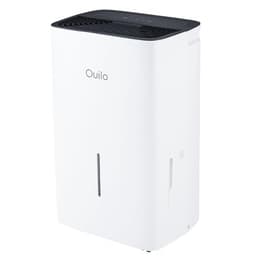
A certified 50-pint pump unit that puts its pump reach in writing - 15 feet, vertically or horizontally - and adds a laundry-drying mode nothing else we track offers.
Average draw
487 W
Computed from the ENERGY STAR certified entry for Quilo QLDAD50PWK - the same model number as this listing: 49.67 pt/day at IEF 2.01 L/kWh. Quilo publishes no wattage itself.
What is good
- States its pump reach - up to 15 feet vertically or horizontally - with the drain tube included
- Exact certified model match, so the 487 W figure describes this machine
- Dedicated laundry mode dries clothes and the room at the same time
- Child lock, thermal overload protection, auto defrost and a clean-filter alert
What is not
- Tank capacity is not stated on the listing
- No Wi-Fi or app is mentioned, so no remote alerts if the pump stops
- A newer brand name with no long track record under this name
Who it is for
Someone who needs a pump to reach a sink or window up to 15 feet away, especially in a laundry room where the drying mode earns its place.
Skip it if
Skip it if you want to be told on your phone when something stops. Nothing on the listing mentions connectivity.
Honeywell
Honeywell Smart Wi-Fi 30 Pint Dehumidifier (TP50AWKN)
Best for: A room you want to run on a schedule
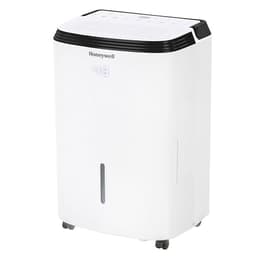
The anti-spill design is the actual selling point here, and it is a better reason to buy than the voice control the listing leads with.
Average draw
Not published
Not published. Honeywell's certified 32-pint entries, the TPFIT32AWK and TPFIT32WK, compute to 318 W at 32.46 pt/day and IEF 2.01. This is a different product line, so that figure sits in the note rather than in the spec table.
What is good
- Anti-spill bucket, which matters more than any app feature if the machine lives upstairs
- Scheduling through the app, so it can run when electricity is cheapest
- ENERGY STAR certified at a small-room capacity
- Alerts on the phone rather than only a beep in an empty room
What is not
- No published wattage, and the certified list carries a different Honeywell line
- 3,000 sq ft for 30 pints is an optimistic claim
- Depends on Honeywell's app remaining supported
Who it is for
An upstairs room or a rental where a spilled bucket is somebody's ceiling, and where scheduling is genuinely useful.
Skip it if
Skip it if the machine will sit on concrete next to a drain. You would be paying for spill protection and scheduling that a floor drain makes irrelevant.
FAQ
Questions
What happened to the Honeywell TP70PWKNR?
Is the Honeywell TP70 a 50-pint or a 70-pint dehumidifier?
How high could the Honeywell TP70 pump lift water?
How many watts did the Honeywell TP70PWKNR use?
Sources
Sources
- Honeywell TP70PWKNR - Amazon.com listing as retrieved 2026-09-01, stating 50 pints and 70 pint under the 2012 previous DOE standard; re-read 2026-09-16 showing Currently unavailable, and stating an auto-drain pump to 15 feet vertically or horizontally
- ENERGY STAR Certified Dehumidifiers list - Honeywell TPFIT50PWK and siblings, 49.66 pt/day, IEF 2.01; Quilo QLDAD50PWK, 49.67 pt/day, IEF 2.01 (retrieved 2026-09-16)
- Quilo 50-Pint ENERGY STAR Dehumidifier, QLDAD50PWK - Amazon.com listing stating a 15 ft drain pump, 4,000 sq ft, sold by the Honeywell Air Comfort storefront (retrieved 2026-09-16)
Read next
- Quilo 50 Pint with PumpA certified 487 W pump unit that states its reach - 15 feet, up or across - and adds a laundry mode.
- What the pint number on a dehumidifier actually meansThe 2019 DOE test change, the official conversion table, and the saturation rating that is 3x the certified one.
- 50-pint versus 70-pint: check the test firstThree different things a 70-pint claim can mean, and which one you are actually looking at.
- The best dehumidifiers with a built-in pumpFive pump-equipped units, ranked partly on which makers will state what their pump can actually reach.
- The best 50-pint dehumidifiersSix 50-pint units and the certified data behind them: a 443-490 W range and a coverage claim that varies 1.9x.
- The square footage on the box is not a specificationIdentical certified capacity, coverage claims 1.9x apart. What the number is, and what to size from instead.