Compare / Comparison
Dehumidifier or air conditioner?
Both use a cold coil and both take water out of the air. Only one of them will do it in a 62-degree basement, and running them together costs more than either alone.
#adThis page contains affiliate links. We earn a commission on qualifying purchases, at no cost to you, and it never changes a ranking. Full disclosure.
The short answer
An air conditioner cools and dehumidifies as a side effect, but only while it is actively cooling. A dehumidifier dries the air and warms the room slightly. In a cool basement an air conditioner will not run at all, so it cannot dry it.
They are the same machine pointed differently
Both are refrigeration circuits. Both chill a coil below the dew point so water condenses onto it. The difference is what happens to the heat: an air conditioner dumps it outside, so the room ends up cooler and drier. A dehumidifier dumps it back into the same room, so the room ends up drier and slightly warmer.
That single difference explains everything else about the comparison. How a dehumidifier works.
| Dehumidifier | Air conditioner | |
|---|---|---|
| Primary job | Remove water vapor | Remove heat |
| Effect on room temperature | Warms slightly - all its power becomes heat in the room | Cools |
| Effect on humidity | Direct and controllable via a humidistat | Incidental, only while cooling |
| Runs when the room is cool | Yes - that is its normal condition | No. A thermostat satisfied at 62F will not call for cooling |
| Typical draw | 105-488 W by class | 500-1,500 W for a window unit |
| Where the water goes | Bucket, hose or pump | Usually drains outside or evaporates off the condenser |
Air conditioner draw is the common band for household window units. We have not measured one; the range is context, not a claim about a specific model.
The basement case, which decides it for most people
A basement in July is often 62 to 68F and 70 percent relative humidity. It is not hot. It is clammy.
An air conditioner in that room does nothing, because its thermostat is already satisfied - there is no cooling to call for, so the compressor never starts, so no water condenses. Setting the thermostat to 55F to force it to run makes an uncomfortable room worse and still dries it inefficiently, because an air conditioner is optimized to move heat rather than water.
A dehumidifier is the machine for that room. It has a humidistat rather than a thermostat, so it responds to the actual problem, and the small amount of heat it adds is welcome in a space that was too cold anyway.
Quick picks
| # | Product | Best for | Draw | Price |
|---|---|---|---|---|
| 1 |  Midea Cube 50 Pint DehumidifierThe only unit here that solves the real basement problem, which is not capacity but where the water goes when you are not standing next to it. Midea Cube 50 Pint DehumidifierThe only unit here that solves the real basement problem, which is not capacity but where the water goes when you are not standing next to it. | A basement you visit once a month | 487 W | |
| 2 |  hOmeLabs 32 Pint DehumidifierThe one hOmeLabs unit with a named entry in the ENERGY STAR list, so it is the one where the running cost is a published figure rather than a class estimate. hOmeLabs 32 Pint DehumidifierThe one hOmeLabs unit with a named entry in the ENERGY STAR list, so it is the one where the running cost is a published figure rather than a class estimate. | A bedroom that is damp but not wet | 318 W | $234.99View on Amazon #ad Price as of October 16, 2026. How we are funded |
| 3 |  GE 50 Pint DehumidifierGE's current no-pump 50-pint, with a 30 percent humidistat floor and Smart Dry fan control - and no ENERGY STAR claim on the listing, which is the change worth noticing. GE 50 Pint DehumidifierGE's current no-pump 50-pint, with a 30 percent humidistat floor and Smart Dry fan control - and no ENERGY STAR claim on the listing, which is the change worth noticing. | A garage or shop with a floor drain | Not published |
Midea
Midea Cube 50 Pint Dehumidifier
Best for: A basement you visit once a month
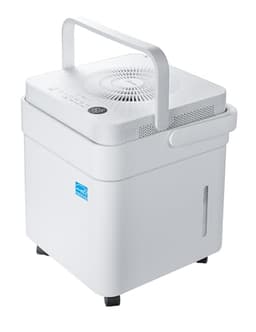
The only unit here that solves the real basement problem, which is not capacity but where the water goes when you are not standing next to it.
Average draw
487 W
Computed from the ENERGY STAR certified entry for Midea MAD50S1QWT-A, the 50 pt / 4,500 sq ft Cube without a pump: 49.67 pt/day at IEF 2.01 L/kWh. Midea's own US product page confirms MAD50S1QWT-A is this configuration. Midea publishes no wattage on the Amazon listing or on that page.
What is good
- The body separates, so the tank half can sit lower than the compressor half and the hose gets a genuine downhill run
- Certified at 49.67 pt/day, which is a real 50-pint machine rather than a saturation number
- IEF 2.01 L/kWh puts it exactly on the median for the 50-pint class - neither a bargain nor a penalty
- Wi-Fi that tells you it has stopped, which is the only smart feature that matters in a basement
What is not
- No pump, so the drain has to run downhill the whole way
- Midea publishes no wattage anywhere, so the 487 W above is computed rather than quoted
- The 4,500 sq ft coverage claim is marketing, not a spec - see the sizing guide
Who it is for
Someone with a floor drain, a sump, or a window well lower than the machine, who wants to set it once and stop thinking about it.
Skip it if
Skip it if the only drain in the room is higher than the unit. Without a pump, gravity is the entire drainage system, and no setting fixes an uphill hose.
hOmeLabs
hOmeLabs 32 Pint Dehumidifier
Best for: A bedroom that is damp but not wet
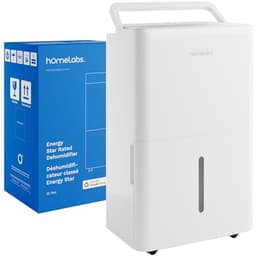
The one hOmeLabs unit with a named entry in the ENERGY STAR list, so it is the one where the running cost is a published figure rather than a class estimate.
Average draw
318 W
Computed from the ENERGY STAR certified entry hOmeLabs HME0089: 32.46 pt/day at IEF 2.01 L/kWh. This is the only hOmeLabs capacity in this registry with a named certified entry, which is why it is the only one carrying a number rather than a band.
What is good
- 318 W against the 50-pint class median of 488 W - about 35% less to run, hour for hour
- Named in the ENERGY STAR certified list, so its IEF is public
- Quiet enough for a bedroom in a way that a 50-pint compressor generally is not
- Wi-Fi and auto shut-off at a small-unit price
What is not
- 32 DOE pints is genuinely less water than 50 - undersizing a wet basement costs more than the machine saved
- Gravity drainage only
- 4,500 sq ft coverage for 32 pints is another claim to ignore
Who it is for
A bedroom, a home office, or a small basement that is humid rather than actively wet.
Skip it if
Skip it if the floor is ever damp to the touch or the walls sweat. That is a 50-pint problem, and a 32-pint machine will run continuously and still lose.
GE
GE 50 Pint Dehumidifier
Best for: A garage or shop with a floor drain
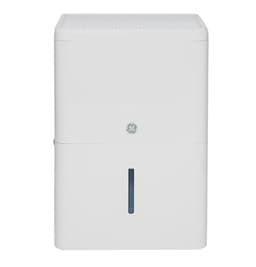
GE's current no-pump 50-pint, with a 30 percent humidistat floor and Smart Dry fan control - and no ENERGY STAR claim on the listing, which is the change worth noticing.
Average draw
Not published
Not published by GE. The ADHE50 series does not appear by name in the ENERGY STAR certified list and this listing makes no ENERGY STAR claim - its predecessor did. The certified 50-pint class runs 443-490 W with a median of 488 W, and a non-certified unit is more likely to sit at the top of that band than below it.
What is good
- Humidistat sets down to 30 percent where most units stop at 35 or 40
- Smart Dry adjusts fan speed to room humidity rather than running flat out
- Bucket-full alarm sounds for ten seconds rather than only lighting an icon
- Clean-filter alert, which is the maintenance nobody remembers to do
What is not
- No ENERGY STAR certification claimed, and no certified entry to compute a draw from
- Gravity drainage only
- A 5,000 sq ft coverage claim, up from its predecessor's 4,000 on the same capacity - a reminder that coverage claims are not a spec
Who it is for
A garage, workshop or utility room with a floor drain, where a low humidistat floor is useful and efficiency certification is not the deciding factor.
Skip it if
Skip it if it will run all season and efficiency matters. A certified 50-pint unit costs about $8 a month less by ENERGY STAR's own figure.
The upstairs case, which is more nuanced
In a hot humid living room, the air conditioner is doing both jobs and usually doing them adequately. Adding a dehumidifier to the same room has a cost that is easy to miss: essentially all of its 488 watts become heat in that room, and the air conditioner then has to remove that heat as well as everything else.
There is a counter-argument and it is real. Drier air feels cooler at the same temperature, so a dehumidified room can be comfortable at a higher thermostat setting - and an air conditioner set higher runs less. Whether that nets out in your favor depends on the room, the equipment and the climate.
We are not going to put a number on it, because we have not measured it and any figure we produced would be a guess dressed as an answer. What we can say is that running both hard in the same room simultaneously, without adjusting the thermostat upward, is the arrangement that definitely costs more.
The practical rule
- Cool and damp - dehumidifier. This is the basement case and it is not close.
- Hot and damp - air conditioner first. It handles both, and it removes the heat rather than adding to it.
- Hot, damp, and the AC cannot keep up with the humidity - both, with the thermostat set a few degrees higher than you otherwise would.
- Hot and dry - air conditioner only. A dehumidifier here is a space heater with extra steps.
A note on dry mode
Many air conditioners have a dry or dehumidify mode, which runs the compressor with a low fan speed to maximize condensation per unit of cooling. It is genuinely useful in a warm humid room and it is still an air conditioner - it will not run in a 62F basement any more than the cooling mode will, because the machine still needs a temperature difference to work against.
FAQ
Questions
Does an air conditioner work as a dehumidifier?
Should I run a dehumidifier and an air conditioner at the same time?
Is a dehumidifier cheaper to run than an air conditioner?
Will a dehumidifier cool my room?
Sources
Sources
Read next
- How a dehumidifier actually worksThe refrigeration cycle, why the machine warms the room, and why cold air defeats it.
- Running it for lessSix changes ranked by what they save, three that save nothing, and one that costs you money.
- Dehumidifier or humidifier?Opposite machines, one letter apart, and why the wrong one makes the problem worse.
- The best dehumidifiers for a basementFive basement units ranked on drainage first, with computed running costs and a unit we would not buy.
- What it costs per day, month and yearPer day, month, season and year, for every capacity class and every plausible schedule.
- Dehumidifier or just open a window?Free and effective in cold dry weather, actively counterproductive in summer. Compare dew points, not humidities.