Reviews / Honeywell
Honeywell Smart Wi-Fi 30 Pint (TP50AWKN)
The model number says 50 and the capacity says 30, for the same reason the whole category is confusing. Underneath the voice-control marketing there is one genuinely good design decision, and it is the bucket.
#adThis page contains affiliate links. We earn a commission on qualifying purchases, at no cost to you, and it never changes a ranking. Full disclosure.
The short answer
A 30-pint DOE-rated smart dehumidifier whose best feature is the one the listing mentions last: an anti-spill bucket, which is the difference between a leak and a ceiling if the machine lives upstairs. Buy it for an upstairs room or a rental where scheduling is genuinely useful. Skip it if the unit will sit on concrete next to a floor drain, because spill protection and app scheduling are exactly what a drain makes pointless.
The model number says 50. The capacity says 30.
Both are correct, and the gap between them is the single most useful thing to understand before buying anything in this category. In 2019 the US Department of Energy moved the dehumidifier test temperature from 80F to 65F. Ratings fell by roughly a quarter overnight on hardware that did not change at all. Honeywell kept its TP50 designation - which described the machine under the old test - and updated the published capacity to 30 pints under the new one.
50 -> 30
The same machine, old test procedure and current one
The model number predates the 2019 change; the rating does not. ENERGY STAR's published correlation maps an old 50-pint rating to roughly 30 pints new, which is exactly what this listing does. The full explanation.
Honeywell is more honest about this than most. Its discontinued TP70 listing printed both figures in one sentence - 50 pints current, 70 pints under the 2012 standard - which is a construction almost nobody else in the category attempted. That page is still up, because the relabeling it documented is the reason this one is called a TP50.
What "Honeywell" means on a dehumidifier
This is worth knowing before you weigh the badge, and the certified file answers it plainly. Honeywell does not make dehumidifiers. The name appears on two completely separate licensees' products, certified by two different companies, with no hardware in common.
| Brand on the box | Models | Type | Certifying partner |
|---|---|---|---|
| Honeywell | TPFIT25AWK, TPFIT25WK, TPFIT32AWK, TPFIT32WK, TPFIT50AWK, TPFIT50WK, TPFIT50APWK, TPFIT50PWK | Portable | JMA North America, LLC - 8 Honeywell entries |
| Honeywell Home | DHM065R4000/U, DHM090R4000, DHM120R4000/U | Whole-home, ducted | Resideo Technologies, Inc - 3 entries |
| Quilo | QLDAD50WK, QLDAD50PWK | Portable | JMA North America, LLC - the same partner as the Honeywell portables |
From the ENERGY STAR Certified Dehumidifiers list, retrieved 2026-10-17. The TPFIT entries are all certified 6 March 2026 and all flagged connected-capable; the Quilo pair was certified 27 October 2025 and is not.
That last row is the useful one. Quilo and the Honeywell portables share a certifying partner - JMA North America, LLC - which is the hard evidence behind something this site had only inferred from a storefront name. When the TP70 was discontinued, the closest live replacement we could find was a Quilo sold through the Honeywell Air Comfort storefront. The certified file says why: it is the same licensee's hardware with a different badge on it. The Quilo reference.
The number this page cannot give you
Honeywell publishes no wattage for the TP50AWKN, and - this is the part that matters - the TP50AWKN is not in the ENERGY STAR certified file at all. The portables that are there are the TPFIT line, which is a different product line with different model strings.
So this site will not print a draw figure for this machine. What it can tell you is the class the unit sits in, from the certified file, and that is a narrow band: the 30-32 pint DOE class spans 293 to 318 W across 21 certified models, with a median of 318 W and a median IEF of 2.01. Honeywell's own nearest certified siblings, the TPFIT32AWK and TPFIT32WK, compute to exactly that 318 W at 32.46 pt/day and IEF 2.01.
The 30-32 pint class, at its median certified draw
(318 W / 1000) x 12 h x $0.1834/kWh = $0.70 per day
0.318
kWh per hour
$21.30
per month, 12 h/day
$42.61
per month, 24 h/day
Rate is the US residential average of 18.34 cents/kWh from the EIA Electric Power Monthly, June 2026. Yours will differ - use the calculator.
Read that as the shape of the bill rather than as this unit's measurement. It is a class figure, and the honest version of this page says so instead of pinning a sibling's number to a machine that is not in the file. The full wattage ledger, and the calculator at your own rate.
The anti-spill bucket is the actual product
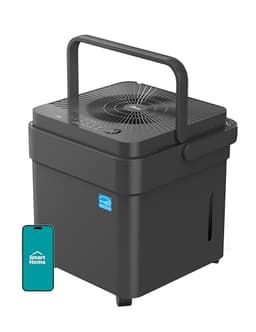
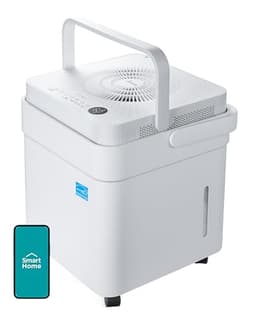
The listing leads with Wi-Fi and Alexa. The genuinely differentiated piece of engineering is further down: a bucket designed not to slosh when you carry it out.
That sounds minor until you think about where a 30-pint unit goes. A 30-pint machine is a bedroom, spare-room or apartment machine - which means an upstairs floor, which means that the half-gallon you are carrying to the bathroom is traveling over somebody's living room ceiling. A 50-pint basement unit sits on concrete and drains to a floor drain; it never has this problem. This one does, every few days, and Honeywell is one of the few makers to have designed for it.
The app, and what depending on one means
The scheduling is the part worth having. A dehumidifier that can be told to run between midnight and six is a dehumidifier running on whatever off-peak rate you have, and in states where residential rates are time-of-use that is a real saving rather than a gadget. Being alerted on a phone that the bucket is full also beats a beep in an empty room, which is the usual arrangement.
The risk is the one every connected appliance carries: the feature lasts as long as the maker keeps the app and its servers running, and that is a licensee's decision rather than Honeywell's. The machine will still dehumidify - the humidistat is on the unit - but the reason you paid the premium may not outlive the warranty. What smart actually buys you makes the general case.

The coverage claim, which is optimistic
The listing claims 3,000 square feet for 30 pints a day. Take that as marketing. Coverage is not a measured specification in this category and nobody states the conditions behind it - units with identical certified capacity in our own registry claim coverage figures 1.9 times apart. A 30-pint machine is comfortable in a bedroom, a spare room, a small apartment or a single damp room, and is not a substitute for a 50-pint unit in a basement. Why coverage claims are not specifications.
Quick picks
| # | Product | Best for | Draw | Price |
|---|---|---|---|---|
| 1 |  Honeywell Smart Wi-Fi 30 Pint Dehumidifier (TP50AWKN)The anti-spill design is the actual selling point here, and it is a better reason to buy than the voice control the listing leads with. Honeywell Smart Wi-Fi 30 Pint Dehumidifier (TP50AWKN)The anti-spill design is the actual selling point here, and it is a better reason to buy than the voice control the listing leads with. | A room you want to run on a schedule | Not published | $311.16View on Amazon #ad Price as of October 17, 2026. How we are funded |
| 2 | 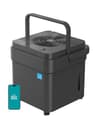 Midea Cube 35 Pint DehumidifierThe middle Cube removes 78 percent more water than the 20 for 50 percent more power, and carries the same 4.2 gallon bucket as the 50 - which makes it the size most people between the two should buy. Midea Cube 35 Pint DehumidifierThe middle Cube removes 78 percent more water than the 20 for 50 percent more power, and carries the same 4.2 gallon bucket as the 50 - which makes it the size most people between the two should buy. | A damp room or a small, dry-ish basement | 351 W | |
| 3 | 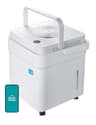 Midea Cube 20 Pint DehumidifierThe smallest Cube, and the least efficient one: certified at IEF 1.70 against 2.01 for the 35 and 50, so every pint it removes costs about 18 percent more electricity. Midea Cube 20 Pint DehumidifierThe smallest Cube, and the least efficient one: certified at IEF 1.70 against 2.01 for the 35 and 50, so every pint it removes costs about 18 percent more electricity. | One small room that is only mildly damp | 234 W | $199.00View on Amazon #ad Price as of October 17, 2026. How we are funded |
Honeywell
Honeywell Smart Wi-Fi 30 Pint Dehumidifier (TP50AWKN)
Best for: A room you want to run on a schedule
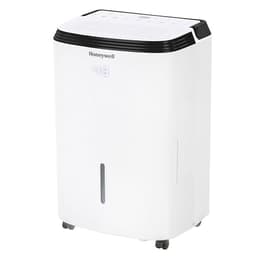
The anti-spill design is the actual selling point here, and it is a better reason to buy than the voice control the listing leads with.
Average draw
Not published
Not published. Honeywell's certified 32-pint entries, the TPFIT32AWK and TPFIT32WK, compute to 318 W at 32.46 pt/day and IEF 2.01. This is a different product line, so that figure sits in the note rather than in the spec table.
What is good
- Anti-spill bucket, which matters more than any app feature if the machine lives upstairs
- Scheduling through the app, so it can run when electricity is cheapest
- ENERGY STAR certified at a small-room capacity
- Alerts on the phone rather than only a beep in an empty room
What is not
- No published wattage, and the certified list carries a different Honeywell line
- 3,000 sq ft for 30 pints is an optimistic claim
- Depends on Honeywell's app remaining supported
Who it is for
An upstairs room or a rental where a spilled bucket is somebody's ceiling, and where scheduling is genuinely useful.
Skip it if
Skip it if the machine will sit on concrete next to a drain. You would be paying for spill protection and scheduling that a floor drain makes irrelevant.
Midea
Midea Cube 35 Pint Dehumidifier
Best for: A damp room or a small, dry-ish basement
The middle Cube removes 78 percent more water than the 20 for 50 percent more power, and carries the same 4.2 gallon bucket as the 50 - which makes it the size most people between the two should buy.
Average draw
351 W
Computed from the ENERGY STAR certified entry for Midea MAD35S1QGR-A - the same model number as this listing: 35.82 pt/day at IEF 2.01 L/kWh. Midea publishes no wattage on the listing. Every certified 35-pint model we track runs IEF 2.01 to 2.09, so this is the class norm.
What is good
- Same IEF 2.01 as the 50-pint Cube, so per pint removed it is exactly as efficient
- 4.2 gallon bucket, identical to the 50 - about 22 hours at full rated capacity
- Lift-and-twist expandable body, Wi-Fi app and included drain hose
- About $9 a month less than the 50-pint Cube at twelve hours a day and the US average rate
What is not
- Midea's listing calls it similar to a 50 pint under the 2012 standard; ENERGY STAR's correlation table puts a current 35 nearer an old 60, so the maker's equivalence undersells it
- 3,500 sq ft is the most generous coverage claim per pint of the three Cubes - treat it as marketing
- No pump, so the drain must be below the machine
Who it is for
A large damp room, an apartment, or a small basement that reads in the low-to-mid 60s rather than the high 60s.
Skip it if
Skip it for a basement that reads above about 68 percent or shows visible moisture. That is 50-pint work, and the 50 costs little more to buy and nothing more per pint to run.
Midea
Midea Cube 20 Pint Dehumidifier
Best for: One small room that is only mildly damp
The smallest Cube, and the least efficient one: certified at IEF 1.70 against 2.01 for the 35 and 50, so every pint it removes costs about 18 percent more electricity.
Average draw
234 W
Computed from the ENERGY STAR certified entry for Midea MAD20S1QWT - the same model number as this listing: 20.16 pt/day at IEF 1.70 L/kWh. Midea publishes no wattage on the listing. The 20-22 pint certified class runs IEF 1.70 to 1.97, so this unit sits at the bottom of its own class.
What is good
- Lowest draw of any Cube at 234 W, which matters in a room where it runs most of the day
- Same lift-and-twist expandable body, Wi-Fi app and included drain hose as the larger Cubes
- 3.2 gallon bucket - about 30 hours at full rated capacity before it needs emptying
- The listing states its own pre-2020 equivalent, 30 pint, which matches ENERGY STAR's correlation table
What is not
- IEF 1.70 is the bottom of the certified 20-22 pint class - it uses about 18 percent more electricity per pint than the 35 or 50 Cube
- Undersized for any basement: running around the clock it costs about as much as a 50-pint Cube on half the hours and removes 20 pints to its 50
- No pump, so the drain must be below the machine
Who it is for
A single above-grade room reading in the low 60s - a bedroom, a home office, a bathroom that stays damp between showers.
Skip it if
Skip it for a basement or anything reading above about 65 percent. It will run continuously, never reach its target, and cost as much as the 50-pint Cube while doing less than half its work.
Who should buy it, and who should not
- Buy it for an upstairs bedroom, a spare room or a rental where the bucket has to be carried and where running it overnight on a cheaper rate is worth something.
- Buy something else if the machine will sit next to a floor drain. You would be paying for spill protection and scheduling that the drain makes irrelevant, and the money is better spent on capacity. The 50-pint class.
- Buy something else if you want a computed running cost before you spend. This model is not in the certified file, so nobody can give you one honestly - the Midea Cube line and the Waykar units are certified under their own model strings.
- Buy something much smaller if the target is a closet or a wardrobe. 30 pints in a closet is absurd. The closet picks.
What we did not do
We have not run this machine, measured its draw, timed its extraction, or tested the anti-spill bucket by carrying one. We have not installed the app. Every figure here is either quoted from Honeywell's published listing or read from the ENERGY STAR certified file under the model strings that are actually in it - and where this unit's own string is absent, which is the case for its wattage, this page says so rather than substituting a sibling's number. There is no score on this page because we did not run a test that could produce one. How we work.
FAQ
Questions
Is the Honeywell TP50AWKN a 50 pint or a 30 pint dehumidifier?
How many watts does the Honeywell TP50AWKN use?
Who makes Honeywell dehumidifiers?
Does it have a continuous drain?
Is 3,000 square feet a realistic coverage claim for 30 pints?
Is the Wi-Fi worth paying for?
Sources
Sources
- Honeywell TP50AWKN Smart Wi-Fi 30-Pint Dehumidifier - Amazon.com listing stating 30 pints, a 3,000 sq ft coverage claim, Wi-Fi app and Alexa voice control, an anti-spill bucket design and a continuous drain option
- ENERGY STAR Certified Dehumidifiers list - the TP50AWKN does not appear; Honeywell's certified portables are TPFIT25AWK/WK (24.48 pt, IEF 1.75), TPFIT32AWK/WK (32.46 pt, IEF 2.01, 343 kWh/yr, computing to 318 W) and TPFIT50AWK/WK/APWK/PWK (49.66 pt, IEF 2.01), all certified 2026-03-06 under partner JMA North America, LLC; Honeywell Home DHM065R4000/U, DHM090R4000 and DHM120R4000/U are whole-home units under partner Resideo Technologies, Inc; Quilo QLDAD50WK and QLDAD50PWK are certified under JMA North America, LLC (retrieved 2026-10-17)
- ENERGY STAR, Dehumidifiers - the program's product page and the pre-2020 to post-2020 capacity correlation
- EIA Electric Power Monthly, Table 5.6.A, June 2026 - the residential electricity rate used
Read next
- Honeywell 50 Pint with Pump (TP70PWKNR)Discontinued. The listing that printed both pint ratings, and the certified pump unit that replaces it.
- Quilo 50 Pint with PumpA certified 487 W pump unit that states its reach - 15 feet, up or across - and adds a laundry mode.
- The best dehumidifiers for a bedroomFour options for a room you sleep in, ranked on cycling behavior rather than a decibel figure nobody measured.
- The best smart dehumidifiersFour connected units compared on what the app really buys you - which is being told the machine has stopped.
- What the pint number on a dehumidifier actually meansThe 2019 DOE test change, the official conversion table, and the saturation rating that is 3x the certified one.
- The best dehumidifier brands136 brand names, 77 companies. Who makes their own machines, who shares a factory, and how to check in two minutes.